Financial Management for Construction Companies: A Strategic Framework for 2026

Updated: 6 days ago
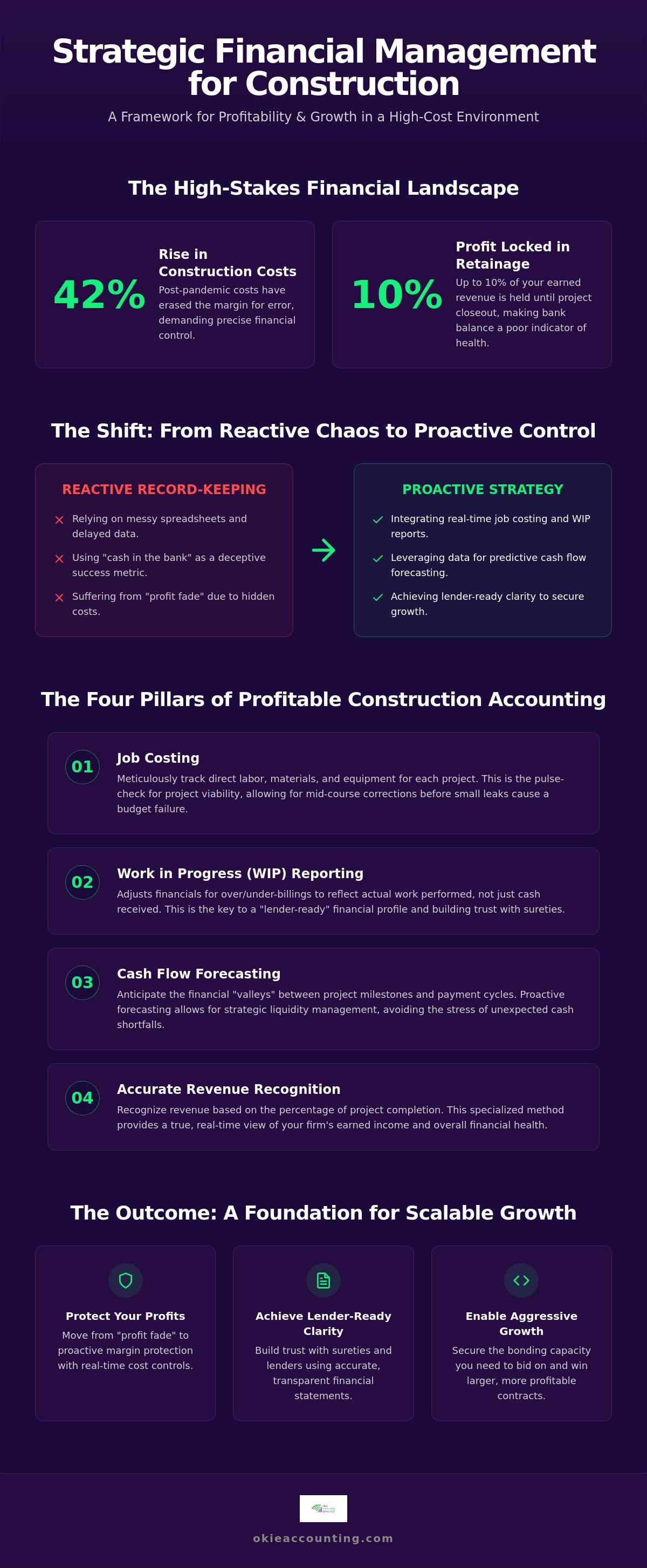
With construction costs remaining 42% above pre-pandemic levels in 2026, the margin for error in your project estimates has effectively vanished. You likely feel the constant pressure of cash flow gaps between milestones and the nagging anxiety of shifting payroll regulations. Effective financial management for construction companies isn't just about recording transactions anymore. It's about building a structural framework that supports aggressive growth. You know that messy spreadsheets and reactive bookkeeping won't secure the bonding capacity or lender trust you need to scale.
We're here to help you move beyond basic administrative tasks and toward high-level controller oversight. This guide will show you how to master the complexities of project-based accounting and leverage data-driven insights to protect your profits. You'll learn how to implement real-time job costing, navigate the 100% bonus depreciation rules for 2026, and transform your financial statements into strategic assets. We'll explore the transition from operational complexity to a state of total financial clarity, giving you the freedom to focus on the build while your numbers work as hard as your crew.
The Unique Complexity of Financial Management in Construction
Financial management for construction companies requires a fundamental shift in perspective. Unlike a retail business where a sale is recorded and finalized at the register, a contractor's financial health is tied to the lifecycle of projects that can span months or even years. True financial management in this sector is the disciplined integration of granular project-level data with high-level corporate strategy. It isn't just about recording what happened; it's about building a framework that tells you what will happen next. Without this structural oversight, you're essentially building on a foundation of sand.
One of the most dangerous traps for any contractor is relying on "cash in the bank" as a measure of success. This metric is often a deceptive illusion. Because of the industry's reliance on "float" and the common practice of retainage, your bank balance might look healthy while your firm is actually insolvent. Retainage, often 5% to 10% of the total contract value, is money you've earned but won't see until the project is fully closed out. If your systems don't account for these delayed inflows and the structural risks of unallocated overhead, your profit margins will erode before you even realize there's a problem.
Project-Based vs. Business-Based Accounting
Effective financial management for construction companies demands a dual-view approach. You must be able to zoom in on the health of a single job site while simultaneously zooming out to assess the total firm's stability. A comprehensive Construction Management Overview highlights that cost control is the pulse of any build, yet many firms struggle when financial data lags behind field operations. This delay leads to "profit fade," where the expected margin at the start of a job slowly vanishes as hidden costs emerge. Long-term contracts further complicate this by requiring specialized revenue recognition methods that standard accounting software isn't always configured to handle without expert setup.
The Burden of Compliance: Payroll and Regulations
The regulatory environment in 2026 is more rigorous than ever. Handling multi-state payroll, union requirements, and Davis-Bacon Act compliance adds layers of complexity that can bury a business owner in paperwork. Accuracy here isn't just about avoiding fines; it's about protecting your reputation and your ability to work. Many firms are now utilizing specialized construction payroll services to ensure every hour is tracked correctly and every tax is paid on time. This level of precision is exactly what bonding companies and insurers look for. If your financial data is messy, you'll find yourself locked out of the larger, more profitable contracts that require lender-ready financial statements and proof of rigorous management.
The Four Pillars of Profitable Construction Accounting
If the first step in successful financial management for construction companies is recognizing complexity, the second is building the structural supports to manage it. You cannot scale a firm on intuition alone. You need a framework that provides immediate clarity on where your capital is tied up and how much profit you're actually retaining. This framework rests on four specific pillars: Job Costing, Work in Progress (WIP) Reporting, Cash Flow Forecasting, and Revenue Recognition. When these four elements work in tandem, they transform your accounting from a historical record into a predictive tool for growth.
Mastering Job Costing for Profit Protection
Job costing is the pulse-check for project viability. It requires a meticulous breakdown of direct labor, materials, and equipment costs specific to each individual job site. Without this granular data, your overhead remains a mystery and your margins become a guess. Professional construction bookkeeping services build the necessary data foundation by ensuring every invoice, receipt, and payroll hour is coded to the correct project. This level of precision allows you to identify cost overruns while the project is still active. It gives you the power to make mid-course corrections before a minor leak becomes a structural failure in your budget.
WIP Accounting and Financial Accuracy
Work in Progress (WIP) reports are the most critical tool for maintaining a "lender-ready" financial profile. These reports adjust your financials for over-billings and under-billings, ensuring your profit reflects the actual work performed rather than just the cash that moved through your bank account. WIP reports prevent the dangerous habit of "borrowing from tomorrow" to pay for today's operational expenses. When you recognize revenue based on the percentage of completion, you gain an accurate view of your firm's earned income. This transparency is vital for building trust with sureties and lenders who need to see a clear picture of your current obligations and future capacity.
Beyond these reports, proactive cash flow forecasting helps you predict the "valleys" between project milestones. By anticipating these gaps, you can manage your liquidity without the stress of unexpected shortfalls. A comprehensive construction project management guide often highlights the necessity of these forecasts for long-term stability. Transitioning from cash-basis to accrual or percentage-of-completion methods ensures your financial statements mirror the physical reality of your builds. If you're ready to move toward this level of oversight, you might consider scheduling a strategy session to review your current systems and identify gaps in your reporting.
Leveraging Technology: QuickBooks Online as a Strategic Asset
The era of manual ledgers and disconnected spreadsheets has ended. In 2026, the market for construction management software is projected to grow toward a valuation of $23.9 billion by 2031, reflecting a massive industry shift toward integrated digital systems. For modern firms, QuickBooks Online (QBO) has emerged as the preferred engine for financial management for construction companies. It isn't merely an administrative tool; it's a strategic platform that bridges the gap between field operations and office oversight. When configured correctly, QBO provides the real-time data necessary to protect your margins in a volatile market.
The foundation of a high-performing QBO setup is a clean Chart of Accounts tailored specifically for the construction industry. A generic setup fails to capture the nuances of job costing and WIP adjustments, leading to "blind spots" in your profitability. By automating bank feeds and receipt management, you reduce the risk of human error and ensure that every transaction is captured instantly. This automation allows your team to move away from tedious data entry and toward the analysis of project health. Integrating field-to-office data ensures that your financial reports reflect the current reality of your job sites, not just the history of your bank account.
Customizing QuickBooks for Contractor Workflows
Effective operational control starts with specialized configuration. Mastering QuickBooks for contractors involves implementing advanced features like classes and locations for multi-project tracking. These tools allow you to isolate the financial performance of individual crews or regional branches, giving you a granular view of where you're making money. Because a system is only as reliable as its users, professional software training for your internal staff is essential. It ensures that data integrity is maintained at the point of entry, preventing the "messy data" that often leads to costly errors during tax season or bonding audits.
Cloud-Based Collaboration and Remote Access
The primary advantage of a cloud-based framework is the ability to maintain visibility from anywhere. As a business owner, you're rarely tethered to a desk; you're on-site, in meetings, or traveling between projects. Real-time remote access means you can review a project's financial status the moment a question arises. This accessibility must be paired with rigorous security protocols and internal controls to protect your firm's sensitive data. By leveraging cloud-synchronized information, you can drive sophisticated management accounting decisions. You'll gain the ability to forecast labor needs and material purchases with a level of precision that manual systems simply cannot match.
Bridging the Gap: From Basic Bookkeeping to Fractional Controller Oversight
Bookkeeping is a reactive function. It ensures your bills are paid, your bank accounts are reconciled, and your historical data is recorded. While these tasks are essential, they don't provide the strategic foresight required for high-level financial management for construction companies. To transition from a firm that merely survives to one that leads the market, you must move toward controller-level oversight. This shift changes the internal conversation from "How much did we spend last month?" to "How will our current project backlog impact our liquidity in the next quarter?"
A controller doesn't just record history; they plan the future. They establish the internal controls that prevent fraud, manage the risk of "profit fade" mentioned earlier, and ensure that every financial decision aligns with your long-term growth targets. For many growing firms, the cost of a full-time executive is prohibitive. This is where a fractional model provides a structured remedy, offering the expertise of a seasoned financial veteran on a part-time basis. It allows you to build a sophisticated financial department without the overhead of a full-time salary.
The Strategic Advantage of Fractional Leadership
Implementing fractional controller services provides the structural framework necessary for scaling. These experts bring a disciplined, "outsourced advantage" to your books, identifying red flags that internal staff might miss. Professional controller services act as a catalyst for professionalizing a family-owned or small firm. They take the burden of financial analysis off the owner's shoulders, allowing you to focus on the build while they focus on the health of the business. This partnership ensures that your financial management for construction companies is proactive rather than defensive.
Data-Driven Decision Making
The true value of controller oversight lies in the ability to turn raw data into actionable intelligence. By analyzing detailed financial reports, a controller can identify which project types are consistently the most profitable and which are draining your resources. They look for "hidden" waste in your overhead and help you establish the "lender-ready" financial habits that banks require for credit increases. This methodical approach ensures that when an opportunity for a major project arises, you have the data to prove your firm is stable and ready for the challenge. If you're ready to professionalize your firm's financial department and gain this level of clarity, book a discovery call today to discuss your specific needs.
Implementing a Scalable Financial Infrastructure for Your Firm
Implementing a scalable infrastructure is the final step in securing your firm's future. It represents the transition from a collection of administrative tasks to a repeatable, disciplined system. You must first evaluate if your current data is accurate, timely, and accessible. If you can't see your numbers in real-time, you simply can't manage them effectively. This process often starts with a deep ledger cleanup to fix existing QuickBooks mistakes and modernize your Chart of Accounts. Proper financial management for construction companies requires a ledger that reflects the project-based reality of your builds, not a generic retail template.
Establishing a disciplined monthly rhythm is essential for maintaining this clarity. You need firm deadlines for reconciliations and financial reviews to ensure that your data stays current. Protecting your liquidity also requires more than just checking your bank balance. You must implement robust construction cash flow management to navigate the inevitable gaps between project milestones. This level of oversight turns your financial data into a competitive advantage. Finally, transitioning to a specialized accounting partner provides the ongoing expertise needed to maintain the structural integrity of your firm's finances.
The First 90 Days: From Chaos to Clarity
The initial phase of professionalizing your books is a period of total transformation. During a specialized cleanup and setup phase, you'll work to reconstruct accurate historical data. This history is the only reliable foundation for future forecasting. You'll also establish clear communication flows between your field teams and your accounting partner. This ensures that job costs are captured the moment they occur, rather than weeks later. This 90-day window is about removing the noise of messy data and replacing it with the quiet confidence of lender-ready financials.
Building Long-Term Profit Stability
Ongoing oversight acts as an insurance policy against project failure. When you have a strategic partner monitoring your WIP reports and overhead, you can scale with the certainty that your margins are protected. This structured approach allows you to use your financial history as a strategic asset during the bidding process. You'll know exactly what it costs to complete a job, allowing you to bid aggressively on profitable work while walking away from high-risk contracts. By closing the loop between field data and financial reporting, you ensure your firm is building a legacy of stability. Effective financial management for construction companies means your numbers finally work as hard as your crews do.
Build Your Firm on a Foundation of Financial Control
Navigating the volatile market of 2026 requires more than just skilled craftsmanship; it demands a rigorous, data-driven approach to your books. You've seen how integrating real-time job costing and WIP reporting can eliminate "profit fade" and protect your liquidity. By leveraging specialized technology and shifting toward high-level controller oversight, you transform your financial department into a structural asset that supports long-term growth. This transition from reactive record-keeping to proactive strategy is the hallmark of modern financial management for construction companies.
At Okie Accounting Group LLC, we understand that you need a partner who speaks your language. Led by the authoritative guidance of founder Sarah O’Quinn, our team provides specialized construction job costing expertise and nationwide fractional controller services designed for your unique needs. We help you move from messy data to lender-ready financial statements, giving you the clarity to bid with confidence and scale with precision. It's time to build a business that is as resilient as the structures you create.
Gain Financial Clarity for Your Construction Firm with Okie Accounting Group LLC and start your journey toward operational excellence today.
Frequently Asked Questions
How is construction financial management different from regular business accounting?
Construction accounting is project-centric rather than period-centric. While regular retail or service accounting focuses on fixed sales cycles, financial management for construction companies requires tracking labor, materials, and equipment across multiple job sites simultaneously. It involves specialized revenue recognition methods, such as percentage of completion, and the management of retainage. These niche-specific complexities demand a structural framework that standard accounting systems often lack.
What is WIP accounting, and why does my construction company need it?
Work in Progress (WIP) accounting is a method that adjusts your profit and loss statement based on over-billings and under-billings. It's essential because it aligns your reported revenue with the actual costs incurred on a project. Without a WIP report, your financial statements might show a massive profit one month and a loss the next. This report provides the "lender-ready" accuracy needed to secure bonding and financing.
Why should I use QuickBooks Online instead of a desktop version for my contracting firm?
QuickBooks Online provides real-time accessibility and automated data feeds that legacy desktop versions can't match. For a modern contracting firm, this means field teams can upload receipts and track time instantly, giving the office immediate visibility into job costs. QBO also integrates seamlessly with other construction-specific management tools. This creates a unified cloud-based ecosystem that supports remote delivery and collaborative oversight.
What are the benefits of hiring a fractional controller vs. a full-time CFO?
A fractional controller provides high-level strategic oversight and risk mitigation at a fraction of the cost of a full-time executive. You gain access to sophisticated budgeting and internal controls without the burden of a full-time salary and benefits package. It's a scalable solution that allows growing firms to professionalize their financial department. This model ensures you have expert eyes on your books while keeping your corporate overhead lean.
How does job costing help improve my construction profit margins?
Job costing improves margins by identifying exactly where every dollar is spent on a specific project. It allows you to track fully burdened labor rates and material variances in real-time. By seeing these costs early, you can adjust field operations to prevent profit fade. This granular data also allows you to bid more accurately on future contracts, ensuring you only commit to work that meets your margin requirements.
Can an outsourced accounting firm handle my multi-state construction payroll?
Yes, specialized firms can manage complex multi-state payroll and labor compliance across the United States. This includes handling varying tax rates, union requirements, and Davis-Bacon Act standards. Outsourcing this task ensures your firm remains compliant with shifting federal and state regulations. It alleviates the administrative burden of payroll management, allowing you to focus on the build while experts handle the technical compliance details.
What financial reports should a construction owner review every month?
You should review your WIP Report, Job Costing Report, Cash Flow Forecast, and a professional Balance Sheet every month. These documents provide a comprehensive view of your project health and corporate liquidity. Reviewing these reports allows you to make data-driven decisions about equipment purchases and labor needs. Regular reviews ensure you have the visibility required to identify red flags before they impact your firm's stability.
How do I know if my construction company is ready for fractional controller services?
You're ready for fractional controller services if your bookkeeping is accurate but you lack a strategic roadmap for future growth. If you feel anxious about cash flow gaps or struggle to secure higher bonding limits, you need professional oversight. This service is designed for owners who want to transition from recording history to planning the future. It provides the disciplined leadership needed to scale a firm with confidence.


Comments