Fractional Controller for Construction Companies: A Strategic Framework for Growth

Updated: 6 days ago
Why does your bank account often tell a completely different story than your profit and loss statement? It's a frustrating reality for many contractors who see revenue growing while their actual margins slowly erode through profit fade and inaccurate job costing. You know that basic bookkeeping isn't enough to handle the weight of WIP schedules and retainage, yet hiring a full-time financial executive can cost your business upwards of $450,000 annually when benefits and bonuses are factored in. This gap often leaves owners stuck in a reactive cycle, struggling to manage cash flow or secure the higher bonding limits needed for larger projects.
We understand that your financial data should be a tool for growth, not a source of stress. In this article, you'll learn how a specialized fractional controller for construction companies bridges the gap between administrative tasks and high-level strategy to protect your margins. We'll examine a strategic framework that moves you toward lender-ready financial statements, provides clear visibility into project-level profitability, and establishes the disciplined systems required for long-term stability in an increasingly complex market.
Beyond Basic Bookkeeping: Defining the Fractional Controller for Construction
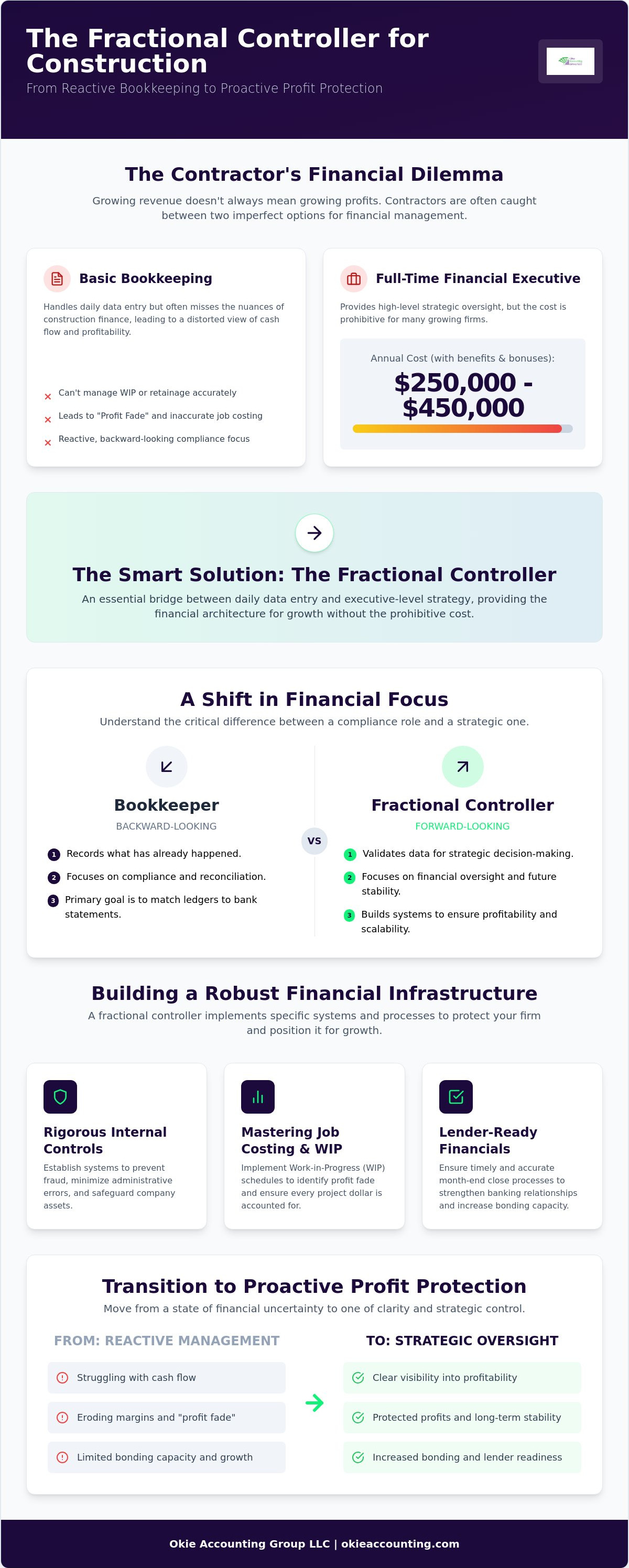
A fractional controller acts as the architect of a firm’s financial structural integrity. While a bookkeeper is primarily responsible for recording what has already happened, this specialized role provides high-level financial oversight on a part-time basis. For many growing firms, a fractional controller for construction companies serves as the essential bridge between daily data entry and executive-level strategy. They transform raw numbers into a reliable framework that supports expansion without the prohibitive cost of a full-time executive. In 2026, the total cost for a full-time financial leader often ranges from $250,000 to $450,000 annually, making the fractional model a disciplined choice for firms that need expertise without the massive overhead.
Generalist bookkeepers often struggle with the technical nuances of the building industry, specifically regarding retainage, overbillings, and underbillings. Without a controller's oversight, these items can easily become lost in the shuffle, leading to a distorted view of a company's actual cash position. A fractional controller ensures that these industry-specific mechanics are handled with precision, protecting your margins from the "profit fade" that occurs when financial data doesn't match the reality of the job site.
The Critical Gap Between Compliance and Strategy
Traditional bookkeeping is inherently backward-looking. Its primary goal is compliance, ensuring that bank statements match the ledger and that bills are paid. A Financial controller, however, is focused on the future. They don't just reconcile accounts; they validate the accuracy of the data before it reaches the decision-making stage. This proactive oversight moves a business beyond simple reconciliations toward a comprehensive understanding of financial health. It's the difference between knowing you spent money and knowing if that spend was profitable for a specific contract. By establishing this higher level of oversight, you ensure that your strategic choices are based on validated truths rather than unverified entries.
Why Construction Accounting Requires Specialized Oversight
The construction sector faces unique challenges that standard accounting practices aren't designed to handle. Project-based cycles, complex payroll requirements, and varied tax obligations require a specialized approach to the general ledger. A fractional controller for construction companies manages the financial systems so they mirror the physical progress of your projects. This involves meticulous management of Work-in-Progress (WIP) schedules to ensure revenue recognition is accurate. When your accounting system reflects the physical reality of your job sites, you gain the clarity needed to manage cash flow effectively. This specialized fractional controller services model provides the structural framework necessary to scale your firm with confidence, ensuring every project contributes to long-term stability.
Building a Robust Financial Infrastructure: Key Controller Responsibilities
A robust financial infrastructure is the backbone of any successful contracting firm. While the previous section defined the high-level role, it's essential to understand the specific mechanisms a fractional controller for construction companies uses to stabilize your operations. Their primary objective is to establish rigorous internal controls that prevent fraud and minimize administrative errors. By managing the month-end close process, they ensure that your financial reporting is not just accurate but timely enough to drive real-time adjustments. This level of discipline ensures that your data remains lender-ready at all times.
They also provide oversight for specialized administrative functions, such as construction payroll services and regulatory compliance. This oversight ensures that labor costs are allocated correctly to specific jobs, which is a fundamental principle of Financial Management in Construction. When these foundational systems are in place, the controller can begin interpreting complex data to provide actionable insights that help you navigate market fluctuations with quiet confidence. If you're ready to move from reactive management to proactive oversight, you can schedule a discovery call to discuss your firm's specific needs.
Mastering Job Costing and WIP Reporting
Effective job costing is more than just tracking expenses; it's about ensuring every project dollar is accounted for in real time. A fractional controller for construction companies implements Work in Progress (WIP) schedules to identify "profit fade" before it erodes your bottom line. These reports highlight overbillings and underbillings, allowing you to see which projects are truly performing. When your job costing is accurate, your bidding strategy becomes more competitive and profitable because it's based on historical reality rather than guesswork.
Strategic Cash Flow Forecasting for Project Stability
Many contractors manage their business by simply checking their bank balance, but this reactive approach often leads to liquidity crises. A controller shifts this focus toward 13-week cash flow projections. This forward-looking view is critical for managing the "pay when paid" cycle common in the industry. By forecasting material and labor costs against expected receivables, you ensure funds are always available for critical project milestones and unexpected expenses. This structured approach creates the stability needed to take on larger, more complex contracts without risking your firm's solvency.
Evaluating the Fractional Model: Cost, ROI, and Scalability
Investing in a fractional controller for construction companies allows firms to access elite financial oversight without the burden of a full-time executive salary. In today's market, a full-time CFO or Controller can cost a business between $250,000 and $450,000 annually when you include benefits and bonuses. For most mid-sized contractors, this is a prohibitive overhead that drains cash flow. The fractional model solves this by providing specialized expertise on a part-time basis, ensuring you only pay for the high-level guidance you actually need. Fractional services are an investment in structural stability, not an administrative expense.
The return on investment often manifests as "profit protection." In the construction industry, where margins are frequently thin, a single caught error in a WIP report or a prevented overbilling can pay for an entire year of service. This model is also inherently scalable. As your project volume increases, your controller's hours can expand to meet the complexity of your reporting. Conversely, during slower seasons, the service scales back, ensuring your overhead remains aligned with your revenue. This flexibility provides the quiet confidence that your financial systems will grow alongside your business rather than becoming a bottleneck.
Fractional Controller vs. Full-Time CFO: Which Do You Need?
Many owners confuse these roles, but the distinction is critical for your firm's health. Controllers focus on the "how" of your business; they manage the systems, ensure data accuracy, and oversee the daily mechanics of your general ledger. CFOs focus on the "where" by managing capital structures and long-term growth strategies. Most firms with revenues between $2M and $10M require a controller's oversight to fix messy data before they ever need a CFO's high-level strategy. Paying for specialized fractional controller services allows you to build a reliable foundation first, ensuring that when you do seek growth capital, your financials are already lender-ready.
Signs Your Construction Company Has Outgrown Its Bookkeeper
You'll know it's time to level up your oversight when your administrative systems can no longer keep pace with your field operations. Watch for these specific indicators:
Decisions are being made based on "gut feel" or bank balances rather than validated financial reports.
The month-end closing process takes weeks instead of days, leaving you with outdated information.
Your CPA consistently complains about the quality or organization of the data they receive at tax time.
You're struggling to secure higher bonding limits because your financial statements lack the necessary structural integrity.
If these challenges sound familiar, your firm has likely reached the stage where basic bookkeeping is no longer sufficient to protect your interests. Moving to a professional controller model ensures your data is accurate, timely, and strategic.
Strengthening Your Firm’s Foundation: Internal Controls and Bonding Readiness
Structural integrity in a construction firm extends beyond the job site; it begins with the internal systems that safeguard your capital. A fractional controller for construction companies establishes the rigorous internal controls necessary to prevent fraud and ensure that every transaction is documented with precision. This oversight is vital in a sector where bond claim loss ratios have been rising by 10% to 20% annually, leading surety agents to scrutinize financial data more closely than ever before. By standardizing your accounts payable and receivable processes, a controller ensures that your financial readiness is a constant state rather than a last-minute scramble before a big bid.
Professional oversight significantly reduces the perceived risk for external partners like banks and surety agents. When these partners see that a disciplined mentor is managing the general ledger, they gain confidence in the reliability of your reporting. This trust is essential for maintaining compliance with industry-specific regulations, including Davis-Bacon requirements for federal projects. If you want to position your business as a low-risk partner for high-value contracts, you can secure your firm's financial future by establishing these foundational systems today.
Mitigating Risk Through Rigorous Internal Controls
One of the most dangerous vulnerabilities in a growing firm is a lack of separation of duties. If your bookkeeper has total control over the checkbook, payroll, and bank reconciliations, your business is exposed to unnecessary risk. A fractional controller implements a structural framework where duties are divided, ensuring that no single person has unchecked access to your assets. This includes regular audits of job costs to ensure they align with original project estimates. By standardizing these workflows, you create project consistency that protects your margins across every job site.
Preparing Lender-Ready Financials for Growth and Bonding
Surety agents and lenders don't just look at your bank balance; they look for the "financial package" that proves your operational health. This package includes accurate Work-in-Progress (WIP) schedules, accounts receivable aging reports, and professional balance sheets. Under the Miller Act, payment and performance bonds are required on all federal construction contracts exceeding $150,000. To meet these thresholds and increase your bonding limits, you must provide transparent, CPA-ready data. A fractional controller for construction companies prepares these documents, positioning your firm as a sophisticated and reliable entity that is ready for larger, more complex projects.
Strategic Partnership: Scaling Your Firm with Okie Accounting Group
Okie Accounting Group operates as a disciplined mentor for contractors who are ready to trade administrative chaos for operational clarity. We don't just record transactions; we build the structural framework necessary for sustainable expansion. By focusing on fractional controller services, we provide the high-level oversight that generalist accounting firms often lack. Our nationwide, remote-first model ensures that your firm has access to elite financial leadership regardless of where your job sites are located. This specialized approach allows us to integrate seamlessly with your existing team while bringing a level of expertise that is deeply rooted in the unique mechanics of the construction sector. We act as a strategic partner, invested in your long-term stability and profit protection.
Our Methodology: From Data Entry to Data-Driven Decisions
Our methodology focuses on moving your firm from simple data entry to high-impact, data-driven decisions. We leverage QuickBooks for contractors to establish a scalable cloud infrastructure that provides real-time visibility into your project health. However, a sophisticated system is only as effective as the data flowing through it. That's why we emphasize software training for your in-house staff to ensure every entry supports the overall integrity of your reports. We ensure your team understands the specific workflows required for job costing and WIP management. Our proactive approach includes rigorous monthly financial reviews and rolling cash flow forecasting, giving you the quiet confidence to bid on larger projects with a clear understanding of your liquidity and margins.
Next Steps for Financial Clarity and Profit Protection
Transitioning to a fractional controller for construction companies is a deliberate process designed to stabilize your firm's foundation and prepare it for growth. During the first 90 days, we focus on three core pillars: cleanup, systemization, and reporting. We begin by auditing your current general ledger to eliminate historical inaccuracies and reconcile often-overlooked items like retainage and over/under billings. Once the data is clean, we implement the internal controls and WIP schedules discussed in previous sections to prevent future errors. By the end of this initial phase, you'll receive monthly reporting packages that are not only lender-ready but strategically useful for daily operations. If you're ready to move beyond reactive bookkeeping and protect your bottom line, schedule a consultation with Okie Accounting Group to begin building your firm’s financial future.
Securing Your Firm's Financial Future
Transitioning from reactive bookkeeping to proactive financial management is the most significant step a contractor can take to ensure long-term stability. By implementing a structural framework that includes rigorous internal controls and accurate WIP reporting, you protect your margins from profit fade and position your firm for higher bonding limits. A fractional controller for construction companies provides the specialized expertise needed to bridge the gap between daily operations and high-level strategy. This oversight ensures that every project contributes to your bottom line while providing the data necessary for confident decision-making.
Okie Accounting Group offers nationwide remote financial leadership designed specifically for the construction and real estate sectors. Our deep expertise in WIP and project-based accounting ensures that your financial statements are always accurate, transparent, and lender-ready. We act as a disciplined mentor, helping you navigate complex industry nuances so you can focus on building in the field. It's time to trade administrative chaos for operational clarity. Build a stronger financial foundation with Okie Accounting Group today. You've built your business with hard work; now let's protect it with data-driven precision.
Frequently Asked Questions
What is the difference between a bookkeeper and a fractional controller?
A bookkeeper focuses on the administrative recording of historical transactions while a fractional controller provides high-level financial oversight and strategic guidance. While the bookkeeper ensures the bills are paid and bank accounts are reconciled, the controller validates that data to ensure it is accurate for decision-making. This role creates the structural framework needed to transition from simple compliance to proactive profit protection.
How much does a fractional controller for a construction company typically cost?
The cost of a fractional controller for construction companies is significantly lower than the expense of a full-time executive hire. In 2026, a full-time financial leader can cost upwards of $450,000 annually when benefits and bonuses are included. A fractional model allows you to pay only for the specialized hours your firm requires. This provides access to elite leadership while keeping your overhead aligned with your current project volume.
Can a fractional controller help my construction firm get a higher bonding limit?
Yes, a controller is essential for increasing your firm's bonding capacity by providing the transparent, lender-ready financials that surety agents require. They prepare detailed WIP schedules and accurate balance sheets that reduce the perceived risk for external partners. By maintaining professional financial integrity, you demonstrate to the surety that your business is stable and capable of handling larger, more complex contracts.
Does my construction company need to be local to work with a fractional controller?
No, your firm does not need to be local because we utilize a nationwide remote service model. Through secure cloud-based systems like QuickBooks Online, we provide real-time financial oversight regardless of where your job sites are located. This remote approach gives you access to specialized construction accounting expertise that may not be available in your local market, ensuring your financial health is managed by industry experts.
How many hours a month does a fractional controller usually work for a contractor?
The number of hours varies based on your firm's revenue and the complexity of your project load. Some contractors require only a few hours of high-level review and strategy each month, while others need more intensive oversight for WIP management and cash flow forecasting. The fractional model is designed to be scalable, allowing the level of service to expand or contract as your business needs change.
Will a fractional controller replace my existing bookkeeper?
A fractional controller typically works alongside your existing bookkeeper rather than replacing them. The controller acts as a disciplined mentor, overseeing the bookkeeper's work to ensure data integrity and establishing the internal controls necessary to prevent errors. This partnership allows your bookkeeper to focus on daily administrative tasks while the controller handles the high-level reporting and strategic analysis that drives your business forward.
What software does a fractional controller typically use for construction accounting?
We primarily utilize QuickBooks Online as the core technology for building a scalable financial infrastructure. This cloud-based platform allows for real-time collaboration and integrates with specialized construction management tools to provide a comprehensive view of your health. By using these modern systems, a fractional controller for construction companies ensures that your financial data is accessible, secure, and capable of supporting your firm's long-term growth.
How does a fractional controller help with construction project job costing?
A controller ensures every project dollar is tracked with precision by implementing Work in Progress (WIP) schedules. They analyze overbillings and underbillings to identify "profit fade" before it erodes your margins. By providing clear visibility into project-level profitability, they help you understand which types of jobs are most successful. This data allows you to refine your bidding strategies and ensure every contract contributes to your firm's stability.


Comments