General Contractor Bookkeeping: 2026 Strategic Framework

Updated: 6 days ago
Bookkeeping for a general contractor is not about recording historical data; it is about building a structural framework for profit protection. If you are like most builders, you know the frustration of watching hard-earned revenue vanish into inaccurate job costing, or feeling the stress of cash flow gaps between major project milestones. Managing subcontractor compliance, especially with the 2026 1099-NEC reporting threshold increasing to $2,000, only adds to the operational burden. You don't just need to track expenses; you need to know exactly where every dollar goes before it leaves your account.
This article will show you how to transform your construction financial tracking from a chaotic box of receipts into a strategic engine for profit protection and business scalability. You will learn how to implement automated workflows for payroll and subcontractor management, establish real-time visibility into project profitability, and produce lender-ready financial statements. Here is your 2026 strategic framework to replace administrative stress with absolute financial clarity and control.
Why Bookkeeping for a General Contractor Requires a Specialized Approach
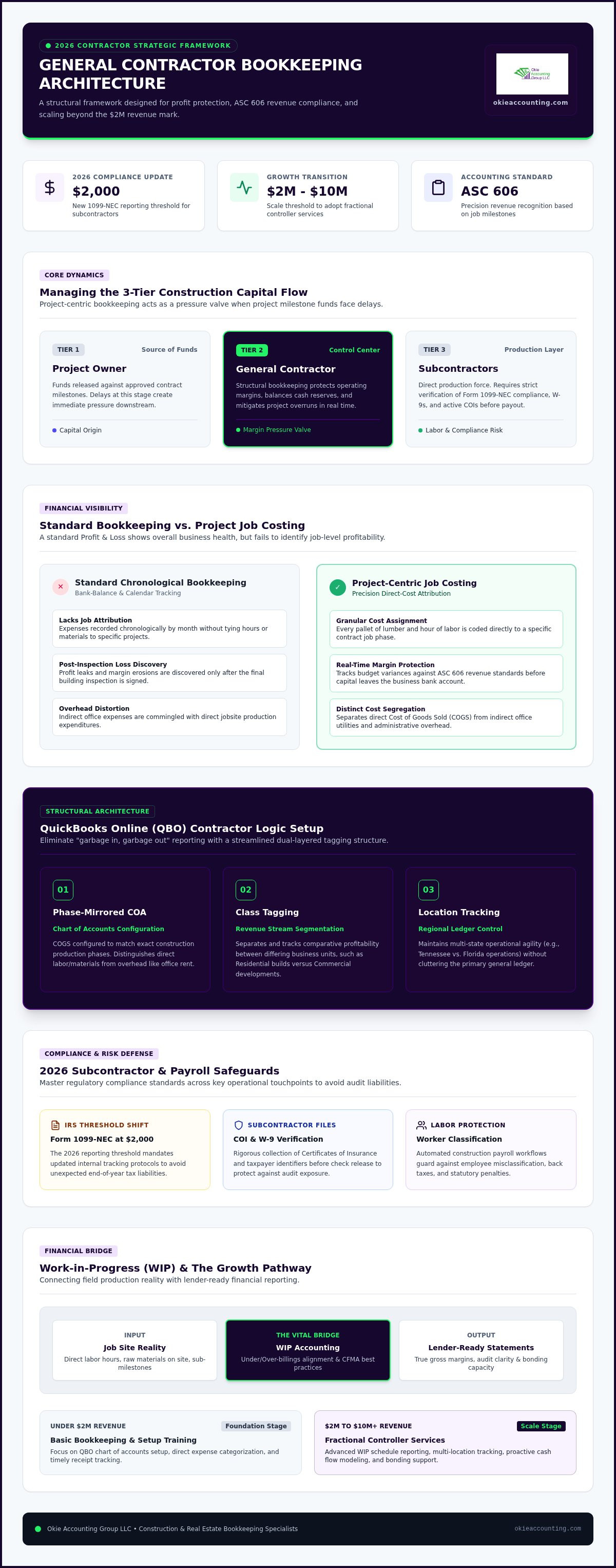
Bookkeeping for a general contractor is a specialized discipline that prioritizes project-based outcomes over simple calendar dates. While a standard business might track monthly expenses, a construction firm must track every cent against specific contract milestones. This project-centric approach is the only way to manage the complex three-tier cash flow between the project owner, your company, and your subcontractors. When funds are delayed at the top, the pressure builds at the bottom. Effective bookkeeping acts as a pressure valve, providing the data needed to protect your margins.
In 2026, the regulatory landscape for contractors in Tennessee and Florida has become more demanding. With the reporting threshold for Form 1099-NEC rising to $2,000, your administrative systems must be more robust than ever. Accurate data entry isn't just a chore; it's a form of profit protection that guards against unexpected tax liabilities and project overruns. You need a system that captures costs in real time, ensuring you aren't discovering a loss only after the final inspection is complete.
Job Costing vs. General Bookkeeping
A standard Profit & Loss statement tells you if the company is profitable, but it won't tell you which job is actually making money. Job costing is the DNA of construction profitability. It assigns every hour of labor and every pallet of lumber to a specific project. This precision is essential for applying the revenue recognition principle correctly, especially under ASC 606 standards. Without this granularity, you're flying blind, relying on bank balance accounting rather than true financial health. It's the difference between guessing your margin and guaranteeing it.
The Burden of Subcontractor Management
Managing subcontractors involves more than just cutting checks. It requires a rigorous system for tracking Certificates of Insurance (COIs) and W-9s to avoid massive audit liabilities. In the 2026 labor market, the IRS is increasingly focused on worker misclassification. Treating an employee like a subcontractor can lead to devastating back taxes and penalties. Implementing specialized Construction Payroll Services ensures your team remains compliant while you focus on the build. By automating these workflows, you reduce the administrative weight that often slows down project momentum.
Building Your Structural Framework: QuickBooks Online Setup
QuickBooks Online (QBO) stands as the industry standard for cloud-based construction accounting. It provides the necessary agility for nationwide remote leadership, allowing you to access financial data from a job site in Jacksonville or an office in Tennessee. However, the software is only as effective as the logic behind its setup. A "Structural Framework" within your bookkeeping system prevents the common "garbage in, garbage out" scenario that plagues many growing firms. When your accounting system integrates seamlessly with field project management tools, you create a single source of truth for every stakeholder.
Leveraging Construction Financial Management Association (CFMA) Resources can help you align your setup with national best practices. This alignment ensures that your financial reporting isn't just a record of the past, but a tool for future stability. If you feel your current setup lacks this level of precision, scheduling a discovery call is a practical first step toward gaining financial clarity.
Designing a Contractor-Specific Chart of Accounts
Your Chart of Accounts (COA) must be more than a list of expenses. It should mirror your project phases to provide meaningful job costing data. By configuring your Cost of Goods Sold (COGS) to track specific production categories, you gain immediate insight into where project funds are being deployed. You must clearly distinguish between direct project costs, like lumber and subcontractor labor, and indirect overhead, such as office utilities. Proper QuickBooks Setup & Training empowers your internal team to maintain this integrity, ensuring every transaction supports your long-term health. It's about building a foundation that stays solid as your volume increases.
The Role of Classes and Locations
Effective bookkeeping for a general contractor utilizes advanced tagging to avoid a cluttered ledger. Using "Classes" in QuickBooks allows you to track profitability across different revenue streams, such as residential versus commercial projects. If your firm operates in multiple regions, like Tennessee and Florida, "Locations" enable you to segment your data by geography. These features allow you to generate granular reports for specific business units while maintaining a streamlined and manageable general ledger. This dual-layered approach provides the structural integrity needed for scaling a $2M to $10M construction firm without losing control of the details.
Mastering WIP Accounting and Progress Billing
Work in Progress (WIP) accounting serves as the essential bridge between project reality and financial reporting. While many small businesses rely on cash basis accounting, this method often hides a construction company’s true health. Cash basis only tracks when money moves; it fails to account for earned revenue that hasn't been billed or costs that haven't been paid. For effective bookkeeping for a general contractor, transitioning to a WIP-based accrual system is non-negotiable for profit protection.
Strategic progress billing ensures you maintain a positive cash flow throughout the project lifecycle. By billing based on the percentage of completion rather than arbitrary dates, you align your revenue with the actual work performed. This methodology prevents the dangerous traps of over-billing, which creates a false sense of wealth, and under-billing, which starves the project of necessary capital. Accuracy here is the difference between a profitable year and a cash crunch.
The Mechanics of WIP Reports
A reliable WIP report relies on a precise formula: Total Contract Price compared against Estimated Costs and Actual Costs incurred to date. By calculating the percentage of completion, you determine exactly how much revenue should be recognized on your Profit & Loss statement. These monthly WIP adjustments ensure your financial statements reflect the project's actual performance rather than just bank activity. You can explore deeper strategies in our guide on WIP Accounting: Tracking Work in Progress for Profit to see how these foundational systems support scaling.
Progress Billing and AIA Documents
For commercial general contractors, standardized billing through AIA-style documents like the G702 and G703 is the gold standard. These forms provide a clear breakdown of the contract sum, work completed to date, and the remaining balance. A critical component of this process is tracking retainage, typically 5% to 10% of the contract value held back by the owner until project completion. It is easy for retainage to get lost at the end of a long-term project if your ledger isn't configured to track it as a separate asset.
On a 2026 balance sheet, properly recorded retainage ensures you have a clear view of your future cash inflows. Failing to track this accurately can lead to significant cash flow gaps when a 12-month project finally closes. Maintaining this discipline ensures your structural framework remains intact from groundbreaking to the final walkthrough. This methodical oversight provides the clarity needed to manage multi-year contracts with confidence.
Risk Mitigation: Payroll, Compliance, and 1099s
Many builders dismiss bookkeeping as a back-office chore or simple data entry. In reality, effective bookkeeping for a general contractor is a rigorous form of risk management. It serves as your primary defense against IRS audits, labor disputes, and insurance claims. In the 2026 regulatory environment, the stakes have increased. The reporting threshold for Form 1099-NEC has moved to $2,000, meaning more of your project partners now fall under federal reporting requirements. If your records are disorganized, you aren't just losing time; you're inviting financial exposure.
Operating across state lines, such as between Tennessee and Florida, adds layers of complexity to your tax filings. Tennessee's business tax structure and Florida's specific worker classification rules require precise oversight to avoid penalties. Automated payroll systems are no longer optional for firms with multi-state operations. These systems ensure that state-specific withholdings and unemployment taxes are handled accurately, protecting you from the high cost of compliance failure. To secure your firm's future, you must move beyond manual spreadsheets toward a disciplined, automated framework. You can schedule a discovery call to evaluate your current compliance posture.
Automating Subcontractor Compliance
Subcontractor management is often where profit bleed occurs. By utilizing cloud-based accounting tools, you can create a system that automatically blocks payments to any subcontractor with an expired Certificate of Insurance (COI). This proactive approach ensures you never carry the liability for an uninsured worker on your job site. It's equally critical to collect a completed W-9 before the first check is ever cut. Integrating these steps into specialized Construction Payroll Services reduces the administrative burden on your team while maintaining total compliance. This level of oversight turns a potential liability into a controlled operational process.
Lender-Ready Financials
Growth requires capital, and capital requires clean books. Whether you are seeking a higher bonding limit or a new line of credit, lenders demand financial statements that demonstrate structural integrity. A "compiled" financial statement is often the starting point, where an expert organizes your data without providing an opinion on the underlying numbers. As you scale, lenders may require a "reviewed" statement, which involves a higher level of scrutiny and analytical procedures. While our firm focuses on Management Accounting and fractional oversight rather than certified audits, we ensure your internal systems produce the accurate, lender-ready data these institutions require. This preparation is the key to unlocking the financing needed for larger, more profitable projects.
Scaling Your Firm with Fractional Controller Services
Scaling a construction firm from $2 million toward $10 million in annual revenue requires more than just high-volume lead generation. It demands a sophisticated financial engine that supports rapid operational growth. At this stage, standard bookkeeping for a general contractor must evolve from simple data recording to high-level data interpretation. This is where Fractional Controller Services become essential. Instead of merely knowing that your bills are paid, you gain a strategic partner who understands how those payments impact your long-term stability and profit margins. It's the transition from looking at where you've been to planning where you are going.
A fractional controller acts as a disciplined mentor for your business. They don't just provide reports; they provide insight into your firm's structural integrity. By analyzing your project-based financial tracking, a controller can identify where overhead leaks are draining your capital or which service lines are underperforming. This level of oversight ensures that your growth is both sustainable and profitable, protecting you from the common pitfall of "growing broke." We focus on these foundational systems to ensure your business remains lender-ready and resilient.
From Bookkeeper to Strategic Advisor
The difference between a monthly reconciliation and a strategic financial review is the difference between looking in the rearview mirror and using a GPS. While a bookkeeper ensures transactions are categorized correctly, a controller interprets what those numbers mean for your future. They help you navigate complex decisions, such as using cash flow forecasting to determine exactly when you can afford to hire your next project manager without straining your reserves. You can learn more about this transition in our guide on Fractional Controller Services: The Strategic Framework. This proactive stance allows you to make data-driven choices that protect your bottom line.
Taking the Next Step
If you are still relying on the "shoebox" method of accounting or feeling overwhelmed by the complexity of your growth, it's time to build a more robust foundation. Transitioning to professional Fractional Controller Services allows you to step away from the ledger and back onto the job site with total confidence. The first step toward establishing this clarity is assessing your current financial systems to identify gaps in your reporting. We invite you to Book a Discovery Call with Okie Accounting Group LLC today. Together, we can construct the structural framework your business needs to scale securely through 2026 and beyond.
Constructing Your Path to Financial Stability
Building a successful firm requires more than just skilled labor; it demands a rigid financial framework that protects your profits at every stage of the build. By implementing a specialized Chart of Accounts and mastering Work-in-Progress reporting, you move from reacting to project expenses to proactively managing your firm's health. Effective bookkeeping for a general contractor isn't just about clean ledgers; it's about having the data-driven confidence to take on larger contracts and navigate the 2026 regulatory landscape with ease.
As QuickBooks Certified ProAdvisors specialized in construction and real estate, we understand the unique mechanics of your market. Our fractional controller expertise provides the strategic oversight needed to transform your financial data into a tool for scaling. It's time to replace administrative stress with operational clarity and long-term stability. Secure Your Financial Foundation: Book a Discovery Call today to begin your transition from a service provider to a strategic partner. Your business deserves a foundation as solid as the structures you build.
Frequently Asked Questions
What is the best bookkeeping software for a general contractor in 2026?
QuickBooks Online remains the industry standard for cloud-based construction accounting due to its robust project tracking features. It provides the agility needed for contractors in Tennessee and Florida to manage remote job sites in real time. By using the Projects feature in the Plus or Advanced editions, you can establish a structural framework for job costing that protects your margins and integrates seamlessly with specialized field management tools.
How often should a general contractor review their financial statements?
You should review your primary financial statements at least once a month, though weekly reviews of job costing reports are recommended for active projects. Monthly reviews ensure that bank reconciliations are accurate and that your WIP reports reflect current job site reality. For builders in Jacksonville or Tennessee, these regular check-ins allow for immediate course correction if a project begins to show profit bleed before a milestone.
What is the difference between an accountant and a construction bookkeeper?
While a general accountant focuses on historical compliance and year-end tax filing, a construction bookkeeper manages the daily, project-centric financial tracking. Specialized bookkeeping for a general contractor involves managing subcontractor insurance, processing progress billings, and maintaining accurate job costing. A construction bookkeeper acts as a strategic partner, building the structural framework that a CPA uses to prepare high-level tax strategies and lender-ready financial statements.
Do I need to track receipts if I use QuickBooks Online?
Yes, you must track receipts to provide a clear audit trail and support your expense claims during an audit. QuickBooks Online allows you to attach digital copies of receipts directly to transactions, which is vital for maintaining lender-ready financials. This digital record-keeping is especially important for contractors in Florida and Tennessee to ensure compliance with 2026 IRS documentation standards. It replaces the chaotic box of receipts with an organized, cloud-based system.
How do I handle retainage in my bookkeeping system?
Retainage should be recorded as a separate asset on your balance sheet, distinct from standard accounts receivable. When you issue a progress billing, you should categorize the held-back portion, typically 5% to 10%, into a Retainage Receivable account. This ensures your cash flow forecasting remains accurate and that these funds aren't forgotten during the final project closeout. Proper setup in QuickBooks prevents these earned funds from distorting your monthly income reports.
Can a general contractor use cash-basis accounting for taxes?
Most small contractors with gross receipts under $32 million in 2026 can use the cash method for tax purposes, but this shouldn't be your primary management tool. While cash-basis might be simpler for tax filing, it hides your true profitability by ignoring earned revenue and unpaid costs. We recommend using accrual-basis WIP accounting for your internal operations in Tennessee and Florida to ensure you have real-time visibility into project health.
What are the most common bookkeeping mistakes general contractors make?
The most frequent errors include failing to track subcontractor insurance certificates, neglecting job costing, and relying on bank balance accounting. Many GCs also struggle with misclassifying employees as subcontractors, which is a significant audit risk in 2026. These mistakes lead to profit bleed and inaccurate reporting. Establishing a disciplined structural framework for your bookkeeping for a general contractor prevents these common pitfalls and ensures your business remains stable and scalable.
How much does specialized construction bookkeeping cost?
Fees for specialized construction bookkeeping are typically based on the complexity of your projects and the volume of transactions. While we don't provide flat rates here, the investment reflects the specialized knowledge required for job costing and subcontractor management. For growing firms in Jacksonville and Tennessee, the cost of professional oversight is an investment in profit protection. It is the difference between simple data entry and building a strategic engine for growth.


Comments