Job Costing for Home Builders: Profit Protection Framework

Updated: 6 days ago
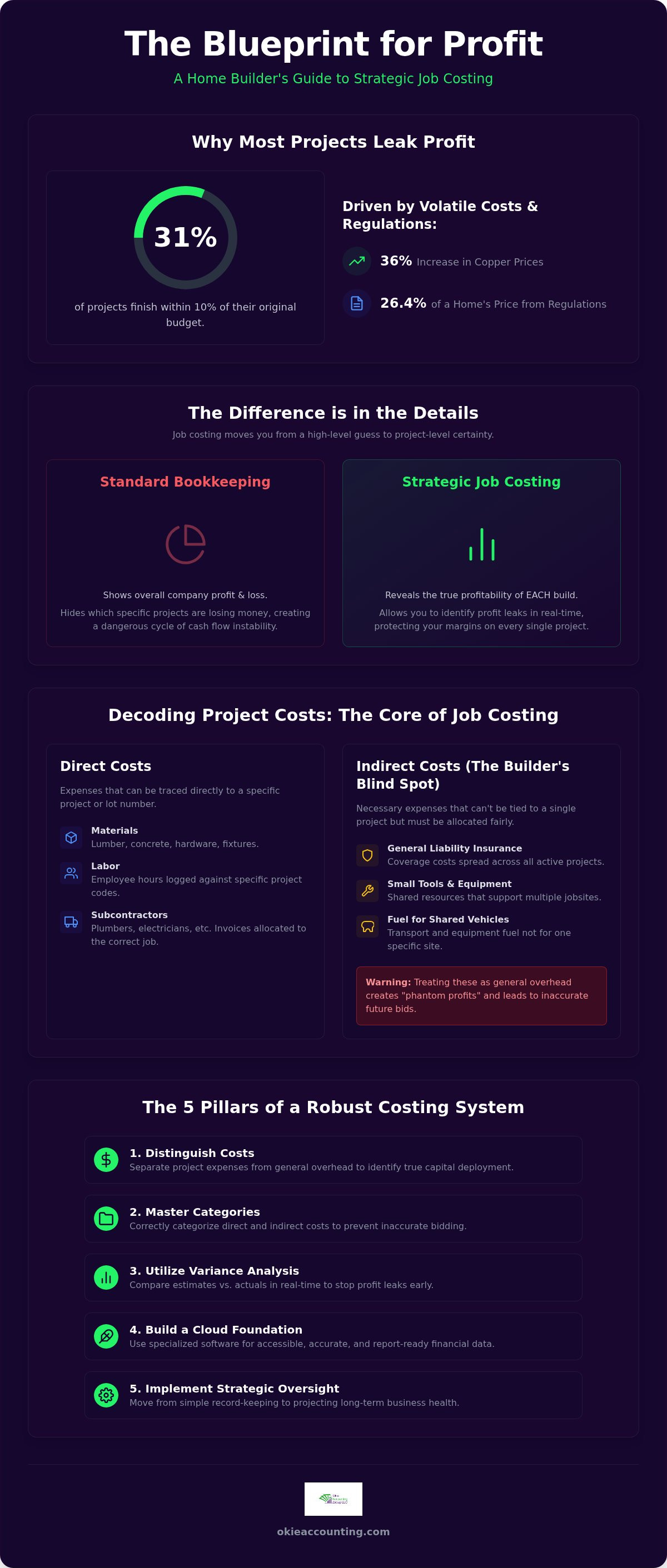
Only 31% of construction projects finish within 10% of their original budget, leaving the vast majority of builders to absorb the impact of unexpected expenses and shrinking margins. You likely feel the weight of this uncertainty every time you review a project's final numbers and realize the profit isn't where it should be. With copper prices climbing as much as 36% and regulatory costs now accounting for over 26% of a new home's final price, the margin for error has vanished. Implementing a rigorous framework for job costing for home builders is no longer just an administrative task; it's a vital survival strategy for your business.
This article provides the roadmap to eliminate profit leaks and gain total financial clarity for every home you build. You will learn how to separate project-specific costs from company overhead and use historical data to build more accurate, profitable bids. We will break down the essential components of a robust costing system, from leveraging the latest QuickBooks Construction Edition features to establishing the structural oversight your business needs to grow with confidence. By the end of this guide, you'll have the tools to transform your financial data into a strategic asset that protects your bottom line.
The Strategic Importance of Job Costing for Home Builders
Job Costing is the disciplined practice of assigning every expense to a specific project rather than grouping them into broad categories. For residential contractors, job costing for home builders acts as a foundational profit protector. With copper conduit prices rising up to 36% and aluminum products jumping 33% as of early 2026, you can't afford to guess where your money is going. Precise tracking ensures that these volatile material costs don't silently erode your margins. With regulatory costs now accounting for an estimated 26.4% of the final price of a new single-family home, there's no room for financial ambiguity.
Sustainable growth requires more than just a positive bank balance. It demands a granular understanding of how each build contributes to your bottom line. Without this framework, you're building on sand. With it, you're creating a resilient business capable of weathering any market shift.
Identifying Profit Leaks in Residential Construction
Profit leaks often hide in plain sight when job costing for home builders isn't strictly enforced. They manifest as untracked change orders, unallocated labor hours, or small material runs that aren't billed back to the client. Over time, these minor oversights aggregate into significant financial losses that can sink an otherwise healthy company. You need to know exactly which line items are exceeding their estimates before the project concludes.
Many builders fall into the trap of "robbing Peter to pay Paul," using the deposit from a new project to cover the overruns of a closing one. This creates a dangerous cycle of cash flow instability that is difficult to break. Real-time data allows you to spot these variances immediately. Instead of discovering a loss at the end of a six-month build, you can adjust your strategy in week two to protect your remaining margin.
Beyond Bookkeeping: The Project-Level View
Standard bookkeeping provides a high-level view of your company's general health, but it often obscures the performance of individual projects. Your Profit and Loss (P&L) statement might show a net gain for the quarter, yet hide the fact that two out of three homes actually lost money. This lack of visibility makes it impossible to identify which types of builds are truly driving your success.
Job costing serves as the structural integrity of your financial reporting. It provides the visibility needed to see which project types are your most profitable and which are draining your resources. Moving toward a management accounting approach allows you to make data-driven decisions that protect your long-term stability. This shift from recording history to projecting the future is what separates a service provider from a strategic partner.
Decoding the Mechanics: Direct vs. Indirect Costs
Accurate job costing for home builders relies on the structural integrity of your cost categories. If you misclassify a field truck's fuel as a general administrative expense instead of a project cost, your bidding data becomes corrupted. This leads to inaccurate future estimates and potential complications during financial reviews. Establishing consistent coding across all projects ensures that your historical data remains a reliable guide for growth. A comprehensive guide to construction job costing highlights that the distinction between direct and indirect expenses is where most profit leaks are born.
Direct Costs: Materials, Labor, and Subcontractors
Direct costs are the most visible components of any build. These expenses are easily traced to a specific lot number or project ID. For a residential builder, this includes lumber, concrete, and hardware. Every invoice must be coded to the correct phase of construction to ensure the budget stays on track. Managing subcontractor invoices requires the same level of discipline. You must verify that a plumber's bill is allocated to the specific project where the work was performed rather than being dumped into a general "subcontractor" bucket.
Internal labor remains one of the most significant challenges in this category. With construction labor rates in California ranging from $48 to $70 per hour as of May 2026, even small errors in time tracking can lead to massive budget overruns. You must implement a system where employees log their hours against specific project codes. This granular data allows you to see exactly how much labor is required for each phase of the build, from framing to final trim.
Indirect Costs and Allocation: The Builder’s Blind Spot
Indirect costs are the expenses necessary to complete a project that cannot be tied to a single lot. These include items like general liability insurance, small tools, and fuel for shared equipment. Many builders treat these as general overhead, which creates "phantom" profits. If you don't allocate a portion of these costs to each project, you aren't seeing the true cost of the build. You might think a house netted a 15% profit, but after accounting for unallocated indirect costs, that margin could actually be closer to 10%.
Fairly allocating these costs requires a logical framework. Common methods include assigning a percentage of the total project cost or a flat fee per build. This ensures that every dollar spent by the company is accounted for at the project level. Utilizing Fractional Controller Services can help you define these categories specifically for your firm's operational model. This high-level oversight ensures your financial systems are built for long-term stability rather than just basic record-keeping. If your current system lacks this level of detail, you might consider a discovery call to discuss building a more robust framework.
Estimating vs. Actuals: Managing the Variance
Your original estimate is a strategic roadmap, but the actual costs recorded during the build reveal the reality of your operations. For many residential contractors, the disconnect between the bid and the final invoice is where profit disappears. Effective job costing for home builders requires a systematic comparison of these two datasets. Without this analysis, you're unable to identify "scope creep," where small, unbilled changes slowly erode your margin. Only 31% of construction projects come within 10% of their original budget, making this comparison a critical survival skill in a volatile market.
Variance analysis isn't just a back-office task. It should be the most important meeting on your monthly calendar. By reviewing where you overspent on the last project, you gain the data necessary to refine your 2026 bidding strategy. If your HVAC costs are consistently coming in 18% higher than projected due to the mandatory transition to A2L refrigerants that began on January 1, 2026, your future bids must reflect that new baseline immediately. This disciplined review process ensures your pricing remains competitive yet profitable.
The Role of Work-in-Progress (WIP) Accounting
Accurate monthly reporting depends on WIP accounting for construction. Work-in-Progress (WIP) accounting ensures that revenue is recognized in the same period as the expenses incurred to earn it. Without these adjustments, your financial statements will show misleading "profit spikes" during months with heavy billing, even if the project is technically over budget. This framework prevents you from making strategic decisions based on a temporary surplus of cash that is already committed to future vendor payments.
Analyzing Variance to Protect Your Future Bids
When you spot a variance, you must determine if it was a one-time error or a systemic under-estimation. A one-time error, such as a specific subcontractor mistake, requires a different response than a systemic issue like under-pricing framing labor. With labor rates in some regions reaching $70 per hour as of May 2026, failing to adjust your pricing based on actual performance data can lead to compounding losses across your entire pipeline. Variance analysis is the feedback loop for construction profitability, ensuring that every lesson learned on the job site is captured in your financial records. This data-driven approach allows you to move from defensive management to proactive profit protection.
Implementing a Job Costing System in QuickBooks Online
QuickBooks Online has solidified its position as the primary financial management tool for modern contractors. Intuit's discontinuation of support for the 2023 Desktop version on May 31, 2026, accelerated the industry's shift toward cloud-based platforms. For residential builders, the "Plus" plan is the minimum requirement to access essential project tracking features.
Implementing job costing for home builders effectively requires more than just a subscription. A professional QuickBooks setup for contractors ensures that your "Projects" and "Classes" are configured to capture data correctly from the start. This structural foundation allows you to automate data entry through bank feeds and credit card tags, ensuring that job costs are captured in real-time without manual errors.
The release of the QuickBooks Construction Edition in February 2026 introduced advanced features like cost groups and AIA-style invoicing. These tools allow you to move beyond basic administrative tasks and build a comprehensive framework for financial oversight. By utilizing project-specific tags, you can generate a "Project Profitability" report with a single click, providing the immediate clarity needed to manage multiple builds simultaneously.
Setting Up the Chart of Accounts for Builders
Your Chart of Accounts must mirror the physical stages of your construction process. Instead of a generic list of expenses, your accounts should be organized to reflect phases like site prep, framing, and finishes. The most critical area for job costing is the "Cost of Goods Sold" (COGS) section. Properly categorizing these direct costs allows you to see your gross margin clearly for every lot. For a deeper dive into these configurations, consult our guide on Mastering QuickBooks for Contractors. A well-structured COGS section is the difference between a vague financial snapshot and a precise surgical tool for profit protection.
Tracking Time and Materials by Project
Field data is the lifeblood of an accurate costing system. You must establish best practices for your teams to log labor hours directly to specific jobs. With labor rates reaching up to $70 per hour in some markets as of May 2026, untracked time is a significant profit leak. Connecting your bank feeds directly to project tags ensures that every material purchase, from a lumber package to a box of nails, is assigned to the correct build. Reviewing these project-level reports weekly allows you to spot variances while you still have time to course-correct. If your current software setup feels disconnected from your job site reality, you can schedule a discovery call to discuss building a more integrated system.
Strategic Oversight: How a Fractional Controller Protects Your Margins
As your firm expands, the complexity of managing multiple builds often outpaces the capacity of basic record-keeping. There is a distinct tipping point where a builder must transition from simply recording financial history to actively projecting their future. This is where job costing for home builders evolves from a data entry task into a high-level strategic framework. Fractional controller services provide the specialized oversight required to ensure that your business remains financially healthy while you focus on the physical demands of construction. This partnership ensures that your financial data is not just accurate, but actionable.
The difference between a bookkeeper and a controller is the difference between recording what happened and planning for what is next. While a bookkeeper ensures your transactions are coded correctly in QuickBooks, a controller analyzes that data to identify trends, mitigate risks, and protect your long-term stability. This level of discipline is essential for maintaining the structural health of your firm as you take on more complex projects.
Moving from Administrative Tasks to Strategic Partnership
Basic bookkeeping records what you've already spent; strategic oversight explains why you spent it and how to optimize for the next build. This shift allows you to move beyond administrative burdens and return your focus to the job site. A monthly financial review with an expert acts as a critical checkpoint for decision making. During these sessions, you can analyze the variances in material and labor costs with a partner who understands the nuances of the industry. For many growing firms, Fractional Controller Services represent the bridge between operational survival and long-term stability.
Financial Readiness for Scaling Your Building Firm
Scaling a firm requires more than just a high project load; it requires financial readiness. If you're seeking capital to fund new builds, lenders and investors look for the structural integrity of your reporting. With construction loan rates from traditional banks ranging from 6.5% to 9.5% in early 2026, presenting precise, project-level data is essential for securing favorable terms. A scalable infrastructure ensures that your financial systems can handle ten projects as easily as they handle two. This preparation allows you to grow without the fear of outrunning your cash flow.
Okie Accounting Group LLC acts as your strategic partner, building the foundational systems that protect your margins during every stage of growth. We move beyond simple data entry to provide the high-level oversight your business demands. If you are ready to implement a professional framework for job costing for home builders, you can schedule a consultation for specialized construction bookkeeping.
Securing Your Firm’s Future Through Financial Discipline
Transitioning from reactive bookkeeping to proactive management is the only way to ensure long-term stability in residential construction. By mastering the nuances of job costing for home builders, you move beyond the uncertainty of project-level variances and begin building a resilient framework for growth. Precise cost categorization and variance analysis turn raw data into a strategic asset that protects your bottom line against material price hikes and labor shortages.
True profit protection requires a commitment to structural integrity in your financial reporting. Whether you need professional QuickBooks Online training and setup or the high-level strategy of fractional controller services, the goal remains total financial clarity. This specialized oversight allows you to focus on the job site while knowing every dollar is accounted for. Strategic financial oversight for contractors isn't just an administrative task; it's the foundation of a healthy building business.
Build your financial foundation with Okie Accounting's specialized construction services. You don't have to navigate these financial complexities alone. With the right systems in place, you can lead your firm with confidence and scale your operations without compromising your margins.
Frequently Asked Questions
What is the difference between job costing and general accounting for home builders?
General accounting tracks the overall health of your business, while job costing focuses on the specific profitability of each project. General accounting tells you if your company is profitable at a high level. In contrast, job costing identifies which specific houses are making money and which are losing it. This granular tracking is essential for identifying where resources are being over-utilized on the job site.
Can I use QuickBooks Online for job costing in residential construction?
Yes, QuickBooks Online is an excellent tool for modern builders, provided you use the "Plus" or "Advanced" versions. These versions include the "Projects" feature, which serves as the engine for job costing for home builders. When combined with the latest Construction Edition features, it provides real-time visibility into project-level profitability and automated expense tracking through bank feeds and project tags.
What are the most common direct costs in home building?
Direct costs include any expense that can be tied directly to a specific lot or project ID. For residential builders, this typically includes lumber packages, concrete foundations, roofing materials, and framing labor. Subcontractor invoices for specialized trades like electrical, plumbing, or HVAC are also classified as direct costs. Accurately coding these items ensures your gross margin reflects the true cost of production for each build.
How often should I review my job cost reports?
You should review your job cost reports at least once a week to maintain total control over your margins. Waiting until the end of the month often means you've missed the window to course-correct on a specific phase of construction. Weekly reviews allow you to spot variances in labor or material usage early. This proactive approach prevents a minor overage from becoming a significant profit leak.
What is a WIP report and why do home builders need it?
A Work-in-Progress (WIP) report tracks the costs incurred on a project relative to the revenue recognized. Home builders need this report to ensure their financial statements align with the actual progress on the job site. It prevents misleading profit spikes by matching expenses to the specific period they were earned. This provides a much more accurate picture of your company's current financial readiness and cash flow.
How do I allocate overhead costs to specific building projects?
Overhead or indirect costs should be allocated using a consistent and logical formula. Most builders use a percentage of the total project cost or a flat fee per build to distribute shared expenses like insurance, fuel, and small tools. This ensures that every dollar spent by the company is accounted for at the project level. Proper allocation eliminates "phantom" profits and provides a true net margin for every home.
Is job costing necessary for small-volume home builders?
Yes, job costing for home builders is essential regardless of your production volume. Small-volume builders often have tighter margins and less room for error, making every dollar of variance more impactful to the bottom line. Implementing a professional tracking system early provides the foundational data needed to scale safely. It ensures that you aren't just breaking even on your custom projects but actually building wealth.
How does job costing help with more accurate bidding?
Job costing provides the historical data needed to build more accurate estimates for future projects. Instead of guessing based on outdated price sheets, you can use the actual final costs from your most recent builds to set your prices. This data-driven approach is particularly important when material prices are volatile. It allows you to adjust your bids based on real-world performance to protect your future margins.


Comments