Job Costing for Spec Home Builders: A Strategic Framework for Profit Protection in 2026

Updated: 6 days ago
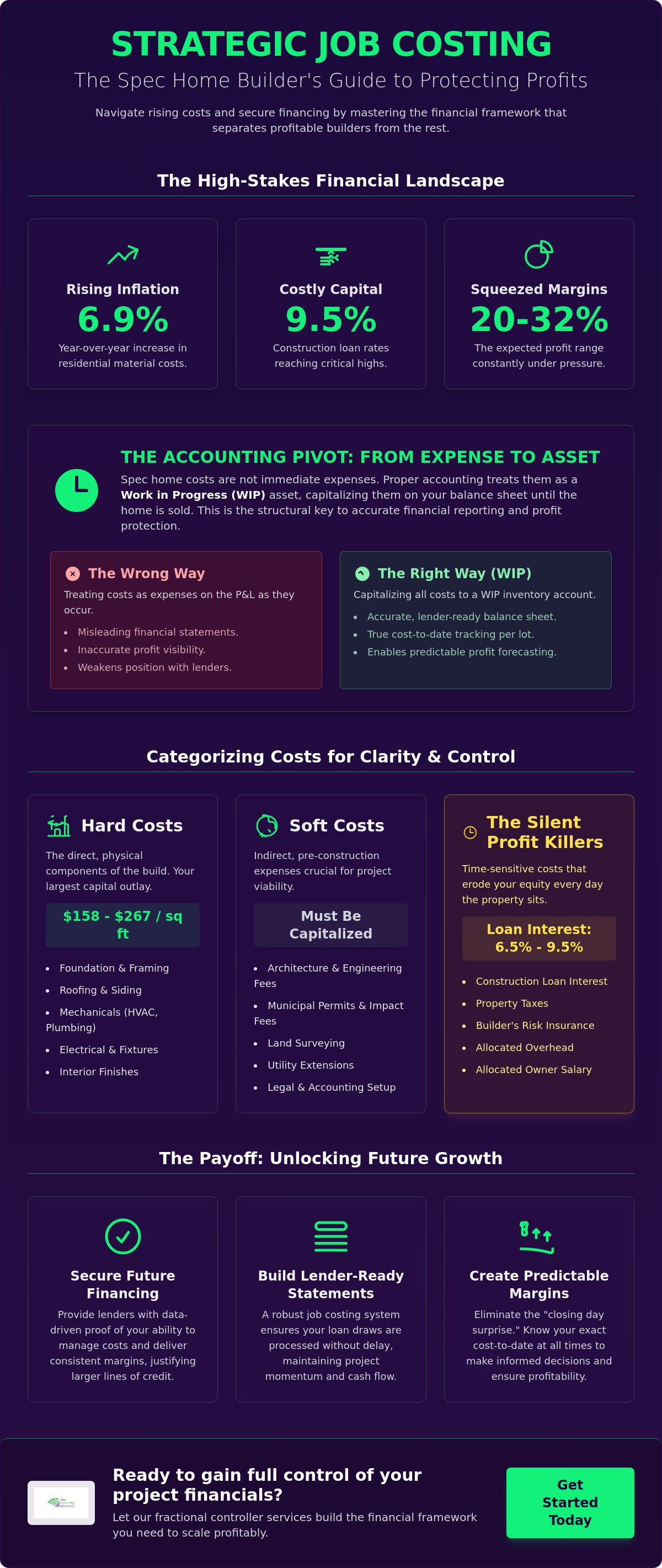
With residential material inflation rising 6.9% year over year and construction loan rates reaching up to 9.5%, your spec home is more than a building; it's a capitalized asset that requires precise management. You likely feel the pressure of carrying costs eating into your expected 20% to 32% profit margin while a property sits on the market. It's a common struggle to differentiate between hard construction costs and soft development costs, especially when lenders demand pristine records before releasing your next draw. When your financials are disorganized, you aren't just losing time; you're losing the leverage needed to secure future funding.
By implementing a rigorous system for job costing for spec home builders, you can regain control over your financial data and protect your bottom line. This article provides a strategic framework to track every dollar per lot, ensuring your business remains profitable regardless of market volatility. We'll examine how to build lender-ready financial statements, account for expiring energy credits like Section 45L, and create the predictable margins you need for your next build cycle in 2026.
Key Takeaways
Identify the critical distinction between hard construction costs and soft development fees to stop silent profit killers from eroding your project margins.
Understand the mechanics of Work in Progress (WIP) accounting to properly treat spec builds as capitalized inventory rather than immediate expenses.
Implement a standardized framework for job costing for spec home builders by configuring QuickBooks Projects and Classes for precise, lot-by-lot tracking.
Leverage fractional financial leadership and cash flow forecasting to secure the capital necessary for a successful build and a profitable exit.
Understanding the Unique Dynamics of Spec Home Job Costing
In 2026, building a spec home requires a different financial lens than traditional contracting. While general contractors focus on project management for a client, you're managing a high-stakes investment portfolio. Job costing for spec home builders is the process of accumulating every direct and indirect cost associated with a specific lot until that asset is sold. This isn't just administrative busywork; it's a structural requirement for profit protection. With building material inflation rising 6.9% year-over-year as of May 2026, even a minor oversight in tracking can turn a projected 25% margin into a loss.
Traditional accounting methods often fail because they treat construction costs as immediate expenses on the Profit and Loss statement. For a spec builder, these costs are actually investments in inventory. If your system doesn't reflect this, your financial statements won't just be messy; they'll be misleading. Real-time data prevents the "closing day surprise" where builders realize their bank balance doesn't match their estimated profits after the house sells. You need to know your exact cost-to-date every Tuesday, not three weeks after the project closes.
Construction loan draws are the lifeblood of your operation, but they're also a source of friction if your records are weak. Lenders in 2026 have tightened their standards, frequently requiring detailed reports that prove funds are being used for their intended purpose. A robust job costing system ensures your draws are processed without delay, maintaining your project's momentum and reducing the time your capital is tied up.
Spec vs. Custom: Why Your Accounting Must Pivot
Pivoting your accounting strategy is essential because of how you recognize revenue. Custom builders often use the percentage-of-completion method, but spec builders must hold all costs on the balance sheet until the title transfers. This shift requires a spec-specific architecture in your Chart of Accounts. You must manage holding costs, such as loan interest and property taxes, which act as silent profit killers while the house sits on the market. Without this pivot, you can't accurately assess the feasibility of your next project or your actual cash position.
The Role of Job Costing in Securing Future Financing
Lenders demand clarity. They look for project-level financial reports that demonstrate a builder's ability to manage costs under pressure. Implementing a system for job costing for spec home builders provides the data-driven proof lenders need to see. By maintaining rigorous records, you establish a track record of margin consistency. This historical data is essential when you want to justify larger lines of credit or secure funding for multi-phase developments. Professional fractional controller services can help you present these lender-ready statements, ensuring you have the capital to keep building.
Categorizing Costs: Hard, Soft, and the Silent Profit Killers
Effective job costing for spec home builders requires a granular breakdown of every expense that touches a project. It's easy to track the lumber delivery or the foundation pour, but those visible expenses are only part of the equation. To protect your 20% to 32% profit margin, you must categorize costs into three distinct buckets: direct hard costs, indirect soft costs, and the carrying costs that often act as silent profit killers. Without this structure, you're merely guessing at your true break-even point.
Direct hard costs are the physical components of the build. These include framing, foundation, roofing, and mechanicals. With the national average cost to build ranging from $158 to $267 per square foot in 2026, these figures represent your largest capital outlay. However, the complexity increases when you move into indirect soft costs. Architecture, engineering fees, and municipal permits must be tracked per lot. Following IRS guidelines for construction industry accounting is essential here to ensure these costs are properly capitalized rather than prematurely expensed, which can lead to significant compliance issues.
The most dangerous expenses are the silent killers: interest expense, property taxes, and insurance. For professional builders, construction loan interest rates currently range from 6.5% to 9.5%. Every day a house sits on the market, these costs erode your equity. A disciplined builder also allocates a portion of owner salary and general overhead to each specific lot to understand the true cost of production. If you need help establishing these foundational systems, consider a discovery call to discuss your project architecture.
Mastering Soft Cost Allocation
Tracking pre-construction costs is vital. You must account for engineering and design before the first shovel hits the dirt. In multi-unit developments, shared costs like site preparation or utility extensions must be allocated across all lots using a consistent logic. This prevents one lot from appearing artificially profitable while others look like losers. Furthermore, tracking the financial impact of design changes ensures that "character-rich" upgrades, like arched openings or built-in features, don't accidentally wipe out your net gain.
Carrying Costs: The Variable You Can Control
You must calculate your daily "burn rate." This is the total cost of interest, insurance, and taxes for every 24 hours a spec home remains unsold. Interest capitalization is a critical accounting choice; it moves these costs from the Profit and Loss statement to the Balance Sheet, preserving your margin until the exit. By maintaining high financial visibility, you can identify which projects are approaching their "profit cliff" and adjust your sales strategy or builder incentives accordingly to reduce time-to-close.
Inventory vs. Expense: Managing the Balance Sheet Transition
Spec building is essentially a manufacturing process. Unlike a custom builder who performs a service for a client, you're creating a tangible product for the open market. This distinction changes everything on your financial statements. In the disciplined framework of job costing for spec home builders, every dollar spent on framing or permits is a dollar added to the value of an asset. It isn't an expense that hits your bottom line today; it's a capitalized cost that stays on your balance sheet until the moment of sale.
A common error in residential development is treating construction costs as immediate expenses. Traditional contractors often record materials and labor as they are paid, which creates a distorted view of profitability. You might look like you're losing money for six months, only to see a massive, artificial profit spike at closing. By treating spec houses as inventory, you align your financial reporting with the actual economic reality of the build. This ensures that your Cost of Goods Sold (COGS) is only recognized when the revenue is earned, providing a clear picture of your true margins.
Tax implications are equally significant in 2026. Under the One Big Beautiful Bill Act (OBBBA), the expansion of the Completed Contract Method allows many builders to defer income until a project is finalized. This improves your cash flow by keeping capital inside the business during the construction cycle. Managing the transition from Work in Progress (WIP) to Finished Goods at the certificate of occupancy stage is a critical milestone. It signals that the asset is ready for sale and triggers the final valuation of your inventory, ensuring your records are lender-ready at all times.
The WIP to Inventory Workflow
Precision matters when recording invoices at the lot level. Every bill must be tied to a specific lot asset account to ensure accuracy. You must reconcile these figures against physical progress to confirm your balance sheet is a true reflection of your company's value. If your Profit and Loss statement looks "empty" while you have three houses in framing, you're actually maintaining a healthy, organized system. This structural approach prevents the financial fog that leads to overextension and protects your equity from being mismanaged.
Strategic Advantage through Management Accounting
Maintaining this level of detail is difficult when you're managing multiple build sites simultaneously. You need a reliable system that ensures monthly reconciliations happen without fail. Our management accounting services provide the oversight required to manage these complex inventory needs. Professional management ensures your balance sheet reflects true asset value, which is exactly what lenders want to see when you apply for your next round of construction financing. This strategic partnership allows you to focus on the build while we focus on the financial architecture.
Building the System: QuickBooks Setup for Spec House Tracking
Spreadsheets are a liability for builders managing multiple lots in 2026. While Excel might suffice for a single project, it lacks the audit trail and scalability required for professional development. Precise job costing for spec home builders requires a structural setup within QuickBooks that moves beyond simple expense tracking. You must treat every lot as a unique financial entity by utilizing the "Projects" or "Classes" features. This allows you to isolate the financial performance of each build, ensuring that one profitable sale doesn't mask the inefficiencies of a struggling site.
A successful system relies on a standardized Items list that mirrors your estimate categories.
When your accounting records match your construction budget, you can perform a side-by-side analysis of projected vs. actual costs with surgical precision. Automation is equally vital; utilizing mobile capture for receipts and subcontractor invoices ensures that no expense is left unrecorded. This real-time data entry feeds directly into the "Profitability by Project" report, providing the oversight needed to pivot before a budget overrun becomes a permanent loss.
If you're ready to transition from basic bookkeeping to a professional financial framework, we can help you implement these systems. Schedule a discovery call to discuss how we can refine your project tracking.
Configuring Your Construction Chart of Accounts
Your Chart of Accounts is the foundation of your financial house. For spec builders, this means creating a parent Asset account titled "Spec Inventory" on your balance sheet. Under this parent account, you should establish sub-accounts for Land, Hard Costs, and Soft Costs for every active lot. This architecture ensures your costs are capitalized correctly, reflecting the true value of your inventory at any given moment. For a professional setup that aligns with industry standards, our QuickBooks training for contractors provides the specific guidance you need to manage these complex asset accounts.
Mastering the Data Entry Architecture
Consistent data entry is the backbone of reliable reporting. Without a standardized process, you risk the common "double counting" mistake where costs are recorded both as an expense and an asset. This error distorts your profit margins and complicates your lender reports. You can find deep-dive tutorials on avoiding these pitfalls in our guide on Mastering QuickBooks for Contractors. Establishing these disciplined habits now will ensure your financials remain lender-ready as you scale your build cycle in 2026.
Strategic Oversight: How Fractional Financial Leadership Secures Your Exit
Accurate data entry is only the first step in protecting your equity. The true value of job costing for spec home builders lies in how that data informs your next strategic move. It's the difference between merely recording financial history and actively shaping your company's future. A fractional controller acts as a strategic mentor, moving beyond the "what" of your expenses to the "why" of your profitability. They provide the high-level oversight needed to evaluate build feasibility before you commit significant capital to a new lot.
You can't finish a build on hope alone. Cash flow forecasting ensures you have the liquidity to reach the finish line, especially with professional construction loan rates currently ranging from 6.5% to 9.5%. By analyzing your "Exit Margins" against your original "Target Margins" (typically between 20% and 32%), a controller helps you adjust pricing or builder incentives for the next cycle. This level of financial discipline protects your personal wealth from the inherent volatility of speculative development, ensuring your business remains a source of stability rather than stress.
Moving from Bookkeeping to Strategic Controller Services
Our fractional controller services are designed to help you scale from two builds to twenty without losing financial control. We help you interpret complex project data to make informed "Go/No-Go" decisions on new land acquisitions. This isn't about basic administrative tasks; it's about building a structural framework for long-term firm stability. When you understand the specific mechanics of your market, you can navigate challenges like the 6.9% rise in material inflation with quiet confidence.
Closing the Loop: Post-Project Financial Reviews
The process shouldn't end at the closing table. Conducting a financial "autopsy" on every closed spec house is the only way to identify where profit was lost and where it was protected. You must use your actual job cost data to refine your estimating model for the next project. This rigorous review prepares your firm for a successful 2026 and beyond, allowing you to adapt to shifting buyer priorities like "healthy home" features or smart HVAC systems. By closing the loop on every build, you ensure that each project is more efficient and more profitable than the last.
Building a Foundation for Scalable Profit in 2026
Protecting your margins in a volatile market requires more than just high-quality construction. It demands a sophisticated financial architecture that distinguishes between physical assets and operational expenses; it requires a proactive approach to inventory management. By accurately categorizing carrying costs and managing the transition from work-in-progress to finished inventory, you transform your books from a source of stress into a tool for strategic growth.
Mastering job costing for spec home builders ensures that every decision, from land acquisition to the final closing, is backed by real-time data. This level of clarity allows you to scale with confidence and secure the financing necessary for your next phase of development. We specialize in the construction and real estate sectors, offering fractional controller expertise and cloud-based accounting for nationwide remote support. Our team is dedicated to building the foundational systems that safeguard your equity throughout the build cycle.
Gain financial clarity for your next build with Okie Accounting Group. Your next project deserves the stability of a professional financial framework.
Frequently Asked Questions
What is the difference between job costing and process costing for builders?
Job costing assigns specific expenses to a single, unique project like a custom or spec home. Process costing averages costs across a mass production line of identical items. Because every lot has distinct site conditions and permit requirements, job costing is the only method that provides the granular detail needed for residential development. It allows you to see exactly which house is performing well and which is facing budget pressure.
Can I use QuickBooks Online for spec home job costing?
You can definitely use QuickBooks Online for job costing for spec home builders by utilizing the Projects and Classes functions. These tools allow you to tag every receipt, invoice, and payroll entry to a specific lot. When configured correctly, the system generates real-time profitability reports that are essential for managing multiple builds. It also provides the audit trail required for professional construction loan draws and financial reporting.
How do I handle land costs in my job costing system?
Land costs must be recorded as a capitalized asset on your balance sheet rather than being expensed immediately. This includes the acquisition price, legal fees, and initial site preparation. These costs remain in your inventory account throughout the construction cycle. Only when the house is sold do these capitalized land costs move to the Profit and Loss statement as part of your Cost of Goods Sold.
Should I capitalize interest expense on my spec builds?
Capitalizing interest is a strategic accounting choice that moves loan costs from your Profit and Loss statement to the balance sheet. This process adds the interest to the total value of the home as it's being built. It prevents your monthly financials from showing large, artificial losses while you're in the middle of a project. This method ensures that your expenses are matched with revenue at the time of the sale.
What are the most common job costing mistakes spec builders make?
Common mistakes include failing to allocate indirect soft costs and neglecting to track daily carrying costs like property taxes. Many builders also struggle with double-counting expenses when using both project management and accounting software. Another significant error is treating construction costs as immediate expenses, which distorts your company's actual asset value. Avoiding these pitfalls requires a disciplined framework and a standardized Chart of Accounts for every project.
How often should I review my job cost reports?
You should review your project profitability reports at least once a week to maintain absolute control over your project's financial health. A weekly cadence allows you to identify budget variances early and make necessary adjustments to your field operations. Regular reviews also ensure that your books are always ready for a lender's inspection. This habit builds the financial discipline needed to protect your margins as you scale your building operations.
Is job costing necessary if I only build one spec house at a time?
Job costing is vital even for a single build because it's the only way to calculate your true return on investment. Without a lot-level tracking system, you can't differentiate between your hard construction costs and your general business overhead. This data is essential for determining the feasibility of your next project. Even with one house, you need to know your exact break-even point to make informed pricing decisions.
How do I track labor costs for my own crew on a spec project?
To track internal labor, you must use a time-tracking system that allows employees to code their hours to specific projects. These labor costs, including burden items like payroll taxes and workers' compensation, should then be capitalized into the value of the home. This ensures that your team's work is reflected as an investment in inventory rather than a general expense. It provides a complete picture of the total capital invested in the build.


Comments