Managing Subcontractor Payments in Construction: A Strategic Framework for 2026

Updated: Nov 7
A construction firm's financial health isn't built on the job site; it's forged in the precision of its back-office systems. You likely already know that managing subcontractor payments in construction is far more than a clerical task. It's a high-stakes balancing act where a single manual data entry error or a missing lien waiver can trigger cascading legal risks and drain your hard-earned margins. It is frustrating to navigate the cash flow gaps between receiving owner payments and paying your crews while administrative overhead continues to climb.
We're here to help you move beyond the chaos of reactive administration. You will learn how to transform your payment process from a burden into a disciplined system that protects your margins and ensures 100% compliance. This guide outlines a strategic framework for 2026, addressing new complexities like California's 5% retainage cap and the strict payment deadlines mandated by SB 440. We'll preview the methodologies needed to achieve predictable cash flow and a streamlined back office that acts as a true strategic partner in your business's success.
Key Takeaways
Understand how managing subcontractor payments in construction serves as a risk-mitigation framework rather than a simple administrative task.
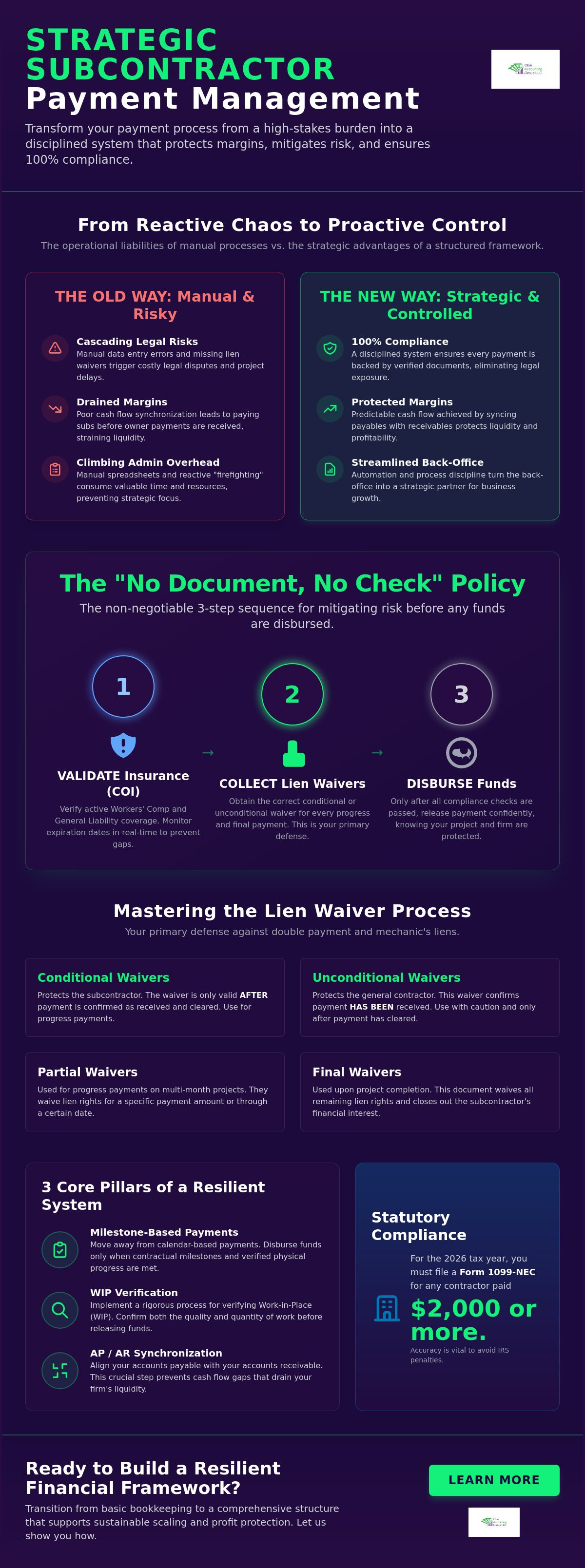
Establish a "No Document, No Check" policy to ensure 100% compliance with lien waivers and insurance requirements before any funds are released.
Recognize the operational liabilities of manual spreadsheets and the strategic advantages of moving toward automated, project-based financial tracking.
Apply a structured verification process to manage retention and protect your cash flow from the start of a project through final closeout.
Discover how to transition from basic bookkeeping to a comprehensive structural framework that supports sustainable scaling and profit protection.
What is Strategic Subcontractor Payment Management?
Strategic management is the systematic validation of project milestones coupled with rigorous compliance tracking and cash flow synchronization. It moves beyond the basic act of cutting checks to establish a foundational system for project integrity. When managing subcontractor payments in construction, you aren't simply performing a clerical task. You're acting as a system architect. This approach ensures that every dollar disbursed aligns perfectly with verified physical progress and comprehensive legal protection. It turns a chaotic administrative burden into a disciplined, predictable workflow.
The health of your entire project ecosystem depends on this discipline. Without it, you face a dangerous ripple effect. Poorly managed payment cycles lead to sudden work stoppages, costly lien claims, and a total erosion of trust with your trade partners. Transitioning from reactive "firefighting" to a proactive, controlled financial environment is essential for long-term stability. This shift allows you to maintain project momentum while safeguarding your firm's cash reserves and overall profitability. By mastering the art of managing subcontractor payments in construction, you protect your firm's structural integrity.
The Role of the General Contractor as a Financial Steward
General contractors carry a significant fiduciary responsibility to both project owners and each subcontractor on the job. You're the steward of the project's capital. Maintaining disciplined, predictable payment cycles builds your reputation as a "preferred contractor" in a competitive market. When trade partners trust your systems, they prioritize your projects and deliver higher performance. This transparency transforms a potentially adversarial relationship into a supportive partnership that values accuracy and stability.
Core Components of the Payment Infrastructure
Building a resilient framework requires more than just software. It requires a commitment to three core operational pillars. First, move away from calendar-based payments and toward contractual milestones. This ensures payments reflect real progress. Second, you need a rigorous process for verifying work-in-place (WIP). Funds should only be released once the quality and quantity of the work are confirmed. Finally, you must synchronize your accounts payable with accounts receivable. This alignment is a primary focus of our Fractional Controller Services, as it prevents the cash gaps that often drain a firm's liquidity during the middle stages of a build.
Mitigating Risk: Lien Waivers, COIs, and Compliance
Risk mitigation is the bedrock of a stable construction firm. When managing subcontractor payments in construction, you must adhere to a strict hierarchy of compliance: insurance validation first, followed by lien waiver collection, and finally, the disbursement of funds. This sequence is not optional. Establishing a "No Document, No Check" policy is the most effective way to enforce back-office discipline. It ensures that no payment leaves your accounts until every legal and financial safeguard is firmly in place. This structured approach protects your firm from vicarious liability and ensures that your project remains unencumbered by legal disputes.
Tracking Certificates of Insurance (COI) is a critical component of this oversight. A valid COI today does not guarantee coverage tomorrow. You need a system that monitors expiration dates in real time to prevent gaps in Workers' Compensation or General Liability coverage. Integrating these compliance checks with specialized construction payroll services allows for a seamless flow of data between your labor costs and subcontractor obligations. This integration reduces the administrative burden on your team while maintaining a rigorous defense against project-level risks.
Mastering the Lien Waiver Process
The lien waiver process is your primary defense against double payment and mechanic's liens. You must understand the distinction between conditional and unconditional waivers. A conditional waiver remains invalid until payment is actually received, protecting the sub, while an unconditional waiver confirms that payment has been cleared, protecting you. Utilizing the correct lien waiver and release forms is essential for legal compliance. For multi-month projects, partial waivers track progress payments, while final waivers close out the subcontractor's financial interest in the job. Maintaining an organized, audit-ready digital repository of these documents is a hallmark of a mature financial system.
Insurance and Statutory Compliance
Statutory compliance extends beyond insurance to include federal and state reporting requirements. For the 2026 tax year, the filing threshold for Form 1099-NEC is $2,000 per contractor. Accuracy here is vital to avoid penalties. Furthermore, you must verify that every sub has active coverage before they even step onto the job site. This proactive verification prevents the financial disaster of a claim occurring under an expired policy. If you find your current administrative load is preventing this level of detail, you might consider how professional financial oversight can secure your margins and simplify your compliance workflow.
Systematizing the Workflow: Manual vs. Automated AP
Relying on manual entry for accounts payable is a liability that many scaling firms can no longer afford. When managing subcontractor payments in construction, the hidden costs of labor hours spent on data entry and the inevitable error rates of manual systems drain your resources. Spreadsheets might work for a single project, but they lack the structural integrity required for a growing business. They create silos of information that prevent real-time visibility into project liabilities. Transitioning to an automated workflow isn't just about speed. It's about building a proactive, controlled financial environment that supports long-term health.
Real-time data is the cornerstone of financial readiness. By leveraging cloud-based accounting, you gain immediate clarity on where your money is committed. Integrating your billing tools with QuickBooks for contractors allows you to synchronize project data across your entire team. This connectivity ensures that your project managers and back-office staff are working from a single source of truth, eliminating the reactive "firefighting" mentality that plagues disorganized firms. It allows you to move from a state of complexity to one of operational clarity.
The Cloud-Based Advantage
A centralized digital repository is essential for modern project oversight. Instead of chasing paper invoices, all subcontractor documentation is stored in one accessible location. This standardization allows you to build a disciplined approval workflow that moves logically from the field superintendent to the project manager and finally to the controller. This hierarchy increases audit transparency and reduces the paper trail. It ensures that no invoice is approved without a corresponding verification of work-in-place, keeping your financial data accurate and reliable.
QuickBooks Online as a Central Hub
QuickBooks Online serves as a powerful engine for job costing when configured correctly. You can map every subcontractor cost to a specific job, providing the granular reporting needed to protect your margins. Utilizing bill-pay integrations further reduces manual data entry, allowing your team to focus on strategic oversight rather than clerical tasks. When managing subcontractor payments in construction, having this data at your fingertips allows for data-driven choices rather than guesswork. To truly master these systems, it's vital that your QuickBooks training for contractors specifically addresses AP automation and project-based financial tracking. This level of technical proficiency ensures that your software acts as a structural framework for your business, not just a digital ledger.
Best Practices for Maintaining Profitability and Cash Flow
Profit protection requires a shift from viewing payments as an expense to seeing them as a controlled disbursement. When managing subcontractor payments in construction, your objective is to ensure that cash leaves your accounts only after value is confirmed and risk is mitigated. Implementing a 5-step verification framework creates a barrier against margin erosion. This process includes verifying work-in-place, checking compliance documents, calculating retention, mapping to cost codes, and syncing with owner payments. This methodology ensures that your project remains financially viable even during the complex middle stages of a build, where cash flow often feels the most strained.
Strategic use of "Pay-When-Paid" clauses can be a vital component of your construction cash flow management strategy. While these clauses protect your firm from funding a project out of pocket, they must be managed with care to maintain strong trade partner relationships. Transparency regarding owner payment status is often the difference between a supportive partnership and a project-halting dispute. By aligning your payables with your receivables, you create a synchronized financial environment that supports steady growth. This alignment allows you to honor your commitments to subcontractors while protecting your own liquidity.
The Mechanics of Retention
Retention, or retainage, is your primary leverage for ensuring project quality and completion. Effective January 1, 2026, California Civil Code § 8811 caps retainage on most private projects at 5%, making accurate calculation more critical than ever. You must account for these held funds on your balance sheet as a long-term liability to maintain an accurate picture of your firm's financial health. Final release protocols should never be initiated until the punch list is fully cleared and all close-out documentation is verified. This discipline prevents the common pitfall of overpaying before a project is truly finished, ensuring that the last 5% of work receives the same attention as the first.
Job Costing and Real-Time Profit Tracking
Granular job costing transforms your financial data into a strategic asset. Linking every subcontractor payment to a specific cost code allows for precise margin analysis and the early identification of "budget creep." When managing subcontractor payments in construction, you're not just moving money; you're managing the lifeblood of your project's profitability. Weekly payment reviews provide the immediate clarity needed to pivot before a project loses its financial footing.
Our fractional controller services interpret these metrics to provide the high-level oversight necessary for sustainable scaling. This analysis moves you from simply recording history to actively shaping your firm's future. If you're ready to move beyond basic administrative tasks and build a structural framework for your firm, schedule a discovery call today to discuss your specific needs.
Scaling Your Firm with Strategic Financial Oversight
Scaling a construction business requires a fundamental shift in how you view your back office. As your project volume increases, you'll find that your firm quickly outgrows the capabilities of basic bookkeeping. You don't just need someone to record history; you need structural financial leadership to shape your future. This transition from "doing the books" to "managing the system" is what separates stagnant companies from industry leaders. By mastering the art of managing subcontractor payments in construction, you provide the data-driven confidence required to pursue larger contracts and complex multi-state projects.
Okie Accounting Group LLC builds the framework for nationwide construction success by establishing these foundational systems. A disciplined approach to payment management does more than just keep subs happy. It positions your firm for better bonding and lending opportunities. Lenders and bonding agents look for impeccable payment records and documented compliance histories as proof of operational maturity. When your financial data is organized and predictable, you become a lower-risk partner in the eyes of financial institutions, which is essential for securing the capital needed for growth.
The Role of a Fractional Controller in Sub-Management
A fractional controller acts as a strategic mentor who designs the internal controls necessary to prevent fraud and overpayment. They provide high-level oversight of your AP aging reports, ensuring that cash requirements are forecasted weeks in advance. This level of scrutiny ensures that your firm remains liquid and ready for any project contingency. You can explore how this fits into a broader strategy by reviewing our management accounting approach, which focuses on structural integrity and long-term financial health.
Next Steps: Building Your Financial Foundation
Your first step toward a more disciplined system is a thorough assessment of your current processes to identify "leakage" and hidden risks. Start by implementing a standardized subcontractor onboarding packet that requires all insurance and tax documentation before a sub is even entered into your system. This proactive stance ensures that compliance is a prerequisite, not an afterthought. If you're ready to move from administrative chaos to operational clarity, contact Okie Accounting Group LLC for a strategic controller review. We'll help you build the financial infrastructure needed to support your firm's ambitions while managing subcontractor payments in construction with professional precision.
Build Your Structural Financial Framework for 2026
The transition from administrative burden to strategic oversight begins with a commitment to foundational systems. You've seen how a disciplined approach to managing subcontractor payments in construction protects your margins and ensures 100% compliance across every project. By replacing manual errors with automated precision and enforcing a rigorous document policy, you safeguard your firm against legal risks and cash flow gaps. These aren't just clerical improvements; they're the building blocks of a firm ready for sustainable scaling.
As QuickBooks Online Certified ProAdvisors specialized in Construction and Real Estate, Okie Accounting Group LLC is dedicated to your long-term health. We provide the strategic financial oversight focused on growth that modern contractors require to stay competitive. It's time to stop firefighting and start building with confidence. Gain financial clarity with Okie Accounting Group LLC’s Fractional Controller Services and secure your firm's future today. Your journey toward operational clarity and profit protection is a partnership we're ready to begin.
Frequently Asked Questions
What is the most common mistake contractors make with subcontractor payments?
The most common mistake is releasing funds before verifying compliance or physical work progress. This reactive approach creates significant financial exposure and invites costly lien claims. By failing to enforce a strict "No Document, No Check" policy, firms lose the leverage needed to ensure project quality and legal protection. Establishing a disciplined, weekly verification cycle is the only way to maintain control over your project margins.
Do I really need a lien waiver for every single payment?
You should absolutely collect a lien waiver for every single progress and final payment. Using a conditional waiver for progress payments ensures that the subcontractor's right to file a lien is only waived once the funds have cleared. This practice is a cornerstone of managing subcontractor payments in construction, as it provides a clear paper trail for project owners and lenders while protecting your firm from double payment.
How does retention work in construction accounting?
Retention works as a financial safeguard by withholding a percentage of each progress payment until the project reaches substantial completion. In 2026, many private projects follow a 5% cap on these funds. From an accounting perspective, you must record these amounts as a liability on your balance sheet. This ensures you have an accurate view of your total project obligations and cash requirements for the final closeout phase.
Can I manage subcontractor payments effectively in QuickBooks Online?
QuickBooks Online is highly effective for managing subcontractor payments in construction if you utilize its job-costing features correctly. By mapping every bill to a specific customer and project, you gain real-time visibility into your liabilities and profit margins. We recommend integrating third-party bill-pay tools to automate the collection of lien waivers and insurance documents, which reduces the manual administrative burden on your back-office staff.
What is a "Pay-When-Paid" clause and is it legal?
A "Pay-When-Paid" clause is a contractual provision that dictates you will pay your subcontractors after you receive payment from the project owner. While these are generally legal in many jurisdictions, their enforcement depends on specific state laws and the precise wording of the contract. Some states distinguish these from "Pay-If-Paid" clauses, which can shift the risk of owner non-payment entirely to the subcontractor; always consult legal counsel for compliance.
How often should I review my subcontractor AP aging report?
You should review your accounts payable (AP) aging report at least once a week to maintain total financial control. Frequent reviews allow you to identify upcoming cash requirements and ensure that no payments are released to subcontractors with expired insurance. This steady rhythm helps you catch "budget creep" early and maintains the synchronization between your accounts receivable and payable. It's a vital habit for maintaining a proactive financial environment.
What documents should I collect before paying a new subcontractor?
You must collect a completed W-9 form, a valid Certificate of Insurance (COI) with necessary endorsements, and a signed subcontract agreement. For the 2026 tax year, the 1099-NEC filing threshold is $2,000 per contractor. Collecting these documents during the onboarding phase prevents administrative bottlenecks later. It also ensures that your firm is protected from vicarious liability before the subcontractor ever steps onto the job site.
How can a fractional controller help with subcontractor disputes?
A fractional controller provides objective, data-driven mediation by auditing work-in-place records against the original contract milestones. When a dispute arises over payment or progress, they analyze the financial data to establish a single source of truth. This high-level oversight helps resolve conflicts quickly without the need for costly legal intervention. Their presence signals a commitment to accuracy and fairness, which often de-escalates tension between you and your trade partners.


Comments