Mastering Accounting for Long-Term Construction Contracts: A Strategic Framework for 2026

Updated: Nov 7
Profit fade isn't an inevitable side effect of scaling your business; it's a direct symptom of a fractured financial foundation. When projects span across multiple years, the gap between what you've billed and what you've actually earned can quickly become a black hole for your profit margins. Mastering accounting for long term construction contracts is the only way to close that gap and ensure your cash flow remains predictable throughout the project lifecycle. Most contractors feel the constant pressure of inaccurate monthly statements, yet they continue to rely on administrative systems that weren't built for the complexities of the 2026 market.
We understand that you need more than just basic bookkeeping to protect your business's structural integrity. You deserve a system that transforms your financial data into a strategic tool for growth. This article provides a specialized framework to help you gain total clarity over your project-based tracking. We'll explore how to move beyond billing confusion, prepare lender-ready financial statements, and implement the precise revenue recognition methods required for long-term success. By the end of this guide, you'll have the roadmap needed to build a scalable system that protects every dollar of your hard-earned profit.
Key Takeaways
Learn to differentiate between the Percentage of Completion and Completed Contract methods to ensure your revenue recognition aligns with project reality.
Understand how to utilize Work in Progress (WIP) accounting to identify overbillings and underbillings, preventing unexpected profit leakage on your balance sheet.
Discover a strategic framework for accounting for long term construction contracts that stabilizes cash flow when projects span multiple fiscal years.
Get a step-by-step approach to configuring QuickBooks Online for specialized job costing, including custom Charts of Accounts and project tracking.
See how moving from basic bookkeeping to Fractional Controller services provides the high-level financial oversight needed to drive scalable growth.
Defining Long-Term Construction Contracts: Why Timing is Everything
In the construction industry, a long-term contract is defined as any project that spans across more than one fiscal year or reporting period. While this sounds like a simple administrative distinction, it represents a fundamental shift in how you must view your financial health. The core challenge lies in the timing; revenue and expenses often occur at completely different times than the actual cash flow hits your bank account. Mastering the nuances of accounting for long term construction contracts is vital because traditional cash basis accounting provides a lagging, distorted view of your actual profitability.
Structural integrity in your general ledger isn't a luxury; it's the bedrock of your business. Without a setup rooted in specialized construction accounting principles, you're essentially flying blind through the most critical phases of your projects. You need a system that tracks every dollar, protects every margin, and predicts every shortfall before it becomes a crisis. Establishing this framework from day one ensures that your financial reporting remains a reliable tool for decision-making rather than a source of constant confusion.
The Asynchronous Billing Dilemma
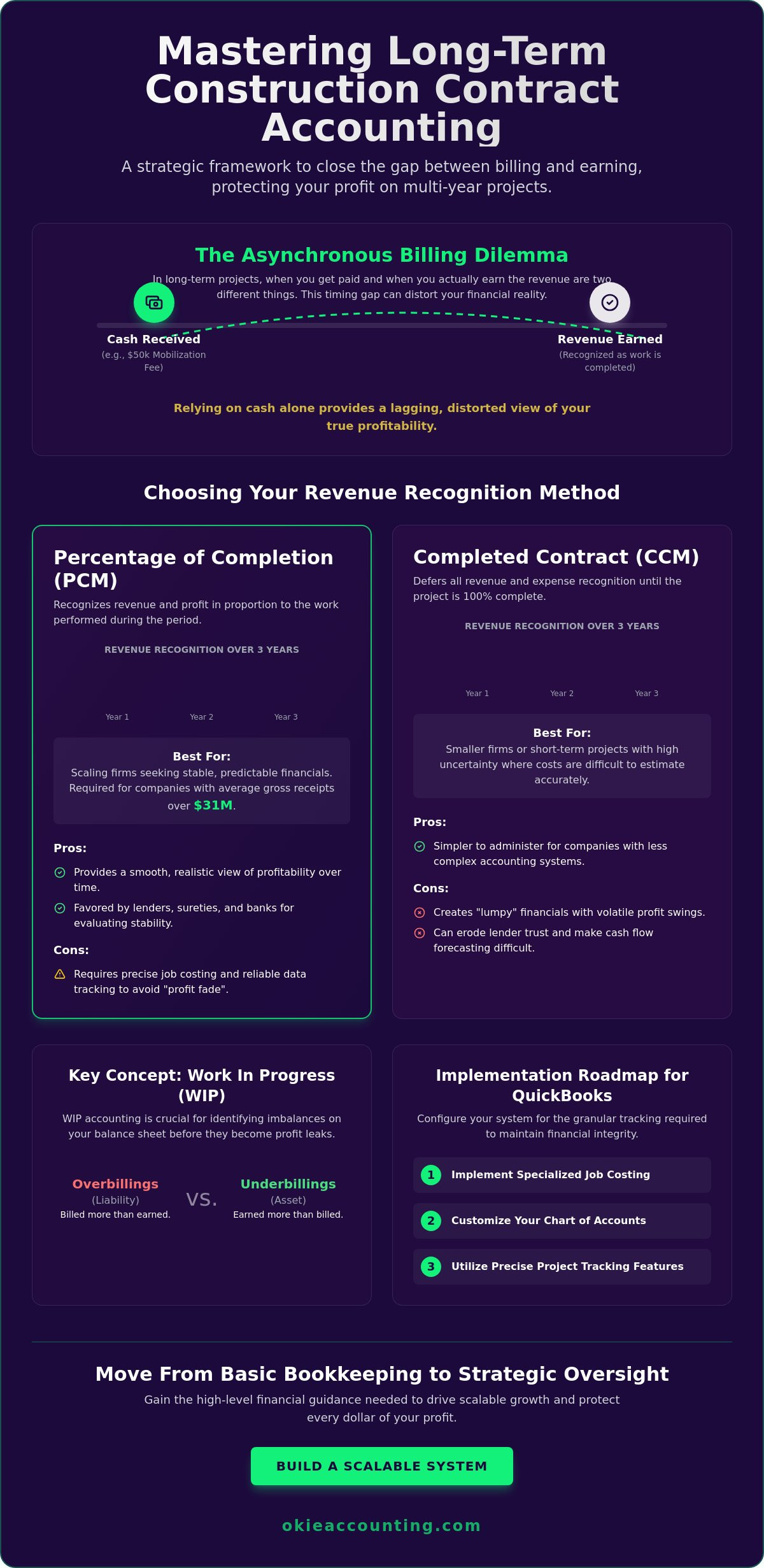
Imagine billing a client $50,000 for a mobilization fee. Your bank balance looks healthy, but your profit and loss statement might be lying to you. That $50,000 isn't earned revenue yet; it's a liability until the work is actually performed. Distorting your P&L through front-loading or back-loading contracts creates a false sense of security or an unnecessary panic. There is a profound psychological benefit to having financial data that matches the daily reality on the job site. When your books reflect actual progress, you can lead your team with quiet confidence instead of reacting to perceived cash shortages.
Project-Based vs. Product-Based Accounting
Contractors must treat every individual project as its own distinct profit center. Unlike product-based businesses that sell identical units, every construction project has a unique risk profile and cost structure. You must distinguish between administrative overhead and direct project costs like labor, materials, and equipment. This is where specialized construction bookkeeping services become essential. They provide the granular tracking needed to ensure that one underperforming job doesn't quietly cannibalize the profits of your entire company. Effective accounting for long term construction contracts requires this level of precision to maintain long-term stability and growth.
PCM vs. CCM: Choosing the Right Revenue Recognition Method
Selecting the right revenue recognition method is a pivotal decision that impacts your tax strategy, cash flow, and ability to secure bonding. Choosing the right method is the cornerstone of robust accounting for long term construction contracts. While smaller firms might lean toward simplicity, larger enterprises must adhere to specific IRS regulations on long-term contracts. For 2026, the gross receipts threshold for the small contractor exception is approximately $31 million. If your average annual revenue exceeds this over the prior three years, you're generally required to use the Percentage of Completion Method (PCM). Aligning your accounting method with your growth stage is essential for maintaining transparent relationships with your lenders and sureties.
Percentage of Completion Method (PCM)
PCM recognizes revenue and gross profit in proportion to the work performed. The most common approach is the "cost-to-cost" method. You calculate the percentage of completion by dividing the total costs incurred to date by the total estimated project costs. This method is the gold standard for firms looking to scale. It provides a smooth, realistic view of profitability over time, which is exactly what sureties and banks look for when evaluating your stability. Reliable financial reporting is the engine that drives PCM accuracy. Without precise data tracking, you risk "profit fade" where estimated costs are lower than actuals, leading to a nasty surprise at the end of a multi-year project.
Completed Contract Method (CCM)
CCM allows you to defer all revenue and expense recognition until the job is 100% finished. This can be advantageous for short-term projects or environments with high uncertainty where costs are difficult to estimate precisely. However, CCM often leads to "lumpy" financials. One month shows zero profit, and the next shows a massive spike. This volatility can erode lender trust and make it difficult to forecast cash flow accurately. Proper accounting for long term construction contracts requires a strategic choice between these two paths based on your current size and future trajectory. If you're planning to transition from CCM to PCM, it's wise to schedule a discovery call to ensure your systems are prepared for the increased reporting requirements.
The Structural Importance of WIP (Work in Progress) Accounting
Work in Progress (WIP) accounting isn't merely a supplementary report; it's the essential bridge between your project management in the field and your financial statements in the office. While your project managers focus on milestones and materials, your accounting team must translate that activity into earned revenue. In the complex landscape of accounting for long term construction contracts, the WIP schedule acts as a translator that aligns your billings with the actual costs incurred. Without this structural framework, your balance sheet remains a series of guesses rather than a reflection of reality.
The WIP report serves as the ultimate truth for a contractor’s financial health, revealing the exact delta between project costs and recognized revenue. This report identifies two critical figures: Overbillings and Underbillings. Overbillings occur when you've billed the client more than the value of the work performed. While this feels like a cash surplus, it's actually a liability on your balance sheet, representing work you still owe. Conversely, Underbillings are assets; they represent work you've completed but haven't yet invoiced. Balancing these figures ensures you don't spend "profit" that hasn't actually been earned yet.
Detecting Profit Fade Before It Happens
Profit fade is the silent killer of construction margins. It happens when estimated costs slowly climb while revenue remains fixed. By using WIP data to compare estimated costs against actual costs in real-time, you can spot these trends while there's still time to course-correct. A fractional controller provides the high-level oversight needed to review these reports and protect your margins. Implementing WIP Accounting: Tracking Work in Progress for Profit ensures that your team isn't just recording history, but actively managing your future profitability.
Lender-Ready Financials and the WIP Report
Banks and bonding companies look at your WIP schedule before they look at anything else. They need to see that you understand your own costs and that your revenue recognition is disciplined. A clean WIP schedule, built on recognized GASB standards for construction contracts, drastically improves your borrowing capacity for larger projects. It proves to external stakeholders that your business is managed with professional rigor. Accurate reporting also directly impacts your construction cash flow management, giving you the data-driven confidence to take on more ambitious contracts without risking your company's stability. When you master accounting for long term construction contracts, you aren't just filing reports; you're building a foundation for scalable growth.
Implementing Construction Accounting in QuickBooks Online
Successfully implementing accounting for long term construction contracts in QuickBooks Online requires moving beyond the software's default configurations. Many contractors struggle because they treat their accounting software as a simple digital checkbook rather than a specialized job-costing engine. For 2026, Intuit has expanded its capabilities with the "Construction Edition" for its Enterprise Suite, which includes cost groups and AIA-style invoicing. However, for most mid-sized firms, QuickBooks Online Plus remains the minimum viable plan for tracking project profitability and class-based reporting. The transition from a generalist setup to a construction-specific framework involves four critical steps.
Step 1: Specialized Chart of Accounts. Your COA must include specific accounts for Work in Progress (WIP), including Underbillings as an asset and Overbillings as a liability.
Step 2: Project Configuration. Utilize the "Projects" center to track direct labor and materials at the job level. This allows for real-time visibility into whether a project is staying within its estimated budget.
Step 3: Classes and Tags. Use Classes to separate different revenue streams or divisions and Tags to track granular details without cluttering your COA.
Step 4: Payroll Integration. Automate the allocation of labor costs to specific jobs. This ensures your labor burden is accurately reflected in your project margins.
Customized QuickBooks Setup for Contractors
"Out of the box" settings are designed for retail or service businesses; they aren't built for the complexities of multi-period projects. Professional QuickBooks training for contractors is vital to ensure your items are mapped correctly to your COA. When your mapping is precise, PCM reports can be automated, saving hours of manual data entry. In 2026, managing cash flow is further streamlined by using QuickBooks Payments, where ACH bank transfers carry a 1% transaction fee. By leveraging AI-powered features like Intuit Assist, you can even automate invoice drafting and expense categorization, allowing you to focus on high-level strategy instead of administrative tasks.
Software Training for Financial Readiness
Financial integrity starts in the field. If your team doesn't know how to code expenses or track time to specific projects, your boardroom data will always be flawed. Clean data at the ground level is the only way to achieve the strategic insights needed for long-term health. We offer specialized software training to help your staff master these workflows. To build a system that supports your growth, book a discovery call today to discuss a customized setup for your firm.
The Strategic Advantage of Fractional Controller Services
Moving beyond basic administrative tasks is the defining step for a construction firm ready to scale. While monthly bookkeeping keeps your records current, it doesn't provide the forward-looking oversight necessary to navigate the 2026 market. High-level financial leadership transforms your data from a historical record into a predictive tool. By integrating a strategic partner into your operations, you shift from reactive accounting to proactive profit protection. This transition ensures that every decision, from bidding on a new multi-year project to investing in heavy equipment, is backed by rigorous financial analysis.
A disciplined approach to accounting for long term construction contracts requires more than just software; it requires an expert who can interpret the "story" behind the numbers. In decentralized projects where field costs can fluctuate daily, establishing internal controls is vital to prevent financial leakage and fraud. A dedicated controller builds the structural framework that ensures your decentralized teams are following standardized coding and reporting protocols. This level of oversight protects your margins and provides the structural integrity your business needs to survive and thrive during economic shifts.
High-Level Financial Oversight
Our fractional controller services provide your firm with CFO-level insights without the burden of an executive-level salary. This model is becoming increasingly popular for mid-sized construction companies in the $10 million to $75 million revenue range. We focus on budgeting and forecasting based on your actual project performance data, not just general industry trends. This allows for strategic advisory regarding tax planning and growth initiatives that are specific to your unique market position. When you have an expert reviewing your WIP and PCM data monthly, you can manage your firm with a sense of quiet confidence.
Building a Structural Framework for Growth
In the 2026 construction landscape, disciplined accounting is no longer a back-office function; it's your ultimate competitive advantage. Organized, methodical financial systems provide the peace of mind you need to focus on project execution and client relationships. When your financial statements are lender-ready and your cash flow forecasts are accurate, you're positioned to win larger, more profitable contracts. Don't let billing confusion or profit fade stall your momentum. It's time to move toward a more sophisticated model of oversight. Schedule a consultation with Okie Accounting Group today to gain total control over your project financials and build a foundation for long-term health.
Building a Resilient Financial Foundation for 2026
Success in the construction industry requires more than technical skill on the job site; it demands a rigorous, methodical approach to your financial data. By mastering the nuances of accounting for long term construction contracts, you move beyond the uncertainty of profit fade and "lumpy" cash flow. Whether you're implementing a specialized WIP schedule or transitioning to the Percentage of Completion Method, these structural frameworks provide the stability needed to scale your operations with confidence. You don't have to navigate these complex regulatory and software requirements alone.
Okie Accounting Group, led by construction accounting expert Sarah O’Quinn, provides the specialized QuickBooks for Contractors knowledge and nationwide fractional controller support your firm deserves. We're invested in your long-term health, helping you transform financial reporting into a strategic advantage. It's time to stop reacting to your bank balance and start leading with data-driven clarity. Gain Financial Clarity with Specialized Construction Bookkeeping and secure your profit margins for the years ahead. Your business has the potential for incredible growth, and we're here to help you build the systems that make it possible.
Frequently Asked Questions
What is the main difference between construction accounting and regular accounting?
The primary distinction lies in the focus on project lifecycles rather than simple time periods. Regular accounting tracks revenue and expenses within a month or year, but construction accounting must track these metrics across the entire duration of a project. This requires specialized methods to match income with the actual physical progress made on a job site, regardless of when the client is invoiced or when the cash hits the bank.
When should I use the Percentage of Completion Method (PCM)?
You should utilize PCM when you need to provide a realistic, real-time view of your company's financial health to external stakeholders. It's the industry standard for firms looking to secure bonding or larger credit lines because it smoothes out the "lumpy" income associated with long-term projects. By recognizing revenue as work is performed, you demonstrate a consistent level of profitability that reflects your true operational capacity.
Is the Completed Contract Method (CCM) allowed for tax purposes in 2026?
Yes, the Completed Contract Method remains an option for qualifying small contractors in 2026. For this tax year, the inflation-adjusted average annual gross receipts threshold is approximately $31 million for the three prior tax years. If your business falls below this limit, you may be exempt from the requirement to use PCM, allowing you to defer tax liabilities until a project is fully finished.
How does ASC 606 affect revenue recognition for small construction firms?
ASC 606 requires firms to recognize revenue based on the transfer of control rather than just the passage of time. For small contractors, this means identifying specific performance obligations within a contract and recording revenue as those obligations are satisfied. It brings a higher level of standardization to accounting for long term construction contracts, ensuring that your financial statements are comparable to other firms in the market.
Can QuickBooks Online handle long-term construction contract accounting?
QuickBooks Online Plus and Advanced are fully capable of managing these complexities when configured correctly. These plans include essential features like project profitability tracking, class tracking, and specialized job costing. By setting up a custom Chart of Accounts that includes WIP assets and liabilities, you can automate many of the reporting requirements needed for multi-period projects.
What is a WIP report, and why does my bank keep asking for it?
A Work in Progress (WIP) report is a schedule that shows the financial status of every active project. Your bank requires this because it reveals your "overbillings" and "underbillings," which are the true indicators of your liquidity and project management efficiency. It proves that you aren't just surviving on cash flow from new deposits but are actually earning the profit shown on your P&L statement.
How often should I review my construction project financials?
You should conduct a formal review of your project financials at least once a month. For firms with high project volume or tight margins, a bi-weekly review of the WIP schedule is often necessary to catch "profit fade" early. Regular reviews allow you to adjust your "estimated costs to complete" before a project's expenses exceed its remaining budget.
What are the most common mistakes in long-term contract accounting?
The most frequent errors include failing to account for the full labor burden and treating overbillings as earned profit. Many contractors also neglect to update their project estimates regularly, leading to inaccurate financial statements that don't reflect current material price increases. Avoiding these mistakes requires a disciplined system of oversight and a clear understanding of how project data flows into your general ledger.


Comments