Mastering Construction WIP Reports for Profit Protection

Updated: 6 days ago
Why does your bank balance feel so tight when your Profit and Loss statement says you're making money? This discrepancy is a primary source of stress for firms managing long-term projects, especially as construction loan rates for bank financing range from 6.5% to 9.5% in early 2026. Most owners view the WIP report for construction as a tedious administrative hurdle required by bonding agents or banks. You likely feel that it's just another layer of complexity in an industry already squeezed by a 500,000-worker labor shortage.
We understand that you need more than just basic bookkeeping; you need a structural framework for your financial health. This article will show you how to transform the Work-in-Progress report from a compliance chore into your most reliable tool for profit protection and operational scaling. We'll examine the mechanics of over and under billings, explain how to stabilize your cash flow, and provide a roadmap for predictable growth through disciplined financial oversight. By moving beyond simple data entry, you can gain the real-time visibility necessary to protect your margins and increase your bonding capacity.
Why Your P&L Lies to You: The Critical Role of WIP Accounting
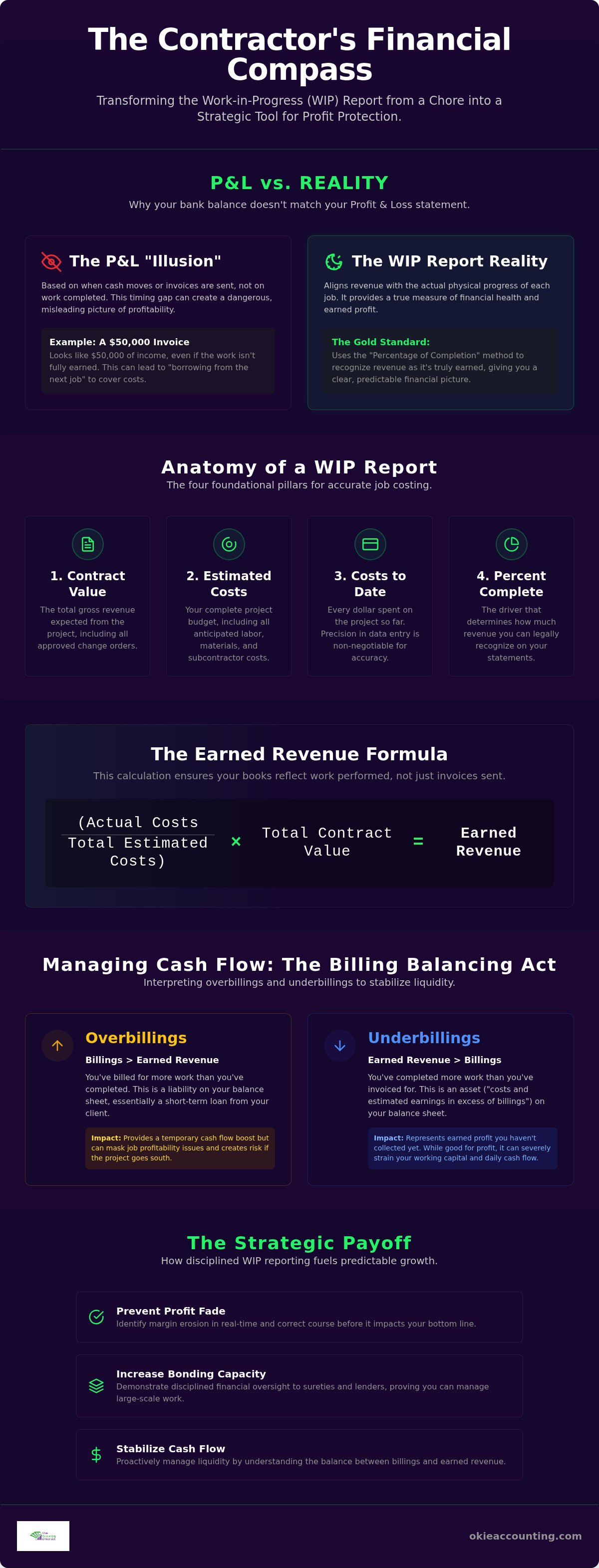
Standard financial statements often paint a misleading picture of a construction firm's health. If you rely solely on cash-basis or accrual accounting, your Profit and Loss (P&L) statement reflects when money moves or when invoices are sent, not when value is created. In a project-based environment, this timing gap creates a dangerous illusion of profitability. A WIP report for construction corrects this by aligning your revenue with the actual physical progress of each job. It relies on the concept of Work in process, ensuring that your financial data reflects the structural reality of your projects rather than just your bank balance.
The "Percentage of Completion" method serves as the gold standard for construction revenue recognition. It recognizes revenue based on the portion of the total estimated costs incurred to date. This approach provides a disciplined structural framework for your books. Without this methodology, your financial reports remain disconnected from the field. This makes it nearly impossible to predict year-end tax liabilities or future cash needs with any degree of accuracy.
The Gap Between Billing and Reality
Imagine you bill a client $50,000 for a milestone. On a standard P&L, that looks like $50,000 in income. However, if you've only completed 20% of the work but billed 40% of the contract, you haven't "earned" that full amount yet. You're effectively holding onto the client's money for work you still owe them. This creates a liability that standard accounting often misses.
Contractors often fall into the trap of "borrowing from the next job." They use the cash from a new project's deposit to pay off the tail-end expenses of a finishing project. This cycle masks underlying job costing inaccuracies until the cash eventually runs out. A properly managed WIP report aligns your income statement with actual project milestones, preventing these "profit surprises" at the end of the year.
Why Bonding Companies Demand a WIP Schedule
Lenders and sureties don't just look at your current assets; they look at your ability to manage complex, long-term commitments. Your bonding capacity is directly tied to the transparency of your financial data. If a surety can't see how much profit is left in your current backlog, they won't risk extending more credit. Transparent reporting reduces their risk. It shows you're in control of your margins.
High-level fractional controller services help firms build these lender-ready frameworks by interpreting complex data into actionable strategy. By providing a clear view of overbillings and underbillings, you demonstrate that your firm has the disciplined oversight required for large-scale commercial work. The WIP report for construction serves as the single source of truth for every stakeholder invested in your firm's success.
Anatomy of a Construction WIP Report: Key Components & Calculations
A WIP report for construction isn't just a list of numbers; it's a structural framework for your projects. To build it correctly, you need four foundational pillars that reflect the reality of your job site. Without these components, your financial data remains a collection of disconnected facts rather than a strategic tool for growth.
Contract Value: This is the total gross revenue you expect from the project. It must include all approved change orders. If you fail to capture these additions, your revenue recognition will be perpetually understated.
Estimated Costs: Your baseline budget for the entire project. This includes every anticipated dollar for labor, materials, and subcontractors.
Actual Costs to Date: This reflects every dollar spent so far. Precision here is vital. It's why QuickBooks training for accurate data entry is a non-negotiable requirement for scaling firms.
Percent Complete: The mathematical driver that dictates how much revenue you can legally claim on your financial statements.
Calculating Earned Revenue
The formula for earned revenue is straightforward: (Actual Costs / Total Estimated Costs) x Total Contract Value. This calculation prevents "front-loading" from distorting your monthly profit. Many contractors bill heavily at the start to secure cash, but that doesn't mean they've earned that profit. By using this formula, you ensure your books reflect work actually performed rather than just invoices sent.
Keeping the "Estimated Costs" figure accurate is the most challenging part of this process. If your budget is stale, your percent complete calculation will be wrong. You've got to update these estimates regularly to account for price fluctuations or field delays. This disciplined approach ensures that your profit margins don't evaporate as the project progresses.
The Role of Backlog and Remaining Costs
Your "Backlog" is simply the remaining contract value you haven't earned yet. While many owners focus on what they've already spent, strategic leaders focus on the "Cost to Complete." This forward-looking metric tells you if you have enough fuel in the tank to finish the job without eroding your margin. It's the difference between reactive bookkeeping and proactive financial leadership.
Integrating this data into your cash flow forecasting for construction allows you to see potential shortfalls months before they happen. This visibility is essential for maintaining your firm's long-term health. If you're struggling to keep these calculations current, you can schedule a discovery call to discuss how fractional oversight can streamline your reporting systems.
Decoding Overbillings and Underbillings: Managing Your Cash Flow
Understanding the two primary adjustments on a WIP report for construction is essential for maintaining liquidity. These figures represent the difference between what you've billed and what you've actually earned based on project progress. When these values are calculated accurately, they move from your project schedule to your Balance Sheet, providing a true reflection of your firm's financial position rather than just a snapshot of your current bank balance.
Underbillings (Costs in Excess of Billings) are recorded as a current asset, representing revenue you've earned but haven't yet invoiced. Conversely, Overbillings (Billings in Excess of Costs) appear as a current liability, signifying cash you've received for work not yet performed. This distinction is vital for accurate reporting. If your reports don't account for these adjustments, your firm's net worth is essentially a guess. Strategic oversight helps you identify "Job Borrowing" before it leads to a catastrophic cash crunch. This occurs when you use the cash from overbilled projects to fund the expenses of underbilled ones, a cycle that masks systemic failures.
Underbillings: The Silent Profit Killer
Chronic underbilling is often a symptom of deeper operational issues within a firm. It frequently signals unapproved change orders or inefficient billing cycles where the field team hasn't communicated project milestones to the office. When you are underbilled, you are effectively acting as an interest-free lender for your client. You've already paid for the labor and materials, but you haven't yet secured the right to bill for that value. This strain on your current ratio can make it difficult to secure bonding or bank loans when you need them most.
For specialty contractors, reducing underbilled amounts requires tightening the communication loop between project managers and accounting. If your underbillings remain high, you are significantly increasing your risk of profit fade. You must ensure that every dollar spent in the field is accounted for and billed according to the contract's terms to maintain a healthy, stabilized cash position. This discipline ensures that your liquidity isn't tied up in unbilled work.
Overbillings: Managing Your Liability
Overbilling is often viewed as a positive because it puts cash in your pocket early. In reality, this cash is an interest-free loan from your customer. While it provides a temporary boost to your bank balance, it also represents work you are obligated to perform in the future. The risk lies in spending this "overbilled" cash on overhead or other projects before the associated costs are incurred on the specific job that generated the cash.
A fractional controller helps you manage these temporary cash reserves by creating a structural framework for your capital. They ensure that your overbillings are tracked as liabilities so you don't mistake temporary cash flow for permanent profit. This disciplined approach protects your margins and ensures you have the necessary funds to complete your backlog without relying on the next project's deposit to stay afloat.
Avoiding Profit Fade: Common WIP Pitfalls and How to Fix Them
Profit fade is the silent erosion of your firm's bottom line. It occurs when a projected 15% margin at the project's inception slowly dwindles to 8% by the time the punch list is complete. This usually happens because the WIP report for construction is treated as a static document rather than a dynamic tool. If your estimates are "set and forgotten," you won't see the impact of rising material costs or labor inefficiencies until it's too late to adjust your strategy. You need a system that highlights these variances in real time.
Stale data is another significant risk. Running reports based on last month’s or last quarter’s numbers is like driving a truck by looking in the rearview mirror. By the time you see a problem, you've already passed the point where you could have fixed it. Additionally, failing to account for committed costs, such as future subcontractor payments and open purchase orders, creates a false sense of security. Your WIP must reflect what you are obligated to pay, not just what has already hit your bank account.
Garbage In, Garbage Out: The Data Entry Hurdle
Poor job costing in QuickBooks leads to useless reporting. If your labor hours aren't coded to the correct job or if material expenses are lumped into general categories, your financial data loses its structural integrity. Precision is the only way to ensure your reports reflect reality. This is why QuickBooks training for contractors is essential for firms that want to scale. It moves your team away from "doing the books" and toward maintaining a rigorous data framework.
Standardizing your Chart of Accounts is equally vital. When your coding is consistent, you can compare performance across different projects and identify which types of work are truly profitable. This disciplined approach eliminates the guesswork that often plagues construction accounting. It ensures that every entry supports the long-term health of the business.
The Monthly WIP Review Cycle
Establishing a monthly review cycle is a non-negotiable practice for strategic growth. This routine requires project managers and accounting teams to reconcile physical project progress with the financial data on the WIP report for construction. During these sessions, you can spot red flags in project margins before they become permanent losses. A disciplined monthly review protects your construction bookkeeping services foundation by ensuring your financial readiness for bonding and bank audits.
You don't have to manage these financial complexities in a vacuum. If you're ready to transition from basic administrative tasks to a comprehensive structural framework, schedule a discovery call to learn how our fractional leadership can protect your profit margins.
Strategic Financial Oversight: Scaling with a Fractional Controller
Many contractors view financial management as a series of administrative tasks to be completed for the bank or the tax man. Strategic leaders, however, understand that financial data is the primary engine for driving the business forward. Moving from "doing the books" to "driving the business" requires a transition from reactive record-keeping to proactive oversight. A WIP report for construction provides the data, but a fractional controller provides the interpretation needed to make high-level choices about your firm's trajectory.
Professional fractional controller services offer the specialized expertise of a full-time executive without the associated overhead. This partnership allows you to build a structural framework for long-term health and profit protection. By interpreting trends within your WIP, a controller helps you decide when it's safe to hire more crew, when you should bid more aggressively, and when you need to pull back to preserve cash flow. This disciplined approach ensures that your growth is both predictable and sustainable.
WIP as a Tool for Growth
Your historical WIP data is a goldmine for refining your future performance. By analyzing past projects, you can identify which types of jobs yield the highest actual margins and which ones consistently suffer from profit fade. This insight allows you to refine your estimating process, ensuring that your future bids are based on field reality rather than optimistic projections. When you understand your true capacity and cost structure, you can stop chasing every project and start focusing on the ones that build real wealth.
Clean, accurate financials also significantly increase your firm's market value. Whether you are looking to secure a larger line of credit, attract private investors, or eventually sell your business, a history of disciplined reporting is your greatest asset. It demonstrates to external stakeholders that your firm is managed with professional rigor and that your reported profits are backed by a verifiable WIP report for construction. This level of transparency builds the trust necessary for large-scale capital moves.
The Okie Accounting Advantage
At Okie Accounting Group LLC, we move beyond basic bookkeeping to become your strategic partner in growth. We help contractors implement cloud-based management accounting systems that provide real-time visibility into project health. Our proactive approach focuses on monitoring overbillings and underbillings to protect your liquidity and ensure your cash flow remains stabilized. We don't just hand you a report; we help you understand the story it tells about your business.
Partnering with a strategic mentor allows you to navigate niche-specific complexities with quiet confidence. We focus on building the foundational systems that allow you to scale without losing control of your margins. By providing remote financial leadership, we ensure your firm remains lender-ready and operationally sound at every stage of your growth journey.
Building a Foundation for Scalable Profit
Mastering the WIP report for construction is the definitive step toward moving your firm from operational complexity to financial clarity. By aligning your revenue recognition with actual project progress, you eliminate the dangerous illusions created by standard P&L statements. You've learned that identifying underbillings early prevents liquidity drains, while disciplined overbilling management ensures you aren't spending cash you haven't yet earned. These foundational systems don't just protect your current margins; they build the structural integrity required to scale your operations with confidence.
Okie Accounting Group provides the specialized construction sector expertise needed to transform these reports into strategic assets. Our cloud-based strategic financial oversight focuses on profit protection and scalability, helping you navigate the unique mechanics of your market. You don't have to manage these high-level requirements alone. Gain financial clarity with specialized fractional controller services for contractors.
Your firm’s long-term health depends on the systems you build today. We're ready to help you build a more predictable and profitable future for your business.
Frequently Asked Questions
What is the difference between a WIP report and a Job Cost report?
Job cost reports track actual expenses against a budget. A WIP report for construction goes further by adjusting those costs to recognize earned revenue based on the percentage of completion. While job costing tells you what you've spent, the WIP tells you if you've actually made money on that spending. It bridges the gap between field operations and your financial statements. This disciplined approach ensures your books reflect project reality rather than just bank balances.
How often should a construction company update its WIP report?
You should update your report at least once a month during the close process. High-volume firms or those managing high-risk projects often benefit from bi-weekly reviews. Regular updates ensure that your Cost to Complete estimates remain accurate. Waiting until the end of a quarter to run these numbers allows profit fade to set in before you have a chance to intervene. Frequent reviews help you maintain tight control over your margins and project health.
Can I generate a WIP report in QuickBooks Online?
QuickBooks Online doesn't have a native WIP button, so you must build a custom schedule using data exported from your job costing reports. You'll need to maintain a separate spreadsheet or use an integrated tool to calculate the percentage of completion and overbillings. Specialized training helps your team set up the correct Chart of Accounts to make this data export seamless. This ensures your financial reporting remains consistent and accurate as your firm grows.
Why do sureties and bonding companies care about my WIP schedule?
Sureties use this document to evaluate your firm's internal controls and the reliability of your profit projections. They look for consistency between your estimated margins and your actual results. If your schedule shows chronic underbilling or frequent profit fade, it signals a lack of disciplined oversight. Transparent reporting reduces their perceived risk. This directly impacts your ability to secure larger bonds and higher-value contracts for your business by proving your financial readiness and stability.
What does it mean if my WIP shows I am significantly underbilled?
Significant underbilling means you've incurred costs and earned revenue that you haven't yet invoiced to the client. This often happens because of unapproved change orders, lagging field reports, or inefficient billing cycles. It's essentially an interest-free loan you're providing to your customer. High underbillings drain your cash flow and can negatively impact your current ratio. This makes your firm appear less liquid to lenders and bonding agents during their financial reviews. You must tighten these billing cycles.
How do I calculate the percentage of completion for a WIP report?
You calculate it by dividing your actual costs to date by your total estimated costs for the project. For example, if you've spent $200,000 on a job estimated to cost $800,000, your project is 25% complete. You then multiply this percentage by the total contract value to determine your earned revenue. Accuracy depends entirely on having a realistic, up-to-date estimate. If you don't update these figures, your percent complete calculation will be consistently wrong.
What is profit fade, and how does the WIP report help prevent it?
Profit fade is the gradual decrease in a project's gross margin as it moves toward completion. It usually stems from underestimated costs or unexpected field delays that weren't captured in the initial budget. A WIP report for construction prevents this by highlighting variances between estimated and actual costs every month. This visibility allows you to address inefficiencies or negotiate change orders before the project's profitability is permanently compromised. It's your financial early warning system.
Do small specialty contractors really need a WIP report?
Yes, any contractor managing projects that span multiple months needs this level of oversight. Even for smaller firms, the timing difference between billing and earning revenue can mask serious cash flow problems. Implementing a WIP schedule early builds the structural framework necessary for scaling. It ensures you have a clear understanding of your true profitability. This clarity is essential for making informed decisions about hiring, equipment purchases, and future bidding strategies. It's a vital tool for growth.


Comments