Mastering the Chart of Accounts for Property Management in 2026

Updated: 6 days ago
What if your current financial setup is actually the biggest barrier to your next acquisition? If your records feel like a tangled web of miscellaneous expenses and property-wide guessing games, you aren't just losing time; you're likely losing your competitive edge. Most property managers struggle with inconsistent reporting and a messy chart of accounts for property management across their portfolios. It's frustrating when you can't easily distinguish between a routine repair and a major capital improvement, leading to a sense of dread as tax season or a lender audit approaches. You deserve a system that offers control rather than confusion.
This guide will show you how to transform your bookkeeping into a high-level strategic asset for the 2026 market. By establishing a disciplined structural framework, you'll gain the clarity needed to see the exact profit and loss for every door you manage. We'll explore how to standardize your accounts, prepare your books for rigorous lender scrutiny, and build the financial readiness required for your next acquisition. It's time to move beyond basic administrative tracking and start building for long-term stability and rigorous management.
The Foundation of Property Management Accounting: Why Your COA Matters
A chart of accounts for property management is the structural map of your entire financial universe. It determines how every dollar is categorized, tracked, and reported. Many investors begin their journey using generic accounting templates, but these often lead to financial fog. This fog settles in when your reports lack the specific nuance required for real estate, making it impossible to see where your cash is actually going. To maintain long-term portfolio health, you must implement property-level tracking that offers immediate clarity. The ultimate goal is to produce lender-ready financials. Banks and investors demand a rigorous, organized system that proves your business's stability. When your books are lender-ready, you move from a position of hoping for approval to one of quiet confidence during the underwriting process. Precision leads to profit.
The Difference Between Bookkeeping and Financial Infrastructure
Basic bookkeeping records history, but financial infrastructure prepares your business for the future. There's a distinct line where simple record-keeping fails. For most, this happens when scaling beyond five units. At this stage, the complexity of multiple mortgages, escrow accounts, and tenant deposits requires a professional-grade system. Without this structural integrity, tax season becomes a period of high-stress chaos. Investing in specialized QuickBooks Setup & Training helps build this foundation early. It ensures that your data entry isn't just a chore, but a method for protecting your profit. This proactive stance prevents the common pitfalls of DIY accounting, such as misclassifying security deposits as income. Banks want data. They want clarity.
Standardizing Data Across Your Entire Portfolio
Uniformity is the key to strategic analysis. If your properties use different account names for the same expenses, you lose the ability to compare performance across your portfolio. You need uniform account names to achieve true portfolio-wide visibility. This standardization allows you to spot trends, identify underperforming assets, and optimize your cash flow. Moving from property-by-property tracking to a holistic view requires a disciplined approach to your management accounting systems. It's about creating an atmosphere of trust where your data is reliable and actionable. A professional COA serves as the essential backbone of real estate scalability, providing the structural integrity required to support long-term growth.
Structuring the Five Pillars of a Real Estate Chart of Accounts
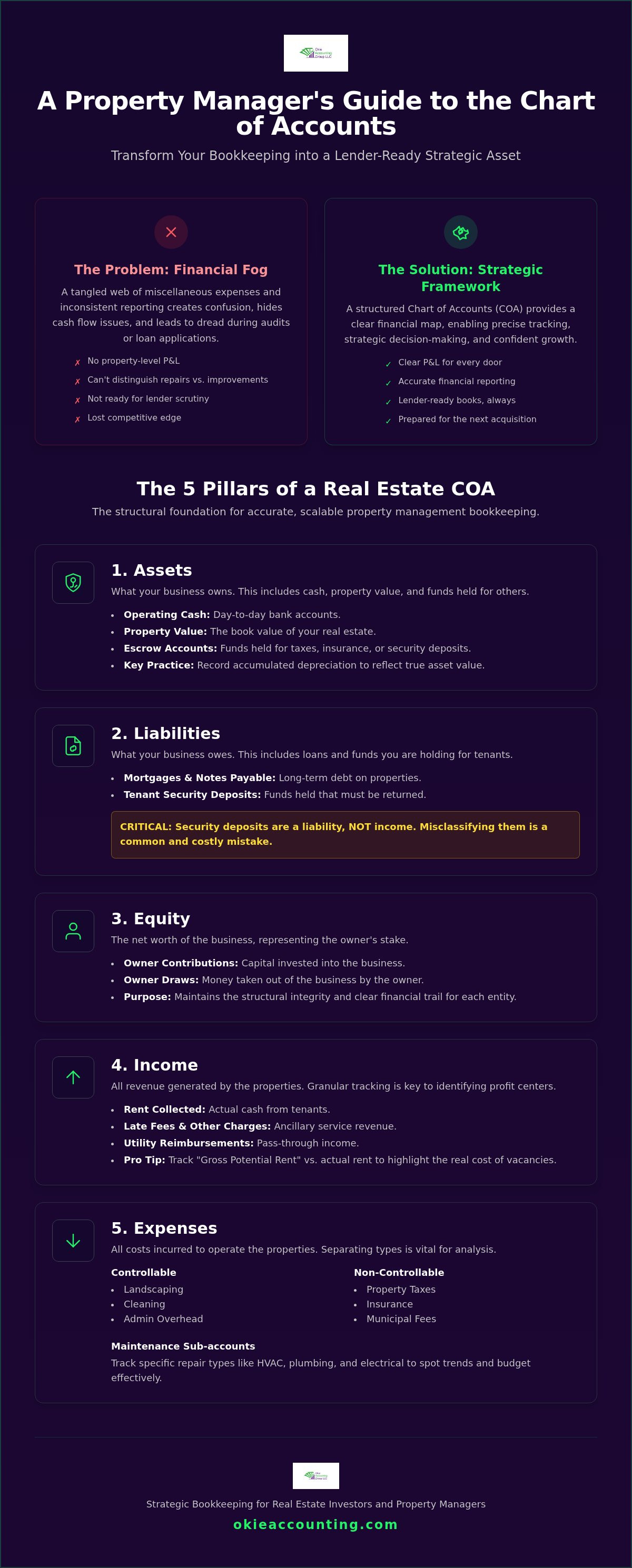
Building a robust chart of accounts for property management requires a clear understanding of the five financial pillars: Assets, Liabilities, Equity, Income, and Expenses. These categories form the structural foundation of your reporting. Without this organization, your financial data remains a chaotic list of transactions rather than a strategic asset. Each pillar serves a specific purpose in reflecting the health of your portfolio, from the cash on hand to the long-term debt obligations that fuel your growth.
Assets and Liabilities: Protecting the Balance Sheet
Assets go beyond just the cash in your bank. They include the book value of the property and specialized accounts like escrowed security deposits. On the flip side, liabilities track your mortgages and notes payable. A critical error many DIY bookkeepers make is recording security deposits as income. These funds aren't yours; they are a liability that must be returned or applied to damages. Properly Accounting for Real Estate Investors involves recording accumulated depreciation to reflect the true book value of your assets. This level of detail ensures your balance sheet remains accurate for lenders and partners.
Equity accounts round out the balance sheet by tracking owner contributions and draws. This ensures that the money you put into or take out of the business is clearly documented, maintaining the structural integrity of each entity. When you separate these pillars correctly, you create a transparent trail that lenders value during the underwriting process. It moves you from a state of financial complexity to one of operational clarity.
Income and Expenses: Tracking Operational Efficiency
Your income accounts should capture more than just the monthly rent check. Categorize late fees, laundry income, and utility reimbursements separately to see which ancillary services are actually profitable. To get a true sense of performance, track "Gross Potential Rent" against actual rent collected. This highlight's the cost of vacancy and collection losses, which are often hidden in generic reporting systems. For expenses, the distinction between controllable and non-controllable costs is vital for operational efficiency.
Controllable Expenses: Landscaping, cleaning, and administrative overhead.
Non-Controllable Expenses: Property taxes, insurance, and municipal fees.
Maintenance Sub-accounts: Specific tracking for HVAC, plumbing, and electrical repairs.
Utilizing sub-accounts for specific maintenance categories allows for granular oversight. If you notice HVAC costs spiking across multiple properties, you can investigate a systemic issue rather than guessing at the cause. If you're feeling overwhelmed by the complexity of these categories, you might consider a discovery call to discuss how a professional framework can simplify your portfolio oversight.
Advanced COA Strategies for Renovations and Capital Improvements
Managing a value-add renovation requires a level of accounting precision that basic property management systems often lack. When you undertake a major project, your bookkeeping must shift from simple operational tracking to project-based accounting. This means integrating Job Costing logic directly into your financial framework. By doing so, you ensure that every dollar spent on a renovation is properly accounted for, whether it should be expensed immediately or capitalized on the balance sheet. A sophisticated chart of accounts for property management must handle this transition from a stabilized rental to an active construction site with total accuracy.
Tracking Work in Progress (WIP) is essential for renovation projects that span several months. Instead of burying these costs in your profit and loss statement, you should record them as a current asset on the balance sheet until the project is finished. Once the renovation is complete, you move these costs into the property's fixed asset account. This transition from a construction phase to a rental phase keeps your financial reporting clean and provides the structural integrity lenders expect. It creates a narrative of transformation that proves you're managing the asset's long-term health, not just its daily repairs.
Capitalization Rules for Property Managers
IRS guidelines define whether a cost is a repair or a capital improvement based on whether it constitutes a betterment, restoration, or adaptation. A repair maintains the property's current condition; an improvement increases its value or extends its life. You should structure your COA to reflect these categories clearly, simplifying your year-end depreciation calculations.
Misclassifying a $10k roof as an expense is a major audit risk. Accurate classification protects your business from unnecessary scrutiny and ensures your tax filings align with regulatory requirements. It's about building a foundation that survives an audit with quiet confidence.
Tracking Renovation Projects Within QuickBooks
To isolate renovation costs from daily operations, utilize the Classes or Projects features in your accounting software. This allows you to run a profit and loss report for a specific renovation without cluttering your standard property management data. One-time project costs that don't qualify for capitalization can be categorized under Other Income/Expense to keep your core operating income visible. For those managing complex multi-property renovations, our guide on Mastering QuickBooks for Contractors provides deeper insights into project-based financial tracking. This organized approach creates an atmosphere of trust with your investors by proving you have total control over every project dollar.
Standardizing Your Numbering System and Coding Logic
A logical numbering system transforms a simple list into a professional framework. It ensures that your chart of accounts for property management remains scalable as you add properties or complex multi-entity structures. Without a coding standard, you risk duplicate accounts and data entry errors that cloud your financial visibility. Precision in your numbering creates a predictable rhythm that allows you to spot anomalies before they become systemic issues.
Implementing a standardized system involves five disciplined steps:
Step 1: Assign blocks of numbers to the five main pillars. Standardize your 1000s for Assets and 5000s for Expenses to create immediate recognition.
Step 2: Reserve specific ranges within those blocks. For example, use 1000-1499 for current assets like cash and 1500-1999 for fixed assets like property value.
Step 3: Implement a consistent naming convention. Eliminate "Miscellaneous" or "Other" accounts that serve as hiding places for uncategorized data.
Step 4: Align your account numbers with Schedule E categories. This makes tax preparation a seamless, stress-free transition rather than a manual reconciliation project.
Step 5: Document your "Account Manual." This internal guide ensures that your team or virtual assistant applies the same coding logic to every transaction.
The Logic of a 4-Digit or 5-Digit System
Using a 4-digit system like 1000-1999 for Assets is the industry standard for real estate accounting. The "tens" and "hundreds" places allow you to group related sub-accounts logically. For instance, 1100 might be your operating account while 1110 and 1120 represent specific escrow or reserve accounts. This hierarchy speeds up data entry and reduces the cognitive load on your staff. When your numbering follows a clear logic, errors drop and reporting speed increases.
Avoiding the "Over-Detailed" Trap
Many property managers believe more accounts lead to better data, but having 500 accounts is just as dangerous as having ten. This creates a "wall of data" that's impossible to interpret at a glance. You should follow the "Roll-Up" principle, ensuring your COA provides high-level clarity first. If you need to track granular details like specific unit repairs, use "Tags" or "Classes" in QuickBooks rather than creating new accounts. This keeps your financial reporting clean while maintaining the precise oversight required for a growing portfolio.
Establishing this structural foundation is the first step toward moving from basic bookkeeping to strategic asset management. If you are ready to build a scalable financial framework that supports your long-term goals, schedule a discovery call to discuss how we can standardize your systems for growth.
Scaling Your Portfolio with Fractional Controller Oversight
As your portfolio expands, the volume of data can become overwhelming. You must move from simply recording transactions to the critical task of interpreting financial signals. This is where a disciplined chart of accounts for property management becomes a strategic asset rather than a basic list. A Fractional Controller uses this structural framework to perform high-level cash flow forecasting, ensuring you have the capital required for future acquisitions. This transition represents a shift from reactive bookkeeping to proactive financial leadership. It's about having the quiet confidence that your data is accurate and actionable.
Okie Accounting Group LLC positions itself as a strategic partner in this journey. We focus on building the structural integrity your business needs to scale with confidence. By moving beyond administrative tasks, we help you protect your profit margins and maintain a clear vision of your portfolio's long-term health. We don't just provide reports; we provide a methodical approach to financial growth that mirrors the organized systems we build for our clients.
Beyond the Basics: Monthly Financial Reviews
Monthly reviews are the heartbeat of a successful real estate business. Using your standardized COA, a Fractional Controller generates Variance Reports that compare actual performance against your budget. These reports highlight operational inefficiencies before they drain your cash reserves. A monthly review of the Balance Sheet is non-negotiable for serious investors. It ensures that your assets are correctly valued and your liabilities, such as tenant deposits, are fully accounted for. This structured approach makes the information easy to digest while reinforcing your image as an organized and methodical partner. For those ready to implement these high-level systems, our Fractional Controller Services provide the expertise needed to manage these complex layers of data.
Taking the Next Step Toward Financial Clarity
Investing in professional QuickBooks Setup & Training offers a significant return on investment. It empowers your team to maintain the coding logic we've established, preventing the financial fog that plagues many growing firms. This level of organization is exactly what lenders look for during a discovery call. When you present organized, lender-ready books, you signal that you're a disciplined operator capable of handling larger assets. Accuracy isn't just about compliance; it's about building the credibility required for your next big move. You'll find that clear data leads to faster decisions and more successful acquisitions.
Ready to build a scalable framework? Book a Discovery Call with Sarah O’Quinn.
Building Your Financial Foundation for 2026
Mastering your chart of accounts for property management is the first step toward true portfolio oversight. By implementing a standardized numbering system and distinguishing between operational repairs and capital improvements, you create a structural framework that lenders trust. This level of organization eliminates the financial fog that often stalls growth. It moves you from a state of data entry to a position of strategic leadership where every decision is backed by clear, accurate data. Precision in your books today ensures your readiness for the acquisitions of tomorrow.
At Okie Accounting Group LLC, we provide specialized fractional controller services and expert QuickBooks setup and training tailored specifically to the needs of real estate investors. Our cloud-based systems ensure national reach and precision, giving you the clarity needed to scale your portfolio with confidence. You don't have to manage these complexities alone. When you have a dedicated strategic partner, tax season and lender audits become routine milestones rather than sources of anxiety. We are committed to your long-term stability and success.
If you're ready to transition from basic record-keeping to a comprehensive financial strategy, we're here to help. Schedule your Discovery Call to build a scalable financial framework. Your future growth depends on the stability you build today.
Frequently Asked Questions
What are the five main sections of a property management chart of accounts?
The five essential sections are Assets, Liabilities, Equity, Income, and Expenses. These pillars provide the structural foundation for your financial reporting. Assets track property value and cash, while liabilities manage debt and tenant deposits. Equity records owner investment, and the income and expense categories track your daily operational performance across the portfolio.
How do I handle tenant security deposits in my chart of accounts?
Tenant security deposits must be recorded as a liability on your balance sheet, never as income. Because these funds are technically owed back to the tenant, they represent a debt your business carries. You should also hold these funds in a designated escrow bank account to ensure they aren't used for operational costs, which maintains strict financial integrity.
Should I have a separate chart of accounts for each rental property?
No, you should use one standardized chart of accounts for property management across your entire portfolio. To track individual property performance, utilize Classes or Tags within your accounting software. This approach allows you to run property-specific profit and loss statements while maintaining a clean, consolidated view of your entire business health.
What is the difference between a repair and a capital improvement in my COA?
A repair is an immediate expense that maintains the property's current condition, while a capital improvement is an asset that increases value or extends the property's life. Fixing a broken window is a repair. Replacing the entire roof is a capital improvement. Improvements must be capitalized on the balance sheet and depreciated over time rather than expensed at once.
Can I use a standard QuickBooks chart of accounts for property management?
A standard QuickBooks setup is usually insufficient for the unique complexities of real estate. Generic templates lack specialized accounts for escrow, tenant-held deposits, and property-specific debt obligations. You need a customized chart of accounts for property management that includes accounts for accumulated depreciation and gross potential rent to ensure your books remain lender-ready.
How often should I review or update my property management chart of accounts?
You should review your accounts monthly during your financial close and perform a structural update annually. Monthly reviews ensure transactions are coded correctly to the right pillars. An annual refinement allows you to adjust your categories based on portfolio growth or shifts in your investment strategy, ensuring your financial framework remains scalable and organized.
What is the best numbering system for a real estate chart of accounts?
The most effective system uses a logical 4-digit block numbering approach. Assign 1000s to Assets, 2000s to Liabilities, 3000s to Equity, 4000s to Income, and 5000s to Expenses. This structure provides enough space for detailed sub-accounts while keeping your financial data organized and easy for your team or a fractional controller to navigate quickly.
How does a fractional controller help with my property management accounting?
A fractional controller moves you beyond basic data entry to strategic financial oversight. They use your organized accounts to perform cash flow forecasting and variance analysis. This partnership helps you interpret complex data to make informed acquisition choices and ensures your systems support long-term stability rather than just basic administrative compliance.


Comments