Outsourced CFO for Real Estate: Growth Framework 2026

Updated: 6 days ago
In 2026, the success of your portfolio depends less on finding the next deal and more on the structural integrity of your financial data. Most investors find themselves trapped in a reactive cycle, where bookkeeping is a historical chore rather than a proactive strategy. You likely feel the weight of complex lender reporting requirements or the nagging uncertainty of project-level profitability during a renovation. It's a common frustration to realize your current systems aren't built for the scale you envision. Partnering with an outsourced CFO for real estate investors changes this dynamic by shifting the focus from basic administrative tasks to a comprehensive framework for growth.
We understand that you're looking for more than just a service provider; you need a strategic partner invested in your long-term health. This article explains how an outsourced CFO transforms raw data into a strategic roadmap for portfolio scalability and profit protection. We'll preview the 2026 Growth Framework, including how to leverage the permanent 100% bonus depreciation and the increased $40,000 SALT deduction cap. You'll learn how to build a scalable financial infrastructure that provides a clear vision of your cash flow and ensures you're always ready for the next big acquisition.
Beyond Basic Bookkeeping: Why Real Estate Investors Need Strategic CFO Oversight
Many investors mistake a clean set of books for a healthy financial strategy. While accurate data entry is the foundation, it doesn't provide the roadmap required to scale a portfolio in a shifting market. An outsourced CFO for real estate investors functions as a strategic mentor, moving beyond the administrative burden of recording transactions to build a structural framework for growth. This approach utilizes the Fractional Executive Model, providing high-level oversight and executive leadership without the $250,000 to $400,000 annual salary required for a full-time hire.
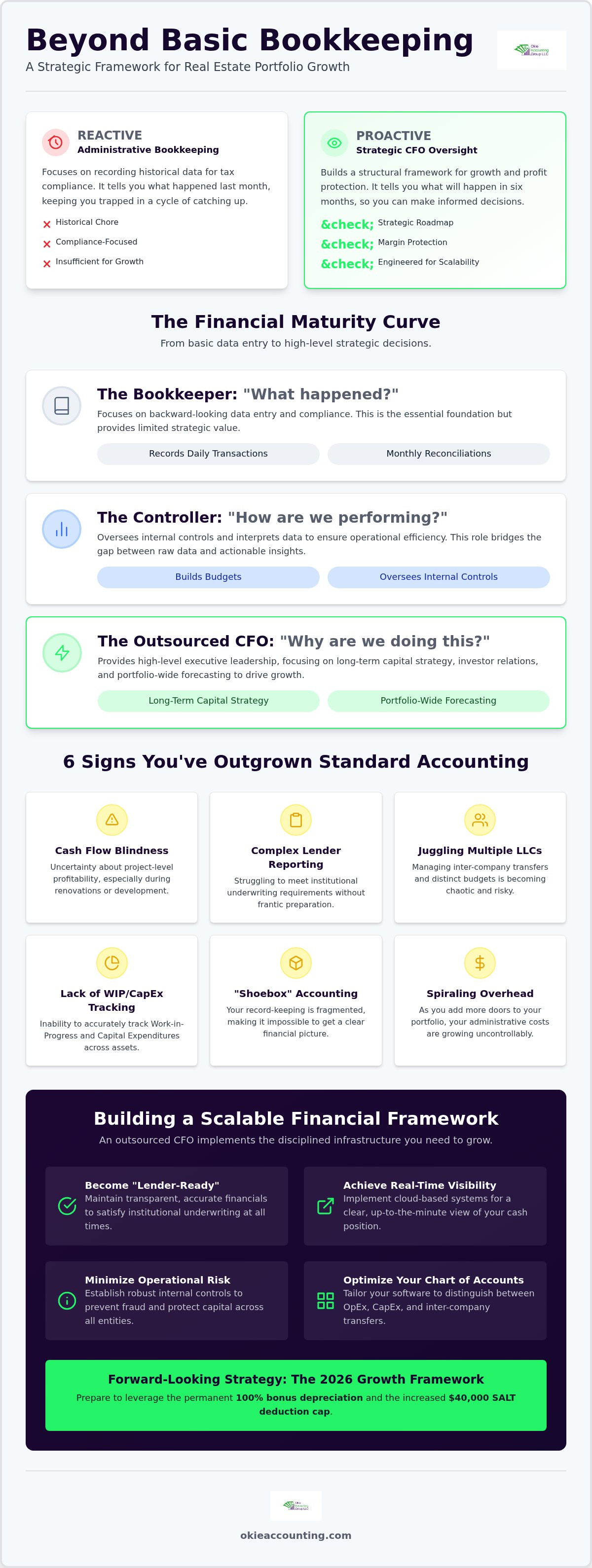
The divide between traditional bookkeeping and strategic oversight is best described as reactive versus proactive management. A bookkeeper tells you what happened last month so you can stay compliant with tax authorities. While this is necessary, it's insufficient for growth. A CFO tells you what will happen in six months so you can protect your margins. This concept of profit protection is vital for investors who need to ensure their capital is deployed efficiently across multiple projects. It involves identifying risks before they manifest as losses, ensuring that every dollar in your portfolio is working toward your long-term objectives.
The Accounting Hierarchy: Bookkeeper vs. Controller vs. CFO
Understanding where your firm sits on the financial maturity curve is the first step toward stability. Standard bookkeeping focuses on the "what": recording daily transactions and performing monthly bank reconciliations. It's essential, but it's a backward-looking function. Moving up the hierarchy, a fractional controller provides the "how": overseeing internal controls, building budgets, and interpreting data to ensure operational efficiency. Finally, an outsourced CFO for real estate investors provides the "why": focusing on long-term capital strategy, managing complex investor relations, and conducting portfolio-wide forecasting to drive high-level decisions. This tiered approach ensures your financial infrastructure grows at the same pace as your acquisitions.
Why Real Estate Complexity Demands Specialized Leadership
Real estate is uniquely difficult because it involves managing a web of entities rather than a single business. You're likely juggling multiple LLCs, inter-company transfers, and distinct project budgets for renovations or new developments. Generalist accounting firms often struggle with the nuances of project-based financial tracking, which can lead to "cash flow blindness." You need specialized systems that can handle work-in-progress (WIP) reporting and capital expenditure (CapEx) planning across various asset classes. Implementing Fractional Controller Services allows you to bridge the gap between basic data and the sophisticated financial infrastructure needed to satisfy lenders and attract sophisticated partners. This disciplined approach ensures your entity structure supports your growth rather than hindering it. By establishing these foundational systems, you create a scalable environment where data drives every choice.
Building the Structural Framework for Portfolio Scalability
Scaling a real estate portfolio requires a shift from fragmented record-keeping to a disciplined financial infrastructure. For investors managing multiple acquisitions, the goal is to become "lender-ready" at all times. This means your financial statements must be transparent, accurate, and organized enough to satisfy institutional underwriting requirements without a week of frantic preparation. An outsourced CFO for real estate investors designs this framework by implementing cloud-based systems that provide real-time visibility into your cash position. The Benefits of a Fractional CFO include this high-level system design, ensuring your business has the internal controls necessary to prevent fraud and minimize operational risk across your various entities.
Transitioning from "shoebox" receipts to a project-based ledger is a non-negotiable step for growth. When your records are organized by property and project, you gain the ability to pinpoint exactly where capital is being drained. This structural integrity allows you to move away from reactive management and toward a model where every dollar is tracked and protected. Establishing these systems today ensures that as you add more doors to your portfolio, your overhead doesn't spiral out of control.
QuickBooks Optimization for Real Estate Entities
A generic Chart of Accounts is a liability for serious investors. Your accounting software must be tailored to the specific mechanics of real estate, distinguishing between operating expenses, capital improvements, and inter-company transfers. By integrating payroll and project costs directly into your ledger, you create a holistic view of your firm's overhead. This level of software integrity is the baseline for any successful firm. For those managing active renovations or development projects, Mastering QuickBooks for Contractors provides the necessary logic to track job costs with precision, ensuring that your software works for your strategy rather than against it.
KPIs and Reporting: Measuring What Actually Matters
Net income is often a vanity metric in real estate; true scalability is measured through more sophisticated indicators. Your outsourced CFO for real estate investors will focus on the Debt Coverage Ratio (DCR) and Cash-on-Cash Return to evaluate the actual health of your assets. For renovation-heavy portfolios, tracking Work-in-Progress (WIP) is critical to avoid "cash flow blindness" during the construction phase. These metrics transform raw data into a strategic roadmap, allowing you to see which assets are performing and which require intervention. Utilizing professional Management Accounting Services ensures these reports are delivered with the accuracy required to make high-stakes choices. If you're ready to build a more resilient financial foundation, you can schedule a discovery call to discuss your portfolio's specific needs.
6 Critical Indicators Your Investment Firm Has Outgrown Standard Accounting
Hitting a growth plateau is often a silent process. It begins when the manual systems that served you at ten units start to fracture at fifty. You might find that your month-end close is taking weeks instead of days, or that your team is spending more time in spreadsheets than analyzing new deals. These operational bottlenecks are clear signals that your firm has outgrown basic bookkeeping. An outsourced CFO for real estate investors identifies these fractures before they lead to a liquidity crisis, ensuring your financial infrastructure remains as robust as your acquisition strategy.
The most distressing symptom of this transition is "Cash Flow Blindness." You might appear profitable on a standard Profit and Loss statement, yet you feel a constant, underlying anxiety about your actual cash position. This happens when your accounting system fails to account for the timing of draws, retention, or capital expenditures. Beyond cash flow, other indicators include:
Struggling to produce project-level profitability reports for active renovations.
Feeling overwhelmed by the 2026 FinCEN reporting mandates for all-cash LLC transactions.
Realizing your internal team lacks the technical depth to handle complex debt restructuring.
Experiencing friction with partners due to a lack of transparent, real-time reporting.
Navigating Lending and Investor Requirements
Tier 1 lenders in 2026 have moved beyond simple bank statement reviews. They require sophisticated debt service coverage ratios (DSCR) and transparent entity structures that prove your portfolio's resilience. Providing this level of transparency is equally vital for equity partners and syndication members who expect institutional-grade updates. If you cannot produce these reports on demand, you risk losing access to the capital required for your next major acquisition.
"Financial readiness is the price of admission for institutional-grade capital."
The Burden of Multi-Entity Management
Managing a single property is straightforward; managing a web of LLCs is a liability without structural integrity. When inter-company reconciliations become a monthly nightmare, your firm is at risk. The danger of co-mingling funds is not just an accounting error; it's a legal risk that can pierce the corporate veil and expose your personal assets. A strategic partner enforces the discipline needed to keep these entities distinct and compliant. For a deeper look at establishing these systems, see our guide on Accounting for Real Estate Investors. By implementing these controls, you protect your profits and ensure your portfolio remains a scalable, corporate-grade asset rather than a fragmented collection of properties.
Evaluating Outsourced CFO Partners: Niche Expertise vs. Generalist Firms
Choosing the right financial partner is a decision that dictates your portfolio's structural integrity. Generalist bookkeepers often struggle with real estate-specific logic. They might understand basic debits and credits, but they lack the specialized knowledge required to navigate complex tax strategies or project-based financial tracking. An outsourced CFO for real estate investors brings a level of niche expertise that generalists simply cannot match. You aren't just hiring someone to file reports; you're looking for strategic mentorship. This ensures your financial data isn't just compliant but strategically optimized for long-term profit protection.
A high-level partner must demonstrate proficiency in your specific technology stack. This includes not only QuickBooks mastery but also the ability to integrate payroll and property management software into a unified system. When your data flows seamlessly, your CFO can focus on interpreting that data rather than fixing it. This transition from data entry to data analysis is the hallmark of a successful fractional partnership.
The Value of a Construction-Aware CFO
Active investors, particularly those engaged in developments or the BRRRR method, require a CFO who understands the intersection of construction and finance. Proper job costing in renovations directly impacts the long-term basis of your assets and your eventual tax liability. Without rigorous oversight of Work-in-Progress (WIP) and Capital Expenditures (CapEx), you risk overpaying in taxes or underestimating your project's true cost. Utilizing specialized Controller Services ensures that your project logic is sound. This oversight protects your margins during volatile development phases, turning potential financial leaks into controlled, predictable investments.
Remote National Support: The 2026 Efficiency Standard
The geographical constraints of the past are no longer relevant for modern investment firms. A cloud-based, national-serving CFO firm provides access to top-tier talent that may not be available in your local market. These firms are proficient in a modern technology stack, integrating cloud accounting with specialized payroll systems to create a seamless flow of information. In 2026, your CFO should be as accessible as your data, regardless of where your properties are located. This remote leadership model allows you to scale across state lines with the confidence that your financial mentor understands the national landscape. If you're ready to transition from reactive bookkeeping to proactive leadership, you can book a discovery call today to explore how specialized oversight can stabilize your portfolio.
Scaling with Confidence: The Okie Accounting Fractional Controller Approach
Okie Accounting Group LLC operates as a strategic mentor for investors who refuse to let administrative bottlenecks dictate their future. While earlier sections highlighted the indicators of an outgrown system, this approach focuses on the remedy: constructing a corporate-grade financial department. By engaging an outsourced CFO for real estate investors, you transition from the frustration of reactive bookkeeping to a disciplined, forward-looking strategy. We help you build the foundational systems required to stabilize your finances, ensuring your data is always accurate and ready for executive-level analysis.
Our "Structural Framework" methodology is designed specifically for the unique mechanics of the real estate and construction sectors. We recognize that your business involves more than simple income and expenses; it requires meticulous project-based tracking and complex multi-entity management. We focus on profit protection by identifying financial leaks and optimizing your capital structure. This transformation results in "Lender-Ready" clarity, where your financial statements meet the rigorous standards of Tier 1 lenders and sophisticated equity partners. With Okie Accounting Group LLC, you gain a partner as invested in your portfolio's long-term health as you are.
Our Specialized Service Framework
We provide a tiered suite of services designed to support your firm at every stage of its growth curve. Our Fractional Controller services offer high-level oversight and data interpretation, bridging the gap between daily accounting and executive strategy. This includes managing internal controls, overseeing budgeting processes, and ensuring your financial reporting reflects the true health of your assets. To ensure your foundational data is reliable, we offer comprehensive Software Training and QuickBooks setup. These systems are tailored to handle the specific needs of real estate investors, including inter-company reconciliations and complex job costing logic.
Take the Next Step Toward Financial Clarity
The journey toward a scalable portfolio begins with a single conversation. We invite you to experience the difference that specialized oversight makes for your firm. Our Discovery Call serves as the starting point for a strategic partnership, where we assess your current financial infrastructure and identify the bottlenecks hindering your growth. This is an opportunity to discuss your portfolio's specific needs with experts who speak your language and understand your market's unique challenges. If you are ready to protect your profit and scale with a disciplined roadmap, Schedule your Discovery Call with Okie Accounting Group LLC today and take control of your financial future.
Building the Foundation for Your Next Acquisition
Real estate success in 2026 requires a departure from basic administrative tasks. An outsourced CFO for real estate investors provides the high-level oversight necessary to handle the complexities of multi-entity management and project-based profitability. By establishing this structural framework, you ensure your portfolio remains a resilient, corporate-grade asset. Moving beyond historical reporting allows you to treat your investments with the discipline they deserve, transforming raw data into a strategic roadmap for expansion.
At Okie Accounting Group LLC, we provide specialized oversight for the real estate and construction sectors through our cloud-based national service model. Our strategic mentorship focus moves your firm away from reactive bookkeeping and toward a permanent state of financial readiness. We are committed to constructing the foundational systems that allow you to scale your vision with precision and confidence. We treat your business's success with the same dedication and meticulous care that you bring to every deal.
Book a Discovery Call to build your financial framework and begin your transformation today. We look forward to helping you turn your financial data into a strategic roadmap for growth.
Frequently Asked Questions
What is the difference between an outsourced CFO and a regular bookkeeper?
A bookkeeper focuses on recording historical data, while an outsourced CFO for real estate investors provides forward-looking executive leadership. Bookkeepers ensure your transactions are categorized and reconciled for tax compliance. A CFO interprets that data to design a structural framework that protects your profit margins and identifies future growth opportunities. This shift from administrative recording to proactive strategy is what allows a portfolio to scale without operational friction.
How much does an outsourced CFO for real estate investors typically cost?
In 2026, the average monthly retainer for a fractional CFO ranges from $3,000 to $12,000. For firms in the real estate and construction sectors, this typically falls between $4,000 and $9,000 per month depending on portfolio complexity. This model provides access to high-level executive talent for a fraction of the $250,000 to $400,000 annual salary required for a full-time CFO. It is a cost-effective way to gain specialized oversight.
Does my real estate firm need a full-time CFO or a fractional controller?
Most small-to-mid-market firms do not require a full-time executive and instead benefit from the fractional controller model. A fractional controller focuses on internal controls, budgeting, and project-based financial tracking to stabilize your operations. If your portfolio requires high-level capital management or debt restructuring, a fractional CFO provides that additional strategic depth. Both options offer the executive leadership necessary to transition away from reactive bookkeeping without the overhead of a permanent hire.
Can an outsourced CFO help me get better terms with lenders?
Yes, a CFO helps you secure better terms by maintaining "Lender-Ready" financial statements that instill confidence in underwriters. By providing accurate Debt Coverage Ratio (DCR) reports and transparent entity structures, you prove your portfolio's resilience and professional management. Lenders in 2026 prioritize firms with disciplined financial oversight, often resulting in more favorable interest rates and higher loan-to-value ratios. This readiness is essential for maintaining the liquidity needed for rapid acquisitions.
How does an outsourced CFO handle multi-entity real estate accounting?
A strategic CFO manages multi-entity structures by enforcing strict inter-company reconciliation processes across every LLC. This discipline prevents the co-mingling of funds and protects the structural integrity of your corporate veil. We design a unified chart of accounts that allows for granular property-level tracking while providing a consolidated view of your entire portfolio's health. This ensures that your entity structure supports your long-term scalability rather than creating administrative chaos.
What software does Okie Accounting Group LLC use for real estate CFO services?
We primarily utilize QuickBooks Online to build a cloud-based financial infrastructure that provides real-time visibility across your entire portfolio. This platform allows for seamless integration with specialized payroll and project management tools required for construction-heavy investments. Okie Accounting Group LLC also provides comprehensive setup and training to ensure your foundational data is accurate. This technology stack ensures your financial data is accessible and secure, regardless of your properties' geographic locations.
Will an outsourced CFO help with investor relations and reporting?
An outsourced CFO for real estate investors is vital for providing the transparency that equity partners and syndication members demand. We design professional reporting packages that highlight critical metrics like Cash-on-Cash Return and Work-in-Progress (WIP) status for renovations. This institutional-grade reporting builds trust and demonstrates that you are a disciplined steward of their capital. Clear communication of financial health is often the deciding factor for investors considering their next capital commitment.
How often will I meet with my fractional CFO?
Meeting frequency is tailored to your firm's specific needs, though most investors engage in monthly or quarterly strategic reviews. These sessions focus on analyzing project-level profitability, reviewing cash flow forecasts, and adjusting your roadmap for upcoming acquisitions. Outside of scheduled meetings, your CFO provides continuous oversight of your financial department to ensure operational stability. This steady rhythm of communication ensures that your strategic goals remain aligned with your financial data throughout the year.


Comments