Payroll for Construction Companies: A Strategic Framework for Profit Protection

Updated: 6 days ago
Is your payroll system a silent drain on your bottom line? Most contractors view payroll as a necessary administrative headache, but in a high-stakes environment, it's actually your most critical tool for profit protection. Managing payroll for construction companies requires more than just cutting checks. It demands a rigorous framework that can handle the $2,000 Davis-Bacon threshold and the new 2026 electronic filing mandates without missing a beat.
You've likely felt the frustration of manual data entry or the anxiety of a potential audit due to complex prevailing wage laws. It's difficult to scale when you can't see your true labor burden in real time. This article promises to help you master these complexities by providing a strategic framework designed for both compliance and profitability. We will examine how to transition from manual tracking to automated, audit-ready certified reports and accurate job costing. You'll learn to build a scalable system that provides the financial clarity needed to protect your margins and grow your firm with confidence.
Understanding the Unique Complexity of Payroll for Construction Companies
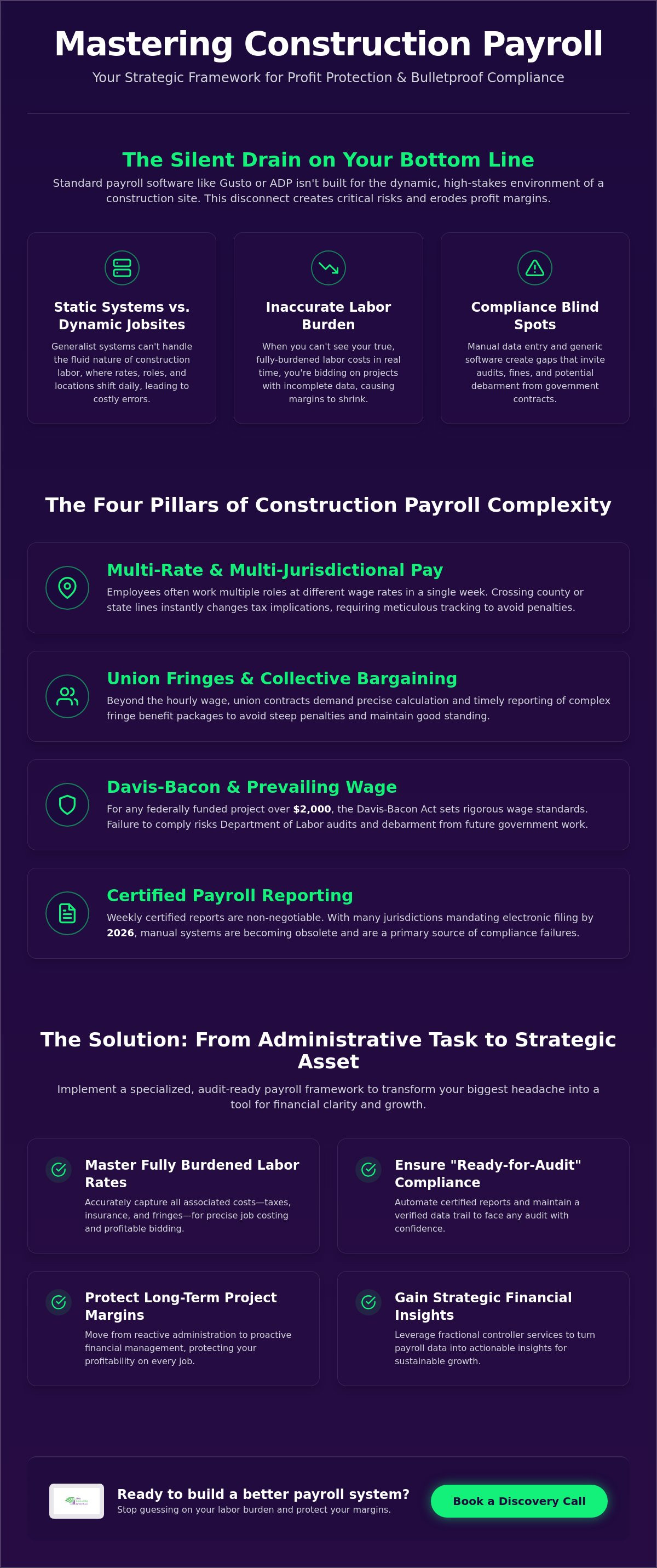
Effective payroll for construction companies is far more than a simple administrative task; it is a specialized financial framework that integrates project management, labor laws, and rigorous tax compliance. While Understanding Payroll Basics is helpful for standard business operations, the construction sector demands a much higher level of precision. A generalist payroll provider like Gusto or ADP often falls short because their systems are built for static environments. They aren't designed to handle the fluid nature of a job site where labor rates, jurisdictions, and compliance requirements shift by the hour.
When you rely on a system that doesn't speak the language of the field, you create a dangerous disconnect between your payroll data and your project margins. Construction payroll must manage multi-rate compensation and complex reporting requirements that ensure every dollar spent is tracked against a specific job. This isn't just about paying people; it's about protecting your profitability. If your payroll system can't accurately reflect your true labor burden, you're essentially bidding on projects with incomplete data. This leads to shrinking margins and an inability to scale your firm effectively.
Multi-Rate and Multi-Jurisdictional Challenges
Tracking varied pay scales across different job sites is one of the most significant hurdles for growing firms. An employee might work as a laborer on Monday and a skilled operator on Tuesday, each requiring a different wage rate. If they cross county or state lines, the tax implications change instantly. National contractors face an immense administrative burden when managing these shifting tax requirements. You can't afford to guess on these figures. Every hour must be meticulously logged against the correct jurisdiction to avoid the Department of Labor's increasing enforcement activities, which are projected to intensify through 2026.
The Impact of Union Fringes and Collective Bargaining
Union environments introduce another layer of structural complexity. It's not just the hourly wage that matters; it's the precise calculation of fringe benefit packages. You must ensure timely, accurate reporting to union halls to avoid steep penalties and interest. This data shouldn't exist in a vacuum. It needs to be integrated directly into your general ledger so that your financial reporting reflects the actual cost of labor. By building a payroll infrastructure that accounts for these union-specific requirements, you move from reactive administration to proactive financial management, ensuring your firm remains audit-ready and operationally sound.
Compliance Frameworks: Certified Payroll and Prevailing Wage Requirements
Compliance isn't just about avoiding fines; it's about maintaining the structural integrity of your business. For any firm handling federally funded projects exceeding $2,000, the Davis-Bacon Act sets a rigorous standard for payroll for construction companies. Failure to meet these prevailing wage determinations doesn't just invite a Department of Labor audit; it can lead to debarment from future government contracts. While federal laws provide the baseline, many states enforce their own "Little Davis-Bacon" laws that add further layers of complexity to your weekly reporting cycle.
Manual tracking remains the primary risk factor for compliance failures. Relying on spreadsheets to manage EEO minority compliance or new hire reporting creates gaps where data entry errors can thrive. In an era of increased enforcement, your firm needs a proactive stance. This involves establishing a "Ready-for-Audit" posture where every hour worked is verified against the specific wage determination for that project before the first check is ever cut.
Mastering Davis-Bacon Payroll Compliance
Understanding Navigating Davis-Bacon Payroll Compliance is essential during the bidding phase. If you don't account for the full scope of prevailing wages and required fringe benefits, your profit margins will erode before the first shovel hits the ground. You must document fringe benefit credits with precision to ensure you aren't overpaying out of pocket while still meeting legal requirements. This level of oversight requires a disciplined approach to financial data that many generalist providers simply cannot offer.
Certified Reporting: Automated vs. Manual Systems
The landscape of Certified Payroll Reporting is shifting rapidly. By 2026, many jurisdictions have transitioned to mandatory electronic filing portals, making manual preparation nearly impossible to sustain at scale. Automated systems reduce the administrative burden, but they aren't a "set it and forget it" solution. You still need professional oversight to verify data integrity and ensure that your system's output matches the specific requirements of the contracting agency. If you're concerned about your current compliance posture, you might consider a discovery call to review your payroll systems. Establishing these foundational controls now prevents the high cost of corrective action later.
The Strategic Value of Labor Burden and Job Costing
Strategic payroll for construction companies transforms a simple expense line into a high-fidelity diagnostic tool. If you only track gross wages, you're essentially flying blind. Profit margins often shrink because of a failure to account for the full weight of employment costs. Every hour your crew spends on a project carries a hidden weight that must be captured to protect your bottom line. By analyzing historical payroll data, you can refine your future estimates to reflect reality rather than optimistic projections. This disciplined approach moves your firm away from guesswork and toward a data-driven bidding strategy.
Many contractors struggle with "leaky" projects where the revenue looks healthy but the bank account says otherwise. This disconnect usually stems from poor job costing. When your payroll system is isolated from your project management data, you lose the ability to see the true cost of labor in real time. Accurate job costing ensures that every dollar spent on fringes, taxes, and insurance is attributed to the correct project. This level of oversight is what distinguishes a scalable firm from one that is merely surviving from one draw to the next.
Calculating Your True Labor Burden
Calculating your true labor burden requires a meticulous look at workers' compensation, FICA, and health insurance premiums. General bookkeeping often misses these "hidden" costs because they are recorded in different accounts or paid on different schedules. Labor burden is the total cost of an employee beyond their gross wages. To achieve structural integrity in your financials, these costs must be allocated to specific jobs. This granularity allows you to identify which projects are truly profitable and which are merely consuming cash. It provides the "why" behind your numbers, giving you the control needed to adjust your labor mix or project scope before a project turns red.
Integrating Payroll with WIP Accounting
Integrating payroll with Work in Progress (WIP) accounting ensures that your financial statements tell a consistent story. Payroll timing often creates a mismatch where labor costs are recognized in one period while the associated project revenue appears in another. This distortion makes it impossible to see your real-time financial health. Accurate WIP Accounting: Tracking Work in Progress for Profit requires that labor costs are matched to the period in which the work was performed. This alignment provides the clarity needed to make data-driven choices regarding project selection and resource allocation. It ensures your monthly reports reflect the actual progress of your builds, protecting your cash flow from unexpected labor spikes.
Building Your Payroll Infrastructure: Software vs. Professional Oversight
Choosing the right platform for payroll for construction companies is a foundational decision that impacts every other financial process in your firm. Many owners look at specialized software like Foundation, Sage 300, or Miter as a total solution for their reporting needs. While these tools offer robust features for multi-rate tracking and union fringes, the software is only as reliable as the logic behind its configuration. A common mistake is the "set it and forget it" mentality. This approach often leads to fragmented data and expensive, multi-year cleanups that drain resources later. Software is a tool, not a strategy.
The decision to manage payroll in-house or through outsourced specialists depends on your firm's complexity and growth trajectory. If you're managing multiple public works projects with varying prevailing wage determinations, the administrative overhead of in-house management often outweighs the cost of professional oversight. Specialized providers don't just process checks; they build the structural framework that ensures your data remains audit-ready. This proactive stance allows you to focus on project execution while experts handle the granular details of compliance and reporting.
Optimizing QuickBooks for Construction Payroll
Most contractors utilize QuickBooks, but few have it configured to handle the specific demands of project-based labor. To prevent data silos, you must configure your Chart of Accounts to handle complex labor allocations from the start. This involves utilizing classes and jobs to segment payroll data effectively, allowing you to see exactly where your labor dollars are going. A Professional QuickBooks Setup for Contractors ensures that your payroll data flows seamlessly into your financial reports. When your system is built correctly, you eliminate the need for manual workarounds and reduce the risk of data entry errors that trigger audits.
The Hybrid Model: Software + Strategic Partnership
The most resilient firms often adopt a hybrid model that pairs construction-specific software with strategic financial oversight. Software alone cannot replace the "why" behind your numbers or identify the subtle trends that signal shrinking margins. By having a specialized bookkeeper manage the software interface, you gain the benefits of automation without losing professional discipline. This partnership reduces your internal overhead and ensures that your payroll administration remains a scalable part of your business. If you're ready to transition from basic administration to a more disciplined financial system, you can schedule a discovery call to discuss your payroll infrastructure. This collaborative approach provides the clarity and control needed to protect your long-term project profitability.
Okie Accounting Group LLC: Strategic Payroll Management for Long-Term Growth
Transitioning from basic administrative tasks to a structural framework for growth requires a shift in perspective. Okie Accounting Group LLC approaches payroll for construction companies as a core component of your firm's financial health rather than a standalone chore. By integrating payroll with monthly bookkeeping and cash flow forecasting, we ensure that your labor data informs every other part of your business. This holistic oversight protects your firm from compliance risks while providing the clarity needed to make informed, data-driven choices about your future projects. We aren't just processors; we are strategic partners invested in your business's structural integrity.
Many firms find themselves stuck in a cycle of "emergency" payroll management, where they are constantly reacting to audit threats or cash flow shortages. Moving beyond this reactive state requires a disciplined system that prioritizes accuracy and long-term stability. When your payroll is managed with the same rigor as your site safety protocols, you create a culture of financial discipline. This methodical approach ensures that your labor costs are always aligned with your project revenue, providing a clear path to sustainable profitability.
Fractional Controller Oversight for Payroll
The true value of Fractional Controller Services lies in the ability to look past the data entry to see the "why" behind your numbers. Our oversight involves reviewing payroll trends to identify inefficiencies in labor allocation before they impact your margins. We analyze how your labor burden fluctuates across different trades and jurisdictions, ensuring your system supports long-term scalability. This high-level advisory service bridges the gap between basic bookkeeping and strategic financial management, giving you the confidence to bid on larger, more complex contracts without fear of losing control over your costs.
Building a Foundation for Scalable Growth
Clean payroll data is the bedrock of lender-ready financial statements. When you seek bonding or financing for major projects, creditors look for the organized, predictable systems that Okie Accounting Group LLC helps you build. We help you move beyond manual workarounds to a professional system that grows with your firm. By establishing these foundational controls today, you protect your business from the "growing pains" that often lead to compliance failures or financial blind spots. If you're ready to transform your payroll from a weekly headache into a strategic asset, it's time to Schedule a consultation with Okie Accounting Group LLC. Let's build a financial framework that protects your profits and supports your vision for the future.
Protecting Your Margins with a Foundational Payroll Framework
Mastering payroll for construction companies is the most direct path to ensuring your firm's long-term stability and profitability. By moving beyond simple check processing and embracing a structural framework for compliance and job costing, you protect your business from the shrinking margins that plague disorganized firms. Accurate labor burden tracking and automated certified reporting aren't just administrative goals; they are the essential tools you need to bid with confidence and scale without fear of audit penalties.
At Okie Accounting Group LLC, we provide more than just basic bookkeeping. We offer specialized expertise in construction and real estate accounting with fractional controller-level strategic oversight. Whether you're navigating local prevailing wage laws or managing multi-state operations, our nationwide service ensures your financial data remains clean, lender-ready, and strategically sound. It's time to stop reacting to payroll headaches and start leveraging your financial data for growth. Gain financial clarity with specialized construction payroll management from Okie Accounting Group LLC. We're here to help you build a stronger, more resilient foundation for your firm's success.
Frequently Asked Questions
What is the difference between standard payroll and construction payroll?
Standard payroll typically involves fixed wage rates and static tax jurisdictions for most employees. In contrast, payroll for construction companies manages a fluid environment where workers often perform multiple trades at different pay scales within a single week. It requires precise job costing to allocate every hour to a specific project and must account for varying local tax requirements as crews move between different job sites and municipalities.
How does certified payroll work for government projects?
Certified payroll is a weekly reporting requirement where contractors submit Form WH-347 or a similar state-specific document to a contracting agency. This report lists every worker, their work classification, the specific hours they worked, and the fringe benefits they received. It serves as a legal affidavit proving that you have paid your crew according to the prevailing wage determinations required for public works projects.
What are prevailing wage requirements in construction?
Prevailing wage requirements are minimum pay and benefit standards set by the Department of Labor or state agencies for specific types of work in a given geographic area. Under the Davis-Bacon Act, these rates apply to all federally funded construction contracts exceeding $2,000. You must ensure that your employees receive at least the total hourly rate, including fringe benefits, specified in the project's wage determination to remain compliant.
Can I use QuickBooks for construction payroll and job costing?
Yes, you can use QuickBooks for these tasks, but it requires a specialized configuration to be effective. You must utilize the "Jobs" and "Classes" features to segment labor costs by project and trade classification. Without a professional setup that aligns your payroll data with your Chart of Accounts, you'll likely struggle with data silos that make accurate job costing and WIP reporting impossible.
How do I calculate the fully burdened labor rate for my crew?
To calculate the fully burdened rate, you must add all employer-paid costs to the employee's gross hourly wage. This includes FICA, federal and state unemployment taxes, workers' compensation premiums, health insurance, and retirement contributions. Once you have the total annual cost for an employee, divide that number by their total billable hours to determine the actual cost of their labor to your firm.
Why is union payroll more complex than non-union payroll?
Union payroll involves intricate fringe benefit structures and specific reporting mandates defined by collective bargaining agreements. You aren't just managing wages; you're also calculating and remitting varied benefit payments to multiple union halls based on specific hours worked. These agreements often have unique overtime rules and holiday pay requirements that must be meticulously tracked to avoid grievances or financial penalties.
What are the risks of misclassifying construction employees as contractors?
Misclassification carries severe financial and legal risks, including liability for unpaid overtime, back taxes, and workers' compensation premiums. The Department of Labor has increased its enforcement activities in 2026, specifically targeting the construction sector for these violations. If an audit reveals that your "subcontractors" meet the legal definition of employees, your firm could face substantial fines and be debarred from future government contracts.
How often should I review my construction payroll reports for compliance?
You should review your reports every week before the payroll cycle is finalized and checks are issued. This proactive review ensures that every worker is paid the correct rate for their specific trade and project location. Regular audits of your payroll for construction companies help identify data entry errors or classification mismatches early, preventing small mistakes from turning into expensive compliance failures during a formal DOL investigation.


Comments