Procore Accounting Integration vs Manual Bookkeeping Services: 2026 Guide

Updated: Nov 7
Connecting field operations directly to your general ledger sounds like an instant fix for job costing chaos, but software integrations only transfer numbers; they don't guarantee financial integrity. When weighing a Procore accounting integration vs manual bookkeeping services, automated workflows alone won't catch unposted expenses or balance a skewed Work-in-Progress (WIP) schedule.
You already understand the frustration of double data entry, field-office communication gaps, and sync errors that leave project managers and accountants working from conflicting reports. Expensive software licenses yield poor returns when your back office still wrestles with delayed pay application billing and eroded job profitability.
This guide evaluates automated Procore ERP synchronization against specialized construction bookkeeping to help you identify the right financial model for your business. We break down the true operational costs of both approaches, examine reliable job cost allocation methods, and outline a scalable workflow designed to protect your project profit margins.
Evaluating Construction Financial Systems: Software Automation vs Manual Workflows
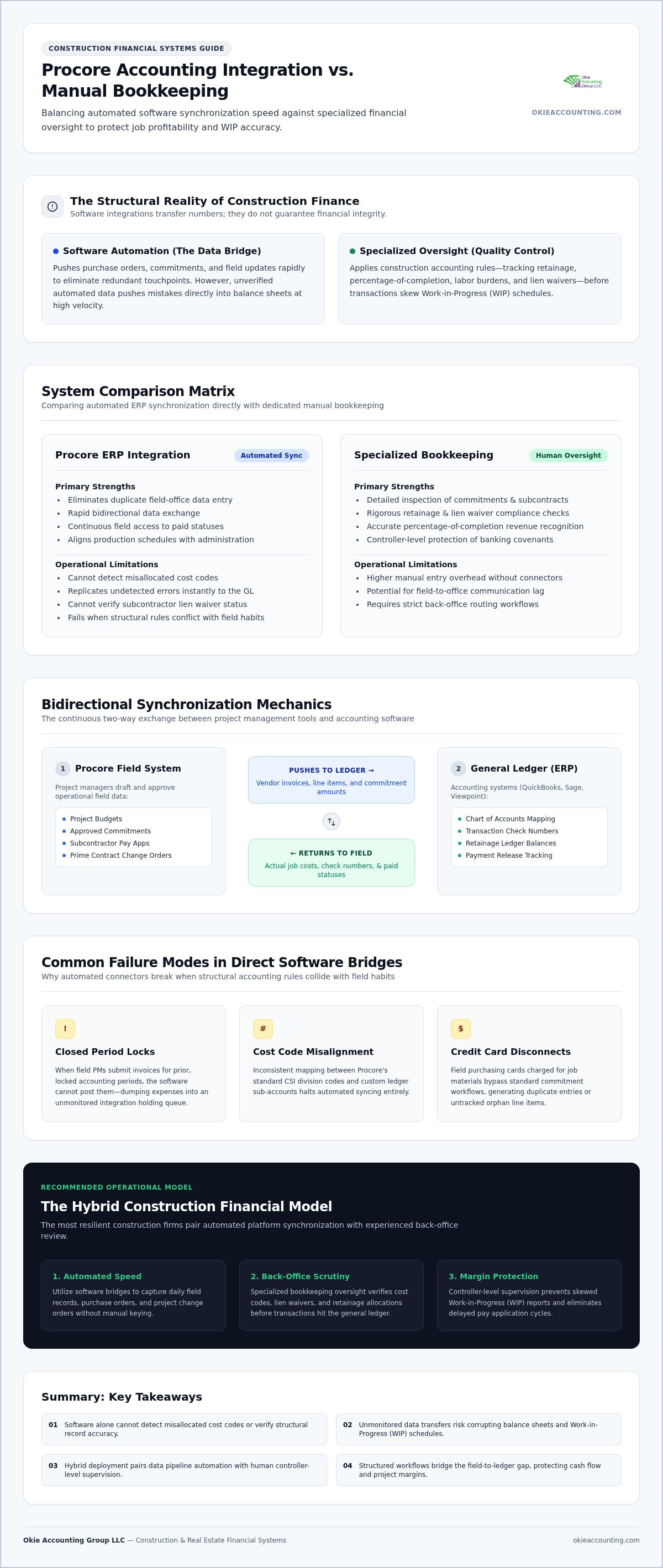
Every commercial build runs on two concurrent tracks: the physical progress on site and the financial movement behind the scenes. An automated Procore accounting integration creates bidirectional synchronization between cloud project management tools and your core accounting ledger. In contrast, specialized manual bookkeeping relies on experienced human oversight to inspect, verify, and reconcile individual job commitments, subcontracts, and vendor invoices.
Standard corporate bookkeeping simply records debits and credits after money moves. Construction finance carries far higher operational risks, governed by strict construction accounting principles like retainage tracking, percentage-of-completion revenue recognition, and fluctuating labor burdens. When mid-market contractors outgrow static spreadsheets, they face a critical operational junction. Choosing between a Procore accounting integration vs manual bookkeeping services is not merely a software choice; it dictates how your firm safeguards job-level cash flow.
The Rise of Integrated Construction Tech Stacks
Cloud management platforms have revolutionized daily project tracking. Field managers can log change orders, verify equipment deliveries, and update punch lists directly from mobile devices. However, disconnects between field teams and the home office generate severe friction. When project managers issue subcontracts in a silo, accounting teams face duplicate data entry and delayed job-cost postings. Automated data bridges aim to eliminate these redundant touchpoints, pushing field-level commitments straight into software like QuickBooks to keep production schedules aligned with administrative records.
The Persistent Value of Specialized Financial Oversight
Speed does not equal precision. While software moves line items rapidly, automated sync tools cannot determine whether a project manager billed an expense to the correct cost code or verified subcontractor lien waivers before payment release. Relying purely on automated pipes without structured review often pushes unvetted figures directly into balance sheets, distorting Work-in-Progress (WIP) reports.
True financial stability requires more than transactional keystrokes. Establishing dedicated management accounting workflows ensures that automated entries undergo disciplined quality control before impacting corporate tax positions or banking covenants. While evaluating a Procore accounting integration vs manual bookkeeping services, builders discover that software accelerates data delivery, but rigorous human scrutiny preserves job margins.
How Procore Accounting Integrations Work: Capabilities and Structural Limits
Automated software connectors link Procore directly with financial software such as QuickBooks Online, Sage, or Viewpoint. When field managers draft purchase orders, process subcontractor pay applications, or submit prime contract change orders, the integration pushes these transactions directly into your accounting system. The core promise rests on speed and eliminating double entry.
Industry research highlights how firms harness the benefits of accounting automation to expand operational capacity and cut administrative hours. Yet automation carries structural boundaries. Automated syncs replicate data instantly, including undetected cost coding errors. If a project manager selects an incorrect cost division or misclassifies retainage on an application for payment, the integration faithfully posts that mistake straight to the general ledger. This creates a classic trap: the faster unverified data travels, the faster your job costing unravels.
Bidirectional Synchronization Mechanics
A functioning software connector runs a two-way exchange. The project management side pushes project budgets, approved commitments, and vendor invoices into the general ledger. In return, the accounting system sends back actual job costs, transaction check numbers, and paid statuses to update field teams. This continuous flow helps align Procore cost codes with your established chart of accounts, keeping retainage balances and lien waiver compliance logs tied to specific payment releases.
Common Failure Modes in Direct Software Bridges
Despite polished marketing claims, API connectors frequently fail when structural accounting rules collide with field operational habits. Common integration roadblocks include:
Closed Period Locks: When a project manager submits an invoice for a prior, locked accounting period, the software cannot post it, dumping the expense into an unmonitored integration holding queue.
Cost Code Misalignments: Inconsistent mapping between Procore's standard CSI codes and custom ledger sub-accounts halts automated syncing entirely.
Credit Card Disconnects: Field purchasing cards charged for job materials bypass standard Procore commitment workflows, resulting in duplicated or orphan line items.
When analyzing a Procore accounting integration vs manual bookkeeping services, contractors realize that software pipelines require continuous administrative maintenance. Without systematic configuration and ongoing oversight, digital connections quickly produce silent data discrepancies. If your team needs structured guidance to configure and troubleshoot these connections, you can schedule a discovery call to evaluate your accounting architecture.
Comparing Automated Integration vs Manual Construction Bookkeeping
Selecting the right financial workflow requires evaluating operational trade-offs across your entire business. When weighing a Procore accounting integration vs manual bookkeeping services, contractors must examine speed, verification depth, implementation costs, and audit readiness. Industry benchmarks from the Construction Financial Management Association emphasize that reliable job-cost allocation directly determines bonding capacity and credit access. Neither approach works as a silver bullet on its own.
Speed and Data Freshness vs Verification Depth
Automated synchronization delivers immediate field visibility, yet rapid posting can undermine general ledger integrity. When a subcontractor invoice bypasses human review, unapproved change orders or disputed unit pricing can slip through unnoticed. Manual checkpoints prevent early payment releases and overbilling disputes. For fast-paced commercial builders operating in regional hubs like Tennessee and Jacksonville, Florida, retaining strict oversight over retainage schedules ensures that cash remains protected before cash outflows occur.
True Cost of Ownership and Resource Allocation
Software integrations appear to cut labor, but ongoing connector subscriptions, annual renewal increases, and technical troubleshooting quickly alter financial projections. Conversely, relying solely on internal administrative staff often ties up valuable management hours with routine keystrokes. Establishing structured management accounting workflows creates a predictable operational baseline. Contractors achieve true stability when they eliminate redundant manual typing while preserving rigorous human review for critical job costs, pay applications, and balance sheet reconciliations.
The Strategic Hybrid Model: Pairing Automation with Expert Financial Oversight
Framing the debate as Procore accounting integration vs manual bookkeeping services assumes a false choice. Forward-thinking contractors don't abandon software automation, nor do they turn their ledgers over to unsupervised scripts. Instead, the most resilient builders deploy a hybrid model that uses technology for fast data ingestion and construction accounting specialists for strict financial governance.
This operational framework follows four structured stages:
Connect: Deploy direct software bridges between Procore and QuickBooks to automate repetitive transactional data transfers, eliminating dual-entry overhead for approved commitments and subcontractor pay applications.
Validate: Establish weekly administrative review gates where accounting specialists audit job cost code assignments, verify tax application rules, and cross-reference billings against project budgets.
Reconcile: Conduct monthly general ledger, bank, and commitment reconciliations to clear integration holding queues, isolate sync exceptions, and confirm that job-to-date costs mirror bank debits.
Strategize: Convert verified, synced project metrics into dependable Work-in-Progress (WIP) schedules, rolling cash flow forecasts, and executive management reports.
Protecting Profit Margins Through Human Verification
Automated software connections move data quickly, but they cannot evaluate contractual compliance. If a project manager logs an informal field directive as an approved change order, an unmonitored connector immediately skews revenue projections. Human verification acts as a necessary firewall.
Experienced financial professionals confirm that valid certificates of insurance, executed change orders, and signed conditional lien waivers exist before authorizing automated payments. Backing your technology stack with specialized controller services gives your firm high-level oversight, identifying margin fade weeks before it compromises project cash flow.
Configuring Scalable Workflows in Tennessee and Florida
Regional building markets introduce unique legal and tax challenges that out-of-the-box software settings fail to recognize. Commercial contractors working across Tennessee and Florida must navigate state-specific statutory notice deadlines, retainage withholding laws, and nuanced sales tax rules on building materials. A software integration handles the mechanics of transferring dollar amounts, but human advisors ensure those transactions follow state compliance guidelines.
This hybrid structure gives decentralized field teams real-time mobile tools while centralizing ledger control with specialized construction accountants. If your firm needs an ironclad operational system that bridges your project software with reliable ledger reporting, book a discovery call today to design your custom accounting framework.
How Okie Accounting Delivers Structural Financial Clarity for Growing Builders
Technology solves data transit, but it cannot fix broken accounting foundations. When evaluating a Procore accounting integration vs manual bookkeeping services, contractors often realize they don't simply need software connectors or basic data entry clerks. They need an architectural framework. Founded by Sarah O'Quinn, Okie Accounting Group serves as that strategic bridge, providing specialized construction bookkeeping and fractional controller oversight that transforms disconnected field logs into dependable business intelligence.
Since 2020, our firm has focused exclusively on the unique mechanics of construction accounting. We configure, audit, and manage the cloud pipelines connecting project platforms like Procore to your QuickBooks ledger. Rather than leaving field teams and office staff to struggle with sync exceptions, we establish disciplined quality control protocols that keep every job cost accounted for and fully verified.
Foundational Systems Built for Construction Scale
Generalist bookkeepers often misclassify retainage, overlook unposted vendor commitments, and fail to tie change orders back to contract schedules. Our team builds customized charts of accounts tailored to construction divisions, ensuring field managers and financial controllers operate from identical metrics. We eliminate synchronization anxiety through systematic monthly oversight:
Routine Transaction Auditing: Isolating integration holding queues and fixing mapping errors before month-end close.
Job Cost Reconciliation: Verifying actual labor, material, and subcontractor invoices against project estimates and AIA billing applications.
WIP Schedule Preparation: Delivering accurate Work-in-Progress schedules that give lenders and surety underwriters complete confidence in your financial stability.
Cash Flow Forecasting: Translating project milestones into reliable cash projections so you can purchase materials and fund payroll without liquidity surprises.
Next Steps: Modernizing Your Contractor Financial Operations
Scaling a contracting firm requires moving past isolated software tools. Whether you manage commercial projects in Tennessee, residential developments in Jacksonville, Florida, or jobs across the country, your financial architecture must keep pace with field production. Choosing between a Procore accounting integration vs manual bookkeeping services isn't an all-or-nothing proposition. By combining automated field synchronization with expert fractional controller oversight, your company secures the speed of cloud tools alongside the rigor of professional human analysis.
Transitioning from transactional recordkeeping to high-level advisory leadership protects your margins and gives you clarity over every job. Explore our specialized controller services or take advantage of targeted software training to transform your back office into a resilient profit center.
Building a Resilient Financial Engine for Your Construction Business
Deciding between a Procore accounting integration vs manual bookkeeping services isn't a winner-take-all contest. Direct software connections speed up transactional flows, but without seasoned back-office review, sync errors and misallocated cost codes will silently distort your Work-in-Progress schedules. Sustainable growth happens when you unite automated cloud pipelines with disciplined construction accounting oversight.
Since 2020, Okie Accounting Group has helped commercial builders and trade contractors replace back-office chaos with structured financial control. Serving clients across Tennessee, Jacksonville, Florida, and nationwide, we deliver specialized QuickBooks setup, precise job costing, and fractional controller leadership tailored to the realities of active job sites. You don't have to choose between software speed and ledger accuracy. Schedule a discovery call with Okie Accounting Group today to establish a clear, scalable financial foundation that protects every dollar of project profit.
Frequently Asked Questions
Can Procore completely replace a construction bookkeeping service?
No, Procore cannot replace a dedicated bookkeeping service because it is an operational project management platform, not an accounting engine. While it automates field documentation and transfers data, it lacks the internal controls to reconcile ledgers, verify tax rules, or balance cash accounts. Evaluating a Procore accounting integration vs manual bookkeeping services shows that software handles data transit, but qualified accounting professionals are essential to guarantee financial accuracy and ledger integrity.
What causes sync errors between Procore and accounting software like QuickBooks?
Sync errors typically occur when transaction parameters in Procore conflict with the setup in your general ledger. Frequent culprits include mismatched CSI cost codes, attempts to post into closed accounting periods, and unmapped sales tax rules. When project managers create commitments using items not recognized by QuickBooks, transactions stall in integration holding queues. Without regular administrative monitoring, these sync failures leave significant project expenses unposted, distorting your true job costs.
Is manual bookkeeping cheaper than maintaining an automated Procore integration?
Manual bookkeeping may seem cheaper initially due to lower software overhead, but it often increases long-term labor costs through double data entry and administrative delays. Conversely, automated software connectors carry ongoing licensing fees and setup expenses that require substantial project volume to justify. Choosing between a Procore accounting integration vs manual bookkeeping services depends on matching transaction volume with back-office capacity, ensuring your administrative spend directly protects project margins.
How does integration affect job costing and Work in Progress (WIP) reporting?
An integration updates job costing data faster by transmitting subcontractor commitments and invoices directly into the ledger. However, automated data transfer does not guarantee accurate WIP reporting. If field personnel enter incorrect completion percentages or fail to record unapproved change orders, your balance sheet will reflect skewed under-billings and over-billings. Human review remains essential to reconcile actual costs against billings and produce reliable percentage-of-completion schedules.
What role does a fractional controller play in an automated accounting environment?
A fractional controller provides high-level financial governance that automated software cannot deliver on its own. While tools synchronize raw numbers, a controller audits cost code distribution, analyzes margin variance, and designs internal controls to stop cash leakage. They interpret synced data to prepare forward-looking cash flow forecasting and executive reports, ensuring project management tools translate into actionable strategic decisions for business owners.
How do regional regulations in Tennessee and Florida impact construction accounting workflows?
Regional compliance requires accounting systems to track specific statutory rules that standard software bridges ignore. In Tennessee and Florida, contractors face distinct mechanics' lien deadlines, retainage withholding mandates, and state sales tax obligations on commercial building supplies. Back-office workflows must incorporate manual compliance checks before releasing automated payments, ensuring that lien waivers, certificates of insurance, and state tax filings align with regional legal requirements.
Can Okie Accounting manage financial reconciliations for contractors using Procore?
Yes, Okie Accounting Group specializes in bridging project management tools with QuickBooks ledgers for construction firms across Tennessee, Jacksonville, Florida, and nationwide. Founded by Sarah O'Quinn in 2020, our firm delivers monthly bookkeeping, job cost reconciliations, and fractional controller oversight. We audit your integration logs, clear error queues, and maintain reliable WIP schedules, giving you the operational speed of cloud tools with complete financial peace of mind.


Comments