QuickBooks Online vs Desktop: 2026 Real Estate Guide

Updated: 6 days ago
The most expensive mistake a growing real estate firm can make in 2026 isn't a bad property acquisition, but a brittle accounting foundation that fails during a high-stakes audit. As Intuit continues to sunset legacy products, the decision between QuickBooks Online vs Desktop for real estate investors has evolved from a simple software preference into a critical strategic choice about your business's structural integrity. You likely feel the daily friction of manual data entry and the persistent worry that your property-level reporting won't satisfy a sophisticated lender as you scale your portfolio.
We believe your accounting system should be a source of clarity rather than a bottleneck. This guide provides a definitive comparison of both platforms to help you build a scalable financial infrastructure that supports your long-term goals. You'll learn how to move beyond basic administrative tasks to create an automated chart of accounts and lender-ready financial statements. We will examine the impact of the 70% price increase for QuickBooks Online Advanced and explain how to design a system that facilitates professional fractional controller oversight, ensuring you maintain total control over your cash flow and profit protection.
The Real Estate Investor’s Dilemma: Why Software Choice Dictates Scalability
Software is more than a utility; it's the skeletal structure of your financial health. When you select between QuickBooks Online vs Desktop for real estate investors, you're deciding how easily your team can access data and how much automation you can realistically deploy across multiple property entities. This foundational choice creates what we call structural integrity in your books. Without it, your financial data becomes a liability that hinders growth. If your systems are siloed or prone to manual errors, you'll struggle to maintain the clarity required for high-level decision making. This choice also dictates your operational flexibility. It determines whether you can effectively leverage fractional controller services or if you'll remain tethered to a local machine, limiting your ability to work with specialized remote partners who can provide strategic oversight.
The Evolution of Accounting for Real Estate Investors
For decades, QuickBooks Desktop was the undisputed industry standard due to its robust local hosting and deep reporting layers. However, the landscape shifted significantly when Intuit discontinued new subscriptions for Desktop Pro Plus and Premier Plus after September 30, 2024. In 2026, we see a decisive move toward cloud-based financial management. While a general Comparison of accounting software highlights broad feature sets, real estate investors must look closer at the transition. Relying on "good enough" bookkeeping in a legacy system often creates a bottleneck. If you can't produce real-time data, you can't move quickly on new property acquisitions. The shift to the cloud isn't just about convenience; it's about building a responsive system that keeps pace with a competitive market.
Defining Your Portfolio’s Complexity Requirements
Your specific needs depend on the architecture of your portfolio. A single-family rental owner has vastly different requirements than an investor managing multiple LLCs, diverse partner equity splits, and complex development projects. You must identify the number of entities and properties in your mix before committing to a platform. Simple rental tracking focuses on cash flow, but complex development requires rigorous job costing and project-based reporting. Regardless of your current size, the ultimate goal is the production of Lender-Ready Financials. We define Lender-Ready Financials as accurate, reconciled, and professional statements that provide a bank with the immediate confidence to fund your next deal. Achieving this standard requires a disciplined approach to how data enters your chosen system.
Number of distinct legal entities (LLCs)
Complexity of partner distributions and equity tracking
Requirement for real-time, remote access for stakeholders
Volume of monthly transactions across all bank accounts
QuickBooks Desktop: The Legacy Powerhouse for Complex Multi-Entity Portfolios
Desktop remains a formidable tool for investors with intricate structures. While the debate of QuickBooks Online vs Desktop for real estate investors often leans toward the cloud, Desktop Premier and Enterprise offer granular reporting layers that are difficult to replicate. High-volume developers prioritize the platform's "Job Costing" depth. It allows for meticulous tracking of construction expenses against specific budgets. One significant advantage is the ability to manage multiple company files under a single license. This eliminates the per-entity subscription costs that can quickly drain the margins of a growing portfolio. However, these benefits come with the cost of isolation. The lack of real-time bank feeds and significant remote collaboration hurdles can slow down your financial visibility.
Mastering Multi-Entity Tracking in Desktop
Tracking separate LLCs within a single ecosystem requires a disciplined framework. You can leverage "Classes" to categorize income and expenses by property, while the "Customer: Job" hierarchy provides a secondary layer for project-based tracking. This level of detail is essential for complex development accounting. This precision comes with a trade-off. Desktop requires a manual data-entry approach that lacks the fluidity of modern systems. There are no real-time bank feeds to automate reconciliations. This creates a reliance on historical data rather than proactive insights. If you find your current Desktop setup is becoming a mess of unreconciled accounts, our QuickBooks training can help restore order and structural integrity.
The 2026 Outlook for QuickBooks Desktop
The environment for Desktop users has changed. As noted in Forbes' 2026 comparison, Intuit discontinued new subscriptions for Desktop Pro Plus and Premier Plus after September 30, 2024. Only existing subscribers can renew these products. These renewals aren't getting cheaper. In February 2026, the annual subscription for a single-user license increased to $1,149. This shift highlights the risks of relying on legacy software. Remote collaboration remains a major hurdle. Working with a remote bookkeeper or a fractional controller often requires expensive third-party hosting or cumbersome file transfers.
For those committed to the desktop environment, you must ensure your setup is optimized for the current year's requirements. You can explore our guide on Mastering QuickBooks for Contractors for deep technical setup tips that apply to complex real estate projects. If the administrative burden of managing these local files is slowing your acquisitions, it might be time to schedule a discovery call to discuss a more automated structural framework.
QuickBooks Online: Building a Scalable, Cloud-Based Framework for Growth
Transitioning to a cloud-based system is often the catalyst for rapid portfolio expansion. When comparing QuickBooks Online vs Desktop for real estate investors, the primary advantage of the Online platform is its ability to serve as a central hub for a tech-forward financial stack. Unlike the static nature of Desktop, QuickBooks Online (QBO) provides the real-time visibility necessary for active investors to make data-driven choices on the fly. This accessibility is a prerequisite for effective fractional controller services. It allows your strategic partners to monitor cash flow and financial health without the lag of file transfers or local hosting limitations. By centralizing your data in the cloud, you create a transparent environment where accuracy is maintained through continuous oversight rather than periodic cleanups.
Automation and Integration: The QBO Advantage
The true power of QBO lies in its ability to communicate with other specialized tools in your ecosystem. You can connect property management software like AppFolio or Buildium directly to your books, ensuring that rent rolls and tenant payments sync without manual intervention. Automated bank rules further reduce human error by categorizing recurring expenses based on predefined logic. While the August 1, 2026, price increases set QBO Plus at $140 per month and Advanced at $340 per month, the efficiency gains are undeniable. By automating up to 80% of transaction categorization, investors reclaim dozens of hours each month, allowing them to focus on high-value acquisitions rather than administrative data entry.
Strategic Reporting for Long-Term Rentals and Flips
Real estate accounting requires a nuanced approach that distinguishes between the cash flow of long-term rentals and the project-based nature of fix-and-flips. QBO facilitates this through the strategic use of Classes and Locations, which can mirror the functionality of property management software. A properly configured Chart of Accounts for Real Estate Investors ensures that every dollar is tracked at the property or unit level. This level of detail allows you to generate customized Profit and Loss statements that reveal the true performance of each asset. QBO is the preferred choice for our monthly bookkeeping services because it supports a proactive partnership. It enables us to catch discrepancies early and maintain the structural integrity of your financial data as you scale from a few doors to a comprehensive portfolio.
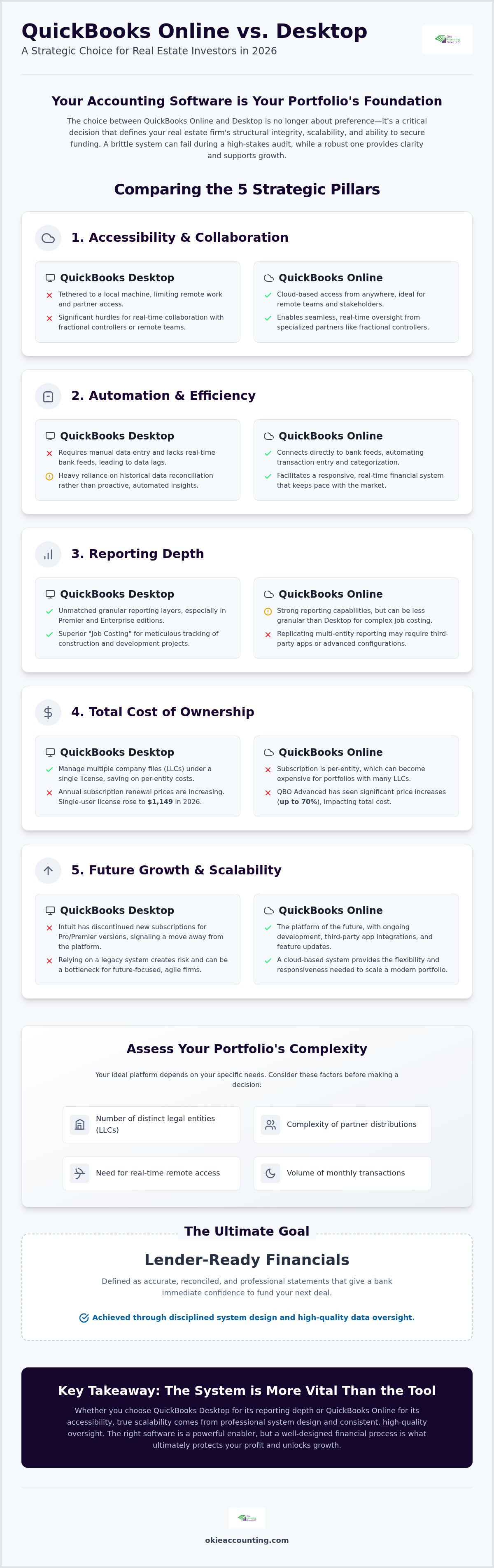
The 2026 Decision Matrix: Evaluating Your Specific Investment Needs
Choosing between QuickBooks Online vs Desktop for real estate investors requires a clinical evaluation of your operational goals. While previous sections detailed individual features, the decision rests on five pillars: accessibility, automation, reporting depth, cost, and scalability. Most investors reach a tipping point where the manual effort of Desktop outweighs its reporting granularities. If you're managing a remote team or require real-time visibility for partners, the cloud is no longer optional. Conversely, if you operate a massive, multi-entity portfolio on a local server with dedicated in-house staff, the deep customization of Desktop Enterprise 24.0 might still hold value. The transition usually becomes necessary when your door count exceeds your ability to manually reconcile accounts every week.
Handling contractor payments and payroll also shifts the needle significantly. QuickBooks Online automates 1099 filings and direct deposits with more fluidity than its desktop counterpart, which is vital for investors juggling multiple vendors. Security is another major differentiator. Cloud hosting relies on Intuit's bank-level encryption and automatic backups. Local servers place the entire burden of data protection and disaster recovery on your shoulders. If a local drive fails without a recent backup, years of financial history could vanish instantly.
Cost vs. Value: Analyzing the True Investment
The financial landscape for both products changed significantly in 2026. QuickBooks Online Plus now costs $140 per month, totaling $1,680 annually. For those requiring the power of QBO Advanced, the monthly cost has reached $340. While this exceeds the $1,149 annual renewal for existing Desktop Pro Plus users, the raw subscription price is a narrow metric. You must factor in the cost of your time. Manual data entry in Desktop often leads to expensive cleanup projects when books are neglected. Investing in a system that supports automation prevents the structural decay that occurs when administrative tasks pile up.
Scalability Checklist for Investors
A scalable system must grow with your door count without requiring a total overhaul of your chart of accounts. Consider these factors as you evaluate your current setup:
Can you add a new LLC or partnership interest in under ten minutes?
Does your software allow for seamless fractional controller services to provide high-level strategy?
Is the system robust enough to handle 50 or 100+ units without lagging?
If your current platform feels like a bottleneck, it's a signal that your financial infrastructure is failing. We help investors navigate these transitions to ensure long-term stability and data accuracy. You can book a discovery call to determine which platform aligns with your scaling strategy for the coming year.
Beyond the Software: Implementing Strategic Oversight with Okie Accounting
While the choice of QuickBooks Online vs Desktop for real estate investors is a critical technical decision, the software itself is merely a tool. The true value for your portfolio lies in the quality of the data going into the system and the structural framework built around it. Even the most sophisticated platform cannot provide clarity if the underlying data is disorganized or if the chart of accounts is poorly configured. At Okie Accounting Group, we focus on the construction of comprehensive financial systems that transform raw numbers into actionable intelligence. We move beyond basic administrative tasks to ensure your business maintains total structural integrity as you scale.
Customized QuickBooks Setup and Training
Generic accounting setups often fail the unique needs of real estate investors because they don't account for complex property-level tracking or multi-entity equity splits. We fix existing messes by building a customized QuickBooks ecosystem tailored to your specific investment strategy. Our team ensures that every transaction is categorized correctly to support project-based financial tracking and professional reporting. We also provide specialized QuickBooks Setup and Training to empower your team. By establishing a disciplined workflow from the start, we protect your business from the "data rot" that typically occurs during rapid growth. This training ensures that your staff can maintain the high standards required for financial readiness.
The Fractional Controller Advantage
Scaling past a few doors requires a shift from historical bookkeeping to forward-looking strategic oversight. Our fractional controller services provide the high-level strategy needed to turn your books into a growth tool. Instead of simply asking what happened last month, you'll be able to answer what you can afford to buy next month. We implement rigorous cash flow forecasting and profit protection strategies that are essential in the 2026 market. This proactive partnership allows you to focus on property acquisition while we maintain the stability of your financial infrastructure. If you're ready to move from administrative chaos to a state of operational clarity, schedule a strategy session with Okie Accounting Group to discuss your path toward long-term stability.
Securing Your Financial Future Through Structural Integrity
Building a scalable portfolio requires more than just acquiring properties; it requires a disciplined financial framework that can withstand the pressures of growth. Whether you choose the granular control of Desktop Enterprise or the automated efficiency of the cloud, your decision between QuickBooks Online vs Desktop for real estate investors should align with your long-term operational strategy. We've seen that the true differentiator isn't just the software's feature set, but the structural integrity of the data that drives your decision-making.
At Okie Accounting Group, we move beyond basic bookkeeping to provide specialized strategic oversight for real estate. Our team offers expert QuickBooks setup and training to resolve existing data issues and national fractional controller support to guide your scaling efforts. If you're ready to transition from administrative stress to data-driven confidence, we're here to partner with you. Gain Financial Clarity with Okie Accounting’s Strategic Bookkeeping today. Your portfolio's stability depends on the foundations you build today, and we look forward to helping you achieve lasting control.
Frequently Asked Questions
Is QuickBooks Online better than Desktop for real estate investors in 2026?
QuickBooks Online is generally the superior choice for investors prioritizing remote collaboration and automated bank feeds. While Desktop still offers deeper custom reporting for complex construction, Intuit’s focus has shifted entirely toward cloud-based infrastructure. Most active investors find that the 750 app integrations in the Online version outweigh the legacy features of Desktop. It is the essential platform for those scaling past a few doors who require real-time visibility into their cash flow.
Can I track multiple rental properties in one QuickBooks Online account?
You can track multiple rental properties within a single QuickBooks Online account by leveraging the Classes and Locations features. This allows you to generate a Profit and Loss statement for each individual property or unit without needing separate subscriptions. If your properties are held in distinct legal entities with separate bank accounts, you should evaluate whether a single file maintains the structural integrity required for clean financial reporting across your entire portfolio.
Is QuickBooks Desktop being discontinued for real estate accounting?
New subscriptions for QuickBooks Desktop Pro Plus and Premier Plus were discontinued after September 30, 2024. Only existing subscribers can renew their licenses, which saw a price increase to $1,149 in February 2026. For new users, QuickBooks Desktop Enterprise remains the only available desktop version. This shift signals a clear transition toward cloud-based systems, making the debate of QuickBooks Online vs Desktop for real estate investors a question of long-term software viability.
How do I set up a Chart of Accounts for rental properties in QuickBooks?
Setting up a Chart of Accounts for rental properties requires a hierarchy that separates property-level expenses from general overhead. You should create specific sub-accounts for categories like repairs, maintenance, property taxes, and insurance. This structure ensures your data is lender-ready and provides the granularity needed for accurate financial reporting. Utilizing a professional setup service helps prevent the common errors that lead to expensive cleanup projects as your property portfolio expands.
Do I need a separate QuickBooks file for each real estate LLC?
You typically need a separate QuickBooks file for each legal entity to ensure proper tax separation and liability protection. While some investors attempt to track multiple LLCs in one file using Classes, this often creates a mess during audits or property sales. Using separate files for each LLC is the standard practice for maintaining structural integrity. Professional fractional controller services can help you manage these multiple entities efficiently through a centralized cloud framework.
Can QuickBooks Online handle job costing for fix-and-flip investors?
QuickBooks Online Advanced is designed to handle job costing for fix-and-flip investors through its Projects feature. This tool allows you to track labor, materials, and overhead costs against specific property acquisitions. You can monitor your profit margins in real-time and compare actual costs against your initial budgets. The August 1, 2026, price increase to $340 per month reflects the added value of these high-level automation and project-tracking capabilities for active developers.
What is the cost difference between QuickBooks Online and Desktop for investors?
The cost difference between QuickBooks Online and Desktop for real estate investors has widened significantly. A single-user Desktop renewal now costs $1,149 per year. In contrast, QuickBooks Online Plus costs $140 per month, totaling $1,680 annually. While the Online version has a higher raw cost, it often reduces expenses related to manual data entry and local server maintenance. It also eliminates the need for expensive third-party hosting required for remote desktop access.
How does a fractional controller help with QuickBooks management?
A fractional controller moves beyond basic bookkeeping to provide high-level strategic oversight and cash flow forecasting. They ensure your QuickBooks ecosystem is configured for long-term health and profit protection. By reviewing your data for accuracy and structural integrity, they turn your books into a growth tool. This professional oversight is essential for investors scaling past a few doors who need to stay in a state of financial readiness for their next major acquisition.


Comments