Strategic Accounting for Property Management Companies: The 2026 Framework for Scalable Oversight

Updated: 6 days ago
What if the biggest risk to your portfolio isn't a vacant unit or a broken boiler, but a trust account reconciliation that's quietly drifting out of balance? For many firm owners, the anxiety of co-mingled funds or the difficulty of explaining financial "leaks" to property owners creates a constant state of professional stress. You've likely realized that even the most expensive software is just a database, not a replacement for disciplined oversight. Mastering accounting for property management companies in 2026 requires a shift from simple data entry to the construction of a rigorous, scalable financial infrastructure.
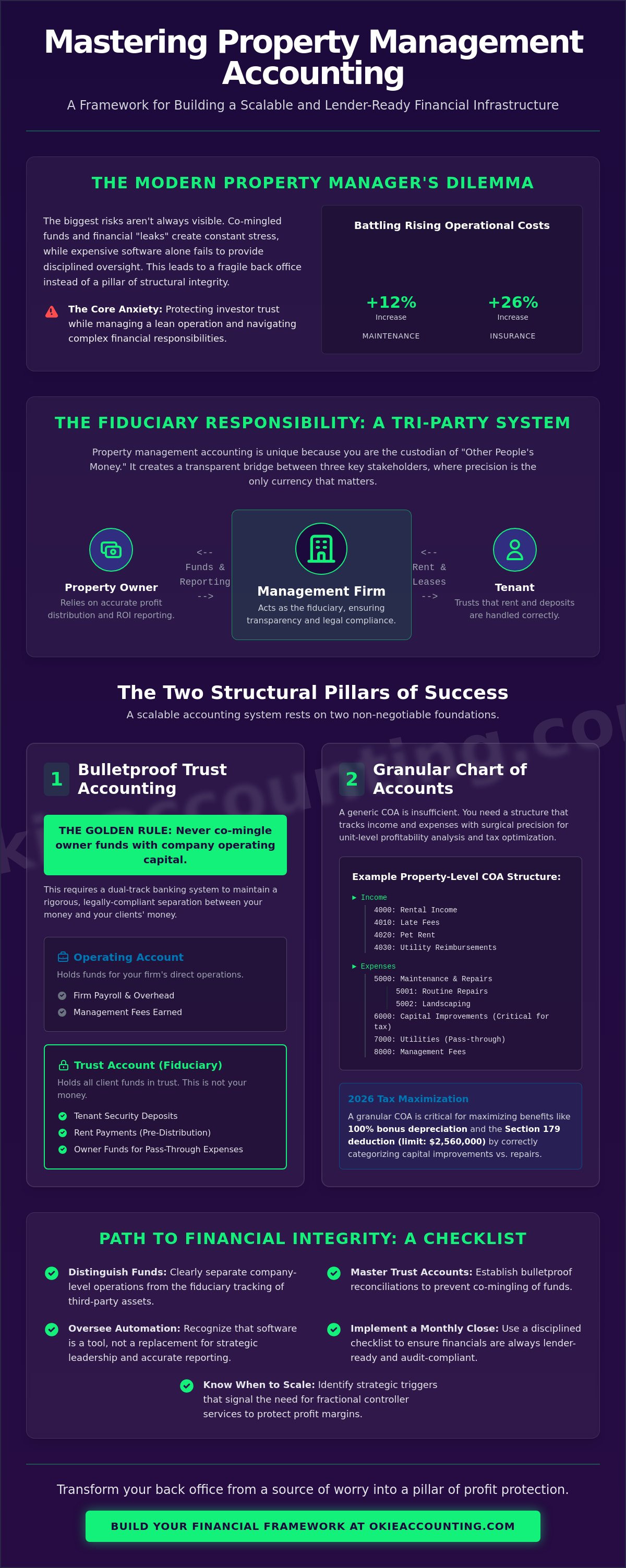
We understand that your goal is to protect investor trust while maintaining a lean operation. This article provides a strategic framework to help you achieve lender-ready financial statements and automated, yet supervised, bookkeeping systems. You'll discover how to leverage current AI-driven efficiencies to combat rising maintenance and insurance costs, which have climbed by 12% and 26% respectively according to recent industry data. By the end of this guide, you will have a clear path to transform your back office from a source of worry into a pillar of structural integrity and long-term profit protection.
Key Takeaways
Learn to distinguish between company-level operations and the fiduciary tracking of third-party assets to ensure long-term structural integrity.
Master the "Golden Rule" of accounting for property management companies by establishing bulletproof trust account reconciliations that prevent the co-mingling of funds.
Recognize why software automation alone creates technical debt and how strategic leadership is required to maintain accurate property-level reporting.
Implement a disciplined monthly close checklist and Work in Progress (WIP) tracking to ensure your financial statements are always lender-ready and audit-compliant.
Discover the strategic triggers that signal the need for fractional controller services to protect your profit margins as your portfolio scales.
What is Property Management Accounting and Why Does It Require Specialized Oversight?
Property management accounting is the fiduciary tracking of third-party assets, rental income, and operational expenses. It differs from standard business bookkeeping because you aren't just managing your own money; you're acting as a temporary custodian for millions of dollars in client capital. Effective accounting for property management companies creates a transparent bridge between three primary stakeholders: the management firm, the property owner, and the tenant. Each party relies on the accuracy of your ledger to verify that rent was paid, maintenance was performed, and profits were distributed fairly.
As we move through 2026, the regulatory environment has become increasingly stringent. With the 2026 IRS Section 179 deduction limit set at $2,560,000 and 100% bonus depreciation in effect, property owners are demanding more sophisticated reporting to maximize their tax positions. Specialized accounting for property management companies ensures that these distinct financial layers don't collapse into a chaotic mess of co-mingled data. This Property management overview highlights how the role has evolved from simple rent collection into a complex financial advisory position where precision is the only currency that matters.
The Fiduciary Responsibility of the Property Manager
Property managers are held to a higher financial standard than general business owners because they handle "other people's money." Mishandling security deposits or failing to segregate rent payments isn't just a bookkeeping error; it's a legal liability that can lead to license revocation or lawsuits. You must maintain a rigorous separation between your operating capital and the funds held in trust for your clients. Fiduciary duty in real estate funds is the legal and ethical obligation to act solely in the best financial interest of the property owner while maintaining absolute transparency in all transactions.
Key Differences Between General and Property Accounting
Standard retail bookkeeping focuses on a single entity's profit and loss. In contrast, property management involves a multi-entity structure where you manage an "Operating" set of books for your firm and separate "Property" ledgers for every owner in your portfolio. A major differentiator is the management of pass-through expenses, such as utility payments or contractor fees that are paid out of the owner's funds rather than your firm's revenue. Understanding the nuances of accounting for real estate investors is foundational to this process. It ensures that every dollar spent on a renovation or a repair is correctly categorized to protect the owner's ROI and your firm's reputation. This structural framework prevents the "technical debt" that occurs when generalist accountants try to apply standard rules to the specialized world of real estate.
The Structural Pillars: Trust Accounting and Property-Level Chart of Accounts
The foundation of scalable accounting for property management companies rests on two non-negotiable pillars: absolute segregation of funds and a granular Chart of Accounts. The "Golden Rule" in this sector is simple. Never co-mingle owner funds with company operating capital. While this sounds straightforward, the execution requires a dual-track banking system. Your Operating Account covers your firm's payroll and rent. Your Trust Account, however, holds tenant security deposits and rent that hasn't yet been distributed. Mismanaging this boundary is the quickest way to trigger a regulatory audit and destroy investor trust.
Establishing these systems correctly from the start prevents the "technical debt" that often plagues growing firms. When you integrate renovation and construction accounting into your property management workflow, the complexity doubles. You aren't just tracking rent; you're managing project-based draws and contractor holdbacks. Following a structured framework like Deloitte's Real Estate Accounting Guide ensures your firm stays aligned with the rigorous standards expected by institutional investors and regulatory bodies.
Mastering the Property-Level Chart of Accounts
A generic Chart of Accounts (COA) is insufficient for a growing portfolio. You need a structure that tracks income by specific unit and categorizes expenses with surgical precision. This level of detail allows you to distinguish between routine repairs and capital improvements, which is critical for maximizing 2026 tax benefits like bonus depreciation. A well-designed COA facilitates management accounting at scale by providing the data needed for unit-level profitability analysis. You must separate rental income from late fees, pet rent, and utility reimbursements. This clarity ensures that when an owner asks about a specific financial "leak," you have the data to explain it instantly.
Trust Account Compliance and Reconciliation
Compliance hinges on the "Three-Way Reconciliation." This process ensures that your bank balance matches your book balance, which must also match the sum of all individual owner liabilities. If these three numbers don't align, your books are out of balance and your firm is at risk. Common red flags include uncleared checks older than 90 days or negative owner balances. These discrepancies often trigger deeper regulatory scrutiny. Our fractional controller services provide the high-level oversight needed to verify these reconciliations and protect your firm from liability. If you're unsure if your current trust accounts would pass a surprise audit, you might benefit from a professional review of your financial structure.
Beyond the Software: Why Automated Tools Are Not a Substitute for Strategic Leadership
A common fallacy in the industry is that modern property management software (PMS) functions as a complete replacement for a skilled accountant. While these platforms are excellent for tracking tenant leases and maintenance requests, they often lack the robust double-entry accounting features required for corporate-level financial health. This assumption leads to "Technical Debt," where automated rules are misapplied across hundreds of units over several months. By the time the error is discovered, the ledger requires a costly, manual cleanup that could have been avoided with professional oversight. Effective accounting for property management companies recognizes that while AI adoption in the sector rose from 21% in 2024 to 34% in 2025, technology remains a tool for data collection, not a substitute for strategic decision-making. To protect the integrity of this digital data and the physical assets under management, many firms also invest in robust IT and security through providers like Beyer Bytes to safeguard their operations.
Strategic leadership ensures that your financial systems are configured to scale without breaking. This involves more than just clicking "approve" on a bank feed; it requires a deep understanding of how each transaction impacts your long-term stability. Relying solely on automated bank feeds without professional review introduces significant risk, as software cannot distinguish between a capital improvement and a routine repair without human context. Mastering QuickBooks for contractors and vendors is a critical part of this process, ensuring that your financial data is structured for maximum tax efficiency and 1099 compliance from the moment a work order is generated.
The Limitations of Property Management Software (PMS)
Most PMS modules are designed for property-level operations rather than complex corporate accounting or payroll management. This creates a gap in your financial visibility. We recommend a "Best of Breed" approach: use your PMS for tenant-facing operations and maintenance triage, but integrate it with a dedicated accounting platform like QuickBooks Online for your firm's internal books. This separation ensures that your corporate payroll, tax liabilities, and overhead expenses don't get lost in the noise of property-level transactions. Without this distinction, your firm's true profitability becomes nearly impossible to track.
The Value of Strategic Financial Interpretation
Strategic accounting for property management companies moves you from reactive bookkeeping to proactive cash flow forecasting. A skilled controller doesn't just record that maintenance costs rose by 12%; they analyze the data to determine if those costs are driven by specific vendors, aging systems, or inefficient dispatching. This insight allows you to make data-driven choices that protect your net operating income (NOI). Our software training programs are designed to bridge the gap between your digital tools and your long-term business goals, turning your financial data into a roadmap for growth rather than a source of confusion.
Establishing a Disciplined Monthly Accounting Cycle for Audit Readiness
A disciplined monthly cycle is the pulse of accounting for property management companies. It transforms chaotic daily transactions into a reliable financial narrative. Without a structured close, small errors compound quickly. This leads to inaccurate owner statements and a frantic scramble during tax season. Establishing a "hard close" by the 10th of each month ensures that your data remains fresh and actionable. This consistency is what separates high-performing firms from those struggling to maintain investor trust.
For firms overseeing renovations, Work in Progress (WIP) tracking is a critical component of this cycle. You must account for costs as they occur, ensuring that project-based draws are matched against actual expenses. This prevents profit distortion on your P&L and provides property owners with a transparent view of their capital investments. In 2026, regulatory focus on 1099-NEC and 1099-MISC compliance is sharper than ever. You must verify that every contractor has a valid W-9 on file before the first payment is issued to avoid significant non-compliance penalties. This proactive documentation protects both your firm and your clients from unnecessary legal exposure.
The Monthly Close Checklist
A successful close requires a systematic approach to data verification. Your team should follow a strict sequence to ensure no detail is overlooked. Start by verifying that all rental income has been recorded and that security deposit accounts match tenant ledgers exactly. Next, process owner distributions only after reconciling all property-level expenses. Reviewing your Aging A/R and Aging A/P reports is equally vital. This helps you identify potential cash leaks, such as uncollected late fees or overdue vendor invoices that could damage your credit reputation. If your firm manages on-site maintenance teams, integrating construction payroll services into this cycle ensures that labor costs are correctly allocated to specific properties for accurate reporting.
Preparing for Audits and Refinancing Events
Lender-ready financial statements are the hallmark of a professional management firm. When an investor decides to refinance a property, they need GAAP-compliant reports that clearly demonstrate the asset's performance. Organizing digital receipts and contracts for instant retrieval is no longer optional; it's a requirement for securing favorable loan terms. High-quality monthly bookkeeping builds the foundation for this readiness, providing the documentation needed to withstand a surprise regulatory audit. By maintaining these standards, you position your firm as a strategic partner capable of supporting an investor's long-term growth. If you're ready to move beyond basic data entry, schedule a discovery call to audit-proof your monthly cycle.
Scaling Your Portfolio with Fractional Controller Services
Scaling a property management business often reveals a hidden "complexity ceiling." While basic bookkeeping suffices when you're managing a handful of units, the systems usually begin to fail once you reach the 50 to 100 unit mark. At this stage, accounting for property management companies evolves from simple transaction recording into a high-stakes game of risk management and capital allocation. You aren't just looking for someone to categorize expenses; you need a strategic partner who can verify internal controls and provide the data-driven insights necessary to keep your most valuable owners from leaving.
The ROI of hiring a fractional controller far outweighs the cost of a full-time in-house executive. You gain access to C-suite financial expertise, advanced cash flow forecasting, and rigorous audit preparation without the burden of a six-figure salary and benefits package. This specialized oversight ensures that your firm remains agile and prepared for the 10% projected growth in the property management software market. By professionalizing your back office, you signal to institutional investors that your firm is built on a foundation of structural integrity rather than administrative guesswork.
As you evaluate your staffing needs, you can visit CTC Tax & Accounting to learn more about the distinct functions of accountants and tax specialists in a growing business.
Transitioning from Bookkeeping to Controllership
The move to fractional controller services marks the transition from reactive to proactive management. A controller doesn't just tell you what happened last month; they help you plan for the next twenty-four months. They establish the internal controls that prevent fraud and ensure that every distribution is backed by cleared funds. This level of oversight is essential for maintaining owner retention. Investors are increasingly sensitive to financial "leaks" and opaque reporting in a high-interest-rate environment where every basis point of ROI matters. By providing lender-ready statements and clear property-level analysis, you become an indispensable partner in their investment journey.
Next Steps: Building Your Financial Infrastructure
Your path forward should begin with a customized Financial Roadmap that aligns your accounting systems with your growth targets. If your firm handles flips, large-scale renovations, or property development, you must integrate construction cash flow management into your core operations. This ensures that project draws don't disrupt your property-level liquidity or cause friction with your vendors. Okie Accounting Group LLC focuses on building a framework that protects your profit while providing the clarity you need to scale confidently. Don't let your financial systems be the bottleneck of your ambition. Connect with Okie Accounting Group LLC today to build a scalable infrastructure for tomorrow.
Securing Your Growth Through Strategic Financial Oversight
The transition from basic rent collection to sophisticated portfolio management demands a rigorous approach to accounting for property management companies. As established, a disciplined monthly close and bulletproof trust account reconciliations are the only ways to insulate your firm from regulatory risk. By moving beyond the limitations of automated software and embracing strategic leadership, you transform your back office into a powerful engine for investor trust. This structural integrity is what ultimately allows you to scale past operational bottlenecks and maintain long-term profitability.
Okie Accounting Group LLC specializes in real estate investor and property management frameworks, providing nationwide cloud-based oversight that scales with your ambition. Led by industry expert Sarah O’Quinn, our team acts as your strategic partner to build the financial systems your business deserves. Don't let financial complexity hinder your expansion. Gain Financial Clarity for Your Portfolio; Schedule a Consultation with Okie Accounting Group LLC. You have the vision to grow your portfolio, and we have the expertise to ensure your financial infrastructure is ready to support it.
Frequently Asked Questions
What is the difference between cash and accrual accounting for property management?
Cash accounting records transactions only when money changes hands, while accrual accounting records them when they are earned or incurred. Most firms use cash accounting for property-level owner reports because investors want to see the actual liquid cash available. However, you should use accrual accounting for your corporate entity to get a true picture of your firm's long-term financial health by matching revenue with the correct period.
Is a separate bank account required for each property I manage?
You don't typically need a separate bank account for every individual property, but you must have dedicated trust accounts that are separate from your operating funds. Most managers use one consolidated trust account for rents and another for security deposits. Your accounting software then uses sub-ledgers to track the specific balance for each property and owner within those consolidated accounts to maintain legal separation.
How often should I reconcile my property management trust accounts?
You should reconcile your trust accounts at least once a month as part of your standard close process. For high-volume firms, performing a weekly reconciliation prevents small errors from ballooning into major compliance issues. Consistent reconciliation ensures that your bank balance, book balance, and owner liabilities always remain in perfect alignment, which is a non-negotiable standard for accounting for property management companies.
Can I use QuickBooks Online for property management accounting?
Yes, you can use QuickBooks Online, but it's best utilized for your corporate-level books rather than property-level tenant tracking. While QuickBooks excels at payroll and firm-level financial reporting, it lacks the specialized sub-ledger capabilities of dedicated property management software. A "best of breed" approach uses specialized software for operations and QuickBooks for the overarching financial management of your management firm.
What are the most common accounting mistakes property managers make?
The most frequent errors include co-mingling operating and trust funds, failing to perform three-way reconciliations, and improper handling of security deposits. Many firms also struggle with inaccurate categorization of pass-through expenses, which distorts property-level profitability. These mistakes often stem from relying on automated software rules without professional oversight to verify the accuracy of the underlying data entering your system.
How do I handle security deposits in my bookkeeping system?
Security deposits must be held in a dedicated trust account and recorded as a liability on your balance sheet, never as income. These funds belong to the tenant until they are either returned or legally applied to repairs after a move-out. Maintaining this separation is a critical component of accounting for property management companies to ensure you are always prepared for a tenant refund or a surprise regulatory audit.
Do I need to issue 1099s to vendors if the property owner paid them directly?
If a property owner pays a contractor directly from their own personal funds, the responsibility to issue a 1099 typically rests with the owner. However, if the payment is processed through your management firm or your trust accounts, you are legally required to issue the 1099-NEC or 1099-MISC. You should always verify that a W-9 is on file before any funds are disbursed to avoid year-end compliance penalties.
What is a fractional controller and how can they help my management firm?
A fractional controller is a high-level financial strategist who provides expert oversight on a part-time or project basis. They help your firm by establishing internal controls, managing cash flow forecasting, and interpreting complex financial data to drive growth. This service allows you to access executive-level expertise without the cost of a full-time hire, providing a scalable solution for firms that have outgrown basic bookkeeping.


Comments