Strategic Accounting for Real Estate: 2026 Growth Framework

Updated: Nov 7
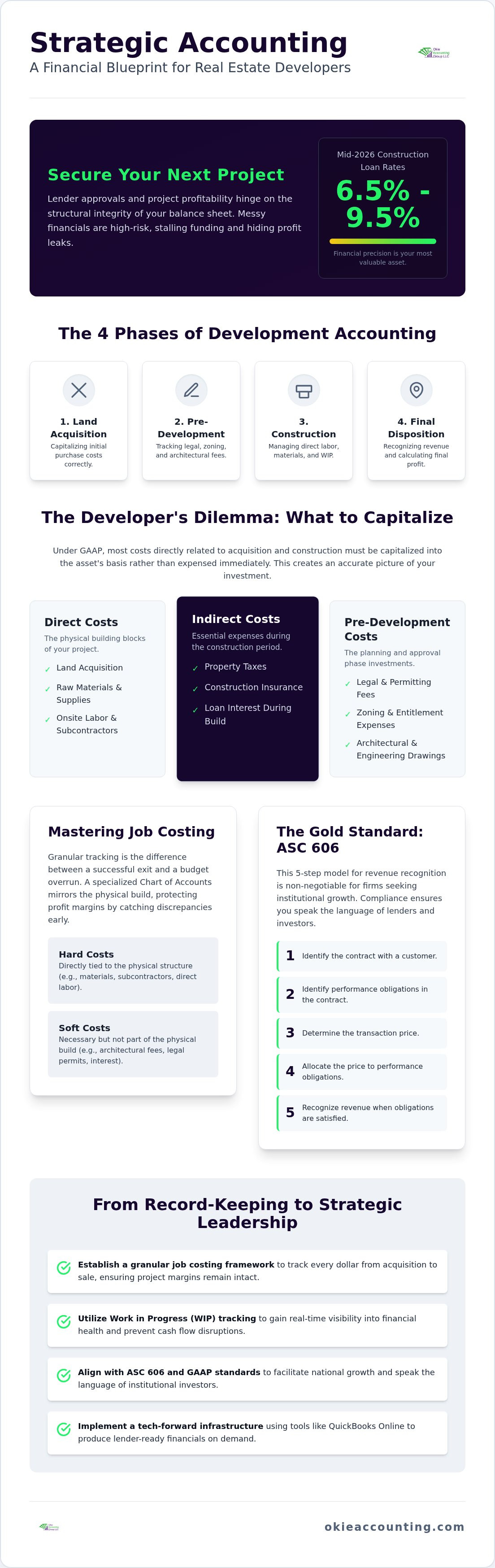
Your next major construction loan won't be won on the quality of your blueprints alone; it'll be won on the structural integrity of your balance sheet. While many firms treat their books as a record of the past, high-growth developers use them as a blueprint for the future. Strategic accounting for real estate developers is no longer just about tracking invoices. It's about building a disciplined framework that protects your margins across multi-year lifecycles. With construction loan interest rates in mid-2026 ranging from 6.5% to 9.5% for professional builders, your financial precision is now your most valuable asset.
You likely know the frustration of fluctuating cash flow or the stress of messy financials that stall lender approvals. It's difficult to scale when you're unsure if a project is truly profitable until the final unit is sold. This guide will show you how to master complex development accounting, from ASC 606 revenue recognition to advanced job costing. We'll explore how to transform your financial reporting into a strategic framework that secures financing and provides real-time visibility into every square foot of your portfolio.
Understanding the Complexity of Real Estate Development Accounting
Accounting for real estate developers isn't just about recording transactions; it's about managing a multi-year financial narrative. Unlike retail businesses that see immediate turnover, developers deal with long-term assets, complex debt structures, and significant lag times between initial expense and final revenue. If your books are messy, you aren't just disorganized. You're high-risk. Lenders and investors look for structural integrity in your data before they'll commit capital to your next project. Precision in your ledger is the difference between a project that scales and one that stalls due to lack of funding.
The Real estate development process moves through distinct phases: land acquisition, pre-development, construction, and final disposition. Each stage requires a different accounting focus. Reactive bookkeeping merely records what happened last month. Proactive strategic accounting anticipates the cash flow needs of the next six months. It ensures that every dollar spent is categorized correctly from day one. This proactive stance protects your future margins and builds an atmosphere of trust with your financial partners.
Capitalization vs. Expense: The Developer’s Dilemma
One of the biggest hurdles in accounting for real estate developers is knowing which costs to capitalize. Under GAAP, most costs directly related to the acquisition and construction of an asset must be capitalized into the asset basis rather than expensed immediately. This creates a more accurate picture of your investment on the balance sheet. Key items to track include:
Direct Costs: Land, materials, and onsite labor.
Indirect Costs: Property taxes, insurance, and interest incurred specifically during the construction period.
Pre-development Costs: Legal fees, zoning expenses, and architectural drawings.
Failing to capitalize correctly can artificially deflate your asset value and lead to significant tax reporting errors. It's a delicate balance that requires deep industry expertise to maintain long-term stability.
The Role of GAAP and ASC 606 in 2026
As of 2026, compliance with ASC 606 remains the gold standard for revenue recognition. This five-step model requires developers to identify the contract, determine performance obligations, and allocate the transaction price. The timing of when you recognize revenue, whether at a specific point in time or over the duration of the project, can radically change your financial profile. Maintaining this compliance isn't just a regulatory hurdle. It's about ensuring the structural health of your firm so you're always ready for a capital call or a lender audit. When your financials are GAAP-compliant, you speak the language of institutional growth.
Mastering Job Costing and Cost Allocation in Development Projects
Job costing is the granular tracking of every dollar spent on a specific project or phase. In the world of real estate, it's the difference between a successful exit and a budget overrun that wipes out your equity. Generic accounting systems often fail because they treat all expenses as overhead. They don't account for the fact that a developer's inventory is a multi-year construction project. Effective accounting for real estate developers requires a specialized Chart of Accounts that mirrors the physical build, allowing you to see exactly where capital is deployed at any given moment.
A robust accounting framework protects your profit margins by catching discrepancies early. If your framing costs are 15% over budget in Phase 1, you need that data immediately to adjust your strategy for Phase 2. This level of oversight transforms your financials from a tax-time chore into a strategic weapon. You aren't just recording history. You're managing your future profitability through data-driven decisions. It ensures that every loan draw is justified and every cost is accounted for before it becomes a crisis.
Allocating Soft Costs and Hard Costs
Precision in cost allocation is essential for maintaining structural integrity in your reporting. Hard costs like materials, subcontractors, and direct labor are typically straightforward to track. However, soft costs often create profit leaks if they aren't handled with discipline. Architectural fees, legal permits, and interest expenses must be allocated across projects or specific units to reflect the true cost of goods sold. When you allocate these costs accurately, you gain a clear view of your break-even point for every unit in the development. This clarity is vital when you're deciding whether to hold an asset or sell in a fluctuating market.
Lender-Ready Financials: The Power of Accurate Data
Lenders prioritize developers who demonstrate a mastery of their project-specific data. When you submit a draw request, a bank wants to see more than just a stack of invoices. They want to see that your job costing aligns with your initial budget and your percentage of completion. Accurate, real-time data speeds up the funding process and builds a track record of reliability. This level of financial readiness is what we call building lender-ready financials. By maintaining this standard, you position your firm for easier financing on future projects. If you're ready to move beyond basic bookkeeping, you can schedule a discovery call to see how a strategic partner can strengthen your financial foundation.
Navigating Revenue Recognition and WIP for Profit Protection
While job costing tracks the granular details of your spend, Work in Progress (WIP) accounting provides the structural framework for your entire profit and loss statement. For many firms, the biggest threat to stability isn't a lack of projects, but a lack of visibility into project health. Without a functional WIP report, your monthly financials are essentially a guess. Accounting for real estate developers must move beyond cash-basis tracking to reflect the reality of multi-phase builds. If you only look at your bank balance, you might feel wealthy while actually being dangerously over-billed.
The danger of over-billing and under-billing cannot be overstated. Over-billing occurs when you've invoiced more than the work performed; this creates a liability that can mask a looming cash flow crisis. Under-billing means you've performed work you haven't yet collected on, which effectively turns your firm into a zero-interest lender for the project. A disciplined WIP framework identifies these imbalances every month. It ensures that your revenue aligns with your actual progress, protecting your margins from the "profit fade" that often plagues long-term developments.
The Mechanics of WIP Accounting
Effective WIP management requires a rigorous reconciliation of estimated costs versus actual costs in real-time. You calculate the percentage of completion by dividing the total actual costs to date by the total estimated project costs. This percentage then dictates how much revenue you can safely recognize on your P&L. WIP accounting acts as the essential bridge between project management and financial reporting. By adjusting your books monthly to reflect these figures, you ensure that your financial statements are accurate and ready for stakeholder review at any moment.
Protecting Profits Through Monthly Financial Reviews
A strategic partner doesn't just hand over a report; they help you interpret the signals within the data. Monthly financial reviews are a non-negotiable discipline for developers who want to scale nationally. These sessions allow you to catch variances before they become insurmountable budget overruns. When a WIP report shows that a project is veering off-track, it serves as an early warning system to adjust subcontractor agreements or material sourcing. Implementing these internal controls prevents financial slippage and reinforces the structural integrity of your firm's growth framework.
Building a Tech-Forward Financial Infrastructure with QuickBooks Online
Spreadsheets are the enemy of scale. While they might suffice for a single-property flip, managing a multi-phase development portfolio on manual tabs is a recipe for data fragmentation and human error. Modern accounting for real estate developers requires a centralized, cloud-based general ledger that serves as the single source of truth. QuickBooks Online has emerged as the industry standard because it balances accessible design with the robust reporting capabilities needed for GAAP compliance. It's the foundational layer of a tech-forward financial infrastructure that supports national growth.
A sophisticated system does more than just record history. It automates the mundane to protect your time and your margins. By integrating your accounting general ledger with project management tools, you eliminate the need for double data entry. This connectivity ensures that when a project manager approves a subcontractor's invoice in the field, it reflects in your cash flow forecast immediately. Automated payroll and subcontractor payment workflows further strengthen your structural framework, ensuring compliance with labor laws and lien waiver requirements without constant manual oversight.
Customizing Your Developer Tech Stack
Selecting the right version of QuickBooks Online is the first step in building a resilient system. For developers who need detailed job costing, the Advanced version offers the granular tracking necessary to monitor multi-phase builds. This setup allows for seamless integration with third-party tools specialized in document management and lien waiver tracking. Moving from manual spreadsheets to this cloud-based framework provides the real-time visibility that lenders demand in 2026. It transforms your data from a static record into a dynamic asset that informs every land acquisition and capital call.
QuickBooks Training for Development Teams
The most advanced software is only as effective as the data entered into it. High-growth firms invest in professional QuickBooks Setup & Training to ensure their staff records transactions with project-level precision. This isn't just about learning where to click. It's about establishing standardized entry procedures that maintain data integrity across your entire portfolio. When your team understands how to categorize costs correctly, you gain the confidence to make data-driven choices. If you want to move beyond basic bookkeeping and establish a professional financial foundation, book a discovery call today to discuss your custom software implementation.
Scaling Your Firm with Fractional Controller Oversight
Every developer reaches a point where basic bookkeeping no longer provides the necessary clarity to move the needle. It's the moment when your volume of work exceeds your capacity for manual oversight. Strategic accounting for real estate developers at this level requires more than just recording receipts; it demands a high-level advisor who can interpret the data built in your tech stack and WIP reports. A Fractional Controller acts as this bridge, moving your firm from administrative survival to proactive financial leadership. They ensure your structural framework is resilient enough to handle the pressures of national expansion.
This role is fundamentally about profit protection. While a bookkeeper ensures your transactions are categorized, a controller ensures your business model is sustainable. They mitigate risk by stress-testing your cash flow and optimizing how you deploy capital across multiple project lifecycles. This transition allows you to focus on high-stakes decisions like land acquisition while having the confidence that your financial foundation is being monitored by an expert invested in your success. It's a disciplined approach that alleviates the stress of financial uncertainty.
Strategic Financial Leadership for Developers
Good data is useless if you don't know how to use it. A controller provides the mentorship needed to turn your financial reports into a roadmap for growth. They help you build sophisticated budgets and forecasts that account for the current interest rate environment and volatile material costs. By interpreting these signals, you can decide with certainty when to pull the trigger on a new deal or when to sit on your cash reserves. This partnership creates a sense of order and predictability, mirroring the organized systems your business needs to thrive.
The ROI of Specialized Accounting Oversight
Professional oversight is an investment that pays for itself through risk mitigation. A single error in cost allocation or a missed variance in a WIP report can cost more than a year of controller services. Beyond immediate profit protection, this level of oversight prepares your firm for the future. Whether you're preparing for a lender audit, looking to be acquired, or planning a generational transition, having clean, strategic financials is non-negotiable. It provides the structural integrity needed to scale without the fear of financial collapse. If you're ready to build a framework for scalable profitability, Schedule a strategy session with Okie Accounting Group LLC to see how we can support your growth.
Constructing Your Financial Blueprint for Scalable Growth
The transition from a reactive business to a proactive powerhouse starts with the data you collect today. We've explored how integrating granular job costing and WIP reporting creates a structural framework that protects your equity. By establishing lender-ready financial reporting, you remove the barriers to national growth and secure the capital needed for your 2026 pipeline. Specialized accounting for real estate developers isn't just about compliance; it's the foundation of every successful land acquisition and multi-phase build.
A strategic partner provides the professional discipline to ensure your projects remain profitable and your firm stays resilient. It's time to trade financial confusion for data-driven confidence. Whether you're refining your tech stack or seeking senior-level leadership, the path to scale requires a dedicated financial mentor who understands the mechanics of your specific market and speaks the language of institutional growth.
Ready to protect your margins and build a scalable system? Schedule a strategy session with Okie Accounting Group LLC. We're here to help you build a legacy of stability and success.
Frequently Asked Questions
What is the difference between real estate bookkeeping and real estate accounting?
Bookkeeping is the administrative process of recording daily transactions, while accounting is the strategic interpretation of that data to build a structural framework. Bookkeeping ensures that invoices are paid and entries are categorized. Accounting involves analyzing those records to manage capitalization, compliance, and long-term profit protection. While bookkeeping tracks where your money went, accounting tells you where your business is going.
How should real estate developers handle land acquisition costs on their books?
Land acquisition costs must be capitalized as part of the asset basis on your balance sheet rather than being expensed immediately. This includes the purchase price, legal fees, title insurance, and any costs directly related to securing the property. These costs remain on the balance sheet until the project is completed and sold, at which point they are recognized as part of the cost of goods sold.
Why is job costing so important for real estate development projects?
Job costing provides a granular view of your spend against specific project milestones, allowing you to identify budget variances before they become crises. It's the only way to accurately track the profitability of individual phases or units in a multi-year build. Without this precision, you risk profit fade and may struggle to provide the detailed data lenders require for construction draw approvals.
What are the most common accounting mistakes real estate developers make?
The most frequent errors include expensing indirect costs that should be capitalized and miscalculating Work in Progress (WIP) adjustments. Many firms also fail to reconcile estimated costs against actual spend on a monthly basis, leading to distorted profit margins. These mistakes create messy financials that can stall lender financing and lead to unexpected tax liabilities during the final stages of a project.
How does ASC 606 affect revenue recognition for condo or multi-unit developers?
ASC 606 mandates a five-step process that typically shifts revenue recognition to the point when control of the unit legally transfers to the buyer. For most developers, this means you can't recognize revenue as you receive progress payments. Instead, income is deferred on the balance sheet until the closing. This standard ensures that your P&L reflects the actual completion of your performance obligations to the customer.
When should a growing real estate development firm hire a fractional controller?
You should hire a fractional controller when your financial reporting needs to transition from administrative record-keeping to strategic forecasting. This tipping point usually occurs when you're managing multiple projects or seeking institutional capital. A controller provides the high-level oversight needed to mitigate risk and optimize cash flow, allowing you to focus on high-stakes land acquisitions and business growth.
Can QuickBooks Online handle the complex job costing needs of a developer?
QuickBooks Online Advanced offers the robust project tracking and reporting capabilities required for modern accounting for real estate developers. When set up correctly, it functions as a cloud-based general ledger that integrates with specialized project management tools. It allows you to track labor, materials, and soft costs at the project level, providing the real-time visibility needed to protect your margins across your entire portfolio.
How does accurate accounting help a developer secure construction loans?
Lenders prioritize "lender-ready" financials that prove you have a meticulous grasp of your project margins and debt obligations. Accurate accounting for real estate developers provides the transparency banks need to approve draw requests quickly and commit capital to future projects. By demonstrating a disciplined financial framework, you lower the perceived risk for the lender and position your firm as a reliable, strategic partner.


Comments