Strategic Growth: The Role of a Fractional Controller for Construction Companies in 2026

Updated: 6 days ago
Most construction owners treat their financial records like a rearview mirror, but your balance sheet should actually be a blueprint for your next build. Hiring a fractional controller for construction companies is about more than just cleaning up messy QuickBooks files; it's about installing a professional-grade financial engine. You've likely felt the frustration of watching profits vanish into project overruns or realized too late that a job wasn't as lucrative as the initial estimate suggested. It's exhausting to lead a growing firm when your data feels like a pile of unorganized scraps rather than a clear map.
We understand that you need more than a historian to record what happened last month. You need a strategic partner to build a foundation for what happens next. This article explains how a fractional controller moves your construction firm from basic data entry to a strategic financial framework that protects your margins and scales your operations. We'll preview the essential transition from administrative tasks to high-level oversight, including accurate WIP reporting and the data-driven decisions required to thrive in the 2026 market.
Why General Bookkeeping Often Fails Growing Construction Companies
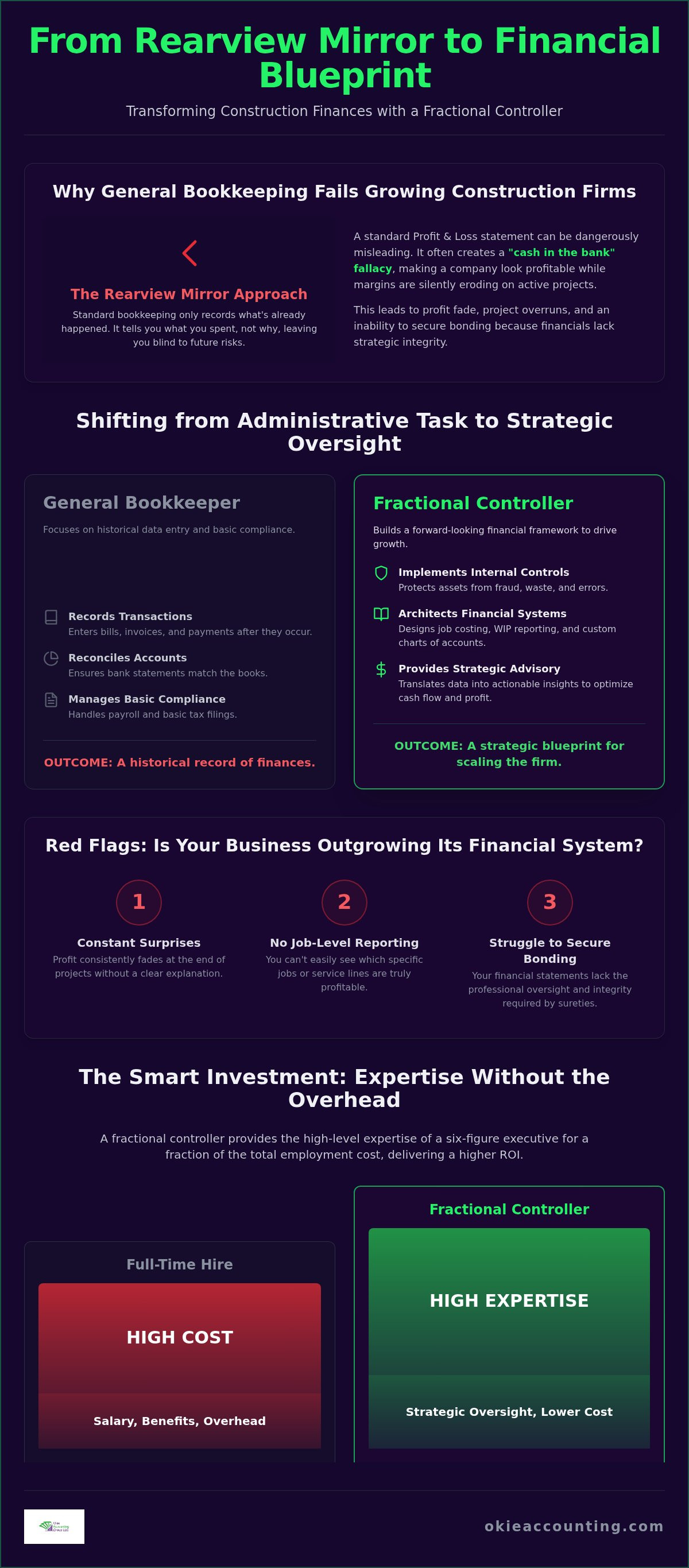
Most construction firms start with a basic bookkeeper who records transactions after they happen. While this keeps you compliant with the IRS, it does nothing to protect your margins on a job site. A bookkeeper tells you what you spent; a fractional controller for construction companies tells you why you spent it and how to prevent that cost from eroding your next bid. General bookkeeping is essentially a look in the rearview mirror, but a growing firm requires a windshield that provides a clear view of the road ahead.
A standard Profit and Loss statement is often a blunt instrument in the construction industry. It shows total revenue and total expenses but fails to account for the timing of those costs. You might see a healthy bottom line today while actually being "upside down" on three major projects because of unrecorded liabilities or front-loaded billings. This creates a "cash in the bank" fallacy where owners feel secure while their profit is actually bleeding out through unmonitored project overruns and inaccurate job costing data.
The Complexity of Construction Accounting
Construction is inherently project-based, requiring a level of granularity that generalist accounting simply isn't built to handle. Without specialized oversight, you lack visibility into whether a specific site is profitable or just being subsidized by other jobs. Accurate reporting relies heavily on WIP accounting for construction to reconcile billings with actual progress. Red flags that your current system is failing include:
Constant "surprises" and profit fade at the end of a project.
A lack of job-level reporting that prevents you from seeing which service lines are most lucrative.
A recurring struggle to secure bonding because your financials lack structural integrity and professional oversight.
Moving from Administrative Tasks to Strategic Oversight
The shift from administrative tasks to strategic oversight marks the difference between surviving and scaling. A bookkeeper focuses on data entry and compliance, ensuring the bills are paid and the bank is reconciled. In contrast, a financial controller interprets that data to identify trends, mitigate risks, and optimize cash flow. They provide the high-level discipline required to move beyond simple record-keeping and into proactive management. A fractional controller for construction companies ensures your financial data is used to drive growth rather than just document expenses.
A strategic framework for 2026 construction growth is a disciplined financial architecture that converts real-time project data into actionable intelligence to protect margins and secure long-term stability.
What Does a Fractional Controller Do for a Construction Firm?
A fractional controller for construction companies serves as the bridge between day-to-day data entry and high-level strategic planning. While a Chief Financial Officer (CFO) typically manages external relationships and capital structure, the controller is the guardian of internal data integrity. They don't just record what happened; they build the systems that ensure every dollar is accounted for before it leaves the bank. This role provides the financial leadership your firm needs on a part-time basis, offering professional-grade oversight without the overhead of a six-figure executive salary.
One of the most critical functions is the implementation of rigorous internal controls. In an industry where fraud and waste can hide in complex subcontracts and material orders, a controller establishes the checks and balances necessary to protect your assets. They oversee construction bookkeeping services to ensure that every transaction aligns with the broader financial strategy. This oversight includes managing the month-end close process, which results in lender-ready financial statements that provide an accurate snapshot of your company's health.
The Architect of Financial Structural Integrity
A controller acts as the architect of your financial systems. They design a Chart of Accounts specifically for contractors, ensuring that costs are categorized to reflect real-world operations. This structural integrity is essential for accurate Job Costing and WIP Reporting. Beyond the ledger, they manage the nuances of high-overhead environments, such as cash flow forecasting and ensuring compliance with Davis-Bacon regulations on prevailing wage projects. This level of detail prevents the compliance surprises that often derail growing firms.
Interpretation and Strategic Advisory
Raw data is useless if it isn't interpreted. A fractional controller for construction companies translates complex reports into actionable insights, helping you understand which projects are driving profit and which are draining resources. These monthly financial reviews become the heartbeat of your firm, providing a dedicated space to discuss performance and adjust course. By engaging with specialized controller services, you gain a mentor who values accuracy and long-term stability. If you're ready to move beyond basic data entry, you can schedule a discovery call to discuss building a more resilient financial framework.
Fractional Controller vs. Full-Time Hire: An ROI Analysis
Deciding between a full-time employee and a fractional partner is a pivotal choice for any growing firm. For many contractors, the traditional route of hiring a full-time controller seems like the logical next step, yet the math often tells a different story. In 2026, a full-time controller in the United States commands a total compensation package ranging from $120,000 to $185,000 when you factor in benefits, taxes, and overhead. This represents a massive fixed cost that remains static even when your project volume fluctuates. A fractional controller for construction companies offers a more agile alternative, providing high-level expertise that scales alongside your revenue without the burden of executive-level benefits packages.
The "Skill Gap" is a hidden risk in the hiring process. A mid-level accountant might manage the books well enough, but they often lack the specialized knowledge to navigate complex revenue recognition or bonding requirements. By engaging a fractional expert, you aren't just hiring a person; you're acquiring a proven system. This partnership delivers an immediate return on investment by reclaiming the owner's time and improving bid accuracy. When you stop acting as your own part-time accountant, you can focus on high-value activities like business development and project execution.
When to Make the Switch
Most construction firms find that the need for a fractional controller for construction companies becomes urgent once they hit the $2 million to $10 million revenue milestone. At this stage, the complexity of the business often outpaces the capabilities of a general bookkeeper. Complexity triggers such as managing union payroll, meeting strict bonding requirements, or overseeing multiple concurrent projects demand a higher level of financial discipline. Waiting too long to make this switch often results in "cheap" bookkeeping becoming incredibly expensive through missed billings, uncaptured change orders, or costly reporting errors.
The "Team" Advantage
A fractional controller brings a broader industry perspective than a single in-house hire could provide. Because they work with multiple firms, they stay at the cutting edge of best practices and specialized QuickBooks for contractors expertise. This collective knowledge allows them to identify red flags in your data before they become disasters. Construction firms that optimize their project margins by even 2-3% through better job costing often see an ROI that covers the cost of fractional services several times over within the first year. This structural approach ensures your firm is built on a foundation of data-driven stability rather than guesswork.
The Framework: Implementing Job Costing and WIP Reporting
A robust financial framework is the difference between a contractor who guesses and one who knows. Implementing this structure begins with standardizing the job costing process across every active site. Without a uniform method for tracking costs, your data becomes a collection of isolated anecdotes rather than a cohesive story. A fractional controller for construction companies establishes these standards, ensuring that every project follows the same rigorous tracking protocols. By using QuickBooks Online as a centralized hub, you can integrate field data with the back office to achieve real-time visibility into your operational health.
The goal is to move away from siloed information where the field and the office speak different languages. When your accounting system reflects the actual progress on the ground, you gain the ability to spot inefficiencies before they drain your bank account. This level of integration creates a single source of truth that allows you to manage multiple projects with quiet confidence. It turns your financial records into a reliable map for scaling your operations.
Mastering Job Costing in 2026
Effective job costing relies on the three pillars of project tracking: labor, materials, and overhead. In 2026, simply recording these expenses isn't enough. You must identify "budget vs. actual" variances before they escalate into financial crises. A controller plays a vital role here by vetting project estimates against historical data to ensure your bids are grounded in reality. When you track labor hours and material costs against the original budget in real time, you can adjust field operations before the profit margin evaporates. This proactive oversight moves your accounting from a clerical function to a defensive shield for your bottom line.
WIP Reporting and Revenue Recognition
Accurate Work-in-Progress (WIP) schedules are the cornerstone of revenue recognition for contractors using the "Percentage of Completion" method. This accounting standard allows you to recognize income based on the progress of a project rather than just the cash that has changed hands. Lenders and bonding agents require these reports because they provide a transparent view of your company's true obligations and earnings. A fractional controller for construction companies ensures these reports are not just compliant, but strategically useful for managing risk. Accurate WIP reports stabilize monthly cash flow by ensuring that billings and costs are perfectly aligned with project milestones.
Building this level of structural integrity requires more than just software; it requires a disciplined methodology. If your current reporting lacks the clarity needed to secure bonding or manage multiple projects, it's time to build a better system. You can book a discovery call to learn how a strategic financial framework can protect your margins and support your next phase of growth.
Scaling Your Firm with Okie Accounting Group LLC’s Fractional Controller Services
Sarah O’Quinn and the team at Okie Accounting Group LLC specialize in rescuing contractors from the weight of disorganized data. We don't just fix entries; we build a structural framework designed for long-term health. As a fractional controller for construction companies, we provide the proactive financial leadership required to navigate the complexities of 2026. Whether you're managing the restoration of 100% bonus depreciation or adjusting to shifting retention laws, our methodology ensures your firm remains resilient. Our cloud-based approach allows us to serve Tennessee-based firms and national contractors with equal precision, ensuring your financials are always accessible and secure.
Transitioning from financial confusion to operational clarity requires a partner who understands the unique mechanics of the construction market. We move beyond the role of a traditional vendor to become a strategic mentor for your business. By focusing on foundational systems, we help you graduate from basic bookkeeping to high-level oversight. This shift allows you to stop reacting to past mistakes and start planning for future growth with data-driven confidence.
A Partnership for Profit Protection
Our approach is designed to integrate seamlessly with your existing team and workflows. We don't disrupt your operations; we enhance them by providing the disciplined oversight necessary for profit protection. This partnership results in lender-ready financials that satisfy bonding agents and banks alike. When your records possess structural integrity, you can secure the capital and bonding capacity needed for larger projects. For firms that require ongoing support to maintain this level of excellence, our management accounting services provide the continuous visibility required to stay ahead of the competition.
Ready to Build Your Financial Foundation?
The journey begins with a thorough discovery process. We assess your current financial health, identify gaps in your reporting, and uncover the red flags that are draining your margins. This assessment allows us to customize the fractional controller for construction companies engagement to your firm’s specific needs. We don't believe in one-size-fits-all solutions; we believe in building a financial engine that matches the scale and ambition of your business.
Scaling a construction firm is difficult enough without the burden of messy books. It's time to install the professional-grade financial framework your hard work deserves. If you're ready to stop guessing and start leading with clarity, you can Schedule a consultation with Okie Accounting Group LLC today. Let’s build a foundation that protects your profits and supports your long-term vision.
Building a Resilient Financial Foundation for 2026
The transition from history-keeping to a forward-looking financial architecture is the most significant move a growing contractor can make. By implementing the job costing and WIP reporting systems discussed, you move beyond the "cash in the bank" fallacy and into a state of operational clarity. A fractional controller for construction companies provides the high-level discipline needed to protect your margins while offering the scalability that a full-time executive hire lacks. This strategic oversight ensures that every bid is grounded in reality and every project is monitored for maximum profit protection.
At Okie Accounting Group LLC, we combine specialized construction industry expertise with QuickBooks Online ProAdvisor certification to deliver remote nationwide service that scales with your ambition. We don't just record history; we act as strategic partners invested in your stability. If you're ready to stop reacting to project overruns and start leading with data-driven confidence, it's time to build a better system. Build your strategic financial framework with Okie Accounting Group LLC. Your firm deserves a financial engine that's as strong as the structures you build. We're here to help you construct that foundation.
Frequently Asked Questions
What is the difference between a bookkeeper and a fractional controller?
A bookkeeper focuses on recording past transactions to maintain compliance, while a fractional controller for construction companies builds the structural systems that ensure data integrity. One manages the administrative task of data entry; the other provides strategic oversight through internal controls and financial reporting. A controller interprets the data to identify risks before they erode your project margins.
How much does a fractional controller for a construction company cost?
The cost depends on your firm’s revenue and the complexity of your project load. While a full-time controller in 2026 can cost between $120,000 and $185,000 annually including benefits, a fractional partner provides the same high-level expertise for a predictable monthly fee. This model allows you to access executive leadership without the burden of a massive fixed salary.
Does my construction company need a fractional controller if I use QuickBooks?
QuickBooks is a powerful tool, but it's only as reliable as the architectural framework behind it. You need a controller to design specialized job costing workflows and Work-in-Progress (WIP) schedules that the software doesn't automate. Professional oversight ensures your QuickBooks data is accurate enough for bonding agents and lenders to trust your financial health.
How many hours a month does a fractional controller typically work?
Most engagements range from 10 to 40 hours per month depending on your specific needs. This flexibility is a key advantage, as it allows your firm to scale professional oversight up or down as project volume fluctuates. You get the benefit of a disciplined financial mentor without paying for idle time during slower construction seasons.
Can a fractional controller help my construction firm get a higher bonding limit?
Yes, providing lender-ready, GAAP-compliant financials is essential for securing and increasing your bonding capacity. Sureties look for the professional-grade oversight a controller provides to verify that your WIP reports are accurate and your cash flow is stable. This level of financial structural integrity gives bonding agents the confidence to support larger contracts.
What is the difference between a fractional controller and a fractional CFO?
A controller manages internal accounting systems and ensures the accuracy of financial data, whereas a CFO handles external strategy and capital structure. Most construction firms with revenue between $2 million and $10 million need the operational discipline of a controller first. Building a foundation of accurate data is a prerequisite for any high-level CFO strategy.
How does a fractional controller improve project-level profitability?
A fractional controller for construction companies improves profitability by implementing real-time job costing and budget-vs-actual analysis. This allows you to identify labor inefficiencies or material overruns while a project is still active. By catching these variances early, you can adjust field operations and prevent profit fade before the job concludes.
Is a fractional controller remote or on-site for construction companies?
Modern fractional services are typically delivered remotely through cloud-based platforms like QuickBooks Online. This remote model provides your firm with specialized nationwide expertise regardless of your physical location. You gain access to high-level financial leadership without the added expense of travel costs or providing dedicated office space for an executive hire.


Comments