The Best Way to Track Construction Expenses: A Strategic 2026 Framework

Updated: Nov 7
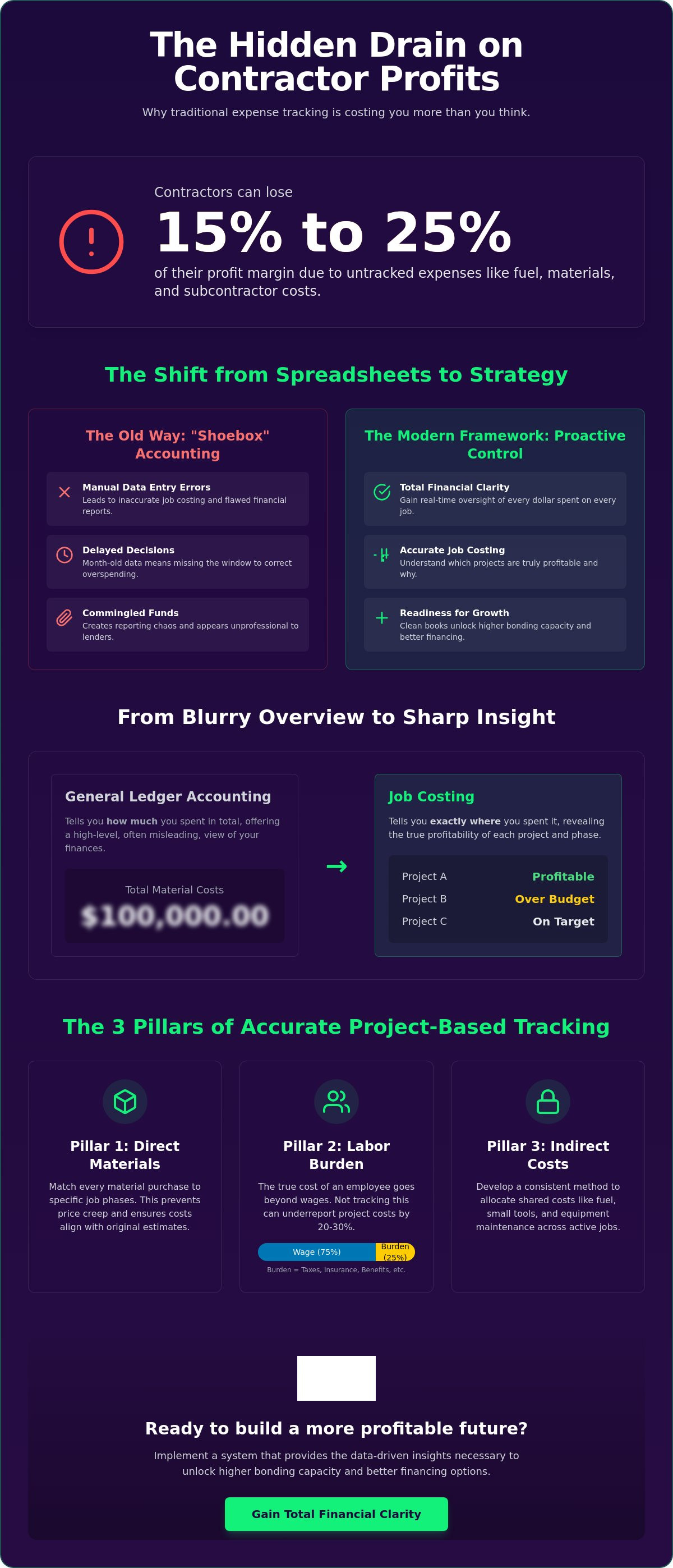
Recent data indicates that contractors can lose between 15% and 25% of their profit margin due to untracked expenses like fuel, materials, and subcontractor costs. This staggering leak in revenue proves that finding the best way to track construction expenses is no longer just a back-office preference; it's a fundamental requirement for business survival. You've likely felt the sting of manual data entry errors or the frustration of seeing labor costs vanish into a general overhead bucket instead of being assigned to specific jobs. These inefficiencies often lead to those dreaded, unexpected cash flow shortages right at the end of a project when your focus should be on the next big win.
We agree that the traditional methods of "getting by" with spreadsheets are failing the modern builder. You deserve a system that offers quiet confidence and rigorous management over every dollar. In this guide, you'll learn how to master the structural accounting frameworks and digital systems needed to protect your profit margins and gain total financial clarity. We will preview a strategic 2026 framework designed to move your firm toward a streamlined, automated system. By the end, you'll have the roadmap for accurate job costing and the financial readiness required for scaling and professional lending.
Beyond the Spreadsheet: Why Construction Expense Tracking Requires a Specialized Framework
Construction expense tracking is the systematic allocation of costs to specific project phases, ensuring that every nail, hour of labor, and gallon of fuel is accounted for. While general bookkeeping provides a high-level view of a company's bank balance, it fails to address the granular complexities inherent in the building industry. In 2026, the best way to track construction expenses has shifted toward real-time financial oversight and cloud-based automation. This evolution moves firms away from reactive record-keeping and toward a proactive stance that protects profit margins before they erode. Without a specialized framework, you're essentially operating in the dark, unable to see which project phases are draining your resources.
General bookkeeping is designed for static businesses with predictable overhead. Construction, however, is a dynamic environment where costs fluctuate based on site conditions, supply chain shifts, and labor efficiency. To manage these variables, professional firms utilize a Total Cost Management framework to maintain structural integrity across their financial data. This strategic approach allows owners to transition from simple administrative tasks to the construction of a comprehensive system that supports long-term health and scalability.
The Danger of 'Shoebox' Accounting
Relying on physical receipts and manual logs, often referred to as "shoebox accounting," creates significant vulnerabilities. Missing receipts lead to substantial tax-deduction losses, which directly impacts your bottom line. There's also a hidden cost to delayed data. If you're making strategic decisions based on month-old information, you've already lost the window to course-correct a failing project. Furthermore, commingling personal and business expenses is a common pitfall that stunts growth. It muddies your financial reporting and makes your firm appear disorganized to potential lenders or bonding agents. True financial readiness requires a clean, automated separation of all costs.
Job Costing vs. General Ledger Accounting
The fundamental difference between general ledger accounting and job costing is the distinction between knowing how much you spent and knowing exactly where you spent it. While your general ledger might show a high total for material costs, job costing reveals which specific projects are actually profitable. This level of detail is the gold standard for profit protection. It allows you to identify patterns in overspending and adjust your future estimates for better accuracy. Job costing is the process of tracking costs to specific projects and comparing them against estimates. By implementing management accounting principles, you gain the clarity needed to stop guessing and start leading with data-driven confidence.
The Three Pillars of Accurate Project-Based Expense Tracking
The structural integrity of your financial data relies on three distinct pillars. If one pillar is weak, your Work in Progress (WIP) reports will provide a distorted view of your company's health. While many contractors look for the latest app, the best way to track construction expenses is to build these pillars into your Chart of Accounts from the ground up. This ensures that every dollar spent is categorized correctly from the moment it leaves your bank account. Without this foundational structure, you're merely recording history rather than managing your future.
Pillar 1 focuses on direct material costs and vendor management. This involves more than just recording an invoice. It requires matching material purchases to specific job phases to ensure they align with your original estimates. When you manage vendors strategically, you reduce the risk of price creep that often goes unnoticed in general bookkeeping. This disciplined oversight is the first line of defense in protecting your project margins.
Mastering Labor Burden
Labor burden represents the total cost of an employee beyond their gross hourly wage. It includes employer-paid taxes, workers' compensation insurance, health benefits, and retirement contributions. To achieve true project clarity, you must assign these costs to specific job codes. If you only track wages, you're underreporting your project costs by as much as 20% to 30%. Implementing a construction cost control cycle allows you to monitor these variances in real time. Automated time-tracking integrations are essential here, as they eliminate manual entry errors and stop payroll leakage before it impacts your bottom line.
Allocating Indirect Costs and Equipment
Indirect costs are the expenses that often float between projects, such as fuel, small tools, and equipment maintenance. The best way to track construction expenses involving these items is to develop a consistent allocation method. You might spread these costs across active projects based on total labor hours or as a percentage of direct costs. Without this step, your equipment-heavy projects will appear more profitable than they actually are because their maintenance costs are buried in overhead. Every dollar spent must have a permanent "home" in your project budget.
When your indirect costs are properly allocated, your financial reports become a reliable tool for forecasting future cash flow. This level of detail is what distinguishes a scaling firm from one that is merely surviving. If you find that your current system lacks this level of detail, scheduling a discovery call can help you identify where your framework needs reinforcement. This disciplined approach transforms your financial data from a source of stress into a strategic asset.
Choosing Your Tools: Cloud Accounting vs. Industry-Specific Software in 2026
Technology in the construction sector has evolved rapidly, but the most sophisticated app is only as effective as the financial framework it supports. In 2026, the best way to track construction expenses isn't necessarily through the most expensive enterprise suite, but through a well-integrated tech stack that prioritizes data integrity. For most scaling firms, QuickBooks Online (QBO) serves as the core foundation. It provides the necessary balance of professional-grade accounting and user-friendly cloud access, allowing your back office to stay in lockstep with field operations. This connectivity is the primary defense against the data silos that often lead to project overruns.
Building this foundation requires more than just a subscription; it demands a strategic setup that aligns with the unique mechanics of your market. You can explore the specifics of this configuration in our guide on Mastering QuickBooks for Contractors. When your core accounting software is properly structured, you create a single source of truth that protects your margins from the "death by a thousand cuts" caused by untracked field costs. This proactive approach ensures that your financial data is both accurate and actionable.
The Power of QuickBooks Online for Contractors
The versatility of QBO lies in its customization capabilities. By tailoring your Chart of Accounts specifically for project-based tracking, you can monitor expenses at a granular level. We utilize "Classes" and "Locations" to segment financial data, ensuring that every invoice and receipt is tied to a specific job site or project type. This structure enables real-time collaboration. When a project manager in the field uploads a receipt via the mobile app, it's immediately visible to the accounting team. This speed is essential for maintaining accurate cash flow forecasts and identifying budget variances before they become crises.
When to Add Construction Management Software
As your firm scales, your needs may eventually exceed the native capabilities of basic accounting software. Signs that you've reached this threshold include a high volume of complex change orders, a need for detailed RFI tracking, or managing dozens of active subcontractors simultaneously. This is where specialized suites like Procore or Buildertrend provide value. These tools shouldn't replace your accounting software; they should integrate with it. Following Best practices for managing construction costs often involves a "best of breed" approach where your project management tools feed data directly into your financial system.
Regardless of the software you choose, the transition is often where firms stumble. Without a disciplined implementation, even the best tools lead to messy data. This is why professional QuickBooks Setup and Training is non-negotiable for success. Investing in the right systems today ensures that your firm is financially ready for the challenges of tomorrow.
Implementing a Bulletproof Expense Coding System: A 5-Step Guide
Transitioning from a reactive "shoebox" approach to a professional financial framework requires more than just a software subscription. It demands a disciplined roadmap for data categorization. The best way to track construction expenses is to implement a standardized coding system that ensures every transaction is mapped to its corresponding project phase. This structure eliminates the ambiguity that leads to budget overruns and provides the granular data needed for accurate job costing. By following a systematic 5-step guide, you can build a foundation that supports both daily operations and long-term scaling.
Step 1: Standardize your Cost Codes based on industry benchmarks. Use a recognized system to ensure consistency across your estimates and reports.
Step 2: Automate receipt capture using OCR technology. Eliminate manual entry by using mobile tools that extract data directly from field receipts.
Step 3: Establish a weekly "Review and Reconcile" rhythm. Address discrepancies while the details are still fresh in your team's mind.
Step 4: Integrate payroll with project cost codes. Ensure labor hours are automatically allocated to the correct job phases.
Step 5: Generate and analyze Monthly Profit and Loss statements by job. Review these reports to identify which projects are meeting your margin targets.
Standardizing Your Cost Codes
Effective expense tracking begins with a clear vocabulary. We recommend using Construction Specifications Institute (CSI) codes as a baseline for your system. These industry-standard codes provide a universal language for material and labor categories. However, it's vital to keep your list simple enough for field crews to use without confusion. If your codes are too complex, data entry becomes a burden and accuracy suffers. When your codes are consistent across estimates, invoices, and reports, you can easily compare actual costs against your original budget to identify variances early.
The "Review and Reconcile" Rhythm
Waiting until the end of a project to review your finances is a recipe for disaster. In the fast-moving construction environment, a month-old report is essentially an autopsy rather than a management tool. A weekly review rhythm allows you to catch misallocated costs before they skew your project budgets. This discipline ensures that your data remains clean and actionable throughout the life of the job. Maintaining this level of oversight is a core component of professional Monthly Bookkeeping, as it provides the steady heartbeat your financial system needs to thrive.
Establishing these systems creates the structural integrity required to move your business forward with confidence. If you're ready to stop managing through guesswork and start leading with data, book a discovery call today to discuss how a customized coding framework can protect your profits.
Scaling Your Firm with Professional Financial Oversight
Scaling a construction company requires a fundamental shift in leadership. You must move from the daily grind of technical execution to a high-level role focused on strategic growth. This transition is only possible when you have absolute confidence in your financial data. Implementing the best way to track construction expenses creates a transparent environment where you manage through data rather than intuition. As your firm targets larger contracts, your ability to demonstrate this structural integrity becomes your greatest competitive advantage. Without this clarity, growth often leads to increased complexity without a corresponding increase in profit.
Accurate expense tracking does more than just protect your current margins; it unlocks the capital needed for expansion. Lenders and bonding agents look for firms that maintain rigorous management over their project costs. When you can present detailed job costing reports and clear cash flow forecasts, you signal that your business is a low-risk partner. This financial readiness is essential for securing the bonding capacity required for the $3.7 trillion in construction volume projected for 2026. Proving that you have total control over your financial data allows you to compete for high-stakes projects with quiet confidence.
For those looking to integrate these financial insights into a broader business strategy, you can learn more about PK Services and their specialized guide to full-cycle construction project management.
From Bookkeeping to Strategic Partnership
While basic administrative tasks keep your records up to date, Fractional Controller Services provide the analytical depth needed to drive business growth. A controller doesn't just record what happened; they interpret the data to inform your future bids. By analyzing historical expense data, you can identify hidden costs that previously eroded your profits. This level of insight is a key feature of our Construction Bookkeeping Services, which focus on building a scalable financial infrastructure for your firm. This partnership ensures that your financial reporting isn't just a backward-looking log, but a forward-looking roadmap.
Using historical data to create more accurate future bids is the hallmark of a mature construction firm. When you know exactly what a specific phase cost on a previous project, you eliminate the guesswork that leads to underbidding. This disciplined approach to data ensures that every new contract you sign is structured for maximum profitability. We work with you to refine these systems, ensuring your bid accuracy improves with every project completed. It's about more than just numbers; it's about the structural integrity of your entire business model.
Financial Readiness for 2026 and Beyond
Maintaining the best way to track construction expenses ensures your firm is ready for any financial challenge that comes your way. Preparation is the antidote to the stress of tax season or lender requests. When every penny is accounted for within a specialized framework, you no longer fear the scrutiny of external audits or financial reviews. You gain the peace of mind that comes from knowing your foundation is solid. Okie Accounting Group LLC serves as your strategic partner, ensuring that your financial systems are as robust as the structures you build. We focus on long-term health and stability, providing the rigorous management your business deserves. To start constructing your specialized financial framework, schedule a consultation with Okie Accounting Group LLC today.
Constructing Your Path to Financial Resilience
Implementing a structural accounting framework is the best way to track construction expenses while protecting your long-term profit margins. We've explored how standardized cost codes, automated data capture, and integrated labor tracking transform raw data into a shield for your business health. Moving beyond basic administration allows you to lead with data-driven confidence. This transition unlocks the bonding capacity and financing needed to scale in a competitive 2026 market.
Okie Accounting Group LLC provides the specialized expertise required to navigate these industry-specific complexities. Our team offers Fractional Controller services for strategic growth and QuickBooks certified professional training and setup to ensure your foundation is solid. We don't just manage your books; we build the financial infrastructure that allows you to focus on the build. You deserve a partner as invested in your success as you are.
Take the first step toward total financial clarity and project control. Build Your Strategic Financial Framework with Okie Accounting Group LLC today. Your firm's long-term stability starts with a partner who understands the mechanics of your market.
Frequently Asked Questions
What is the best software for tracking construction expenses in 2026?
The most effective solution involves using QuickBooks Online as your core accounting engine integrated with specialized field tools like Procore or Buildertrend. This integrated approach ensures your financial data remains structurally sound while providing the granular details project managers need. It creates a single source of truth that bridges the gap between the office and the job site, which is the best way to track construction expenses in a modern market.
How do I track labor costs for specific construction projects?
Tracking labor costs requires integrating automated time-tracking software directly with your project cost codes. Instead of relying on manual paper logs, crews should use mobile apps to clock into specific phases of a job. This allows you to monitor labor productivity in real time. It ensures that every hour worked is accurately assigned to the correct project budget, preventing payroll leakage and unexpected budget overruns.
Is QuickBooks Online good enough for a growing construction company?
QuickBooks Online is a powerful foundation for scaling firms when it's customized with a specialized Chart of Accounts and proper class tracking. While generic setups often fail the construction industry, a professional configuration allows you to generate detailed job costing reports. As your complexity increases, you can scale by adding integrated project management suites that feed data directly into your established financial framework.
What are the most common mistakes in construction expense tracking?
The most frequent errors include relying on manual data entry, neglecting the full labor burden, and waiting until month end to reconcile accounts. These mistakes lead to delayed financial insights and inaccurate profit margin reporting. By the time you notice a cost overrun on a manual spreadsheet, the opportunity to course correct has usually passed. A proactive, automated system is essential to maintain structural integrity.
How often should I reconcile my construction project expenses?
You should reconcile your project expenses on a weekly basis to maintain accurate Work in Progress reporting. Construction is a high velocity industry where costs can spiral quickly if left unchecked for an entire month. A weekly rhythm is the best way to track construction expenses because it allows you to catch misallocated invoices or unexpected material price hikes while you still have time to adjust your strategy.
What is 'Labor Burden' and why does it matter for my profit margins?
Labor burden is the total cost of an employee, including taxes, insurance, and benefits, beyond their gross hourly wage. If you only track wages, you're likely underestimating your labor costs by 20% or more. Accounting for the full burden ensures that your bids are accurate and that you aren't unknowingly eroding your profit margins on labor intensive projects. It's a critical component of professional financial oversight.
How can I automate receipt tracking for my field crew?
Mobile apps equipped with OCR technology allow your field crew to snap photos of receipts that automatically sync with your accounting software. This eliminates the "shoebox" method and ensures that small field purchases are recorded immediately against the correct project. Automating this process reduces the administrative burden on your crew while providing the back office with real time visibility into project spending and vendor management.
Should I track overhead costs per project or as a general expense?
You should track general overhead as a company wide expense but allocate a percentage to each project to see your true net profit. This method ensures that every job contributes its fair share toward fixed costs like rent, utilities, and administrative salaries. Without this allocation, your project level profit may be misleading. It doesn't account for the indirect costs required to keep your firm operational and healthy.


Comments