The Chart of Accounts for Construction Companies: A 2026 Strategic Framework

Updated: Nov 7
Why do so many contractors wait until year-end to discover they lost money on a project they thought was profitable? It’s a common frustration in an industry where steady cash flow can easily mask underlying budget overruns. You likely recognize that a standard, off-the-shelf general ledger isn't equipped to handle the nuances of retainage, work-in-progress (WIP), or complex labor allocations. Implementing a specialized chart of accounts for construction company needs is the only way to bridge the gap between basic data entry and true financial intelligence.
This 2026 strategic framework promises to help you build a financial foundation that enables precise job costing and profit protection. By moving beyond simple administration toward a comprehensive structural framework, you'll gain total clarity over your project margins. We'll preview the essential account structures for automated reporting, explain how to handle industry-specific categories, and show you how to maintain lender-ready financials that support your long-term growth goals. This methodical approach ensures your books serve as a strategic asset rather than a source of confusion.
What is a Construction Chart of Accounts?
A Chart of Accounts (COA) is the organized listing of every category used to record financial transactions in your general ledger. While a retail business might focus on inventory turnover or a tech firm on recurring revenue, a construction firm lives and dies by its project-based data. Your ledger shouldn't just be a random collection of categories; it must be a structural framework that mirrors your estimating process. When your ledger categories align with how you bid work, you ensure consistency across the entire project lifecycle. This alignment prevents the common disconnect between field operations and the back office. The chart of accounts for construction company operations serves as the architectural blueprint for a firm’s financial health in 2026. By treating this list as a strategic asset, you move from simple record-keeping to proactive profit protection.
The Role of the COA in Job Costing
Profitability in this sector is won or lost at the project level. A well-designed COA feeds directly into project-level Profit and Loss statements, allowing you to see which jobs are generating cash and which are draining it. Generic accounts like "Supplies" or "Materials" fail to provide the granular detail needed for accurate bidding. If you can't distinguish between framing lumber and finish hardware in your ledger, you can't refine your future estimates. A specialized COA creates a direct connection between your general ledger and your field reports. This ensures that every dollar spent is tracked against a specific job phase, providing you with the data needed to protect your margins on every contract. Without this level of detail, your financial statements offer little more than a high-level guess at your company's true performance.
Standard Construction Account Numbering (CSI Codes)
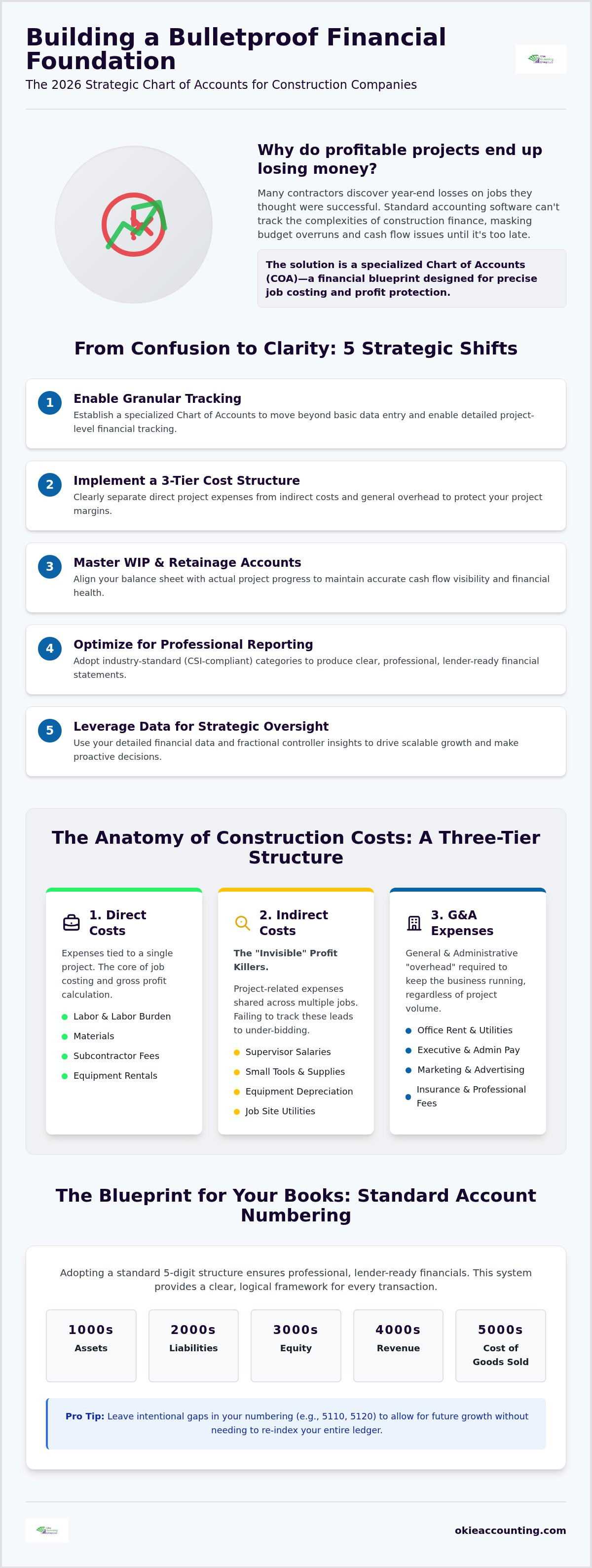
Adopting a standard numbering system is a hallmark of a mature firm. Most construction firms utilize a five-digit structure: Assets (1000s), Liabilities (2000s), Equity (3000s), Revenue (4000s), and Cost of Goods Sold (5000s). Following these industry standards when building a chart of accounts for construction company use allows for seamless communication with lenders and sureties. They expect to see financial statements in a familiar format that reflects structural integrity. We recommend leaving intentional gaps in your numbering, such as skipping from 5110 to 5120. This allows for future growth without forcing you to re-index your entire general ledger later. If you need a more robust structure, our QuickBooks Setup & Training services can help align your ledger with CSI-compliant standards to protect your long-term financial readiness and stability.
Categorizing Costs: Direct, Indirect, and G&A
A robust chart of accounts for construction company management requires more than a single "expenses" bucket. It demands a disciplined, three-tier structure: Direct Costs, Indirect Costs, and General & Administrative (G&A) expenses. This separation isn't just about tax compliance. It's about structural integrity. By isolating these costs, you gain the ability to protect your gross margins while ensuring your overhead is fully covered by your project revenue. This methodical approach transforms your general ledger from a passive record into a proactive management tool that supports long-term financial readiness.
Direct Costs: The Core of Your Project
Direct costs are the expenses specifically tied to a single project. They are the most visible part of your job costing and form the basis of your gross profit calculation. To maintain accuracy, you must look beyond simple gross wages and include "labor burden," which accounts for payroll taxes, workers' comp, and benefits. Categorizing subcontractor costs separately is also vital for monitoring "Sub-Reliance" risk. If too much of your revenue is flowing to a single partner, your business health is at their mercy. Tracking material costs versus equipment rentals per job allows you to see where your cash is actually going. For firms looking to refine these categories, Kean University's Chart of Accounts offers a detailed look at how to organize specific operational accounts like repairs and maintenance.
The "Invisible" Profit Killer: Indirect Costs
Indirect costs are project-related but shared across multiple jobs. These are often the "invisible" profit killers in the construction industry. Items like supervisor salaries, small tools, and equipment depreciation don't belong to a single job site, but they are necessary for production. Failing to track these leads to chronic under-bidding because your estimates won't reflect the true cost of mobilization and oversight. To achieve true margin visibility, you must allocate these shared costs back to specific projects using a consistent methodology. A fractional controller uses indirect cost data to adjust overhead burden rates, ensuring every bid you submit is grounded in financial reality.
Finally, G&A expenses represent the "overhead" required to keep the lights on regardless of project volume. This includes office rent, executive pay, and marketing. By isolating these from project-level costs, you can calculate your break-even point with precision. This clarity is essential for scalable growth and lender-ready financial statements. If your current ledger feels cluttered or inaccurate, you might schedule a discovery call to see how a specialized framework can protect your bottom line.
Essential Construction Accounts: WIP, Retainage, and CIP
"Why does my P&L say I made money, but my bank account is empty?" This question haunts many contractors who rely on a basic accounting setup. The answer usually lies in the timing of revenue recognition and the absence of specialized accounts. A standard chart of accounts for construction company operations must include specific mechanisms to handle the timing gaps inherent in long-term contracts. Without these, your financial statements will show volatile revenue spikes and dips that don't reflect your actual operational health. Implementing these accounts moves your firm from basic data entry to a disciplined structural framework.
Mastering the WIP Account
Work in Progress (WIP) acts as the bridge between your balance sheet and your income statement. It ensures that revenue and expenses are matched in the same period, regardless of when you sent the invoice. If you've spent money on materials but haven't billed the client yet, that's an asset: Costs in Excess of Billings. Conversely, if you've front-loaded your billing, you have a liability: Billings in Excess of Costs. Understanding the underlying WIP logic is essential for providing a smoother financial narrative. This adjustment prevents artificial profit inflation and gives you a realistic view of your project's performance at any given moment.
Retainage Management for Cash Flow
Retainage is the industry-standard 5% to 10% held back from payments until project completion. Many firms mistakenly leave this buried in standard Accounts Receivable, where it gets lost in the shuffle of daily operations. We recommend setting up separate "Retainage Receivable" and "Retainage Payable" accounts. This structure ensures you can track every dollar owed to you and every dollar you owe to subs. Reconciling these accounts at the end of a project is a critical step for ensuring 100% collection. In 2026, where credit is tight and margins are thin, precise retainage tracking is a vital component of accurate cash flow forecasting. It ensures you aren't surprised by a cash shortfall when it's time to pay out your subcontractors.
Construction in Progress (CIP)
While WIP tracks costs for client projects, Construction in Progress (CIP) is used for long-term self-builds or company-owned developments. These are capitalized costs that stay on the balance sheet until the asset is placed in service. This distinction is vital for firms that act as both the contractor and the developer. By maintaining a clean CIP account, you ensure that your fixed assets are recorded accurately, supporting your overall financial readiness and structural integrity. This methodical approach ensures your financial statements are always ready for lenders or bond agents, providing the quiet confidence needed for scalable growth.
Optimizing QuickBooks Online for Your COA
Setting up a specialized chart of accounts for construction company success in QuickBooks Online (QBO) requires a deliberate departure from the software's generic defaults. You must start with a clean slate by disabling unnecessary accounts that clutter your ledger. Once the noise is removed, you can build a structural framework that actually serves your project needs. This methodical optimization ensures that your data entry is efficient and your reporting is accurate. To achieve a high-performance setup in 2026, follow these essential steps:
CSI-Compliance: Import or manually create an account list that aligns with industry-standard cost codes.
Service Mapping: Map your "Products and Services" in QBO to the correct General Ledger accounts to automate categorization.
Multi-Dimensional Reporting: Enable "Classes" and "Locations" to track performance by project type, department, or geographic region.
Software Integration: Connect your ledger with project management tools to ensure real-time data sync between the field and the office.
Avoiding the "Too Many Accounts" Trap
A common mistake is creating a 500-line general ledger that becomes impossible to manage. Using granular Cost Codes within your project management tool is a far more efficient way to track details than bloating your ledger. We recommend a "Parent-Sub" account structure to keep the top level clean for high-level reviews. This hierarchy allows you to collapse details for a concise view while maintaining the ability to drill down into specific costs when needed. If you feel overwhelmed by the technical requirements, our Professional QuickBooks Setup for Contractors provides the structural framework you need to scale without the clutter.
Cloud-Based Automation in 2026
The 2026 accounting landscape is defined by efficiency and real-time visibility. Modern firms use AI-driven bank feeds to auto-categorize recurring direct costs, significantly reducing the burden of manual data entry. However, automation is only effective if the underlying structure is sound. Regular monthly reconciliations are essential to maintain the integrity of your framework and catch errors before they distort your reporting. At Okie Accounting Group, we handle the heavy lifting of monthly bookkeeping so you can focus on field operations. This partnership ensures your data is always accurate, lender-ready, and strategically useful. Ready to transform your ledger into a strategic asset? Schedule a discovery call today to align your QuickBooks setup with your growth goals.
From Data Entry to Strategic Oversight
A perfect chart of accounts for construction company management is merely a tool. It's the structural skeleton of your business, but it requires the muscle of regular, high-level analysis to drive results. Many firms stop at data entry, viewing their ledger as a tax-time necessity rather than a strategic asset. By 2026, the industry has shifted away from passive accounting. Successful contractors no longer rely on historical recordkeeping that only tells them what happened last month. Instead, they use their financial data for forward-looking strategy. This transition allows you to move from reacting to project losses to proactively protecting your margins before the first shovel hits the ground.
Our approach at Okie Accounting Group focuses on building these structural frameworks. A Fractional Controller takes the raw data from your specialized COA and transforms it into actionable intelligence. They conduct rigorous budget-to-actual reviews and develop precise cash flow forecasting models. This oversight ensures that your business stays on track even when project timelines shift or material costs fluctuate. It's the difference between operating on hope and following a methodical plan for long-term stability. When you treat your chart of accounts for construction company operations as a strategic foundation, you gain the quiet confidence needed to navigate market complexities.
Scaling Your Firm with Financial Clarity
Financial integrity is the currency of growth in the modern construction market. When your ledger is clean and follows industry standards, you can secure larger bonding capacities and more favorable bank loans. Lenders and sureties look for structural financial integrity as a sign of a well-managed, low-risk firm. Beyond external financing, this clarity leads to better project selection. You'll have the data to identify which types of jobs yield the highest margins and which ones aren't worth the risk. Our Fractional Controller Services provide the high-level guidance needed to turn these insights into a scalable growth engine.
Your Next Steps for a Stronger Foundation
Ready to strengthen your foundation? Start by auditing your current COA against the CSI standard we discussed earlier. Look for clutter or generic accounts that mask your true project costs. If your ledger needs a professional touch, you can schedule a consultation for a QuickBooks cleanup. This ensures your system is optimized for the specific demands of the 2026 market. To truly protect your profit and scale with confidence, partner with Okie Accounting Group to build your structural financial framework today.
Building Your 2026 Financial Blueprint
Transitioning from a cluttered general ledger to a disciplined structural framework is the first step toward long-term profit protection. By mastering WIP adjustments and isolating retainage, you ensure your balance sheet reflects the true health of your operations. A specialized chart of accounts for construction company growth isn't just about organizing expenses; it's about creating the visibility required for lender-ready reporting and precise job costing. This methodical approach allows you to move beyond basic administration and embrace strategic oversight that supports scalable growth.
Okie Accounting Group offers a specialized construction focus and cloud-based efficiency to help you scale in a complex market. Our nationwide strategic oversight transforms raw financial data into a roadmap for sustainable growth. By prioritizing financial readiness and structural integrity, we ensure your margins are protected at every stage of the project lifecycle. We're dedicated to helping you gain total control over your firm's financial future. Ready to build a stronger financial foundation? Explore our Fractional Controller Services.
Frequently Asked Questions
How many accounts should a construction company have?
Most construction firms operate effectively with 100 to 250 accounts in their general ledger. While a smaller service firm might need fewer, a general contractor requires specific categories for direct costs, indirect overhead, and balance sheet accounts like retainage. The goal is to maintain a clean top-level view while using cost codes for granular project details. This balance ensures your financial reporting remains readable for lenders and sureties.
What is the difference between a cost code and a chart of accounts?
The chart of accounts for construction company management represents the high-level financial structure used for company-wide reporting. In contrast, cost codes are granular identifiers used within specific projects to track labor, materials, and equipment. You shouldn't bloat your general ledger with every possible field activity. Instead, map your detailed cost codes to broader categories in your COA to maintain a structural framework that supports both field operations and executive oversight.
Should I use sub-accounts for every project in my chart of accounts?
You should avoid creating a unique sub-account for every project in your chart of accounts for construction company operations. This practice leads to a massive, unmanageable list that complicates data entry and reporting. Instead, utilize the "Project" or "Customer:Job" features in your accounting software to tag transactions. This allows you to run project-specific Profit and Loss statements without cluttering your primary ledger. It keeps your financial foundation stable as your project volume scales.
Is QuickBooks Online sufficient for a construction chart of accounts?
QuickBooks Online is an excellent tool for construction accounting when it's configured with a specialized structural framework. It provides the necessary features for job costing, progress billing, and automated bank feeds. However, the default setup is often inadequate for the industry's unique needs. To make it sufficient for 2026 standards, you must enable project tracking and classes while customizing your account list to mirror the CSI standards used in your estimates.
How do I handle retainage in my chart of accounts?
Handle retainage by establishing dedicated "Retainage Receivable" and "Retainage Payable" accounts on your balance sheet. This keeps these funds separate from your standard trade accounts, preventing them from being overlooked during cash flow forecasting. By isolating these amounts, you can easily track the 5% or 10% held back on each contract. This discipline ensures that you collect every dollar earned and fulfill all subcontractor obligations once a project reaches final completion.
Can I change my chart of accounts mid-year?
You can change your chart of accounts mid-year, but it requires a meticulous mapping process to ensure historical data remains accurate. It’s often better to implement changes at the start of a new quarter to provide a clean break. If your current ledger is severely cluttered, a professional cleanup can re-categorize existing transactions into a new, CSI-compliant structure. This proactive step restores financial clarity without waiting for the next fiscal year to begin.
What is the best way to track indirect construction costs?
The most effective way to track indirect costs is to pool them into specific "Construction Overhead" accounts before allocating them to projects. This includes expenses like supervisor salaries, small tools, and vehicle depreciation. By using a predetermined burden rate, you can distribute these costs across your active jobs. This method ensures that your project margins reflect the true cost of production, which is essential for accurate bidding and long-term profit protection.
How does a WIP adjustment affect my income statement?
A WIP adjustment moves over-billings or under-billings from the income statement to the balance sheet. If you've billed more than the work performed, the adjustment reduces your current revenue to prevent artificial profit inflation. If you've incurred costs that haven't been billed, it recognizes that earned revenue. This process ensures your financial statements provide a realistic narrative of your progress and profitability, which is a key requirement for lender-ready financials.


Comments