The Real Estate Investor KPI Dashboard: A Strategic Framework for Scaling Portfolios in 2026

Updated: Nov 7
What if the growth of your portfolio is actually the primary obstacle to your next acquisition? Many investors find that as they scale, the complexity of tracking performance across multiple LLCs creates a fog that obscures real-time ROI. You're likely tired of reactive property tracking and the anxiety that incomplete financial reporting might lead to a lender rejection. To move forward with confidence, you need more than just a spreadsheet; you need a sophisticated real estate investor KPI dashboard that provides a clear, unified view of your financial health.
We understand that true scaling requires structural integrity, not just basic administrative record-keeping. In this article, you'll learn how to transition to proactive portfolio management by implementing a strategic framework designed for the 2026 market. We'll break down the essential metrics you must track to stay lender-ready, explain how to navigate the latest FinCEN reporting requirements for legal entities, and show you how fractional controller oversight can turn your data into a powerful tool for long-term profit protection.
Beyond the Spreadsheet: The Evolution of the Real Estate Investor KPI Dashboard
A real estate investor kpi dashboard isn't a static report gathering digital dust in your inbox. It's a dynamic financial infrastructure that bridges the gap between where your portfolio is today and where you intend it to be by the end of 2026. Many investors hit a "Growth Wall" around their fifth or tenth property acquisition. At this stage, manual tracking in spreadsheets leads to data fragmentation. When your financial data is scattered across multiple files, missed opportunities for acquisition or refinancing become the norm rather than the exception.
Recording history is no longer enough for the sophisticated firm. In a market where commercial mortgage rates for apartments start around 6.10% and 30-year fixed rates hover at 6.55%, your dashboard must function as a tool for profit protection. It allows you to identify which assets are underperforming before they drain your liquidity. This proactive stance transforms your accounting from a back-office burden into a strategic risk management engine that supports long-term structural health.
The Transition from Administrative to Strategic Accounting
Basic bookkeeping is the floor; it ensures you stay compliant with standard regulations. However, management accounting is the ceiling that determines how high you can scale your empire. By utilizing a comprehensive Key Performance Indicator (KPI) framework, you move from property-level silos to consolidated portfolio-wide visibility. This shift is essential for building a "lender-ready" reputation. When a lender sees organized, professional financial reporting, they see a low-risk partner. They're more likely to offer favorable terms to an investor who demonstrates rigorous oversight and a clear understanding of their debt service coverage ratios across all entities.
Signs Your Investment Firm Has Outgrown Its Current System
You'll know it's time to evolve when tracking inter-company transfers across multiple LLCs feels like a full-time job. If fund distributions are delayed because you're waiting on manual reconciliations, your current system is failing you. Inconsistent cash flow projections often stall acquisition timelines, causing you to miss out on deals in a market where inventory is finally showing signs of a 2.2% year-over-year increase. Real-time data is a requirement in 2026 to navigate interest rate fluctuations and the new FinCEN reporting rules for legal entities. If you can't see your ROI per property and per fund at a glance, you've likely reached the limits of your current framework and require the specialized oversight of fractional controller services to regain control.
The Core Architecture: Essential KPIs for Portfolio Performance and Profit Protection
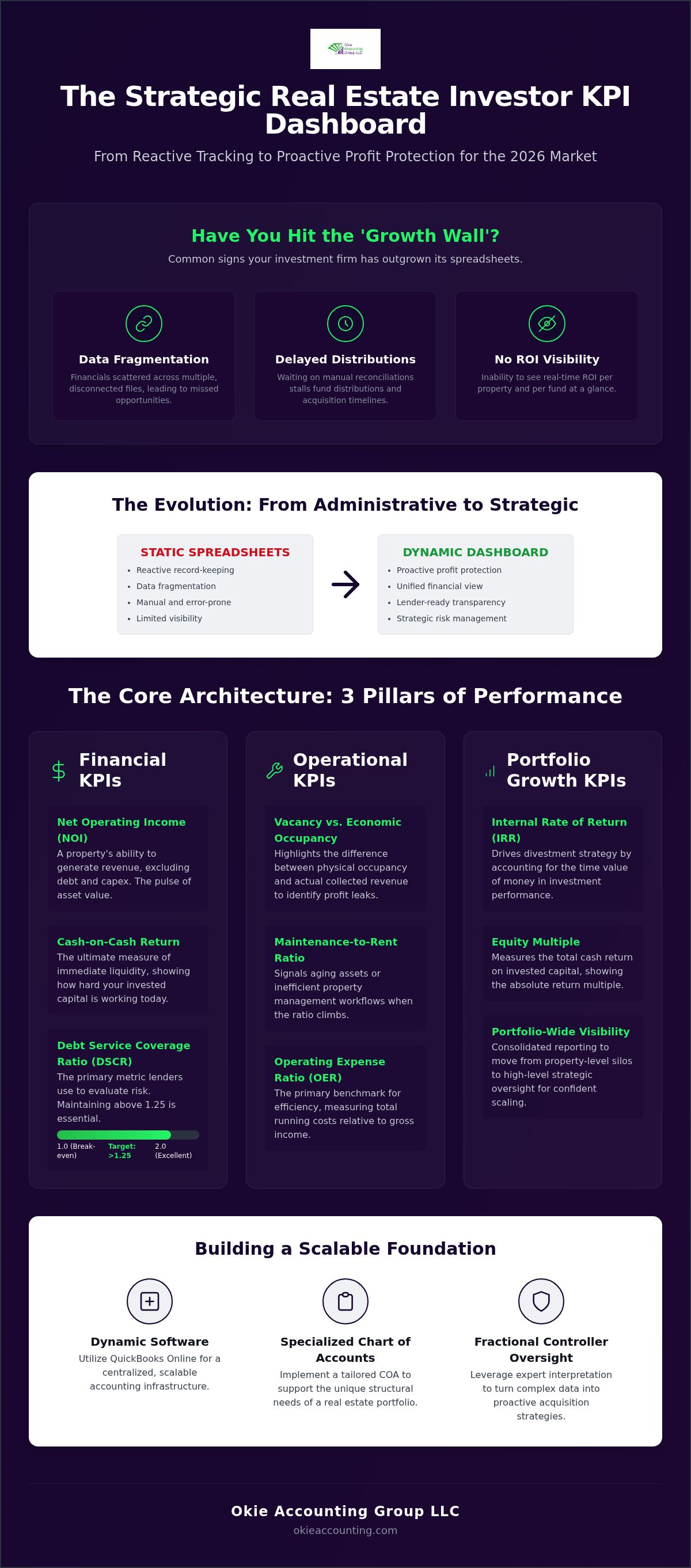
Building a robust real estate investor kpi dashboard requires a structured approach to data categorization. You can't rely on a single metric to tell the whole story of your portfolio's health. Instead, we organize your financial landscape into the "Big Three" pillars: Financial, Operational, and Portfolio-wide performance. This tri-level view ensures that you aren't just seeing the cash in your bank account, but the underlying structural integrity of every asset you own. It's the difference between a simple record of the past and a strategic roadmap for the future.
Your financial metrics start with Net Operating Income (NOI). In the 2026 market, NOI is the pulse of asset value. It's calculated by subtracting all necessary operating expenses from your total income. Because NOI excludes debt service and capital expenditures, it provides a pure look at a property's ability to generate revenue. Closely following this is Cash-on-Cash Return, which we use as the ultimate measure of immediate liquidity. It tells you exactly how hard your invested capital is working today. Finally, the Debt Service Coverage Ratio (DSCR) remains the primary KPI lenders use to evaluate your risk. With commercial mortgage rates starting at 5.70% for multifamily loans, maintaining a DSCR above 1.25 is essential for securing the financing needed for your next acquisition.
Operational Metrics: Tracking the Pulse of Property Management
Operational KPIs identify "profit leaks" before they compromise your bottom line. We distinguish between Vacancy Rate and Economic Occupancy on your dashboard because physical occupancy doesn't always equal collected revenue. If your physical vacancy is low but your economic occupancy is lagging due to concessions or bad debt, your management strategy needs adjustment. Monitoring the Maintenance-to-Rent Ratio is equally vital. If this ratio climbs, it often signals an aging asset or an inefficient property management workflow. The Operating Expense Ratio (OER) serves as your primary benchmark for operational efficiency by measuring the total cost to run a property relative to its gross income.
Portfolio Growth Metrics: Scaling with Confidence
Scaling requires a shift from property-level details to high-level portfolio oversight. We analyze the Internal Rate of Return (IRR) alongside the Equity Multiple to drive your divestment strategy. While the Equity Multiple shows the total cash return, the IRR accounts for the time value of money, which is critical when deciding when to exit a position. We also track Loan-to-Value (LTV) across your entire portfolio to manage leverage risk. In a climate where year-over-year home price growth was just 0.8% in May 2026, maintaining conservative LTV levels protects your equity. Ensuring Capital Reserve Adequacy is the final piece of the framework, providing the stability needed for long-term growth. If you're ready to transition from basic tracking to strategic oversight, you may want to schedule a discovery call to discuss building a custom framework for your portfolio.
Data vs. Strategy: Why a Dashboard Needs Fractional Controller Oversight
A sophisticated real estate investor kpi dashboard provides the visibility you need, but visibility alone doesn't equate to growth. While a standard bookkeeper focuses on recording historical transactions and reconciling bank statements, a Fractional Controller acts as a strategic partner who interprets that data to drive your next move. They turn raw numbers into actionable intelligence. This partnership helps you decide whether to hold an asset, divest for a 1031 exchange, or aggressively acquire new property based on your current liquidity and risk appetite. It's the difference between looking in the rearview mirror and having a navigator for the road ahead.
Scaling a decentralized portfolio introduces significant operational risks. Without rigorous internal controls, firms are vulnerable to fraud or mismanagement, particularly when dealing with third-party property managers and complex inter-company transfers. A controller establishes the necessary oversight to protect your assets. This includes implementing approval workflows for large expenditures and conducting regular audits of property-level financial reports. By securing your financial infrastructure, you ensure that your Fractional Controller Services provide more than just reporting; they provide foundational profit protection.
The Monthly Financial Review: Your Growth Catalyst
A dashboard without a consistent monthly review is merely "data noise." This session is where your controller identifies subtle "red flags" like creeping utility costs or stagnant rent growth before they evolve into full-scale financial crises. It marks the transition from simply recording history to actively forecasting the future of your investment fund. By analyzing trends in your real estate investor kpi dashboard, you can adjust your cash flow forecasting to account for the 6.55% fixed-rate mortgage environment or prepare for upcoming capital improvements. This rhythm creates a narrative of transformation from operational complexity to strategic clarity.
Consolidated Reporting for Multi-LLC Structures
Managing holding companies and disparate investment partnerships requires a level of precision that spreadsheets can't maintain. Consolidated reporting ensures that distributions are accurate and that your Net Asset Value (NAV) reporting remains transparent for your partners. This professional financial leadership positions your firm to attract institutional-grade capital. When investors see that your firm operates with high-level structural integrity and clear reporting across all LLCs, you build the trust necessary to scale. You aren't just managing properties; you're building an investment vehicle that commands respect from lenders and partners alike.
Operationalizing Your Data: Building a Scalable Dashboard in QuickBooks Online
Building a scalable real estate investor kpi dashboard starts with choosing the right engine. While some firms suggest migrating to expensive Enterprise Resource Planning (ERP) systems, a properly configured QuickBooks Online (QBO) environment provides institutional-grade visibility for mid-market investors. Even with the August 2026 price increases that brought QBO Plus to $140 and Advanced to $340 per month, the platform remains the most efficient foundational tool for scaling. The core of this system is a specialized Chart of Accounts for Real Estate Investors. Without this specific structural framework, your data becomes a disorganized collection of transactions rather than a strategic asset.
We utilize Class and Location Tracking to achieve granular property-level Profit and Loss (P&L) reporting. This configuration allows you to view the performance of individual assets or entire funds with a single click. It eliminates the need for manual data manipulation in external spreadsheets. For those managing construction-heavy portfolios or large-scale developments, our guide on Mastering QuickBooks for Contractors offers deeper technical insights into managing project-based financials within this ecosystem.
Automating the Rent Roll and Expense Allocation
Integrating property management platforms like Buildium or AppFolio with QBO creates a seamless data flow that eliminates manual entry errors. You can significantly reduce your administrative burden by leveraging automated bank feeds and rule-based categorization. This automation ensures that your real estate investor kpi dashboard reflects real-time data rather than month-old history. To ensure your team maintains the integrity of this high-level system, we provide specialized QuickBooks Training tailored to the unique mechanics of the real estate sector. This training empowers your staff to handle daily operations while we focus on high-level strategic oversight.
WIP Accounting for Value-Add and Rehab Projects
Value-add and rehab projects require a specialized accounting approach to maintain balance sheet integrity. We track renovation costs as Work in Progress (WIP) assets rather than immediate expenses. This method preserves your capital and accurately reflects the increasing value of your holdings during the construction phase. By managing Job Costing within QBO, you ensure that rehab projects stay within budget and that every dollar is accounted for. Accurate WIP accounting ensures your dashboard’s balance sheet reflects the true value of your assets rather than artificially depressing your net income during heavy renovation phases. If you're ready to build a financial infrastructure that supports your growth goals, book a discovery call with our team today.
Constructing Your Financial Infrastructure with Okie Accounting Group
A sophisticated real estate investor KPI dashboard serves as the definitive roadmap for scaling your investment empire. It represents the transition from a reactive state of property tracking to a proactive era of strategic financial leadership. By centralizing your data and applying a disciplined framework, you eliminate the fog of fragmented reporting. This infrastructure doesn't just show you where your capital has been; it illuminates where it should go next to maximize ROI and ensure long-term stability.
Okie Accounting Group LLC acts as the strategic partner for investors who have outgrown the limitations of basic bookkeeping. We specialize in building the comprehensive systems that mid-market firms require to maintain control over multi-LLC structures. Our approach ensures that your accounting reflects the true mechanics of your business, moving beyond administrative tasks to provide the high-level oversight needed for sustainable growth. We focus on the structural health of your portfolio, ensuring every asset is performing at its peak while your financial reputation remains impeccable.
The Okie Methodology: Specialized, Strategic, and Supportive
Our exclusive focus on the real estate and construction sectors ensures that we speak your language from day one. We understand the nuances of project-based tracking and the critical importance of maintaining a lender-ready status. Through rigorous Management Accounting, we help national investors navigate complex financial landscapes with quiet confidence. As a remote partner delivering services across the United States, we provide fractional controller oversight that scales alongside your acquisitions. This methodology creates an atmosphere of trust, where you can focus on deal-making while we ensure the integrity of your financial data.
Ready to Scale Your Portfolio with Clarity?
The primary objection many investors face is the perceived cost of professional accounting services. However, the true expense is often found in the massive cost of lost opportunities. Missing a prime acquisition because your financial reporting was incomplete, or facing a lender rejection due to unprofessional records, carries a price tag far higher than strategic oversight. Professional management accounting is an investment in profit protection and capital readiness. It provides the clarity needed to make data-driven choices in a market where every basis point matters.
You deserve a partner who is as invested in your success as you are. By constructing a robust financial framework, you gain the peace of mind that comes from total operational control. It's time to stop managing your books and start leading your business with institutional-grade insights. Schedule your strategic discovery call with Okie Accounting Group LLC today to review your portfolio architecture and secure the strategic oversight your firm requires.
Secure Your Financial Future with Strategic Oversight
Scaling a real estate empire in 2026 requires more than just acquiring properties; it demands the construction of a rigorous financial framework that protects your profits. By implementing a sophisticated real estate investor KPI dashboard, you move beyond the limitations of manual spreadsheets and gain the consolidated visibility needed to manage multiple LLCs with precision. Accuracy is the foundation of growth. This infrastructure doesn't just record the past; it illuminates the path toward your next acquisition. Modern software integrations and fractional controller oversight ensure that every metric drives a strategic decision.
Okie Accounting Group provides the expert financial leadership and specialized focus on real estate architecture that scaling firms require. Our nationwide remote delivery model means you have access to authoritative controller services regardless of where your assets are located. It's time to transition from simple record-keeping to proactive portfolio management. We're ready to help you build the structural integrity your business deserves.
Frequently Asked Questions
What is the difference between property management reports and a real estate KPI dashboard?
Property management reports focus on the micro-level operational data of a single asset, such as rent rolls or maintenance tickets. A real estate investor kpi dashboard provides a macro-level financial view across your entire portfolio and all legal entities. It integrates debt service, tax liabilities, and fund-level cash flow to show the actual ROI on your invested capital rather than just property-level income.
How often should a real estate investor review their KPI dashboard?
You should review your high-level financial dashboard at least once a month during a formal strategic review. While you might check operational metrics like vacancy more frequently, a monthly cadence allows you to identify trends and adjust your cash flow forecasting. This rhythm ensures you catch red flags before they impact your ability to secure financing for new acquisitions in the 2026 market.
Can QuickBooks Online handle complex multi-entity real estate fund accounting?
QuickBooks Online can handle complex multi-entity accounting when structured with a specialized chart of accounts and class tracking. By utilizing QBO Advanced, investors can consolidate reporting across various LLCs to see fund-level performance. This setup eliminates the need for expensive ERP systems while maintaining the rigorous data integrity required for institutional-grade financial reporting and accurate investor distributions.
What is the most important KPI for a real estate investor looking to scale?
Net Operating Income (NOI) is the most critical metric because it directly dictates the valuation of your assets and your capacity to service debt. While cash-on-cash return measures immediate liquidity, NOI determines your Debt Service Coverage Ratio (DSCR). Lenders in 2026 prioritize a healthy DSCR, often requiring at least 1.25, to approve commercial loans for multifamily or industrial properties.
Why do I need a Fractional Controller if I already have a property manager?
A property manager handles daily physical and tenant operations, whereas a Fractional Controller manages the strategic financial framework of your entire investment firm. While the PM focuses on collecting rent and fixing toilets, the controller focuses on profit protection, tax efficiency, and capital readiness. You need both to ensure your properties are well-maintained and your business remains financially viable for long-term scaling.
How does Work in Progress (WIP) accounting affect my dashboard metrics?
Work in Progress (WIP) accounting prevents renovation costs from artificially deflating your net income on your real estate investor KPI dashboard. Instead of recording rehab costs as immediate expenses, we track them as assets on the balance sheet. This approach provides a more accurate view of your property's value and ensures your financial statements reflect the equity you're building through value-add improvements.
Is a real estate KPI dashboard useful for small portfolios (under 10 units)?
A dashboard is essential for small portfolios because it establishes the foundational systems needed to grow without losing control. Even with under 10 units, tracking metrics like the maintenance-to-rent ratio helps you identify which properties are ready for divestment. Starting early with a professional framework ensures that your accounting infrastructure is ready to support a rapid increase in your unit count.
How do I ensure my financial statements are "lender-ready" for my next acquisition?
To ensure your statements are lender-ready, you must maintain consistent, GAAP-compliant reporting and a clear trail for inter-company transfers. Lenders look for professional financial leadership and transparency across all entities. By utilizing fractional controller services to oversee your books, you demonstrate a level of sophistication that reduces a lender's perceived risk, making it easier to secure favorable terms.


Comments