The Strategic Chart of Accounts for Real Estate Investors: A 2026 Framework

Updated: 6 days ago
A chart of accounts isn't just a list of labels for your tax preparer; it's the structural blueprint of your financial house that determines your capacity to scale. If you've ever reached the end of the quarter only to realize you can't tell which properties are actually cash-flowing, your foundation is cracked. Implementing a specialized chart of accounts for real estate investors is the only way to stop treating your books like a shoebox of receipts and start treating them like a strategic growth engine.
It's frustrating to feel the weight of tax season approaching while you're still struggling to separate personal expenses from business capital. You deserve a system that provides clarity rather than confusion. In this guide, you'll learn how to build a scalable numbering system that clearly distinguishes between immediate repairs and capital improvements. This framework ensures your financial statements are something lenders will actually trust. We'll explore how the 2026 tax environment, including the permanent 100% bonus depreciation from the One Big Beautiful Bill Act, makes precise categorization a requirement for protecting your profit.
What is a Real Estate Chart of Accounts and Why Does Structure Matter?
In the physical world, you wouldn't dream of building a multifamily complex on a shifting sand foundation. Your financial data requires the same level of structural integrity. A What is a Chart of Accounts? It is the organizational backbone of your general ledger, acting as a filing system for every dollar that enters or leaves your business. For those managing property portfolios, a generic setup is a liability. A specialized chart of accounts for real estate investors ensures that your bookkeeping mirrors the physical assets you own, providing a clear map of your financial health.
A professional COA serves three core functions that basic spreadsheets simply can't handle. First, it ensures compliance by aligning your categories with IRS Schedule E requirements. Second, it enables granular reporting, allowing you to see the performance of individual units rather than a blurry overhead view. Finally, it provides scalability. A well-designed system allows you to add your tenth or fiftieth property without rebuilding your entire accounting framework from scratch. Without this structure, you're flying blind, making critical acquisition decisions based on incomplete or even misleading data; you can learn more about professional accounting services that provide the clarity needed for such growth.
The Consequences of a Poorly Structured COA
When your accounts are disorganized, the first casualty is your ability to calculate true performance metrics. You'll find it nearly impossible to determine an accurate Cash-on-Cash Return or Cap Rate if your expenses are all lumped into a single "Property Costs" bucket. This lack of detail often leads to "Miscellaneous" expense dumping, which is a massive red flag for IRS auditors. Beyond the risk of an audit, poor categorization is expensive. If your data is a mess, your CPA will spend dozens of billable hours reclassifying transactions just to file your return. You end up paying a premium for administrative cleanup rather than strategic advice.
Moving Beyond the "Shoebox" Method
Spreadsheets and manual entry might work when you own a single rental. Once your portfolio grows beyond three units, the "shoebox" method of tracking receipts inevitably fails. The complexity of managing security deposits, escrow accounts, and property-specific repairs requires a transition from simple administrative tasks to strategic financial oversight. A clean, professional COA is the prerequisite for high-level support. It prepares your business to utilize fractional controller services, where an expert can interpret your data to help you secure better financing or identify underperforming assets. It's the difference between just "doing the books" and building a sustainable investment engine.
The 5-Pillar Structure of a Scalable Real Estate COA
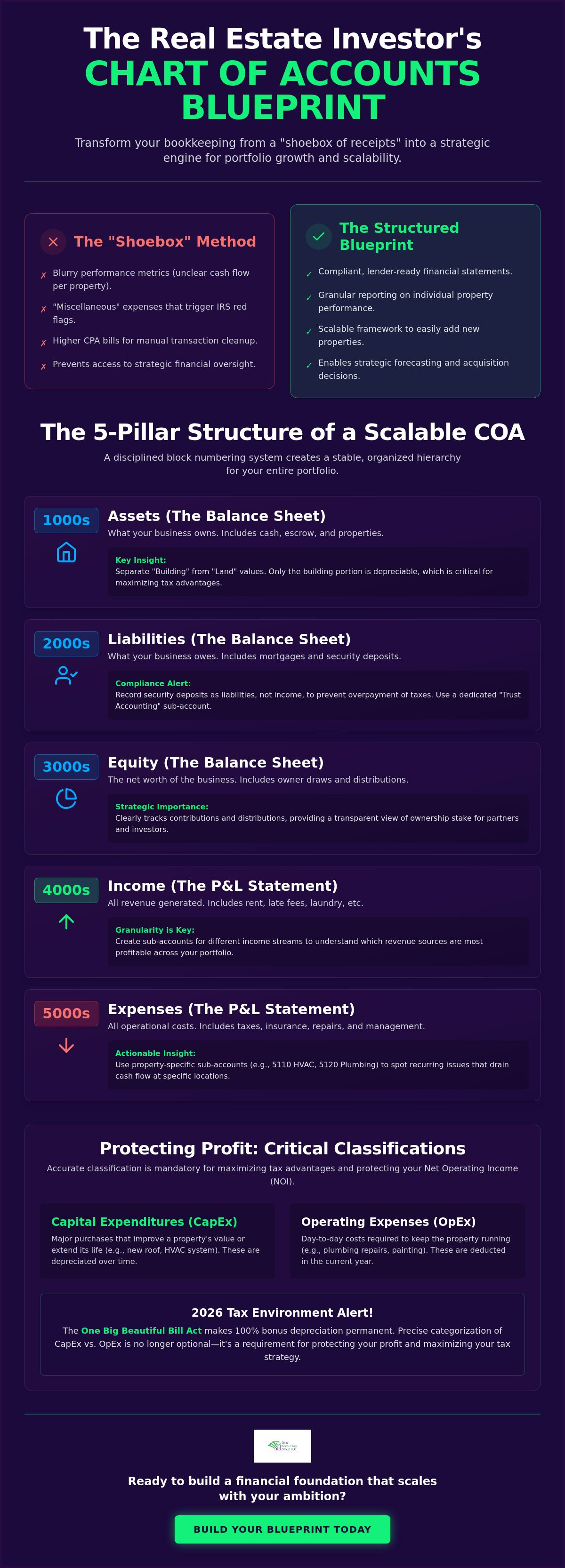
A high-performance chart of accounts for real estate investors relies on a disciplined block numbering system. This logic assigns specific numerical ranges to account categories, creating an organized hierarchy that mirrors professional financial standards. By using a 1000-5000 range, you establish a framework that remains stable as you acquire more doors. This structure isn't just about labeling; it's about creating a predictable environment where every transaction has a logical home. This consistency is exactly what strategic accounting for rental properties requires to produce reports that lenders and partners can trust without hesitation.
Assets and Liabilities: The Balance Sheet Pillars
1000s (Assets): This range includes your liquid cash, escrow accounts, and the properties themselves. It's vital to separate "Building" from "Land" values here, as only the building portion is depreciable.
2000s (Liabilities): Here, you track mortgages, accounts payable, and security deposits.
Security deposits must be recorded as liabilities rather than income to prevent the overpayment of taxes on funds that do not yet belong to the business. Keeping these funds in a dedicated "Trust Accounting" sub-account ensures you remain compliant with state laws regarding tenant funds.
Income and Expenses: The P&L Pillars
4000s (Income): This includes your primary rental income along with secondary streams like late fees, laundry revenue, or utility reimbursements.
5000s (Expenses): This category covers the daily operational costs of your portfolio, from property taxes to insurance.
To gain true visibility into your portfolio, you must utilize property-specific sub-accounts. For instance, rather than a broad "Repairs" category, a professional COA uses sub-accounts like 5110 (HVAC) and 5120 (Plumbing). This level of detail allows you to identify recurring issues at specific properties that might be draining your cash flow. If your current setup feels like a tangled web of uncategorized transactions, it might be time to schedule a discovery call to discuss a more robust structural framework.
Finally, the 3000s range is reserved for Equity. This is where you track owner draws, partner distributions, and initial capital contributions. Proper equity tracking is the only way to maintain a clear distinction between business and personal funds, protecting your corporate veil and ensuring that every partner's stake is accurately reflected in the books. When your equity accounts are managed with precision, year-end distributions become a simple administrative task rather than a source of conflict.
CapEx vs. OpEx: Protecting Your Profit and ROI
Misclassifying property costs is the most common error that erodes the financial credibility of a rental portfolio. Operating Expenses (OpEx) are the necessary, recurring costs required to maintain a property in its current state, such as minor plumbing repairs or landscaping. Capital Expenditures (CapEx), however, are investments that improve the asset, extend its useful life, or adapt it to a new use. When you implement a professional chart of accounts for real estate investors, you create a clear boundary between these two worlds. This distinction is vital because failing to separate them doesn't just mess up your bookkeeping; it fundamentally distorts your Net Operating Income (NOI).
If you dump a $15,000 roof replacement into a general repairs account, your NOI will plummet for that period. To a lender or a potential buyer, this makes the property look significantly less profitable than it actually is. By correctly identifying CapEx, you move that cost to the balance sheet as an asset, preserving your NOI and demonstrating the true health of your investment. While some investors argue that "an expense is an expense," this perspective ignores the strategic advantage of depreciation. Categorizing a project as CapEx allows you to recover the cost over time through depreciation, which reduces your taxable income without impacting your current cash flow.
The "Betterment, Adaptation, Restoration" (BAR) Test
The IRS uses the BAR test to determine if a cost is a repair or a capital improvement. Betterment involves making the property better than it was, such as adding a new bedroom. Adaptation involves changing the property's use, like converting a garage into an ADU. Restoration involves fixing the property after it has fallen into a state of disrepair or replacing a major component. For example, patching a few shingles on a roof is a repair (OpEx). Replacing the entire roof is a restoration (CapEx). Lenders look for this separation because it shows you're reinvesting in the building's structural integrity rather than just reacting to emergencies.
Tracking Depreciation and Amortization
Depreciation and amortization are non-cash expenses that sit below the Net Operating Income line in your COA. They're powerful tools for profit protection, especially under the 2025 "One Big Beautiful Bill Act" (OBBBA), which permanently restored 100% bonus depreciation for qualified property acquired after January 19, 2025. This means that for 2026, you can potentially deduct the entire cost of certain capital improvements in the first year. Understanding where these figures live in your system is a core part of accounting for real estate investors. It allows you to see the difference between your "taxable profit" and your "actual cash in hand," which is the only way to make informed decisions about future acquisitions.
Setting Up QuickBooks Online for Real Estate Investors
Transforming a chart of accounts for real estate investors from a static list into a functional tool requires the right software configuration. You must select either QuickBooks Online Plus or Advanced to access the specific features required for a growing portfolio. These tiers are the only versions that support "Classes" and "Locations," which are the primary mechanisms for tracking individual property performance and entity-level data. Once your subscription is active, your first priority is importing your 1000-5000 block numbering system to establish your structural framework.
Execution involves more than just entering account names. You need to set up "Products and Services" that map directly to your COA. For instance, when you create an invoice for a tenant, the "Monthly Rent" service should automatically point to your 4000-level income account. As of June 2026, QuickBooks Online features AI-powered bank feeds that provide improved category and vendor suggestions. Use these automated tools to match recurring expenses, but always review the color-coded signals to ensure the AI hasn't misclassified a capital improvement as a simple repair. If you're ready to build a system that supports your long-term growth, book a discovery call to discuss your specific portfolio needs.
Using Classes and Locations Correctly
Assigning one "Class" to each property is the gold standard for real estate reporting. This discipline allows you to run a "Profit and Loss by Class" report, which is the most powerful tool for comparing the actual performance of your assets side-by-side. If you operate multiple LLCs, use the "Locations" feature to track entity-level data separately. Consistent naming conventions are vital here; if one property is "123 Main St" in your classes, it must be labeled identically across all transactions to prevent data fragmentation. This organization ensures that as you add more doors, your reporting remains clean and actionable.
Professional Training and Setup
Many investors attempt to DIY their software configuration only to face high costs for forensic cleanup later. Investing in a professional QuickBooks setup prevents these errors by ensuring your chart of accounts for real estate investors is correctly mapped from day one. Customized training for your internal team or property manager ensures that everyone understands how to maintain the integrity of your data. Software is only as good as the structural framework it is built upon. A methodical setup provides the clarity you need to move from basic administrative tasks to high-level strategic oversight.
Scaling Your Portfolio with Strategic Financial Oversight
Establishing a robust chart of accounts for real estate investors is the first step toward true operational clarity. However, the real value of this system is realized when you transition from simple record-keeping to advanced management accounting. This strategic shift allows you to move beyond historical data and begin using your financials as a predictive tool. When every transaction is categorized within a high-integrity framework, you gain the ability to perform deep-dive analyses on your portfolio's performance. You can identify which property types are yielding the highest returns and where operational inefficiencies are quietly eroding your cash flow.
At Okie Accounting Group LLC, we position ourselves as more than just a service provider. We act as a strategic partner, helping you bridge the gap between basic administrative tasks and high-level leadership. A scalable COA ensures that as your holdings grow, your reporting remains consistent and manageable. This structural integrity is what allows you to maintain control over a multi-million dollar portfolio without becoming overwhelmed by the granular details of daily bookkeeping. It transforms your role from an overwhelmed landlord into a disciplined, data-driven investor.
For those managing complex operations in other fields, such as care provision, having a dedicated partner for out-of-hours management is just as essential for maintaining control; you can find out more about how specialized support services can help.
Lender-Ready Financials
When you apply for your next mortgage, banks don't just look at your credit score; they scrutinize your P&L and Balance Sheet. A professional chart of accounts for real estate investors proves your financial readiness by presenting data in a format lenders already trust. This level of transparency is a hallmark of professional firms like Bin Hamad Mathew Joseph and Associates Chartered Accountants, who advocate for rigorous accounting standards to facilitate growth. There is a significant difference between a tax-ready set of books, which only seeks to minimize liability once a year, and a growth-ready set of books, which demonstrates ongoing profitability and stability. Having your financials organized by property and category shows lenders that you're a methodical operator with a firm grip on your business's health. This level of organization often leads to faster approvals and more favorable terms because the bank views your data as reliable and low-risk.
The Transition to Fractional Controller Services
There comes a point in every successful investor's journey where a bookkeeper is no longer enough. When you begin managing complex multi-unit acquisitions or navigating the nuances of the 2026 tax landscape, you need the oversight of a specialist. Fractional controller services provide the high-level interpretation of your COA data that's required for significant scaling. These experts help you interpret cash flow forecasts and evaluate the long-term impact of new acquisitions on your existing portfolio. If you're ready to gain total clarity and control over your investment future, it's time to build a foundation that supports your most ambitious goals.
Securing Your Financial Foundation for Growth
Building a scalable portfolio requires moving beyond the chaos of unorganized data. By implementing a standardized numbering system and mastering the distinction between repairs and improvements, you ensure your business remains compliant and profitable. A professional chart of accounts for real estate investors provides the structural integrity needed to attract lenders and navigate the complexities of the 2026 tax landscape. This framework isn't just about record-keeping; it's about establishing a data-driven environment where your financial decisions are backed by accuracy and long-term stability.
Maintaining this level of structural integrity is a universal requirement for business growth; for those exploring international opportunities or navigating the regulatory landscape in the UAE, you can learn more about IBR Group and their specialized guidance on corporate tax and licensing requirements.
At Okie Accounting Group LLC, we specialize in providing nationwide strategic financial oversight for the real estate and construction sectors. Our team offers expert QuickBooks Online certified training to ensure your systems are built for structural health rather than just temporary tax relief. Don't let poor categorization or a generic setup stall your progress as an investor. We're dedicated to helping you transition from basic bookkeeping to high-level strategic leadership.
Gain financial clarity with a professional QuickBooks setup and training from Okie Accounting Group LLC.
Your commitment to accurate data today is the catalyst for your expansion tomorrow. We're ready to partner with you to ensure your financial house is as solid as the properties you own.
Frequently Asked Questions
What is the best numbering system for a real estate chart of accounts?
The industry-standard numbering system for a professional chart of accounts for real estate investors follows a 1000-5000 block structure. Assets are assigned to the 1000s, liabilities to the 2000s, equity to the 3000s, income to the 4000s, and operating expenses to the 5000s. This methodical approach ensures that your general ledger remains organized and scalable as your portfolio expands.
Should I have a separate QuickBooks file for every property?
You don't need a separate QuickBooks file for every property; in fact, doing so makes consolidated reporting nearly impossible. Instead, use the "Classes" and "Locations" features in QuickBooks Online Plus or Advanced to track performance for each asset within a single file. This centralized framework allows you to run side-by-side comparisons and provides a comprehensive view of your entire portfolio's financial health.
Is a security deposit considered income for a real estate investor?
A security deposit is never considered income at the time of receipt because it's a liability that you owe back to the tenant. You must record these funds in a 2000-level liability account on your balance sheet. The only time a deposit becomes income is if a tenant vacates and you legally apply those funds toward unpaid rent or property damages.
How do I track property-level expenses in QuickBooks Online?
You track property-level expenses in QuickBooks Online by enabling and utilizing the "Classes" feature. Assign a specific class to each property address and ensure every transaction, whether it's a utility bill or a repair, is tagged accordingly. This allows you to generate a Profit and Loss by Class report, which is essential for identifying which assets are meeting your ROI targets.
What is the difference between a repair and a capital improvement for taxes?
The primary difference is that a repair maintains the property's current condition, while a capital improvement increases its value or extends its useful life. Repairs are operating expenses (OpEx) that are deducted in the year they occur. Capital improvements (CapEx) must be depreciated over several years, though 2026 tax rules like 100% bonus depreciation may allow for immediate recovery.
Can I use a standard business chart of accounts for my rental properties?
Using a standard business chart of accounts is a mistake because it lacks the niche-specific categories required for property management. A specialized chart of accounts for real estate investors includes vital accounts for escrow, security deposit liabilities, and the distinction between land and building values. A generic setup often leads to financial blind spots that make it difficult to secure financing or pass an audit.
How often should I review my chart of accounts for accuracy?
You should review your chart of accounts for accuracy at least once a year, ideally before tax season begins. It's also wise to perform a review whenever you acquire a new property or if there are significant changes to federal tax laws, such as the restoration of bonus depreciation. Regular audits of your account structure ensure that your data remains clean and lender-ready.
What are the most common chart of accounts mistakes real estate investors make?
The most frequent mistakes include lumping diverse costs into a "Miscellaneous" account and failing to separate personal funds from business transactions. Investors also frequently forget to separate land from building values, which results in incorrect depreciation calculations. These errors create significant cleanup costs and can trigger red flags during an IRS audit or a bank's loan review process.


Comments