Cash Flow Management for Construction Companies: A Strategic Framework for 2026

Updated: 6 days ago
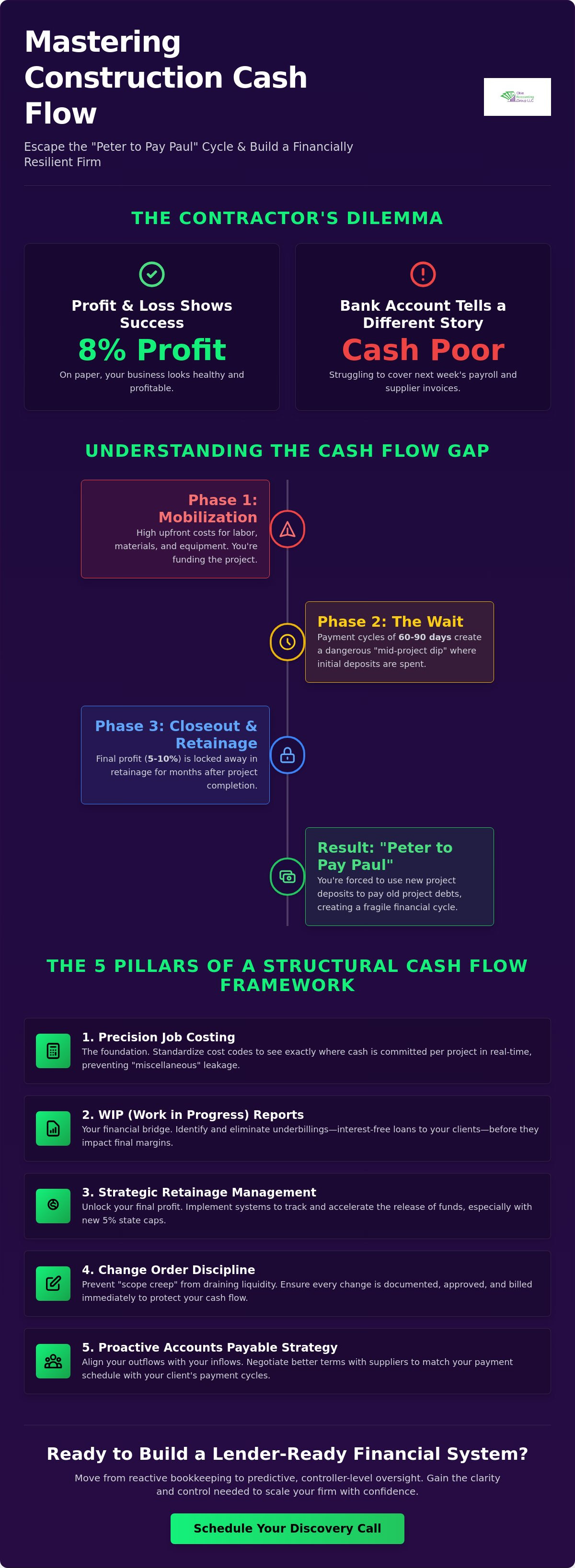
Why does your P&L show a healthy 8% profit while your bank account is struggling to cover next week's payroll? It's a frustrating reality for many contractors who find themselves caught in the "Peter to pay Paul" cycle. High upfront mobilization costs and standard retainage, which can still reach 10% despite new 5% caps in states like California, often mean you're financing the owner's project with your own liquidity. Effective cash flow management for construction companies isn't just about tracking expenses; it's about building a structural framework that protects your margins.
We understand that you need more than just basic bookkeeping to stay ahead of delayed payments and inaccurate job costing. This article promises to help you master the financial systems needed to eliminate cash gaps and ensure every project contributes to a predictable bank balance. We'll explore how the One Big Beautiful Bill Act (OBBBA) reshapes your 2026 tax strategy, the impact of current 6.5% to 9.5% interest rates on borrowing, and the specific reporting tools required to make your business lender-ready so you can scale without hitting a liquidity wall.
Key Takeaways
Identify the structural causes of the "Peter to pay Paul" cycle and learn how to stop funding old debts with new project deposits.
Utilize WIP reports and accurate job costing to catch underbillings before they impact your project's final margins.
Master cash flow management for construction companies by moving beyond reactive bookkeeping to proactive, controller-level oversight.
Create a 13-week forecasting framework that provides clarity on future bank balances and upcoming mobilization requirements.
Build the lender-ready financial systems necessary to scale your firm with confidence alongside Okie Accounting Group LLC.
Understanding the Construction Cash Flow Gap
Construction is a unique industry where you're often required to act as a bank for your clients. You pay for lumber, steel, and labor today, but the check from the developer might not arrive for 60 or even 90 days. This timing mismatch creates the construction cash flow gap. In technical terms, cash flow represents the net amount of cash being transferred into and out of a business. For contractors, the "out" usually happens much faster than the "in."
If you don't actively manage this gap, you'll likely fall into the "Peter to pay Paul" trap. This occurs when you use the mobilization deposit from a new project to cover the overdue supplier invoices from a project you're currently finishing. It creates a temporary illusion of liquidity, but it's actually a structural failure in your financial foundation. In 2026, this gap is widening due to volatile material lead times and rising subcontractor costs that can outpace your initial estimates. Relying on reactive accounting is no longer an option. You need a structural financial framework to ensure your business remains stable during every phase of the build.
The Anatomy of a Construction Cash Flow Cycle
Mobilization costs are the first major hurdle. While many contractors believe "front-loading" their schedule of values solves the problem, it often just masks a deeper liquidity issue. The mid-project dip is the most dangerous phase. This is the point where initial deposits are spent, but the project hasn't reached the milestones required for the next major progress payment. Finally, closeout delays often leave your final profit, typically held in retainage, locked away for months after the physical work is done. Without proper cash flow management for construction companies, these phases can lead to a total stall in operations.
Why High Revenue Often Masks Low Liquidity
High revenue is a vanity metric if it isn't backed by available cash. Your profit and loss statement might show a healthy margin, but paper profit doesn't pay the electric bill. Overbilling is a common but risky tactic. It provides a temporary cash infusion, but it creates a massive future liability for taxes and labor that you haven't yet performed. Many firms also face the "growth paradox." This happens when taking on more work actually drains your cash reserves faster than you can replenish them, leading to a liquidity crisis despite a record-breaking backlog. Transitioning to controller-level oversight is the only way to distinguish between a growing bank balance and a growing mountain of debt.
The 5 Pillars of a Structural Cash Flow Framework
Effective cash flow management for construction companies requires moving beyond simple bank balance checks. It demands a structural framework where every financial decision is data-driven. This approach transforms accounting from a historical record into a predictive tool. Implementing these cash flow management strategies ensures that your capital isn't unnecessarily tied up in project cycles. A robust framework rests on five specific pillars:
Job Costing: This is the foundation. It allows you to see exactly where cash is committed per project in real-time.
WIP (Work in Progress) Reports: These reports are essential for identifying underbillings and overbillings before they escalate into liquidity crises.
Retainage Management: With many states, such as California, capping retainage at 5% for 2026, you need systems to track and accelerate the release of these final funds.
Change Order Discipline: You must prevent "scope creep" from draining project liquidity by ensuring every change is documented and billed immediately.
Accounts Payable Strategy: Negotiate terms with your suppliers to align your payment outflows with your client's payment cycles.
By focusing on these pillars, you move from a reactive state to one of controlled growth. If you're ready to see how these systems look in practice, you can schedule a discovery call to discuss your firm's specific needs.
Mastering WIP Accounting for Profit Protection
WIP acts as the bridge between project completion and financial reporting. Without it, your P&L is essentially a guess. Underbillings are particularly dangerous because they act as interest-free loans you're giving to your clients. When you perform work but haven't billed for it, you're draining your own cash reserves to fund their project. Linking your WIP data to specialized construction bookkeeping services provides the real-time visibility needed to spot these gaps. It ensures that every dollar of labor and material is accounted for and invoiced promptly.
The Role of Precision Job Costing
Standardizing your cost codes is the only way to prevent "miscellaneous" leakage. When costs are buried in vague categories, you lose the ability to analyze where your money is actually going. Accurate job costing doesn't just help you manage current projects; it informs your future bidding process. It ensures you only take on projects that are cash-positive from day one. By integrating time-tracking and field data directly into your QuickBooks setup, you create a seamless flow of information from the job site to the back office. This precision builds the "lender-ready" statements required for scaling.
Bookkeeping vs. Strategic Controller Oversight
Basic bookkeeping is the rearview mirror of your business. It records every invoice, receipt, and payroll run after the money has already moved. While this is necessary for compliance, it doesn't help you navigate the road ahead. Strategic controller oversight acts as the windshield. It uses the data collected by bookkeepers to perform proactive analysis and establish internal controls. For cash flow management for construction companies, this distinction is the difference between surviving a project and actually profiting from it.
Most firms hit a wall when they reach roughly $2 million in annual revenue. At this scale, the volume of transactions and the complexity of project-based accounting become too much for a generalist to handle. You might start seeing tax surprises at year-end or inconsistent reports that don't match the reality on the job site. A controller implements a "Trust but Verify" model. They establish rigorous internal controls to prevent waste and fraud, ensuring that every dollar spent is aligned with your project's budget. This level of discipline protects your margins from the "death by a thousand cuts" that occurs when small expenses go untracked.
When to Move Beyond Basic Bookkeeping
If you've faced lender rejections or struggle to secure higher bonding limits, these are clear signs you need more than simple data entry. Banks and sureties look for the high-level reporting that only a professional financial manager provides. Engaging fractional controller services allows mid-sized firms to access this expertise without the overhead of a full-time executive. A controller ensures your financial statements are accurate, timely, and ready for scrutiny at a moment's notice.
Building a Proactive Financial Culture
A proactive financial culture shifts the focus from an annual tax event to a monthly strategic dialogue. Instead of looking at numbers once a year, you conduct monthly reviews to adjust for overbillings or rising material costs. Empowering project managers with financial data is a cornerstone of effective cash flow management for construction companies. By integrating management accounting into your daily operations, you turn financial data into a tool for strategic decision-making. This ensures that every project manager understands how their field decisions impact the company's overall liquidity.
Implementing a 13-Week Cash Flow Forecast
A 13-week forecast is the primary tool for breaking the cycle of financial uncertainty. While a monthly P&L tells you what happened last month, this rolling forecast tells you exactly how much cash you'll have in the bank every Friday for the next quarter. Effective cash flow management for construction companies relies on this 13-week rhythm to anticipate mobilization needs and payroll spikes. This isn't a complex mathematical exercise; it's a disciplined five-step process.
Step 1: Establish your actual beginning cash balance across all operating, savings, and payroll accounts.
Step 2: Anticipate inflows based on your specific project billing cycles. Don't use the invoice date; use the date the check actually clears based on historical client payment trends.
Step 3: Map out fixed overhead alongside variable project costs. In 2026, you must account for rising subcontractor rates and the 6.5% to 9.5% interest on any existing bank financing.
Step 4: Identify "Danger Zones." These are the specific weeks where cumulative outflows are projected to exceed total inflows.
Step 5: Adjust the "Levers." When a danger zone appears, you must either delay a non-critical equipment purchase or negotiate an accelerated milestone billing to bridge the gap.
If you want to see how these numbers apply to your specific backlog, request a custom cash flow forecast setup to gain immediate clarity on your 2026 liquidity.
Optimizing QuickBooks for Forecasting
Your accounting software should do more than just store receipts. Using the "Project" feature in QuickBooks Online allows for granular tracking of every dollar committed to a job. By setting up automated reminders for overdue invoices, you can significantly shorten your accounts receivable cycle. For a deeper dive into the technical configuration required for these reports, see our guide on QuickBooks for contractors. This setup ensures that your forecast is built on a foundation of clean, real-time data.
Managing the Forecast Volatility
Construction is inherently volatile. You must account for "Black Swan" events such as unexpected weather delays or sudden supply chain breaks that can stall a project. We recommend creating "Best Case" and "Worst Case" scenarios for every major bid in your pipeline. This allows you to see how a delayed payment or a 5% retainage withholding will impact your overall liquidity. A 13-week forecast is not a static document, but a living GPS for your firm’s survival. It allows you to make course corrections before you hit a liquidity wall.
Scaling Safely with Okie Accounting Group LLC
Effective cash flow management for construction companies isn't a byproduct of luck; it's the result of a deliberate structural framework. At Okie Accounting Group LLC, we move beyond the basic administrative tasks of recording transactions to build the financial systems your business needs to thrive. We specialize in taking firms from messy, reactive books to "Lender-Ready" financial statements that command respect from banks and bonding agents. This transition is essential in a 2026 market where interest rates remain between 6.5% and 9.5%, making every point of liquidity a vital asset for your firm's stability.
Our nationwide remote approach provides high-level financial leadership without the burden of a full-time executive salary. We speak the technical language of the job site and the boardroom. We understand the nuances of 2026 regulations, such as the $32 million gross receipts threshold for small contractor exceptions and the shifting retainage caps across various states. We don't just record your history; we act as a strategic mentor to help you navigate the complexities of project-based financial tracking. This partnership ensures that your financial data is accurate, timely, and, most importantly, actionable.
Our Fractional Controller Methodology
Our methodology provides strategic oversight that goes far beyond monthly bookkeeping. We focus on constructing customized financial reporting that highlights project-level profitability, allowing you to see which jobs are truly contributing to your bottom line. We also provide direct support for QuickBooks training to empower your internal team. This ensures that your field data is captured correctly from the start, creating a clean flow of information that supports proactive decision-making rather than reactive fire-fighting.
Your Next Steps to Financial Clarity
Scaling a construction firm requires a solid foundation. Before you can successfully take on larger contracts, you must undergo a thorough "Financial Cleanup" to ensure your existing data is reliable. This process identifies hidden leaks in your cash flow and establishes the internal controls necessary to prevent waste. Once your books are clean, you can make data-driven choices about equipment purchases and labor expansion. If you're ready to move from a state of financial complexity to one of operational clarity, you can schedule your strategic financial review with Okie Accounting Group LLC today. We'll evaluate your current systems and build a roadmap for your long-term financial health.
Securing Your Firm's Financial Future
Success in the 2026 construction market requires more than just high-quality craftsmanship; it demands a rigorous, structural approach to your finances. By implementing 13-week forecasts and mastering WIP reports, you move beyond the cycle that stalls so many talented contractors. These systems provide the clarity needed to handle 5% retainage caps and shifting material costs without compromising your liquidity. You've learned that true cash flow management for construction companies is about shifting from reactive recording to proactive, strategic oversight.
Sarah O’Quinn and the team at Okie Accounting Group LLC provide the specialized construction industry expertise and cloud-based systems required for nationwide support. We understand the specific pressures of your trade and offer the high-level financial guidance needed to protect your margins. It's not necessary to navigate these complex financial waters alone. Gain financial control with Okie Accounting Group LLC’s Fractional Controller Services and ensure your firm is built on a foundation of stability. Your next project should be a source of profit, not a source of stress. We're ready to help you build a more resilient and profitable future.
Frequently Asked Questions
Why is construction cash flow different from other industries?
Construction cash flow is unique because it relies on project-based billing cycles and high upfront mobilization costs. Unlike retail or service businesses where payment is immediate, contractors often wait 60 to 90 days for client funds while paying labor and subcontractors weekly. This creates a structural gap where you're essentially acting as a bank for your clients, requiring a specialized framework to maintain liquidity.
How does retainage affect my cash flow forecasting?
Retainage acts as a forced savings account that you cannot access until the project is fully closed and approved. In your forecasting, you must treat these funds as restricted cash that isn't available for daily operating expenses. Since retainage often represents 5% to 10% of the contract value, it frequently accounts for your entire profit margin on a project, making its delayed release a critical factor in long-term stability.
What is the most common cash flow mistake contractors make?
The most frequent error is the "Peter to pay Paul" cycle, where new project deposits are used to fund the completion of past jobs. This creates a dangerous dependency on a constant stream of new contracts to cover old liabilities. Without a structural framework for cash flow management for construction companies, this habit eventually leads to a liquidity wall where you can no longer cover payroll despite a full project backlog.
Can QuickBooks Online handle construction-specific cash flow management?
QuickBooks Online can handle construction-specific needs if you utilize the "Projects" and "Classes" features for granular job costing. While it's a generalist tool, professional setup and training ensure it tracks underbillings and overbillings accurately. This allows your accounting system to provide the raw data necessary for strategic forecasting and lender-ready reporting, provided the data entry is disciplined and consistent.
How often should a construction company update its cash flow forecast?
You should update your 13-week cash flow forecast every single week without exception. Construction projects are inherently volatile, and a single weather delay or supply chain break can shift your entire financial outlook. Weekly reviews allow you to adjust for actual inflows and outflows, giving you enough lead time to pull "levers" like delaying non-essential purchases before a projected deficit occurs.
What is the difference between a bookkeeper and a controller for a construction firm?
A bookkeeper focuses on the reactive recording of past transactions, while a controller provides proactive analysis and strategic oversight. The bookkeeper ensures your data is entered correctly, but the controller uses that data to build structural frameworks, manage WIP reports, and establish internal controls. This distinction is vital for firms looking to scale safely beyond the $2 million revenue mark where complexity outpaces basic data entry.
How can I improve my accounts receivable collection time?
Improving collection time starts with clear contract terms and automated invoice reminders within your accounting software. You should also consider "front-loading" your schedule of values to cover mobilization costs early in the project life cycle. Consistent follow-up on overdue invoices and offering electronic payment options can significantly shorten the AR cycle and improve your overall liquidity by several days or weeks.
What should I do if my cash flow forecast shows a deficit in 4 weeks?
If your forecast predicts a deficit in four weeks, you must act immediately to bridge the gap. First, look for opportunities to accelerate milestone billings or follow up on aged receivables. Second, delay any non-critical spending, such as equipment upgrades or discretionary overhead. If these steps aren't enough, you'll have enough lead time to tap into a line of credit before the liquidity crisis actually hits your bank account.


Comments