_edited_edited.jpg)

Construction Bookkeeping Services: Building a Scalable Financial Infrastructure

Updated: May 18
Why does a project that looks profitable on the job site often result in a cash flow crisis by the time the final invoice is sent? For many contractors, the answer lies in the gap between daily operations and a disciplined financial system. You likely started your business to build structures, not to spend your nights untangling retainage tracking or worrying about margin erosion. While 80% of bookkeeping firms plan to raise their fees in 2026, simply paying for basic data entry won't solve the underlying issue of inaccurate job costing. You need a partner who understands that construction bookkeeping services are about more than just recording history; they're about building a scalable infrastructure for growth.
At Okie Accounting Group LLC, we agree that financial clarity shouldn't be a luxury, especially with shifting software requirements and complex tax laws. This guide promises to show you how specialized oversight transforms raw data into lender-ready financial statements and real-time visibility. We'll preview the essential components of a systems-first approach, from mastering Work-in-Progress records to leveraging cloud-based tech stacks for better field-to-office communication. By the end, you'll see how a professional accounting infrastructure provides the quiet confidence you need to make informed, strategic decisions.
Key Takeaways
Shift your perspective from traditional record-keeping to building a strategic financial operating system that treats data as a growth asset.
Master the two vital organs of construction profitability: granular job costing and accurate Work-in-Progress (WIP) records.
Identify and eliminate margin erosion by implementing disciplined oversight for unrecorded change orders and field-to-office communication.
Discover how specialized construction bookkeeping services transform QuickBooks Online from a generic tool into a powerful, industry-specific tech stack.
Prepare your firm for sustainable growth with lender-ready financial statements that provide absolute clarity to stakeholders and partners.
Table of Contents
Beyond Data Entry: Defining Specialized Construction Bookkeeping Services
Construction is a project-based business where every job is its own mini-company. Unlike retail or SaaS, where transactions follow a predictable pattern, Construction accounting requires a specialized lens to manage the high-stakes variables of labor, materials, and subcontractors. Traditional bookkeeping often focuses on "recording history," which is essentially looking in the rearview mirror after a project is finished. In contrast, specialized construction bookkeeping services build a financial operating system. This shift moves your data from a static record to a strategic asset that allows for proactive adjustments before a project slips into the red.
As we move through 2026, the stakes for financial accuracy have never been higher. With 100% bonus depreciation available for qualified property placed in service after January 19, 2025, and the discontinuation of QuickBooks Desktop support on May 31, 2026, contractors must have a disciplined system in place to capture every tax advantage and maintain operational continuity. The ultimate goal of this oversight is to produce Lender-Ready financials. These are transparent, accurate, and structured reports that give banks and bonding agents the confidence to fund your next major expansion.
The 'Systems-First' Approach to Construction Finance
Simple data entry involves putting numbers into boxes; a systems-first approach builds the boxes themselves. When implementing construction bookkeeping services, we focus on creating a comprehensive accounting architecture that starts with a clean Chart of Accounts tailored specifically for contractors. This isn't a one-size-fits-all template. It's a structured framework that categorizes costs by job, phase, and type. When your infrastructure is built correctly, you gain real-time visibility into your cash position. You stop making reactive decisions based on bank balances and start leading your firm based on project-level data.
Why Generalist Accounting Fails the Modern Builder
Generalist bookkeepers often struggle with the complexity of long-term projects and irregular payment cycles common in this industry. Without a deep understanding of retainage tracking and progress billing, a generalist might accidentally commingle project funds, leading to a distorted view of actual profitability. This lack of precision often results in margin erosion that goes undetected until the end of the fiscal year. Construction financial infrastructure is the backbone of a $10M+ enterprise. Without it, scaling becomes a high-risk gamble rather than a calculated progression.
The Four Pillars of Profitable Construction Financials
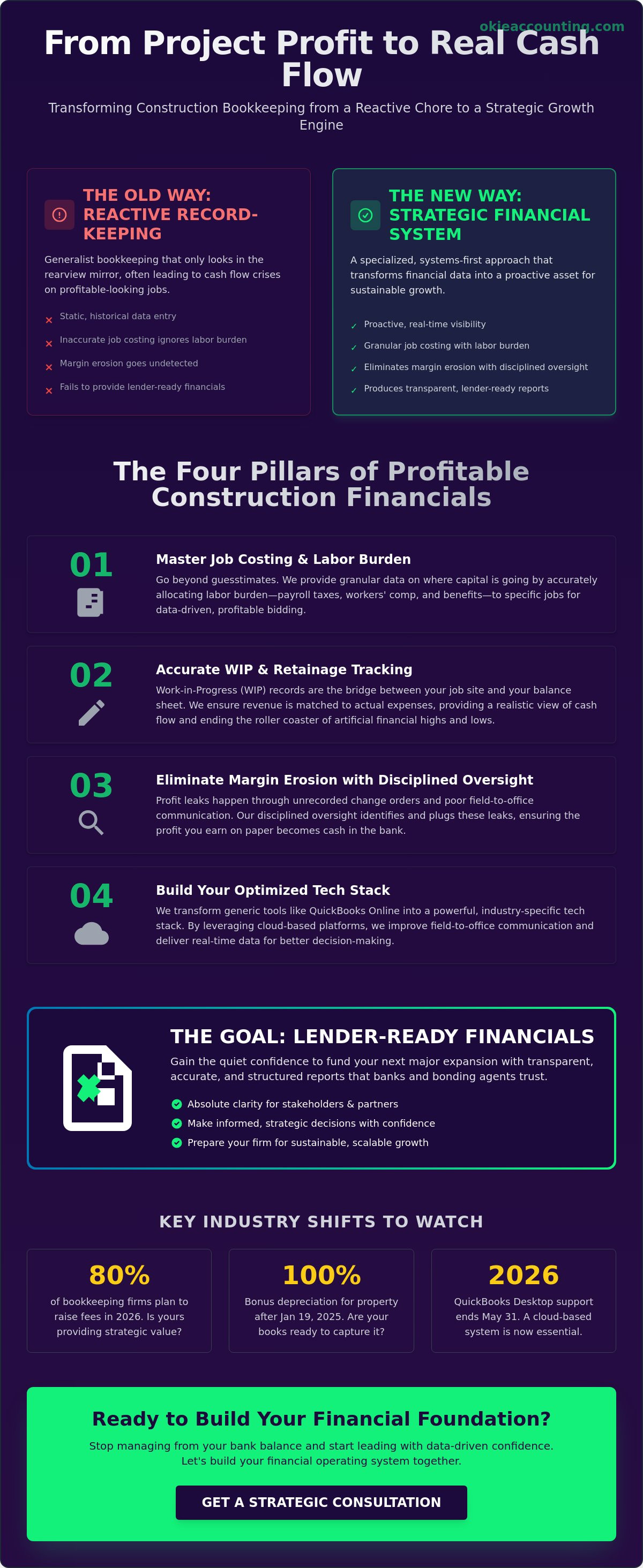
To move from reactive bookkeeping to a high-level financial operating system, your firm must master four specific pillars. These aren't just administrative chores; they are the tactical tools that prevent margin erosion and ensure your business remains lender-ready. While 80% of bookkeeping firms plan to raise their fees in 2026, the value you receive should go far beyond simple ledger entries. True construction bookkeeping services focus on the mechanics of project profitability, ensuring that every dollar spent is a deliberate investment in your firm's growth.
Mastering Job Costing and Labor Burden
Job costing is the vital organ of construction profitability. It provides the granular data needed to understand exactly where your capital is going. Many contractors make the mistake of "guesstimating" based on raw material costs and hourly wages, but this ignores the labor burden. Labor burden includes payroll taxes, workers' compensation insurance, and employee benefits. If these indirect costs aren't allocated to specific projects, your bids are based on a financial fiction. Data-driven bidding allows you to identify "money-loser" jobs before they finish, giving you the opportunity to adjust field operations or negotiate change orders before the damage is permanent.
WIP and Retainage: The Hidden Keys to Cash Flow
Work-in-Progress (WIP) records are the bridge between your project site and your balance sheet. Without accurate WIP accounting, your monthly financial statements are a roller coaster of artificial highs and lows. WIP allows you to match revenue to the actual expenses incurred, providing a realistic view of your current financial health. This level of oversight is particularly critical for maintaining bonding capacity, as lenders and sureties look for consistent, predictable reporting. If you're struggling to maintain this level of detail, professional financial reporting can provide the clarity needed to satisfy these stakeholders.
Retainage tracking is equally vital for protecting your bottom line. It's common for contractors to lose track of that final 10% because it isn't billed until the very end of a project. Without a disciplined system to track these withheld funds, your profit can easily disappear into administrative cracks. Coupled with progress billing, which ensures you are paid for work as it is completed, these pillars keep your project cash flow positive. By implementing these rigorous standards, you transform your accounting from a back-office necessity into a strategic advantage that fuels sustainable growth.
Margin Erosion: Why Your Firm Needs Disciplined Oversight
Margin erosion is the slow, often invisible leak of profit that occurs during project execution. While you might win a bid with a healthy 20% margin, poor oversight can quickly whittle that down to single digits before the final walkthrough. This is where specialized construction bookkeeping services move from a back-office task to a frontline defense. It isn't enough to track what you spent; you must track what you should have spent versus the actual costs in real-time. In 2026, where 80% of bookkeeping firms are raising their fees by up to 10%, the focus for contractors must shift from the cost of accounting to the value of financial protection.
Identifying the 'Silent Killers' of Contractor Profit
Missing job-level clarity is a primary driver of waste. When field teams don't have a direct line to financial data, they might over-order materials or fail to document a change order that adds three days of labor. These unrecorded change orders are profit killers. If you don't capture the extra scope immediately, you're essentially performing free work for the client. This lack of communication between the job site and the office creates a disconnect that generalist bookkeepers rarely catch.
Another danger is the habit of "robbing Peter to pay Paul." This occurs when a firm uses the cash flow from a new project deposit to cover the cost overruns of a finishing job. It creates a cycle of financial instability that masks the true health of individual projects. Margin erosion is often invisible until the bank account hits zero. By the time the cash runs out, the opportunity to correct the project's course has long since passed.
The Role of a Fractional Controller in Margin Protection
Moving beyond basic data entry requires the strategic oversight of a mentor who understands the mechanics of construction finance. A fractional controller acts as a high-level advisor, implementing internal controls and project audits that go beyond the capabilities of a standard bookkeeper. They analyze the "why" behind the numbers, looking for budget variances and identifying trends that suggest a project is veering off course. This proactive stance ensures that leaks are plugged before they impact your overall stability.
This high-level oversight is essential for firms looking to make the revenue jump from $5M to $20M. At this scale, manual tracking and "gut feeling" management are no longer feasible. By integrating Fractional Controller Services, you establish the financial infrastructure needed to protect your hard-earned margins. This disciplined approach provides a sense of quiet confidence. You stop worrying about cash flow surprises and start making decisions based on a foundation of accurate, real-time data.
Building Your Tech Stack: QuickBooks Online for Construction
The foundation of a modern financial infrastructure is a robust cloud-based platform. QuickBooks Online (QBO) has become the industry standard, especially following the May 31, 2026, discontinuation of support for QuickBooks Desktop. However, the software alone isn't a solution. Many contractors fall into the trap of using QBO "out-of-the-box," which often leads to messy data and unreliable reports. Professional construction bookkeeping services ensure that your tech stack is configured to handle the unique mechanics of job costing and progress billing from day one.
In February 2026, Intuit launched the "Construction Edition" for its Enterprise Suite, introducing advanced features like Cost Groups and AIA-style invoicing. Leveraging these tools requires more than just a subscription; it requires a disciplined setup that aligns with your specific project workflows. When your system is professionally configured, it transforms from a simple ledger into a powerful engine for growth. This is the difference between recording history and building a proactive financial operating system.
Five Steps to a Scalable Construction Tech Stack
Step 1: Professional QBO Setup. We build a custom Chart of Accounts tailored for contractors, ensuring every expense has a designated home that makes sense for your tax and bonding requirements.
Step 2: Project Management Integration. We sync QBO with field-focused apps like JobTread. This ensures that estimates and project costs flow seamlessly between the job site and the office.
Step 3: Automated Workflows. By utilizing tools like Intuit Assist AI, we automate the categorization of expenses and the drafting of payment reminders, reducing administrative overhead.
Step 4: Cash Flow Forecasting. We implement tools that look forward, not just backward, allowing you to anticipate capital needs before they become urgent.
Step 5: Monthly Financial Reviews. We establish a steady rhythm of oversight where we analyze project profitability and adjust strategies based on real-time data.
Field-to-Office Data Sync: The Key to Accuracy
Manual data entry is the enemy of construction profitability. When your field team relies on paper receipts or verbal updates, the risk of error increases exponentially. Cloud-based systems eliminate these bottlenecks by allowing for remote financial leadership. Field supervisors can enter data directly from the job site, providing the office with immediate visibility into labor hours and material usage. This disciplined data entry is what separates a chaotic back office from a scalable enterprise.
Technology is only as effective as the people who use it. We provide QuickBooks Setup & Training to ensure your internal staff understands the "why" behind the workflows. This personalized approach empowers your team to maintain the integrity of your financial infrastructure, ensuring your data remains a reliable asset for long-term stability. By investing in professional training, you ensure that your team has the skills to support a system that grows with your business.
Ready for Growth: The Okie Accounting Advantage
Scaling a construction firm requires more than effort; it requires a financial infrastructure that translates your hard work into measurable, sustainable growth. Okie Accounting Group LLC serves as the strategic partner for ambitious contractors who are ready to move beyond basic record-keeping. We specialize in transforming financial complexity into operational clarity, ensuring that every project-level decision is backed by accurate data. By implementing our specialized construction bookkeeping services, you establish a "lender-ready" standard that becomes the benchmark for your firm's success.
The transition from reactive data entry to strategic oversight is what allows a business to confidently pursue larger contracts and increased bonding capacity. We don't just record what happened last month. We build the systems that prevent margin erosion and provide the quiet confidence you need to lead. This disciplined approach ensures that your financials are always prepared for the scrutiny of banks, bonding agents, and partners.
Our National Reach and Remote Expertise
While many local generalists lack the specific vocabulary of the building trades, our firm provides specialized expertise tailored to the US market. We provide nationwide remote financial leadership from our US base, offering a depth of knowledge in progress billing and retainage that is often missing from traditional accounting firms. Our team understands the nuances of the industry because we're as invested in your long-term stability as you are. This proactive partnership allows you to focus on project execution while we maintain the discipline of your back office.
Next Steps: Securing Your Financial Infrastructure
Securing your financial future begins with an initial consultation and a thorough system audit. We identify the gaps in your current workflows, from unrecorded change orders to inefficient tech stacks, and build a structured remedy. This process ensures your transition to a cloud-based operating system is seamless and secure. Once your infrastructure is optimized, we transition your firm to a monthly retainer model for continuous oversight.
This rhythm of regular reporting and cash flow forecasting ensures you have real-time visibility into your profitability. You'll stop wondering where your profit went and start seeing exactly how each project contributes to your bottom line. Take the first step toward financial control and Schedule your consultation with Okie Accounting Group LLC today.
Building a Legacy of Financial Stability
Scaling a construction firm requires a shift from survival mode to strategic oversight. By mastering the pillars of job costing and Work-in-Progress records discussed throughout this guide, you protect your firm from the profit leaks that often go unnoticed until it's too late. Modernizing your financial infrastructure isn't just about compliance; it's about creating a foundation for long-term health. Implementing specialized construction bookkeeping services ensures your data is always lender-ready and your growth remains sustainable.
Okie Accounting Group LLC provides the nationwide remote financial leadership and specialized QuickBooks Online expertise needed to navigate this transition. We're dedicated to helping you achieve real-time visibility into your project-level profitability. You deserve the quiet confidence that comes from knowing your back office is as disciplined as your field operations. This transformation allows you to stop reacting to surprises and start leading with clarity.
Secure your construction profit margins with Okie Accounting Group LLC
Your commitment to financial accuracy today builds the foundation for a more profitable and stable enterprise tomorrow. We're ready to help you build that future.
Frequently Asked Questions
Is construction bookkeeping different from regular small business bookkeeping?
Construction bookkeeping is fundamentally different from regular bookkeeping because it's project-centric rather than period-centric. While standard businesses focus on monthly overhead, contractors must track labor, materials, and subcontractors for every individual project. This requires specialized management of Work-in-Progress records and retainage tracking, which are rarely found in generalist accounting systems.
What is job costing, and why is it essential for my construction business?
Job costing is the disciplined practice of assigning every expense to a specific project to determine its true profitability. It's essential because it reveals which jobs are generating profit and which are suffering from margin erosion. Without this granular data, you're bidding on new contracts based on guesses rather than historical performance data.
How much do specialized construction bookkeeping services cost in 2026?
In 2026, general bookkeeping rates range from $30 to $90 per hour, but specialized construction bookkeeping services often utilize fixed-fee models. For businesses with revenues between $500K and $2M, monthly retainers typically fall between $1,000 and $2,500. Advanced "done for me" plans starting at $2,116 per month include up to 400 specific accounting tasks.
Can Okie Accounting Group help me get my financials ready for a bank loan or bonding?
Achieving lender-ready financial statements is a primary focus of our strategic oversight. We ensure your balance sheet accurately reflects your current liabilities and project assets, which is critical for bonding agents and bank lenders. This disciplined approach provides the professional presentation and accuracy needed to secure expansion capital for your enterprise.
Do I need to switch to QuickBooks Online to work with a construction bookkeeper?
We recommend switching to QuickBooks Online to maximize the benefits of modern construction bookkeeping services. This is particularly urgent because Intuit ends support for QuickBooks Desktop on May 31, 2026. The cloud platform enables real-time data sync from the job site and integrates with tools like JobTread to prevent financial data gaps.
What happens if my current books are a mess; can you perform a cleanup?
Our team specializes in financial infrastructure audits and cleanups for firms with complex or disorganized records. We analyze your existing Chart of Accounts to identify inaccuracies and reconcile historical data to create a clean slate. This process is a prerequisite for building a scalable system that provides the real-time visibility you need.
How does a fractional controller differ from a standard bookkeeper for contractors?
A fractional controller acts as a strategic mentor, while a standard bookkeeper focuses on the administrative task of recording transactions. Controllers provide high-level oversight, including cash flow forecasting and internal audits, to protect your profit margins. This role is vital for firms jumping from $5M to $20M in revenue who need sophisticated leadership.
Can you manage payroll for my construction crew across multiple states?
Multi-state payroll management is a standard part of our service offering for growing crews. We handle the complexities of varying state regulations and ensure accurate labor burden allocation for every project. This allows you to focus on project execution while we maintain the discipline and compliance of your payroll infrastructure.



Comments