
Accounting for Construction Retainage: A Strategic Guide to Protecting Your Profit
- Wendy Okie

- 2 days ago
- 12 min read
If you view retainage as a simple deduction from your progress billings, you're treating your firm’s hard-earned profit like a rounding error. In reality, that withheld amount is often your entire net margin for the project. When you don't have a disciplined approach to accounting for construction retainage, you risk more than just a temporary cash flow shortage. You risk losing track of significant assets as they age across multiple job sites. It's frustrating to see your balance sheet fail to reflect the true value of your work while you wait months for final payment.
We understand that managing these funds requires more than basic bookkeeping; it demands a structural framework for financial health. This guide will show you how to master the recording, tracking, and collection of retainage to ensure your financials remain accurate and your cash flow stays strong. We'll examine the impact of 2026 regulations, such as the 5% caps in California and New York, and provide a clear methodology for using systems like QuickBooks Online to protect your project profitability even without built-in retainage features. By the end, you'll have a roadmap for transforming these withheld funds from a liability into a controlled, strategic asset.
Key Takeaways
Recognize retainage as a structural asset and align your reporting with ASC 606 standards to accurately distinguish between contract assets and receivables.
Implement a dedicated system for accounting for construction retainage within QuickBooks Online to eliminate the errors and lost revenue common with manual spreadsheets.
Protect your firm's long-term solvency by identifying the "Profit Trap" where your retainage percentage exceeds your project’s net margin.
Transition from basic administrative tasks to strategic financial oversight to better predict cash flow and identify high-risk project owners before they impact your bottom line.
Understanding Construction Retainage: More Than Just Withheld Cash
Retainage is often viewed as a simple administrative hurdle, but for a growing firm, it represents a significant portion of your net profit. By definition, it's a portion of the agreed-upon contract price deliberately withheld until a project reaches a specific milestone, typically substantial completion. While it serves as a safety net for owners, failing to implement a rigorous system for accounting for construction retainage turns this safety net into a financial trap. Profit isn't cash. Relying on a "wait and see" approach for these funds creates a distorted view of your company's actual performance and long-term solvency.
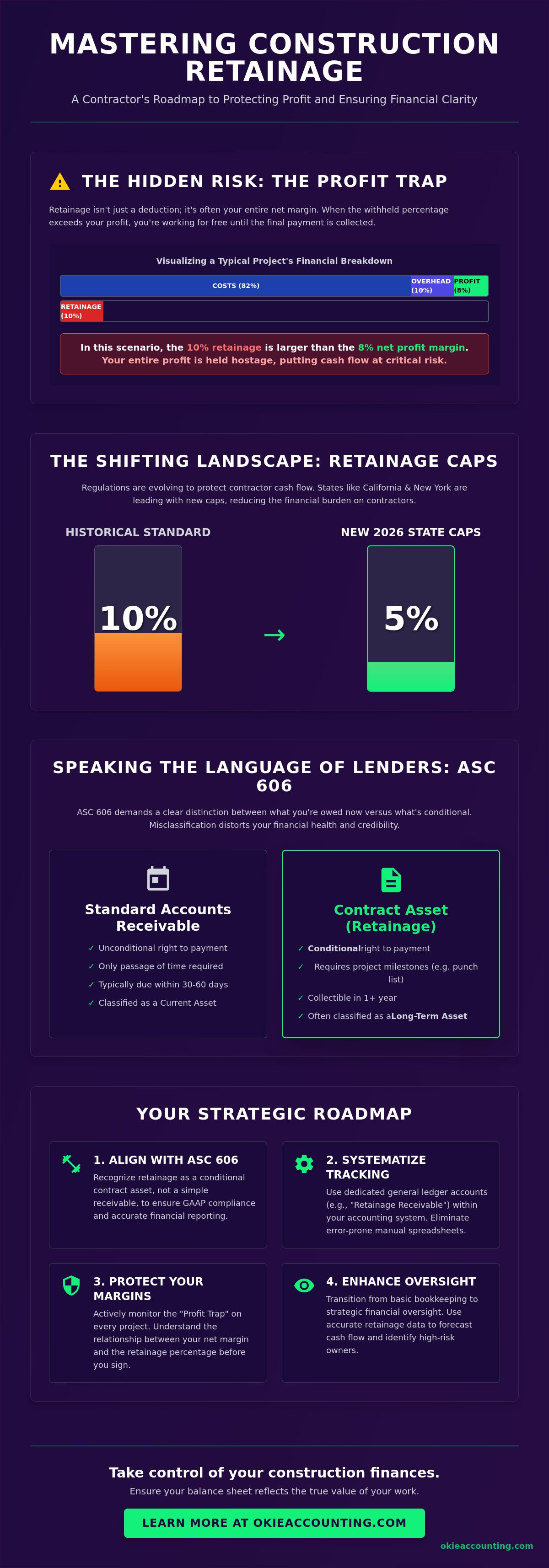
Historically, the industry standard was a flat 10% across all projects. However, the regulatory environment is shifting toward protecting contractor cash flow. As of 2026, states like California and New York have capped retainage at 5% for private contracts. These changes highlight why a one-size-fits-all approach to your ledger is no longer sufficient. You must track retainage held by owners differently than the retainage you withhold from your own subcontractors. If you simply record revenue when the final check arrives, you're operating with dangerous blind spots that hide your true project margins and tax liabilities.
The Purpose of Retainage in the Construction Lifecycle
Understanding Construction Retainage starts with recognizing it as a quality assurance tool. It ensures that punch-list items are finished and mechanic's liens are resolved before the final payout occurs. For project owners, these funds provide a vital financial buffer against contractor default or substandard work. In the 2026 market, retainage acts as a strategic security interest that balances the risk between the entity paying for the build and the firm executing the work.
Retainage vs. Standard Accounts Receivable
Blending retainage with your standard accounts receivable is a common mistake that distorts your liquidity ratios. Standard receivables are typically due within 30 days, whereas retainage might not be collectible for a year or more. This is why our accounting for construction retainage methodology emphasizes separate general ledger accounts. You need a dedicated "Retainage Receivable" account to maintain financial clarity. Without this distinction, your balance sheet suggests you have more immediate cash available than you actually do. For accurate management accounting, you must also identify when these funds transition from long-term assets to current assets as the project nears completion.
Financial Reporting Standards: ASC 606 and Retainage Presentation
GAAP compliance isn't just about following rules; it's about speaking the professional language of lenders and sureties. When accounting for construction retainage, the implementation of ASC 606 (Revenue from Contracts with Customers) fundamentally changed how firms must present these funds. This standard shifted the focus from simple billing to the specific nature of your "right to payment." If your financials don't reflect these nuances, you're signaling to outside partners that your internal controls may be lacking. Consistent reporting is the key to maintaining your credibility in a competitive market.
Contract Assets vs. Accounts Receivable
The core of the modern framework is the distinction between a contract asset and a receivable. A receivable represents an unconditional right to consideration, where only the passage of time is required before payment is due. In contrast, retainage is typically classified as a contract asset because the right to that payment is conditional on something other than time, such as the successful completion of a punch list or the expiration of a lien period.
According to the FASB's guidance on ASC 606 and Retainage Presentation, contractors must rigorously evaluate the collectability of these assets at each reporting period. You shouldn't carry the full amount on your books if there's a known dispute or a high likelihood of a backcharge. ASC 606 requires contractors to evaluate the collectability of retainage to ensure that the balance sheet doesn't overstate the firm's true economic value. This discipline prevents the "profit trap" where your books show earnings that never actually hit your bank account.
Presentation on the Balance Sheet
How you categorize these assets directly impacts your working capital and liquidity ratios. If a project is expected to last two years, retainage held for the duration should often be classified as a long-term asset rather than a current one. This distinction is vital for securing bonding and bank financing. Sureties look for consistency and transparency; they want to see that you understand the lifecycle of your cash and the structural health of your projects.
Misclassifying these funds can lead to a false sense of security or an unnecessary hit to your bonding capacity. Many firms find that moving beyond basic bookkeeping to Fractional Controller Services allows them to implement these complex GAAP requirements with precision. A strategic oversight partner ensures that your year-end disclosures clearly outline retainage terms, aging, and expected collection dates. This level of detail builds an atmosphere of trust with your financial partners. If you're unsure if your current reporting meets these professional standards, it may be time to schedule a brief consultation to review your balance sheet structure. Accurate accounting for construction retainage is the foundation of a stable, bankable construction business.
The Invisible Drain: How Retainage Impacts Cash Flow and Profitability
The mathematical reality of the "Profit Trap" is one of the most significant threats to a contractor’s long-term health. If a project contract mandates a 10% retainage rate but your net profit margin is only 8%, you aren't just waiting for your earnings to arrive. You're actively financing the project owner’s asset with 2% of your own capital for the duration of the build. This structural deficit compounds across high-volume portfolios and multi-year projects, often leading to a state of "profitable insolvency" where the books look good but the bank account is empty.
Using deposits from new contracts to bridge the cash flow gap left by uncollected retainage on completed jobs is a dangerous, yet common, practice. This cycle creates a precarious dependency on new sales to pay for old labor and materials. Proper accounting for construction retainage involves recognizing these funds as a distinct asset class and calculating the real cost of capital. Money held by an owner for 18 months represents lost interest, reduced purchasing power, and a diminished ability to reinvest in your firm’s growth.
Managing the Retainage Cash Flow Gap
Proactive firms mitigate these risks by negotiating for "step-down" retainage clauses. For example, a contract might hold 10% until the project reaches 50% completion, then reduce the withholding to 5% or 0% for the remaining progress payments. This release of capital mid-project can provide the liquidity needed to cover labor and materials without relying on high-interest lines of credit. For a deeper look at these strategies, see our guide on Mastering Construction Cash Flow Management. Implementing these structural safeguards ensures your business remains resilient even during long close-out periods.
Tracking Retainage Aging
Standard 30, 60, or 90-day aging reports are insufficient for accounting for construction retainage because they don't account for contractual release triggers. You need a system that tracks aging based on project-specific milestones like substantial completion or the issuance of a certificate of occupancy. Setting up these automated alerts allows your billing team to initiate proactive communication with owners as milestones approach. Waiting until a project is 100% finished to discuss the release of funds often leads to unnecessary delays. Clear, milestone-based tracking turns an invisible drain into a predictable and manageable stream of incoming capital.
Implementing a Robust Tracking System in QuickBooks Online
Relying on manual spreadsheets is the leading cause of lost revenue in the construction sector. When data is siloed outside your primary ledger, balances often go uncollected because they simply slip through the cracks. While QuickBooks Online is a powerful tool, it doesn't offer a native, one-click solution for accounting for construction retainage. You must build a structural framework within the software to ensure every dollar is accounted for from the first progress billing to the final release. This methodical approach eliminates the guesswork and provides immediate clarity on what you're owed.
Setting Up Your Chart of Accounts for Success
Precision starts in your Chart of Accounts. You must create a dedicated "Retainage Receivable" account, classified as an "Other Current Asset." This keeps these funds separate from your standard Accounts Receivable, preventing the liquidity distortions discussed earlier. If you also work with subcontractors, you'll need a "Retainage Payable" account under "Other Current Liabilities." Mapping these accounts correctly ensures your Profit and Loss statement reflects the full contract value while your Balance Sheet tracks the actual cash timing. For firms looking for a tailored configuration, our QuickBooks training for contractors provides a hands-on approach to mastering these complex setups.
Once your accounts are ready, create a "Retainage" Service Item and link it directly to your new asset account. On each progress invoice, you'll add this item as a line entry with a negative value to represent the withheld portion. This reduces the immediate balance due while simultaneously increasing your "Retainage Receivable" asset. When the project reaches the release milestone, you'll issue a final invoice using the same item but with a positive value. This action zeros out the asset account and moves the funds into your active Accounts Receivable for collection. This workflow ensures your books remain balanced without the need for manual workarounds.
Automating the Release Process
Leveraging the "Projects" feature in QuickBooks allows you to monitor these balances on a job-by-job basis without manual tallying. You can generate custom reports that filter for "Total Retainage by Customer," providing an immediate snapshot of your exposure across the entire firm. It's vital to audit your retainage asset account monthly to ensure that released funds are properly cleared and that no balances are left aging indefinitely. This disciplined oversight transforms a complex administrative task into a predictable, data-driven process. If you want to ensure your system is built for maximum profit protection, book a discovery call today to discuss a custom implementation for your firm.
Beyond the Ledger: Strategic Retainage Management with a Fractional Controller
Mastering the technical side of accounting for construction retainage is only the first step toward financial stability. While your software can track the numbers, it can't interpret the trends that signal long-term risk or opportunity. Strategic financial oversight involves moving beyond the basic recording of transactions to a place where data drives your business decisions. This is where a Fractional Controller becomes a vital partner. By analyzing retainage aging across your entire portfolio, a controller identifies which project owners consistently delay final payouts, allowing you to adjust your bidding strategies or contract terms accordingly.
Integrating your retainage data into a 12-month cash flow forecast is essential for firms aiming to scale without a liquidity crisis. You can't plan for equipment purchases or new hires if you don't know exactly when those 5% or 10% withheld amounts will hit your bank account. A strategic advisor looks at your historical "days to collect" for retainage and builds a realistic model that accounts for the typical delays in project closeouts. This foresight prevents the "profit trap" where your books show earnings that aren't yet available for reinvestment.
Structural Financial Oversight
Internal controls are the backbone of profit protection. Without a rigorous review process, it's easy for retainage to become "forgotten" as your team moves on to the next high-priority project. A Fractional Controller provides the discipline needed to review Work in Progress (WIP) reports monthly, ensuring that every dollar of retainage is correctly adjusted and accounted for as milestones are reached. This structural approach prevents revenue leakage and ensures that your project managers are held accountable for the final administrative steps of a build. You can learn more about how this high-level oversight transforms your operations through our Fractional Controller Services.
Preparing for Scale and Bonding
Sureties and lenders don't just look at your current cash balance; they evaluate the integrity of your entire financial system. If your accounting for construction retainage is messy or blended into general receivables, it signals a lack of professional management that can limit your bonding capacity. Presenting lender-ready financials that clearly distinguish between immediate cash and conditional contract assets builds an atmosphere of trust. It shows that you understand the mechanics of your market and are prepared for the complexities of larger, more lucrative contracts. Building this foundational strength is a core component of our Construction Bookkeeping Services, ensuring your firm is always ready for the next level of growth.
Securing Your Firm’s Financial Future
Transforming retainage from a hidden liability into a strategic asset requires more than just administrative diligence; it demands a comprehensive structural framework. By aligning your reporting with ASC 606 standards and implementing a dedicated tracking system in QuickBooks Online, you protect your firm from the "profit trap" where net margins are eclipsed by withheld funds. Mastering the complexities of accounting for construction retainage ensures that your balance sheet reflects the true value of your work and that your cash flow remains resilient through every project closeout. This level of oversight moves your business beyond basic bookkeeping toward a model of long-term solvency and operational clarity.
Our team specializes in construction job costing and expert QuickBooks Online configuration for contractors. We provide the specialized guidance needed to manage aging assets across multiple projects through our nationwide remote fractional controller services. Gain financial clarity with specialized construction bookkeeping from Okie Accounting Group LLC. You've already done the hard work of building these projects. Now it's time to ensure you collect the profit you've rightfully earned.
Frequently Asked Questions
What is the difference between retainage and a holdback?
Retainage and holdback are essentially the same financial concept used in different geographic regions. Retainage is the standard term used in the United States; however, holdback is the more common terminology in Canada and other international markets. Both represent a contractually agreed upon percentage of the contract price that's withheld until the project reaches substantial completion or a specific milestone.
Is retainage considered taxable income when it is withheld or when it is paid?
For most accrual-basis firms, retainage isn't recognized as taxable income until the right to receive the funds becomes unconditional. This shift usually occurs upon substantial completion or when the final punch list is approved. Maintaining a disciplined system for accounting for construction retainage ensures your tax reporting aligns with these revenue recognition milestones rather than just your cash receipts.
Can I charge interest on retainage that is withheld past the contract date?
You can often charge interest if your contract specifically includes an interest clause or if state prompt payment laws mandate it. Many jurisdictions require project owners to pay interest on funds withheld beyond a specific timeframe after the work is accepted. It's vital to review your specific contract language and local statutes to confirm your firm's rights to these additional funds.
How do I handle retainage if I am a subcontractor with my own subs?
You should implement "back-to-back" retainage clauses in your subcontracts to protect your firm’s liquidity. This practice ensures you withhold the same percentage from your subcontractors that the general contractor withholds from you. This structural safeguard prevents you from paying out 100% of your costs while only receiving 90% of your earned revenue, keeping your cash flow balanced.
What happens to retainage if a project owner goes bankrupt?
If an owner files for bankruptcy, retainage is generally treated as an unsecured debt unless you've successfully perfected a mechanic's lien. Because these funds are often held for long durations, they're high-risk assets in a default scenario. This risk highlights why professional oversight and proactive lien management are necessary components of a healthy construction financial strategy.
Should retainage be included in my Sales Tax calculations on progress billings?
Sales tax requirements vary by state, but most jurisdictions require you to calculate tax on the total amount earned, including the withheld portion. Some states allow you to remit tax only on the cash actually received; however, many demand the full tax amount upfront. You must verify the specific rules with your state’s Department of Revenue to avoid underpayment penalties.
How do I record a partial release of retainage in QuickBooks?
Recording a partial release requires an invoice entry that clears a portion of your asset account. You'll create an invoice and select your "Retainage" service item, entering the release amount as a positive number. This action reduces your Retainage Receivable balance and moves the funds into your standard Accounts Receivable. This workflow ensures your accounting for construction retainage accurately reflects that the funds are now due for payment.


Comments