
QuickBooks Live vs. Outsourced Construction Controller: Which Scales Your Firm?

The perceived savings found in automated, generalist bookkeeping might be the most expensive mistake your construction firm ever makes. It's a common trap; you hire a low-cost service to clean up the books, yet you still lie awake wondering if your project profit margins are eroding or if a Davis-Bacon compliance audit will sink your next big contract. You aren't alone in feeling that QuickBooks is a mess despite having professional help. This frustration stems from a fundamental gap between basic administrative tasks and the specialized structural frameworks required for high-level construction management.
When comparing QuickBooks Live vs outsourced construction controller, the choice determines whether you're simply tracking cash or actively protecting your profit. In this guide, you'll discover the critical differences between automated generalist bookkeeping and the specialized financial leadership needed to survive in a volatile market. We'll preview how a fractional controller transforms your data into accurate Work-in-Progress (WIP) reports and clean, lender-ready financial statements. By moving from a service provider to a strategic partner, you'll gain the clarity and control necessary to scale your overhead and labor with confidence.
QuickBooks Live vs. Construction Controller: Understanding the Scope Gap
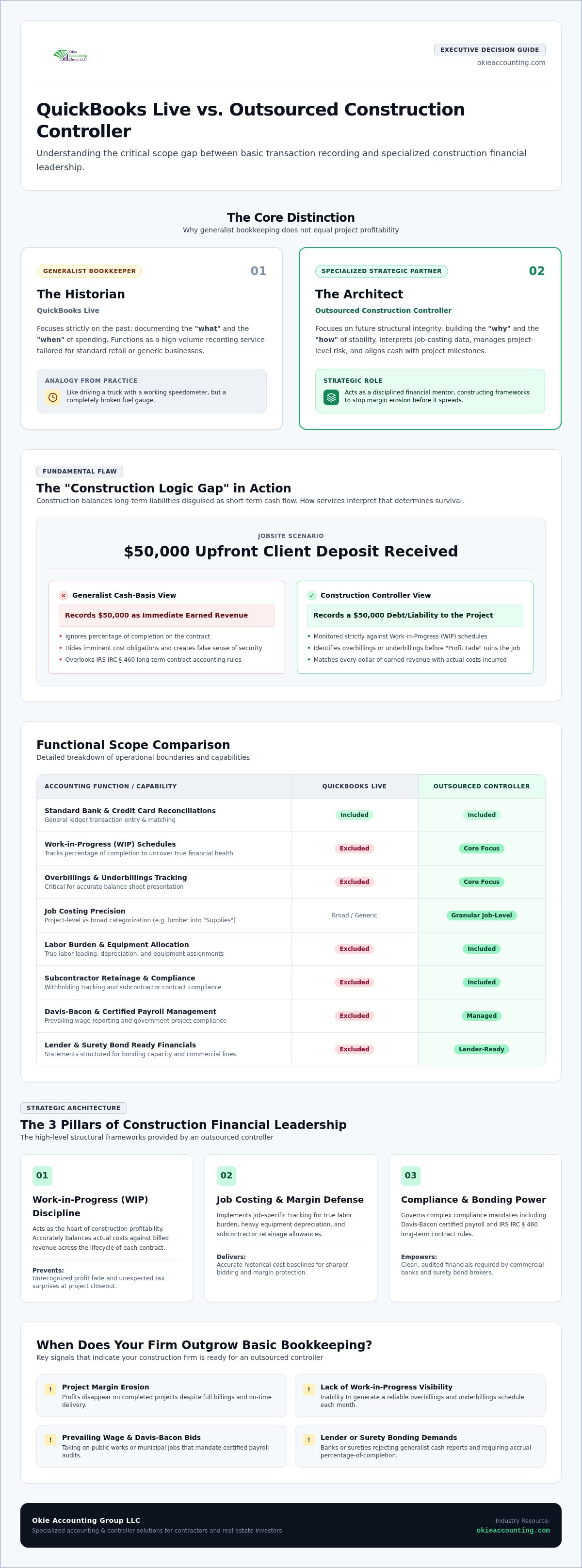
A ledger full of categorized transactions is not the same thing as a profitable project. When you evaluate QuickBooks Live vs outsourced construction controller, you're choosing between a historian and an architect. QuickBooks Live functions as a high-volume bookkeeping service designed for the masses. It focuses on the "what" and the "when" of your past spending. An outsourced controller, however, focuses on the "why" and the "how" of your firm's future stability. This distinction is critical because construction is not a standard retail or service business; it's a high-risk, project-based industry where financial errors have long-term consequences.
Generalist bookkeepers often struggle because they don't speak the unique language of the job site. Construction requires specialized construction accounting methods, such as percentage-of-completion and retainage tracking, that generic automation cannot replicate. While a generalist records history, a controller builds the structural integrity of your financial systems to protect your margins from erosion. They don't just tell you that you spent money; they tell you if that spend aligns with your project's estimated costs and overall health.
What QuickBooks Live Actually Does (and Doesn't)
QuickBooks Live provides a foundational layer of administrative support. Their experts focus on standard bank reconciliations, credit card matching, and general ledger maintenance. It's a useful tool for a startup with simple needs, but it lacks the depth required for a scaling trade contractor or general contractor. The "Live" aspect gives you access to a bookkeeper, but that person is often a generalist who may not understand the nuances of overbillings or underbillings. You won't find job costing, Work-in-Progress (WIP) reporting, or industry-specific advisory in their scope. If you rely solely on this service, you're essentially driving a truck with a working speedometer but a broken fuel gauge.
The Controller’s Domain: Strategic Financial Leadership
An outsourced controller steps into the role of a strategic partner. They go far beyond the ledger to implement internal controls, manage cash flow forecasting, and interpret complex data into actionable insights. This level of leadership ensures that your financial data is not just clean, but meaningful. By providing Fractional Controller Services, these experts act as a disciplined mentor for your business. They establish the frameworks necessary to manage labor burden, equipment depreciation, and subcontractor compliance. This proactive stance alleviates the stress of uncertainty, replacing fear with the quiet confidence that comes from total financial control.
The 'Construction Logic Gap': Why Generalist Bookkeeping Fails Contractors
Construction is a game of long-term liabilities disguised as short-term cash flow. A generalist bookkeeper sees a $50,000 deposit and records it as revenue. A construction controller sees a debt to the project that must be managed through completion. This distinction is the core of the "Construction Logic Gap." When comparing QuickBooks Live vs outsourced construction controller, the failure of the former often lies in a reliance on cash-basis thinking. If you only look at money in and money out, you're ignoring the percentage of completion and the associated future costs that determine your survival.
The IRS Construction Industry Audit Technique Guide highlights how complex these long-term contracts can be, especially regarding IRC § 460 compliance. Generalists simply aren't trained to navigate these regulatory waters. They lack the specialized logic required to identify "Profit Fade" before it ruins a project. WIP accounting is the heart of construction profitability, ensuring that every dollar of revenue is accurately matched against the actual costs incurred on a specific job.
The Critical Role of WIP (Work-in-Progress)
QuickBooks Live cannot generate a real-time WIP report because their scope is limited to general ledger categorization. They don't track the overbillings or underbillings that dictate your true financial position. A controller uses these reports to protect your margins from profit erosion. This data isn't just for your internal peace of mind; it's essential for providing lender-ready financials that prove your firm's stability to sureties and banks. Without a WIP schedule, you're essentially flying blind through a storm.
Job Costing Precision vs. General Categorization
Precision is the antidote to financial mess. Generalist services might lump all lumber into a broad "Supplies" category, but a controller ensures those expenses are job-specific. They track labor burden, equipment allocation, and subcontractor retainage at the project level. This granular oversight is a hallmark of professional QuickBooks Live vs outsourced construction controller comparisons. Implementing these Construction Bookkeeping Services builds a scalable foundation that generic automation can't touch. If you're tired of guessing your margins, it's time to schedule a discovery call to see how strategic oversight can safeguard your profit.
Comparing Features, Compliance, and Industry Expertise
Choosing between QuickBooks Live vs outsourced construction controller often comes down to the depth of expertise required to navigate the regulatory minefields of the building industry. While QuickBooks Live provides a baseline level of support for general ledger maintenance, it operates on a high-volume model that lacks the bandwidth for specialized advisory. A construction controller, by contrast, manages the structural integrity of your financial data. This role aligns with the broader scope of financial management and controller responsibilities, which include long-term forecasting and the oversight of complex internal controls that generalist bookkeepers simply don't provide.
Beyond the technical tasks, a controller acts as a supportive partner with a vested interest in your firm's health. For contractors in Tennessee or the Jacksonville, Florida market, having an expert who understands local labor burdens and regional economic shifts is a significant advantage. This partnership transforms your accounting from a back-office chore into a strategic tool for profit protection.
Payroll and Regulatory Compliance
Standard payroll services often struggle with the nuances of construction, such as managing multi-state workers or varying hourly rates across different job sites. This complexity increases when your firm takes on federally funded projects. The Davis-Bacon Act applies to all federally assisted prime contracts exceeding $2,000, requiring mandatory weekly certified payroll reporting on Form WH-347. QuickBooks Live bookkeepers specifically exclude these tasks from their scope. An outsourced controller ensures your QuickBooks Live vs outsourced construction controller evaluation accounts for these compliance risks. By integrating specialized Construction Payroll Services, a controller protects your firm from the debarment and civil penalties associated with non-compliance.
QuickBooks Mastery: Setup vs. Maintenance
Most "QuickBooks messes" begin with a flawed foundation. A generalist might set up a Chart of Accounts that works for a retail shop but fails a contractor who needs to track committed costs and subcontractor retainage. A professional QuickBooks setup is non-negotiable for firms looking to scale. Controllers don't just maintain the system; they architect it to capture the granular data required for accurate bidding. They fix common mistakes, such as improper job-costing workflows, and train your internal team to use the system properly. This ensures your financial statements remain clean, lender-ready, and reflective of your firm's true operational reality.
Evaluating ROI: Is a Controller Worth the Investment?
ROI is often misunderstood as a simple expense comparison. If you only look at the monthly fee, a generalist service seems like a bargain. However, the hidden cost of cheap bookkeeping manifests in overpaid taxes, missed change orders, and stagnant cash flow that stalls your growth. In the comparison of QuickBooks Live vs outsourced construction controller, the true value lies in profit protection. A specialized controller pays for themselves by protecting 2-5% of project margins through better data and rigorous oversight. This transition allows you to move from working in the daily financial grind to leading your firm with strategic intent. By identifying overhead leaks and improving bidding accuracy, a controller ensures that every project you win is actually worth the effort.
Cash Flow Forecasting for 2026
Construction cycles are notoriously volatile. A controller provides the structural integrity needed to predict the "valleys" in your 2026 project pipeline before they become crises. By implementing advanced Construction Cash Flow Management, they ensure you have the liquidity to cover payroll and materials during lean months. This proactive reporting is also vital for managing lender relationships. Banks and sureties are far more likely to increase your bonding capacity or credit lines when they see professionally managed, forward-looking data that proves your firm's stability and readiness.
Data-Driven Decision Making
When evaluating QuickBooks Live vs outsourced construction controller options, the deciding factor is often the ability to make data-driven choices. Scaling requires knowing which projects are your most profitable and which are simply busy work. A controller helps you identify high-margin trade work so you can stop chasing high-volume contracts that drain your resources. You'll gain the clarity to know exactly when to hire more crews and when to tighten the belt based on actual project performance rather than gut feelings. This precision removes the guesswork from your operations.
This level of clarity provides the psychological relief of "Quiet Confidence." You can stop wondering if the bank account will be empty on Friday and start focusing on the long-term health of your business. To see how this level of oversight can transform your firm's bottom line, schedule a discovery call to begin your transition from a simple service provider to a strategic partnership.
When to Transition to a Construction Controller
Recognizing the moment to move away from entry-level bookkeeping is vital for the structural health of your firm. Many contractors stay with generalist services too long, fearing the cost of a specialist while ignoring the bleed in their margins. If you find that your QuickBooks file is a mess despite having "help," or if you're unable to see project-level profitability in real-time, the limits of the generalist model have been reached. In the debate of QuickBooks Live vs outsourced construction controller, the transition marks the shift from simply recording history to architecting your firm's future.
The transition process typically begins with a deep foundational cleanup. We move your books from a state of complexity to one of operational clarity, establishing the frameworks needed for long-term stability. Once the "mess" is resolved, we shift into strategic oversight, where data drives every bidding and hiring choice you make. This proactive stance ensures you aren't just reacting to your bank balance but are actively building a scalable business.
The 'Messy Books' Audit: A 3-Point Checklist
Before you commit to your next project, ask yourself these three questions to determine if your current system is failing you:
Are your bank balances the only way you track success? If you don't have a reliable WIP schedule, your bank balance is a lagging indicator that doesn't account for upcoming liabilities or underbillings.
Do you dread sending financials to your bonding agent? A lack of lender-ready statements can stall your ability to secure larger contracts and increase your bonding capacity.
Is your job costing more than 15 days behind reality? Financial data that isn't current is useless for making course corrections on an active job site.
Your Strategic Partner in Growth
Okie Accounting Group, led by Sarah O'Quinn, specializes in helping contractors move beyond basic administration. Since 2020, our team has provided the fractional leadership necessary for firms in Tennessee, Jacksonville, Florida, and across the country to scale with confidence. We don't just categorize transactions; we build the foundational systems that protect your profit. When comparing QuickBooks Live vs outsourced construction controller services, remember that our specialized focus on construction and real estate means we speak your language and understand your unique mechanics.
Don't settle for simple data entry when your business requires a financial architect. The complexity of construction accounting demands a partner who understands your specific market and the mechanics of project-based finance. You deserve the quiet confidence that comes from total control over your numbers. By scheduling a discovery call for Controller Services, you take the first step toward professional discipline and supportive partnership. Gain clarity today with Okie Accounting and start building a more stable, profitable future for your firm.
Architecting Your Firm's Financial Future
Scaling a construction firm requires more than just clean bank feeds; it demands the structural integrity of a professional financial framework. The choice between QuickBooks Live vs outsourced construction controller determines whether you're merely tracking expenses or actively protecting your project margins. While generalist automation handles the basics, a controller provides the specialized Work-in-Progress (WIP) reporting and Davis-Bacon compliance oversight that generalist services explicitly exclude. Moving beyond administrative tasks allows you to focus on leading your firm with data-driven confidence.
Okie Accounting Group brings specialized construction and real estate expertise to every partnership. Whether you're navigating the local markets of Tennessee and Florida or seeking remote nationwide leadership, our focus remains on your long-term stability and growth. You don't have to navigate complex job costing or cash flow forecasting alone. Take the first step toward operational clarity and financial readiness by choosing a partner as invested in your success as you are. Secure Your Project Margins with a Construction Controller today and build a foundation that supports your highest ambitions.
Frequently Asked Questions
Can QuickBooks Live handle WIP (Work-in-Progress) accounting?
QuickBooks Live doesn't manage job costing or Work-in-Progress (WIP) schedules. Their scope is limited to general ledger categorization and monthly bank reconciliations. For contractors in Tennessee or Florida, this lack of project-level data makes it impossible to track true profitability. An outsourced controller bridges this gap by matching revenue to expenses through percentage-of-completion methods, ensuring your financials reflect the actual health of your active job sites.
What is the difference between a construction bookkeeper and a controller?
A construction bookkeeper focuses on recording past transactions and maintaining the general ledger. A controller provides high-level financial strategy and structural oversight. In the comparison of QuickBooks Live vs outsourced construction controller, the controller acts as a disciplined mentor. They manage internal controls, interpret complex data for business decisions, and implement the foundational systems required for long-term stability and scaling of your construction firm.
Do I need a local controller in Tennessee or Florida, or is remote okay?
Remote financial leadership is highly effective when supported by cloud-based systems and professional discipline. While Okie Accounting Group operates nationwide, our team brings specific local expertise to contractors in Tennessee and Jacksonville, Florida. This regional knowledge is valuable for understanding local labor burdens and market conditions. You get the benefit of specialized construction leadership regardless of your physical location, provided your partner understands your specific market mechanics.
How much does an outsourced construction controller typically cost?
While generalist bookkeeping services often have a lower entry price, they lack the specialized logic required for project-based businesses. An outsourced controller operates on a fractional basis, which provides a high return on investment by protecting project margins. Instead of paying for a fully burdened in-house executive, you invest in strategic oversight that identifies overhead leaks. This partnership typically pays for itself through improved bidding accuracy and better cash flow management.
Will an outsourced controller help with my bonding and lender requirements?
A controller is essential for meeting the rigorous demands of sureties and banks. Most commercial lenders require accrual-basis financial statements and detailed Work-in-Progress (WIP) schedules before increasing your credit lines or bonding capacity. Okie Accounting Group ensures your reports are clean and lender-ready. This professional oversight proves your firm's stability, making it much easier to secure the financing needed for larger, more complex projects that require performance bonds.
Can a controller fix my existing QuickBooks mess?
A controller specializes in transforming a messy QuickBooks file into a structured financial framework. We often begin our partnership with a foundational cleanup and professional QuickBooks Setup & Training. This process involves fixing common contractor mistakes in the Chart of Accounts and establishing proper job-costing workflows. We don't just clean up the data; we train your team to maintain the system's integrity moving forward so you have reliable data.
How does a fractional controller help with job costing?
Fractional controllers implement precise job-costing systems that track more than just materials. We ensure your labor burden, equipment depreciation, and subcontractor retainage are allocated to specific projects. This granular data allows you to see which trades or project types are your most profitable. By moving away from general categorization, you gain the clarity needed to adjust your bidding strategy and protect your bottom line on every contract you sign.
Is QuickBooks Live sufficient for a contractor with $1M+ in annual revenue?
Once a contractor reaches $1M in annual revenue, the complexity of project-based accounting usually exceeds the capabilities of generalist services. When evaluating QuickBooks Live vs outsourced construction controller at this stage, the risks of profit fade and compliance audits become too high for automated help. You need specialized leadership to manage multi-state payroll, insurance audits, and long-term contract accounting to ensure your firm scales without collapsing under administrative weight.


Comments