
2026 Bookkeeping Strategy for Painting Contractors

A set of clean books won't just help you survive the year; it's the specific structural framework that separates a struggling crew from a $5M enterprise. Many owners treat their records as a historical archive, yet in today's $51.2 billion residential market, your financial data must function as a proactive engine for growth. If you've ever finished a high-end project only to realize that inaccurate job costing turned your projected margin into a deficit, you know that basic data entry isn't enough. Effective bookkeeping for painting contractors requires a specialized approach that bridges the gap between upfront material purchases and final project draws.
You likely feel the weight of cash flow gaps and the confusion surrounding 1099 versus W2 classifications as labor costs continue to rise. We'll show you how to transform disorganized spreadsheets into a disciplined financial system designed for scaling and profit protection. This strategy outlines the path to achieving lender-ready financial statements and automated workflows that significantly reduce your administrative burden. You'll learn how to leverage strategic oversight to move your business from operational complexity to a state of clear, data-driven control.
Why Generic Bookkeeping Fails Painting Contractors
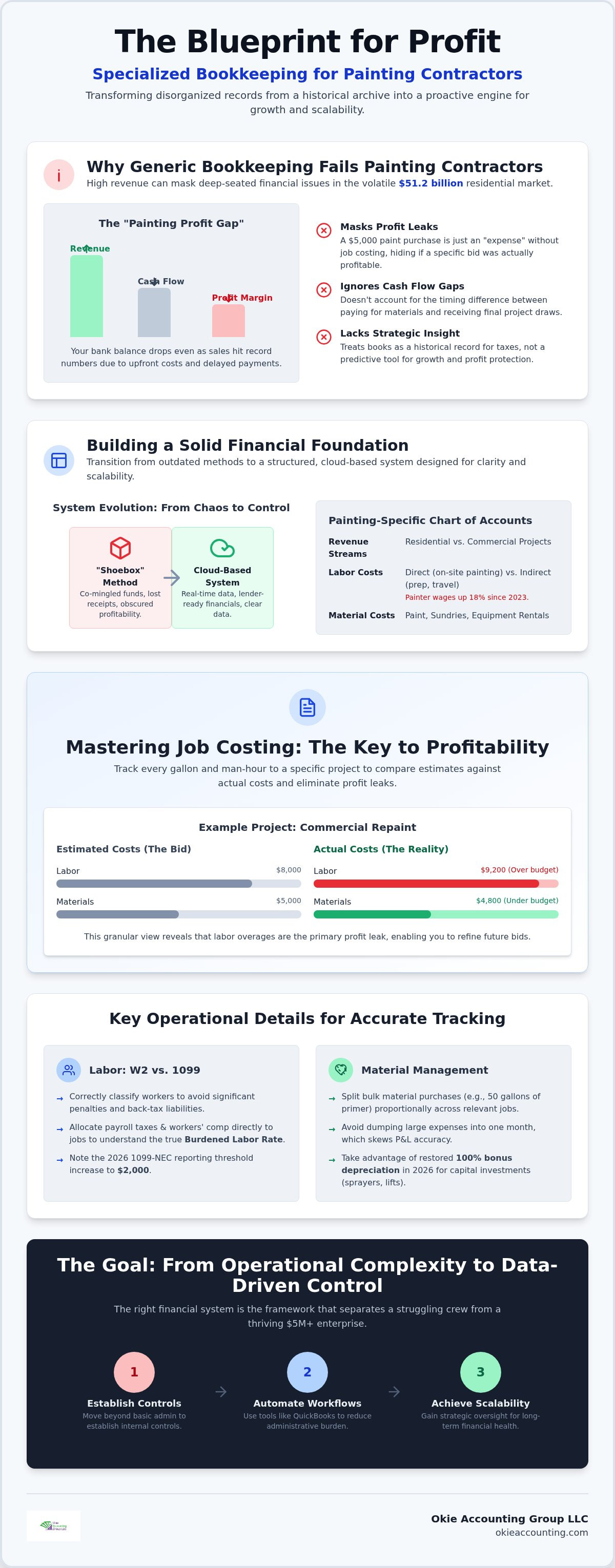
Generic bookkeeping often fails because it assumes a linear flow of cash. Painting is anything but linear. You're navigating a $51.2 billion market where material costs and labor wages fluctuate weekly. A retail-focused bookkeeper might categorize a $5,000 paint purchase as a simple expense, but without a specialized job costing system, you won't know if that specific commercial bid actually returned a profit. Effective bookkeeping for painting contractors requires more than just recording transactions. It demands a deep understanding of project lifecycles and the unique timing of construction cash flows.
High revenue often masks deep-seated financial issues. We call this the "Painting Profit Gap." It happens when your bank balance drops even as your sales team hits record numbers. You pay for premium paint, which averaged $58.48 per gallon in August 2026, and labor hours long before the final draw hits your account. Moving toward strategic management accounting ensures you're looking at predictive data rather than just historical receipts. It transforms your books from a tax-time chore into a tool for profit protection.
The Painting-Specific Chart of Accounts
Your Chart of Accounts is the foundation of your financial house. It must distinguish between residential and commercial revenue streams to protect your margins. Direct labor represents the hours spent with a brush in hand, while indirect labor covers prep, travel, and warehouse management. In an era where painter wages have increased 18% since 2023, this distinction is vital. Categorize your materials into paint, sundries, and equipment rentals. This structure allows you to track marketing spend as a precise percentage of project revenue, ensuring your lead generation stays efficient as you scale.
Moving Beyond the "Shoebox" Method
Co-mingling personal and business funds is a liability that prevents scaling. Using a personal card for a material run might seem convenient, but it creates "data noise" that obscures your true profitability. Transitioning to a cloud-based, paperless environment allows your field crews to capture receipts in real-time. This level of organization establishes the financial readiness required for bonding or securing large-scale commercial contracts. Generic bookkeeping for painting contractors often overlooks these foundational systems, yet they're the very elements that make your business lender-ready and attractive to investors.
Mastering Job Costing: The Key to Painting Profitability
Job costing is the pulse of a healthy painting business. While generic accounting looks at the business as a whole, this method tracks every gallon of paint and every man-hour against a specific project. This granular data allows you to identify "profit leaks" where labor hours exceeded the bid or material waste ate into your margin. By comparing your estimated costs to actual expenditures, you gain the clarity needed to refine future commercial bids and protect your bottom line. Effective bookkeeping for painting contractors transforms these numbers into a roadmap for better bidding.
Implementing a robust QuickBooks for contractors workflow is essential for this level of detail. The 2026 platform updates for QuickBooks Online Advanced now include native progress billing and retainage tracking, which simplify project-based financial management. For a deeper dive into these principles, you might consult an Expert Guide to Construction Accounting to see how revenue recognition and project tracking align with broader industry standards. These systems ensure that every dollar spent is accounted for at the project level.
Tracking Direct Labor and Subcontractors
The distinction between W2 employees and 1099 subcontractors is more critical than ever following the 2026 increase of the 1099-NEC reporting threshold to $2,000. Misclassification can lead to significant financial penalties and back-tax liabilities that can cripple a growing firm. You must allocate payroll taxes and workers' compensation premiums directly to job sites to understand your true project costs. The burdened labor rate for a painter in 2026 represents the total cost of employment, including the base wage, payroll taxes, workers' compensation insurance, and any benefits provided, calculated as an hourly figure.
Material Management and Allocation
Handling bulk material purchases requires a disciplined approach to ensure your P&L remains accurate. When you buy 50 gallons of primer for three different jobs, your bookkeeping for painting contractors must split those costs proportionally rather than dumping the entire expense into one month. Additionally, take advantage of the restored 100% bonus depreciation in 2026 for capital investments like high-performance sprayers or lifts. Proper allocation ensures your material markups are reflected correctly, giving you a transparent view of your project-level gross margins. If your current systems lack this level of detail, consider scheduling a discovery call to discuss a more structured approach.
Managing Cash Flow and Payroll in a Project-Based Model
The "Cash Gap" is a structural reality in the painting industry. You often pay for premium materials and weekly labor long before a client releases the final payment. This lag creates a scenario where your profit and loss statement shows a healthy margin, yet your bank account feels dangerously thin. This discrepancy occurs because traditional reporting doesn't always reflect the timing of cash inflows and outflows. Specialized bookkeeping for painting contractors solves this by aligning your reporting with the actual project lifecycle, ensuring you have the liquidity to keep crews moving.
Integrating construction payroll services is a vital step in protecting those margins. When you automate payroll, you ensure that federal and state tax compliance is handled without manual intervention, which is especially important given the 2026 Social Security wage base of $184,500. Additionally, using progress billing and milestone payments on commercial projects prevents you from acting as a bank for your customers. For a deeper understanding of these frameworks, reviewing Construction Accounting and Tax Reporting Methods can help clarify how to structure your financial reporting for maximum transparency.
The 13-Week Cash Flow Forecast
A 13-week forecast is the most effective way to predict cash needs for upcoming material-heavy project phases. This forward-looking tool helps you manage the timing of subcontractor payments against expected client receipts. By moving away from "gut-feeling" management, you can make data-driven decisions that prevent the risky cycle of "rob-Peter-to-pay-Paul" financing. It provides the clarity needed to know exactly when you can afford to take on a new project or invest in equipment without compromising your operational stability.
Payroll Compliance and Profit Protection
Automating your payroll system ensures that labor costs are captured accurately and allocated to the correct projects. Overtime can quickly erode the profitability of a job if it isn't monitored in real-time. By integrating time-tracking software directly with your bookkeeping system, you eliminate manual data entry errors and gain immediate visibility into labor spending. This integration ensures that your burdened labor rates remain accurate, allowing you to maintain profit protection even as market wages fluctuate in a competitive labor environment.
Optimizing QuickBooks Online for Painting Workflows
QuickBooks Online (QBO) serves as the gold standard for remote painting management because it facilitates real-time data flow between the job site and the back office. Unlike a desktop-based system, QBO allows your project managers to upload site photos and expense data directly from their mobile devices. Configuring the "Products and Services" list is the most critical step in tailoring your system. By mapping specific painting activities, such as interior prep or exterior staining, to your ledger accounts, you ensure your bookkeeping for painting contractors remains accurate and project-specific. This setup eliminates the guesswork often found in generic construction templates.
To maximize these features, professional QuickBooks training for your office staff is essential. It ensures that your team understands the nuances of project-based tracking rather than just basic data entry. Integrating third-party field apps like Jobber or PaintScout with QBO creates a seamless transition from the initial estimate to the final invoice. This integration reduces administrative friction and ensures that your financial data reflects the actual progress of your field crews. If your office workflow feels fragmented, schedule a discovery call to discuss a customized QuickBooks implementation.
Automating Data Entry and Reconciliation
Setting up bank feeds and auto-categorization rules for material vendors like Sherwin-Williams or Benjamin Moore significantly reduces manual entry. This automation allows you to focus on high-level oversight rather than chasing individual receipts. Using receipt capture apps helps eliminate the paper clutter that often plagues field operations, moving you further away from the "shoebox" method mentioned earlier. A disciplined "Monthly Close" process ensures your data is lender-ready every 30 days, providing the financial clarity needed for strategic scaling and bonding applications.
Reporting for Strategic Growth
The Profit and Loss by Customer report is your most valuable tool for identifying which project segments, such as residential repaints versus commercial new construction, are your most profitable. Accounts Receivable (AR) aging reports highlight overdue draws, helping you stop acting as a bank for your clients. The Unbilled Expenses report in QBO allows you to identify costs assigned to a project that haven't been included on a customer invoice yet, ensuring no revenue is left on the table. These reports transform your bookkeeping for painting contractors into a strategic asset that guides your expansion from $1M to $5M and beyond.
Scaling Your Firm with Fractional Controller Services
Moving beyond basic bookkeeping for painting contractors is a necessary evolution for firms targeting the $5M mark. While a bookkeeper ensures your transactions are categorized, fractional controller services provide the high-level oversight required to manage complex growth. A controller doesn't just look at what happened last month; they establish the internal controls necessary to prevent fraud and minimize operational waste. This structural integrity is what allows an owner to transition from "doing the work" to truly "managing the numbers," turning financial data into a competitive advantage.
Securing larger commercial contracts requires more than a standard P&L. General contractors and lenders look for strategic financial reporting that demonstrates stability and project-readiness. When your financial statements are lender-ready and backed by rigorous oversight, you present your firm as a disciplined partner. This level of professionalism often becomes the deciding factor in winning high-margin projects that smaller, less organized competitors simply can't touch. It shifts the perception of your business from a local crew to a sophisticated enterprise.
The Strategic Mentor Approach
A fractional controller acts as a strategic mentor, helping you navigate long-term budgeting and cash flow forecasting. They interpret your financial data to drive critical decisions, such as when to purchase new equipment or expand your fleet. Instead of guessing if you can afford another sprayer or lift, you'll have the data to support the investment. This approach builds a scalable financial infrastructure that supports multi-crew expansion without the typical growing pains associated with rapid scaling. It ensures that every new hire and every new project contributes to your long-term stability.
Protecting Your Profit Margins
Maintaining lean operations during a growth phase requires constant vigilance. Your controller conducts deep-dive audits of project performance to ensure your gross margin targets are actually being met across all crews. They review overhead-to-revenue ratios to ensure your fixed costs don't outpace your production capacity. This meticulous management protects your bottom line from the "profit creep" that often erodes the success of expanding firms. Ready to gain total financial clarity? Partner with Okie Accounting Group today to build the structural framework your business deserves.
Building Your Financial Foundation for 2026
Scaling your business beyond $1M requires a fundamental shift in how you view your numbers. You've seen how specialized job costing and disciplined cash flow forecasting move you away from reactive management and toward proactive profit protection. By optimizing QuickBooks Online and leveraging fractional controller oversight, you establish the structural framework necessary to secure larger commercial contracts and manage multiple crews with confidence.
At Okie Accounting Group, we provide the nationwide strategic oversight needed to transform your back office into a scaling engine. Led by Sarah O’Quinn, a specialized construction accounting professional, our team understands the unique mechanics of the painting industry. We don't just record transactions; we partner with you to ensure your business remains lender-ready and resilient in a competitive market. It's time to stop fighting messy spreadsheets and start leveraging comprehensive bookkeeping for painting contractors to drive your long-term success.
Schedule Your Strategic Financial Review with Okie Accounting today. You have the vision for your company's growth; we have the financial expertise to help you reach it.
Frequently Asked Questions
Do I need a separate bookkeeper for my painting business if I use QuickBooks?
QuickBooks is a software platform, not a financial professional. While it automates many tasks, it doesn't provide the specialized oversight needed for accurate bookkeeping for painting contractors. A professional ensures your chart of accounts is configured correctly for project-based tracking. They handle the complex reconciliations and back-end integration that software alone cannot manage. Without expert management, your data can quickly become disorganized and lose its strategic value for scaling.
What is the best way to track job costs for a painting project?
The most effective method is utilizing the "Projects" feature within QuickBooks Online Plus or Advanced. You must link every gallon of paint and every labor hour directly to a specific project at the point of entry. This allows you to track real-time profitability against your initial bid. Integrating field apps like Jobber or PaintScout with your ledger ensures that site expenses flow directly into your job costing reports without manual duplication.
How should I classify my painters—as employees (W2) or subcontractors (1099)?
Classification depends on the level of control you exert over the worker's schedule and methods. For the 2026 tax year, the reporting threshold for 1099-NEC compensation has increased to $2,000. Employees (W2) offer more operational control but require you to manage payroll taxes and workers' compensation. Subcontractors (1099) provide flexibility but must meet strict IRS criteria to avoid misclassification penalties. It's a critical distinction for protecting your long-term financial health.
What is a typical profit margin for a residential painting business in 2026?
In 2026, the industry standard for gross margin in residential painting remains between 40% and 50%. This margin must cover all direct labor and material costs, including premium paints that averaged over $58 per gallon in late 2026. A healthy net profit margin typically ranges from 10% to 15% after accounting for all administrative overhead and marketing spend. Tracking these benchmarks helps you identify if your current bidding strategy is sustainable.
Can a general bookkeeper handle construction-specific accounting like WIP?
Generalist bookkeepers often lack the specialized knowledge required for construction-specific concepts like Work-in-Progress (WIP) adjustments. Painting projects involve unique timing gaps between material purchases and final draws that retail-focused accounting doesn't address. A specialized partner understands how to manage these project-based cycles. They ensure your financial statements reflect the actual progress of your jobs rather than just your current bank balance, which is essential for maintaining lender-ready records.
How often should I review my financial statements as a painting contractor?
You should review your high-level financial statements at least once a month during a formal "Monthly Close" process. This ensures your data stays accurate for potential lenders or bonding agents. However, strategic owners often review project-level profit and loss reports weekly. This frequency allows you to catch labor overages or material waste before they erode your entire margin. Regular reviews transform your data from a historical record into a proactive management tool.
What are the most common bookkeeping mistakes painting contractors make?
The most frequent errors include co-mingling personal and business funds on material runs and failing to track burdened labor rates. Many contractors also make the mistake of pooling all labor costs into a single category instead of allocating them to specific jobs. This makes it impossible to see which projects are actually profitable. Additionally, neglecting to separate residential and commercial revenue streams can hide poor performance in one segment of the business.
What is the difference between a bookkeeper and a fractional controller?
Bookkeepers focus on the accurate recording of historical transactions and monthly bank reconciliations. In contrast, a fractional controller provides high-level strategic oversight and forward-looking financial leadership. While a bookkeeper maintains your general ledger, a controller focuses on internal controls, cash flow forecasting, and interpreting data to drive business decisions. They act as a strategic mentor, helping you move from operational complexity to a state of clear, data-driven control over your expansion.


Comments