
2026 Cash Flow Guide for Roofing Contractors
- Wendy Okie

- Aug 16
- 11 min read
Updated: Aug 18
Roofing cash flow is a structural engineering problem, not just a basic bookkeeping task. It's a common frustration to see your crews working at full capacity while your bank balance stays stagnant because insurance companies are holding payments for months. You shouldn't have to guess if you can afford that new crew or a specialized piece of equipment. Mastering cash flow management for roofing contractors in 2026 means moving beyond administrative chores to build a comprehensive financial framework.
We understand the pressure of rising material costs, which have climbed 9.6% over the last year, and the urgency of transitioning to cloud-based systems now that older QuickBooks Desktop versions lack support. This guide will show you how to stabilize your firm’s finances and eliminate the feast-or-famine cycle for good. We'll explore strategies to accelerate insurance collections, manage 2026's inflationary pressures, and implement the forecasting tools necessary for long-term profit protection. By the end of this article, you'll have the roadmap to build a predictable bank balance regardless of the weather.
Why Cash Flow is the Primary Killer of Profitable Roofing Firms
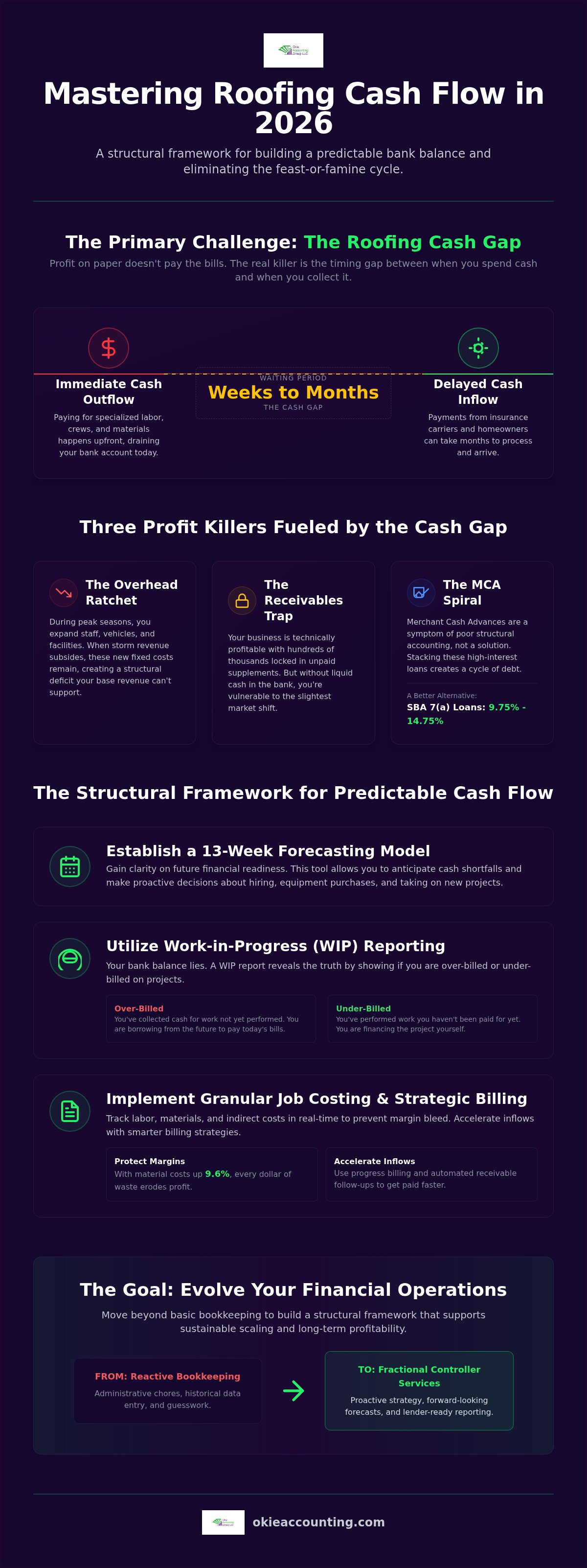
In the roofing industry, profitability doesn't guarantee survival. Many contractors operate under the illusion of success because their project margins look healthy on a spreadsheet. However, cash flow is the actual movement of money in and out of your business. For a roofing firm, this represents the critical timing gap between the immediate cash outflows for specialized labor and materials and the eventual inflow from insurance carriers or homeowners. Effective cash flow management for roofing contractors requires accounting for this delay to ensure the lights stay on while waiting for a check.
Roofing owners often fall victim to the "Overhead Ratchet." During peak storm seasons, firms often expand their back-office staff, lease more vehicles, and move into larger facilities to handle the volume. When the storm revenue eventually subsides, these fixed costs remain high, creating a structural deficit. This is compounded by the "Insurance Receivables Trap." You might have hundreds of thousands of dollars in earned profit locked in unpaid supplements or depreciation. While your business is technically profitable on paper, you aren't liquid in the bank, which leaves you vulnerable to even minor market shifts.
The Feast-or-Famine Cycle in 2026
Stability in 2026 depends on your ability to distinguish between sustainable base revenue and volatile storm spikes. Scaling overhead too quickly during a busy season often leads to a post-storm crash because the cash isn't there to support the new, higher baseline. You must monitor your specific Cash Gap, which we define as the number of days between paying a crew for a completed roof and receiving the final payment from the client or carrier. Without a framework to bridge this gap, rapid growth becomes a liability rather than an asset.
The Danger of Stacking Merchant Cash Advances (MCAs)
When the cash gap widens, many contractors turn to Merchant Cash Advances (MCAs) for a quick fix. These high-interest loans are rarely a solution; they're a symptom of poor structural accounting. Stacking multiple MCAs creates a downward spiral where you're forced to use tomorrow’s job deposits to pay for yesterday’s overhead. Moving toward strategic fractional controller services helps you replace these predatory cycles with lender-ready financial reporting. By building a foundation of accurate data, you can access traditional credit lines with lower rates, such as the 2026 SBA 7(a) rates that currently range from 9.75% to 14.75% depending on loan size.
The Structural Framework: Connecting WIP to Cash Flow
A Work in Progress (WIP) report acts as a crystal ball for cash flow management for roofing contractors. While many owners look at their bank balance to judge health, the WIP report reveals the truth behind those numbers. If you're over-billed, you've collected more cash than the work you've performed, which means you're essentially borrowing from the future to pay today's bills. Conversely, under-billing means you're financing the project out of your own pocket. Managing Cash Flow in this environment requires a precise understanding of these timing differences to avoid a sudden liquidity crisis.
Integrating field data with QuickBooks for contractors allows you to see margin bleed in real time. With roofing material prices 9.6% higher than last year as of May 2026, even a small error in estimating or waste can erase your profit. By the time a project ends, it's too late to fix the budget. Real-time visibility ensures you can pivot before the cash is gone. This structural connection between the job site and the ledger is the difference between a reactive business and a proactive one.
Tracking Job Costs at the Granular Level
Effective oversight requires daily or weekly labor and material tracking. You shouldn't wait for a monthly statement to see if a crew is over-hours. Additionally, unallocated indirect costs like fuel, small tools, and safety equipment quietly erode project cash if they aren't factored into your job costing. We recommend standardizing your Chart of Accounts to reflect roofing-specific categories. This ensures every dollar spent is tied to a revenue-generating activity, providing a clear picture of your actual project margins.
Managing Retention and Supplements
Commercial roofing contracts often involve retention, where a percentage of your payment is held until the very end. This held cash must be tracked meticulously so it doesn't become forgotten revenue. Similarly, insurance supplements often fall through the cracks during busy seasons. Establishing a collection trigger within your monthly bookkeeping service ensures that as soon as a milestone is hit, the invoice is sent and followed up on automatically. If you're ready to move from administrative guesswork to a structured financial framework, you can schedule a strategy session to review your current reporting structure.
Strategic Forecasting: Building a 13-Week Cash Flow Curve
A 13-week cash flow forecast serves as the gold standard for financial readiness. It provides a rolling 90-day window into your bank balance, which is essential for Effective Cash Flow Management. This timeframe is long enough to see upcoming vendor obligations but short enough to remain accurate. To build this curve, you must first aggregate all committed outflows, including payroll, rent, and vendor payments. Don't forget to include the 2026 QuickBooks Online Advanced subscription cost of $340 per month if you utilize that tier for progress billing.
Once your outflows are mapped, estimate your inflows conservatively. Successful cash flow management for roofing contractors relies on historical collection data rather than optimistic "best-case" scenarios. Identify your "Low Point" on the curve, the specific week where your bank balance is projected to be at its lowest. Knowing this date in advance gives you the power to utilize a line of credit or adjust project schedules before a crisis occurs. Finally, perform a weekly reconciliation. Compare your forecast against actual bank activity to refine your model and improve your accuracy over time.
Predicting Inflows in an Insurance-Heavy Market
In an insurance-heavy market, your forecast must account for typical carrier delay patterns. If a specific carrier historically takes 45 days to release supplements, your model should reflect that reality. We recommend using a "Probability of Collection" percentage for each expected inflow. A signed contract with a down payment might be 90% probable, while a contested supplement might only sit at 50%. This weighted approach prevents you from over-committing cash that hasn't arrived yet. Integrating these projections into your QuickBooks Online setup ensures your data remains current and actionable.
Allocating for Taxes and Profit First
Implementing a "Profit First" methodology within a construction framework ensures your business remains healthy. Treat tax reserves as a non-negotiable weekly outflow. With the Consumer Price Index increasing 4.2% year-over-year as of May 2026, protecting your margins is more difficult than ever. Setting aside these funds weekly prevents the year-end panic that often leads to high-interest debt. Similarly, ensure the owner’s draw is a planned expense rather than a "leftover" grab. This disciplined approach builds a structural framework that treats profit as a requirement, not an afterthought.
Actionable Tactics to Accelerate Roofing Cash Inflows
Efficient cash flow management for roofing contractors depends on the velocity of your receivables. You can't afford to have capital tied up in materials for weeks while waiting for a final inspection. Implementing progress billing allows you to invoice for specific milestones, such as material delivery or dry-in, rather than waiting for the entire project to conclude. This shift alone can significantly reduce your cash gap. Additionally, utilizing electronic payment options can shave three to five days off your collection cycle by eliminating the delay of physical mail.
A closed-loop communication system between your project managers and the billing department is vital for financial health. When a manager finishes a job but fails to notify the office immediately, your cash flow suffers. Automate follow-ups on outstanding receivables through software training to ensure no invoice goes ignored. This structural approach ensures your administrative team has the real-time data needed to push for payment the moment a project milestone is achieved.
Optimizing the Supplement Collection Process
Insurance supplements are often the most delayed portion of a roofer's income. We recommend creating a dedicated Supplement Tracker that links directly to your financial system. Treat these supplements as a separate project phase for billing purposes to keep them from stalling your base contract payments. Train your field teams to document hidden damage immediately with clear photos and descriptions. Faster documentation leads to faster approval, which keeps your bank balance stable and predictable.
Managing Vendor and Subcontractor Outflows
Managing outflows is just as important as accelerating inflows. Negotiate "Pay-When-Paid" clauses with your subcontractors wherever legal to align your labor costs with your revenue. Leverage vendor credit terms like Net 30 or Net 60 to keep your cash in the bank longer and align with your project milestones. Some contractors also find success using corporate credit cards for rewards, provided they have the discipline to pay the balance in full to avoid interest charges. If your current collection process feels disorganized, you can book a discovery call to build a more efficient billing framework.
Scaling with Confidence: The Fractional Controller Advantage
Many roofers hit a growth ceiling because they rely on basic administrative bookkeeping. While recording transactions is necessary for tax compliance, it doesn't provide the high-level oversight required for multi-million dollar expansion. This is where fractional controller services become the engine for your firm's growth. A controller doesn't just look backward at what happened; they look forward to build the structural framework necessary for sustainable scaling. They move you beyond the "what" of your numbers into the "why," providing the strategic guidance needed to navigate a volatile market.
Effective cash flow management for roofing contractors requires a shift from reactive fire-fighting to proactive leadership. Through a monthly financial review, you gain the clarity needed to pivot based on real data rather than gut feelings. This process identifies margin erosion early and ensures your overhead remains sustainable during both peak storm seasons and the inevitable lulls. This transition allows you to move from a reactive owner to a proactive CEO who leads with data-driven confidence.
Lender-Ready Financials for Future Growth
Securing capital is a fundamental requirement for long-term health. Whether you're looking for an SBA 7(a) loan, where 2026 interest rates currently range from 9.75% to 14.75%, or a conventional line of credit, bank-ready books are essential. Lenders look for structural integrity and accuracy in your project-based financial tracking. Beyond financing, having professionally reviewed financials is often a prerequisite for winning large-scale commercial contracts. Okie Accounting Group builds these foundational systems, ensuring your firm maintains the financial readiness required to seize new opportunities.
Partnering with Okie Accounting Group
You need a strategic partner who understands the specific mechanics of the roofing industry and "speaks roofer." We specialize in moving firms from administrative stress to comprehensive profit protection. By implementing cloud-based systems and rigorous oversight, we help you protect the profit you've worked hard to earn. Our focus is on accuracy, long-term stability, and the construction of frameworks that support your vision for the future. It's time to stop guessing and start leading your business with total financial clarity. Schedule your consultation with Okie Accounting Group today to secure your firm's strategic advantage.
Securing Your Roofing Firm's Financial Future
Stabilizing your company's bank balance requires more than just hard work in the field. It demands a deliberate move from basic administrative tasks to a comprehensive structural framework. By integrating WIP reporting for real-time visibility and maintaining a 13-week forecast, you gain the clarity needed to survive storm-driven volatility and rising material costs. Mastering cash flow management for roofing contractors isn't about working more hours. It's about making the data-driven choices that protect your hard-earned profit margins.
Transitioning to a proactive CEO starts with having the right strategic partner in your corner. Okie Accounting Group provides specialized construction financial oversight and fractional controller services for $1M+ firms, acting as your nationwide cloud-based accounting experts. We help you move beyond the stress of the feast-or-famine cycle to achieve lender-ready stability and long-term health. You've built the roofs that protect your community; now it's time to build the foundational systems that protect your business.
Get a strategic financial framework for your roofing firm at Okie Accounting Group
Frequently Asked Questions
Why does my roofing company have high revenue but no cash?
Your bank balance often lags behind your revenue due to the "Cash Gap," which is the period between paying crews and receiving final checks from carriers. High revenue can mask margin bleed caused by unallocated indirect costs like fuel or safety equipment. If you're under-billing on projects, you're essentially financing the customer's roof. Successful cash flow management for roofing contractors requires aligning your billing cycles with actual production milestones to ensure liquidity.
How often should a roofing contractor update their cash flow forecast?
You should update your 13-week cash flow forecast every week to maintain financial readiness. This ritual allows you to compare actual bank activity against your conservative projections. By reconciling weekly, you can identify your "Low Point" weeks in advance, giving you time to utilize a line of credit or adjust project schedules. Consistent updates transform your forecast from a static document into a dynamic structural framework for strategic decision-making.
What is the best way to track insurance supplements in QuickBooks?
The most effective method is tracking supplements as a distinct project phase or sub-job within QuickBooks Online. This prevents supplements from stalling the base contract billing and ensures they don't fall through the cracks. We recommend creating a dedicated Supplement Tracker that links directly to your financial reporting. This structure allows your team to document hidden damage immediately, accelerating the approval process and improving your overall cash velocity.
How can I reduce the "feast-or-famine" cycle in my roofing business?
Reducing volatility requires distinguishing between your sustainable base revenue and unpredictable storm spikes. Avoid the "Overhead Ratchet" by keeping fixed costs aligned with your base business rather than peak storm volume. Implement progress billing to ensure a steady stream of inflows regardless of project completion status. By building a predictable cash flow framework, you can maintain a stable bank balance and avoid the post-storm cash crashes that threaten profitable firms.
Should I use a line of credit to manage roofing cash flow?
A line of credit is a strategic tool for bridging the timing gap between project outflows and insurance inflows. However, it should only be used when you have lender-ready financials and a clear repayment plan based on your 13-week forecast. As of August 2026, SBA 7(a) rates range from 9.75% to 14.75%. Using a line of credit as a permanent crutch for poor accounting leads to a downward debt spiral.
What is the difference between a bookkeeper and a fractional controller for roofers?
A bookkeeper focuses on basic administrative tasks like recording transactions and managing payroll. In contrast, a fractional controller provides high-level strategic oversight and profit protection. They build the comprehensive financial structures required for multi-million dollar scaling, such as WIP reporting and cash flow forecasting. While a bookkeeper tells you what happened in the past, a controller acts as a strategic mentor who prepares your business for future growth and lender-ready stability.
Is job costing necessary for every roofing project?
Yes, job costing is essential for every project to identify margin erosion before the work ends. With roofing material prices 9.6% higher than last year as of May 2026, even small estimating errors can destroy profitability. Tracking labor and materials at a granular level ensures you know exactly where your money is going. This data-driven approach is a core component of effective cash flow management for roofing contractors, allowing for real-time adjustments to protect your bottom line.
How do I account for retention on commercial roofing jobs?
Retention should be tracked in a dedicated "Retention Receivable" account on your balance sheet. This ensures that the 5% or 10% held back by the client isn't forgotten during the final collection phase. You must establish a collection trigger within your financial reporting system to follow up the moment a project reaches substantial completion. Proper tracking prevents this earned profit from becoming a permanent loss, ensuring your commercial bids remain profitable and liquid.


Comments