
QuickBooks for Real Estate Investors: Building a Scalable Financial Framework in 2026
- Wendy Okie

- 2 days ago
- 12 min read
Your accounting software isn't failing you; your structural architecture is. Most property owners treat QuickBooks for real estate investors like a digital shoebox, yet they expect it to function as a high-performance engine for a growing portfolio. It's a common trap to use generic settings and then wonder why security deposits are a mess or why personal and business funds are constantly co-mingling.
You've likely felt the familiar sting of tax-season anxiety while trying to reconcile multiple LLCs or track 100% bonus depreciation under the One Big Beautiful Bill Act. We understand that you need more than just a place to record expenses. You need clarity, control, and a system that scales alongside your acquisitions. Financial data should be a tool for growth, not a source of persistent stress.
This article promises to transform your software from a basic ledger into a specialized financial framework. We'll show you how to design a clean, audit-ready Chart of Accounts and automate property-level reporting for maximum visibility. By the end, you'll have the roadmap to turn technical jargon into a strategic asset that protects your cash flow across every door you own.
Why Standard QuickBooks Setup Fails Real Estate Investors
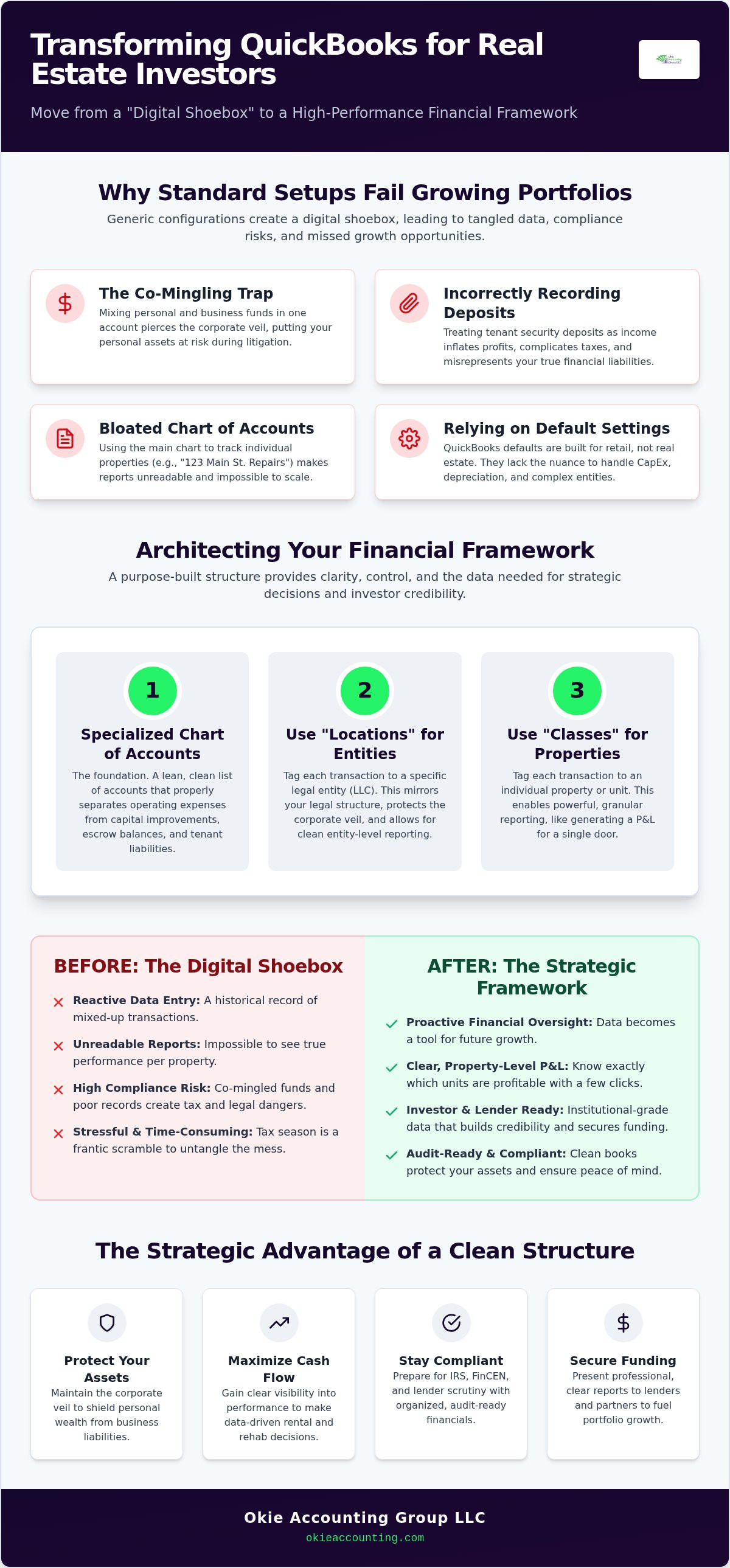
Software is only as effective as the architecture behind it. Many owners assume that purchasing a subscription is enough to organize their finances, but the default settings in QuickBooks are built for general retail or service industries. They aren't designed for the nuances of property management or complex entity structures. When you rely on a "one-size-fits-all" configuration, you're not building a system; you're creating a digital shoebox that will eventually overflow. This gap between basic tracking and a specialized framework leads to fragmented data that makes it impossible to see your true portfolio performance.
A professional setup ensures you're ready for more than just a tax return. It prepares you for the scrutiny of lenders and potential partners who demand clean, property-level reporting. In 2026, this level of precision is mandatory. With new regulatory requirements like the FinCEN beneficial ownership reporting deadlines, having an organized system is the only way to ensure your LLCs remain compliant without a last-minute scramble. Utilizing QuickBooks for real estate investors correctly means moving away from reactive bookkeeping and toward proactive financial oversight.
The Co-Mingling Trap in Real Estate Accounting
Co-mingling personal and business funds is the fastest way to lose the legal protections of your LLC. When you fail to separate these transactions, you risk "piercing the corporate veil," which can leave your personal assets exposed during litigation. Understanding real estate investing fundamentals requires recognizing that each entity must stand on its own financial feet. We often see investors use one bank account for multiple properties, which creates a tangled web that even the best CPA can't easily unweave. A structured QuickBooks Setup & Training plan establishes the necessary boundaries to protect your personal wealth and maintain the integrity of your business entities.
Common Bookkeeping Pitfalls for Growing Portfolios
One of the most frequent errors is using the Chart of Accounts to track individual properties. If your list of accounts includes "123 Main St Repairs" and "456 Oak St Repairs," your reports will quickly become unreadable. Sophisticated investors use "Classes" or "Locations" to segment data while keeping the Chart of Accounts lean and manageable. Another critical mistake is recording security deposits as income. These funds are liabilities held on behalf of the tenant, not revenue for the business. Treating them as income artificially inflates your profit and creates a tax-time nightmare when those funds are eventually returned or applied to damages.
Architecting Your QuickBooks Structural Framework
Building a scalable financial framework requires a shift in mindset. You're no longer just "doing the books"; you're architecting a data system. When using QuickBooks for real estate investors, you must move beyond basic administrative tasks to construct a comprehensive structural framework that mirrors your legal entity setup. This approach ensures that your financial data is not just a record of the past, but a strategic tool for the future.
The three pillars of this architecture are the Chart of Accounts, Classes, and Locations. Together, they create a multi-dimensional reporting environment that follows Generally Accepted Accounting Principles (GAAP). This isn't just about tax readiness; it's about establishing investor credibility. Lenders and potential equity partners expect institutional-grade data that proves you understand the mechanics of your portfolio's performance.
Designing a Specialized Chart of Accounts
Your Chart of Accounts is the foundation of your profit protection strategy. A generic ledger fails because it doesn't distinguish between operating expenses and capital improvements. For instance, properly categorizing "Repairs" versus "CapEx" is vital for maximizing tax benefits while staying compliant with IRS Publication 527. You also need specific sub-accounts for escrow balances, tenant security deposits, and accumulated depreciation to keep your balance sheet accurate. Learn more about our management accounting systems to see how we structure these foundational elements for maximum clarity.
Leveraging Classes and Locations for Property Tracking
The real power of QuickBooks lies in its tagging capabilities. We recommend a specific hierarchy: use "Locations" to represent your legal entities (LLCs) and "Classes" to track individual properties or units. This strategic distinction allows you to generate a Profit and Loss statement for a single unit, a specific LLC, or the entire portfolio with a few clicks. It also simplifies the process of tagging overhead expenses that apply to multiple properties, such as software subscriptions or office supplies. By mirroring your legal structure within the software, you maintain the "corporate veil" discussed earlier and ensure every dollar is accounted for at the source. If you're ready to move from a mess of spreadsheets to a structured system, consider scheduling a discovery call to discuss your portfolio setup.
QuickBooks Online vs. Specialized Real Estate Platforms
The 2026 software market for property owners has split into two distinct camps: operational management and financial architecture. Specialized platforms like AppFolio or Buildium are excellent for tenant-facing tasks, yet they frequently fall short of the rigorous double-entry accounting lenders demand. This is why QuickBooks for real estate investors remains the industry benchmark for established portfolios. While niche apps focus on the "what" of property management, QuickBooks provides the "how" of financial integrity, ensuring your balance sheet is always audit-ready.
Choosing between these tools isn't always a binary decision. Many high-growth firms utilize a hybrid approach, leveraging the operational strengths of property management software while maintaining QuickBooks as the central source of financial truth. This ensures that your front-end efficiency never compromises your back-end structural framework. When you present financials to a bank for a portfolio refinance, the credibility of a full accounting suite often carries more weight than data exported from a simplified management tool.
When to Stick with QuickBooks
Accountant familiarity is a significant asset during tax season. Most CPAs are fluent in QuickBooks, which reduces the time and cost associated with year-end adjustments. The platform's 2026 integration ecosystem, now featuring deep AI-driven automation for bank feeds and document processing, allows for a level of efficiency that niche tools struggle to match. Investors who manage their own rehabs or construction projects benefit from robust job-costing features. These tools allow you to track project-based expenses with surgical precision, ensuring your capital improvements are correctly capitalized rather than mistakenly expensed.
When Specialized Tools Make Sense
If your primary pain points involve tenant communication, maintenance workflow, or automated rent collection, specialized property management tools are invaluable. They excel at the resident experience, providing portals and tracking systems that QuickBooks isn't designed to handle. However, as you scale, the risk of data fragmentation increases. You may find that your operational software doesn't talk to your financial software, leading to manual entry errors. A fractional controller can help you evaluate your current tech stack to determine if you need to bridge these gaps. This level of strategic oversight ensures your systems support your long-term growth goals rather than creating operational bottlenecks.
Advanced Workarounds: Tracking Rehabs, Deposits, and 1031s
As your portfolio matures, you'll encounter transactions that require more than simple categorization. Standard setups often crumble under the weight of complex events like 1031 exchanges or multi-unit rehabs. Mastering QuickBooks for real estate investors means knowing how to handle these advanced workarounds without compromising the integrity of your structural framework. When these scenarios are handled correctly, your books remain a reliable tool for both tax compliance and strategic planning.
Managing security deposits is a primary area where many investors stumble. These funds must be recorded as a liability on your balance sheet, not as income on your profit and loss statement. By keeping these funds separate, you ensure that your revenue isn't artificially inflated and you're always prepared for a tenant move-out. Additionally, automating rent collection through QuickBooks Payments or integrated third-party platforms reduces manual entry errors. This creates a seamless flow of data that provides immediate visibility into your cash position across every door in your portfolio.
Job Costing for Real Estate Rehabs
If you're managing flips or value-add projects, you should apply QuickBooks for contractors principles to your accounting workflow. This involves tracking every dollar of labor and materials at the property level to determine your true project ROI. Without this granular data, you're essentially guessing at your profitability. Work in Progress (WIP) accounting allows investors to accumulate all renovation costs on the balance sheet as an asset until the project is completed, ensuring that capital expenditures are not incorrectly deducted as current-year expenses. This methodology protects your tax position while providing a clear picture of the equity you're building through improvements.
Escrow and Closing Statement Management
Correctly recording a property acquisition is the first step toward long-term financial accuracy. You must translate the data from your HUD-1 or closing disclosure into a balanced journal entry that accounts for purchase price, loan amounts, and prorated taxes. It's critical to separate land value from building value during this process. Since land doesn't depreciate, failing to make this distinction can lead to incorrect depreciation schedules and potential IRS scrutiny. Recording a 1031 exchange requires similar precision, as you must track the basis from the relinquished property into the replacement property to satisfy strict IRS requirements.
Establishing these advanced workflows early prevents a massive cleanup project later. If you're feeling overwhelmed by the technical requirements of these entries, you can get professional QuickBooks setup and training to ensure your books are built on a solid foundation. To discuss how these advanced strategies apply to your specific portfolio, schedule a discovery call with our team today.
Scaling Your Portfolio with Strategic Financial Oversight
Scaling a portfolio from a few single-family units to a complex, multi-entity structure requires a fundamental shift in how you view your financial data. While QuickBooks for real estate investors provides the necessary platform, the true value lies in the strategic interpretation of that data. You must move beyond simple bookkeeping and toward a high-level structural framework that supports long-term stability and profit protection. This transition marks the point where your finances stop being a chore and start being a roadmap for expansion.
At Okie Accounting Group LLC, we bridge the gap between basic data entry and strategic partnership. We understand that software is only as good as the oversight behind it. By building foundational systems that mirror your legal structure, we ensure your data is accurate, your cash flow is protected, and your business is ready for the scrutiny of any lender or partner. This methodical approach turns your accounting from a back-office necessity into a competitive advantage.
The Transition to Fractional Controller Services
There is a specific threshold where "doing it yourself" becomes the single biggest risk to your portfolio's health. Managing multiple LLCs, tracking intercompany transfers, and ensuring compliance with 2026 FinCEN reporting deadlines requires professional discipline. Strategic oversight identifies cash flow bottlenecks before they become crises, allowing you to reallocate capital effectively. Explore our controller services for investors to see how high-level financial leadership provides the clarity you need to manage a growing enterprise without the stress of fragmented data.
Preparing for Your Next Acquisition
When you're ready for your next acquisition, your financials are your primary resume. Lenders in 2026 are increasingly meticulous, demanding clear visibility into property-level ROI and debt-service coverage ratios. By utilizing QuickBooks for real estate investors to maintain clean, audit-ready books, you're always prepared for private equity or bank financing. The importance of professional accounting for real estate investors cannot be overstated, especially when seeking to capitalize on the permanent 100% bonus depreciation restored by the One Big Beautiful Bill Act (OBBBA).
To ensure financial readiness for 2026, every scaling investor should maintain a rigorous checklist:
Verify that all security deposit liabilities are reconciled and held in separate accounts.
Update fixed asset schedules to reflect 100% bonus depreciation on qualifying property.
Confirm that all LLCs have met their current FinCEN beneficial ownership reporting requirements.
Generate a consolidated cash flow forecast that accounts for upcoming property taxes and insurance renewals.
This level of preparation ensures that when the right deal appears, your capital is ready and your financial framework is strong enough to support the weight of a new asset.
Master Your Portfolio's Financial Future
Building a scalable portfolio requires more than just property acquisition; it demands a rigorous financial foundation. You've seen how architecting a specialized Chart of Accounts and utilizing Classes creates the visibility needed for sustainable growth. By implementing advanced workarounds for rehabs and security deposits, you protect your cash flow and ensure your entities remain audit-compliant. Utilizing QuickBooks for real estate investors effectively means your books are always lender-ready and your data is a strategic asset.
The transition from basic administrative tasks to a comprehensive structural framework is the hallmark of a successful owner. At Okie Accounting Group, we provide the specialized expertise in real estate and construction sectors that you need to scale with confidence. From expert QuickBooks setup and training for your team to strategic fractional controller oversight for your entire portfolio, we act as a dedicated partner in your success. Our goal is to alleviate industry-specific stresses by providing the clarity and control you deserve.
Don't let fragmented data hold back your next acquisition. Gain financial clarity with Okie Accounting Group today. We're ready to help you build a financial engine that drives your business forward.
Frequently Asked Questions
Is QuickBooks Online or Desktop better for real estate investors in 2026?
QuickBooks Online is the superior choice for investors in 2026 because Intuit has prioritized cloud development and ceased selling Desktop Pro or Premier to new customers in 2024. While Desktop Enterprise remains available, its high annual cost makes it less efficient for most portfolios. QBO offers superior bank feeds and AI automation that reduce manual entry. This cloud-first approach ensures your financial data is accessible to your fractional controller for real-time strategic oversight.
How do I track multiple properties in QuickBooks without a separate subscription for each?
You can track multiple properties within a single subscription by utilizing the Classes and Locations features found in QuickBooks Online Plus or Advanced. Instead of creating separate accounts in your Chart of Accounts for each property, you tag each transaction with a specific Class. This allows you to generate individual Profit and Loss statements for each door. It's the most efficient way to use QuickBooks for real estate investors without paying for multiple monthly subscriptions.
What is the best way to record a property purchase in QuickBooks?
The best way to record a property acquisition is through a detailed journal entry based on your final closing disclosure or HUD-1 statement. You must debit the asset accounts for the building and land while crediting the mortgage liability and any cash brought to closing. It's vital to separate land value from the building structure since land is not depreciable. This precision ensures your balance sheet accurately reflects your cost basis from day one.
Can QuickBooks handle tenant security deposits correctly?
QuickBooks handles tenant security deposits correctly if you set them up as an Other Current Liability account. You should never record these funds as rental income because they aren't yours to keep until a tenant forfeits them. By keeping these funds on the balance sheet rather than the income statement, you maintain an accurate view of your actual profit. This practice also ensures you have a clear record of what's owed back to residents when they move out.
How should I categorize repairs versus capital improvements for my rentals?
Repairs are categorized as current-year expenses, while capital improvements must be capitalized as assets on your balance sheet. In 2026, the One Big Beautiful Bill Act (OBBBA) allows for 100% bonus depreciation on many qualifying capital improvements. This means you can often deduct the full cost of major upgrades in the first year. Working with a professional ensures you're distinguishing these correctly to maximize your tax benefits while remaining compliant with current IRS guidelines.
Do I need a separate QuickBooks company file for each LLC?
You generally need a separate QuickBooks company file for each legal entity that files its own tax return. While it's possible to track multiple LLCs in one file using Locations, this can lead to co-mingling issues that risk your legal protections. Maintaining separate files ensures that the financial integrity of each entity remains intact. If you have a complex structure, a fractional controller can help you manage these multiple files through a single consolidated dashboard.
How does the new FinCEN reporting rule affect my real estate bookkeeping?
The FinCEN Beneficial Ownership Information (BOI) reporting rules require most real estate LLCs to report ownership details to the federal government. Your bookkeeping system should maintain updated records of all beneficial owners to ensure you meet the 2026 reporting deadlines. Failure to comply can result in significant daily fines. Integrating this oversight into your monthly financial routine ensures that your entities remain in good standing without requiring a frantic last-minute scramble for ownership data.
Can QuickBooks track 1031 exchange funds?
QuickBooks can track 1031 exchange funds effectively by using a Qualified Intermediary (QI) clearing account. When you sell a property, the proceeds are recorded in this liability or asset account rather than your operating bank account. This mirrors the fact that you don't have constructive receipt of the funds. When you purchase the replacement property, the funds are moved from the QI account to the new asset, providing a clean audit trail for QuickBooks for real estate investors.


Comments