
Bookkeeping for Rental Properties: Strategic Framework
- Wendy Okie

- 4 days ago
- 11 min read
Most real estate investors treat their financial records as a necessary evil for tax season, but your ledger isn't just a compliance tool; it's the most powerful growth engine in your portfolio. Establishing a professional system for bookkeeping for rental properties is the difference between a stagnant hobby and a scalable enterprise. You've likely felt the frustration of digging through digital folders for missing receipts or trying to untangle personal funds from business expenses just to see if a specific property is truly profitable. It's draining to realize that while you're managing physical assets, you aren't effectively managing the data that builds your equity.
This guide will show you how to transform your records from a disorganized chore into a scalable financial system that ensures lender readiness and absolute tax-time clarity. You'll learn how to move beyond basic data entry to build a structural framework that supports long-term stability. We will examine the methodology for automated expense tracking, per-door cash flow analysis, and the strategic setup required to leverage 2026 tax benefits like the $40,000 SALT deduction cap and updated passive activity loss allowances.
Why Standard Bookkeeping Fails Rental Property Investors
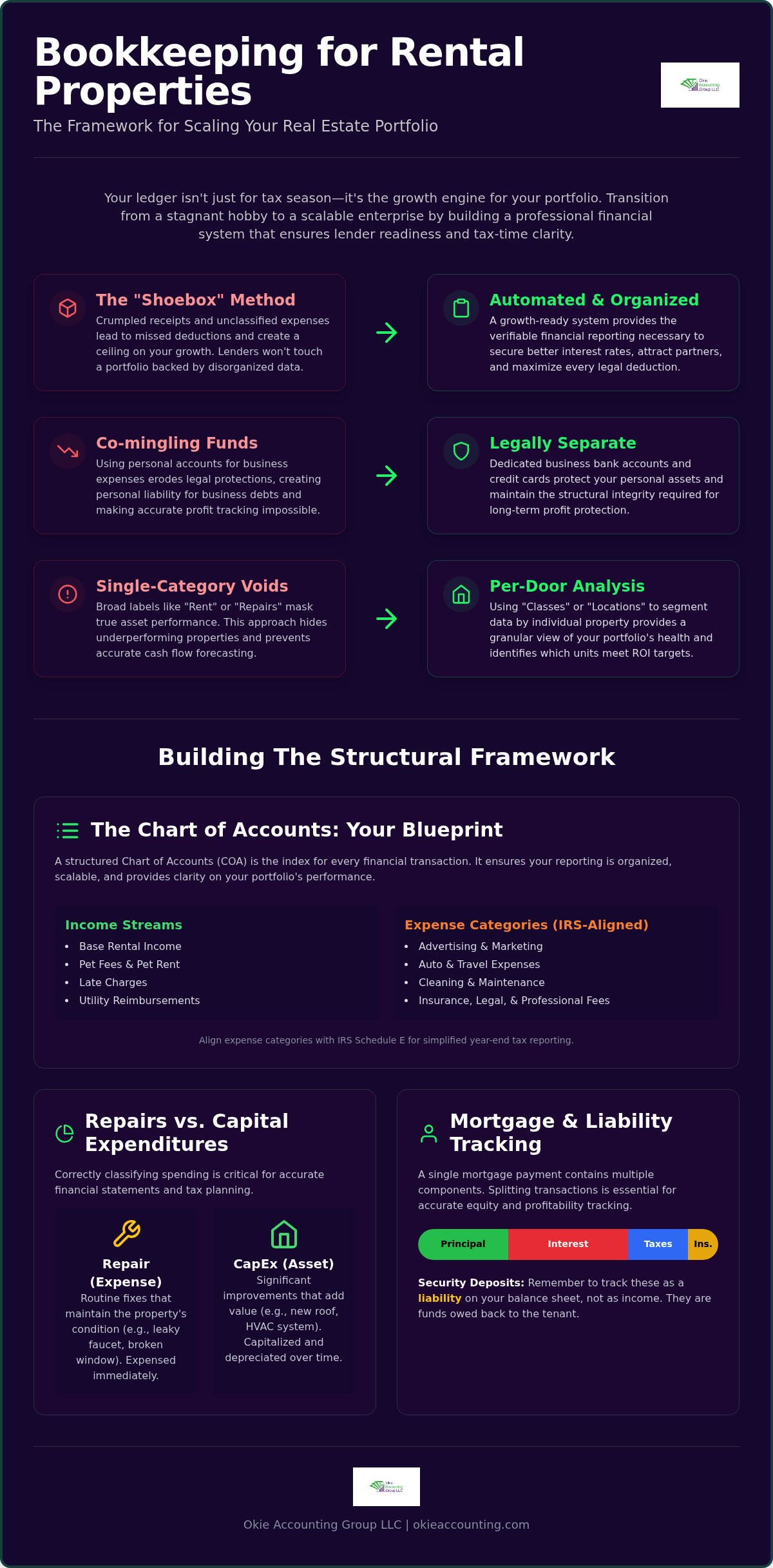
Investors often begin their journey using spreadsheets or physical folders to track expenses. While these standard methods of bookkeeping provide a basic record, they rarely offer the strategic insight required to scale. The "shoebox" method of saving crumpled receipts leads to missed deductions and unclassified expenses. If you can't verify an expense, you can't claim it. This lack of organization creates a ceiling on your growth because lenders won't touch a portfolio backed by disorganized data.
Generic accounting categories like "Rent" or "Repairs" are insufficient for a professional investor. These broad labels mask the true performance of your assets. Effective bookkeeping for rental properties requires a granular approach that distinguishes between base rent, pet fees, and utility reimbursements. Without this level of detail, your financial statements are just a summary of the past rather than a roadmap for the future. Transitioning from a "tax-ready" mindset to a "growth-ready" framework is what separates the amateur from the professional. A tax-ready system simply aims to avoid penalties. A growth-ready system, however, provides the financial reporting necessary to secure better interest rates and attract partners.
The Problem with the Single-Category Approach
Tracking multiple properties in a single "bucket" is a common mistake that hides underperforming assets. A property that looks profitable on paper might actually be draining the cash flow generated by your top performers. Professional systems use "Classes" or "Locations" to segment data by individual door. This structural framework allows for precise cash flow forecasting and ensures you know exactly which units are meeting their ROI targets. Establishing this foundation often starts with QuickBooks Setup & Training to ensure your categories are mapped correctly from day one.
The Legal Reality of Financial Co-mingling
Piercing the corporate veil occurs when a court holds business owners personally liable for company debts because the legal separation between personal and business finances has been ignored. This risk is highest when you use a personal credit card for a property repair or deposit rent into a personal savings account. Maintaining separate bank accounts is the first step in protecting your personal assets and maintaining structural integrity. You should also establish a strict policy of only using business-specific cards for every operational expense. If you accidentally co-mingle a transaction, record it immediately as an owner's contribution or draw to maintain your ledger's accuracy. These clean boundaries are essential for long-term profit protection.
Building the Structural Framework: The Rental Chart of Accounts
A Chart of Accounts (COA) serves as the organizational index for every financial account in your business. It's the blueprint that ensures your bookkeeping for rental properties remains organized and scalable as you add doors to your portfolio. Without a structured COA, your financial reporting becomes a tangled mess of unclassified data. You need to distinguish between various income streams such as base rental income, pet fees, and late charges to understand exactly where your revenue originates. This clarity allows you to identify which income sources are growing and which ones require management intervention.
Aligning your expense categories with IRS Publication 527 is a strategic move that simplifies annual reporting. By mirroring the categories found on Schedule E, you reduce the friction between your monthly records and year-end requirements. This alignment includes tracking specific line items like advertising, auto expenses, and cleaning. Additionally, managing liabilities requires absolute precision. Security deposits must be tracked as liabilities on the balance sheet rather than income on the profit and loss statement. These are funds you owe back to the tenant, and treating them as revenue creates a false sense of profitability that can lead to cash flow crises.
Assets vs. Expenses: The CapEx Distinction
Distinguishing between routine repairs and Capital Expenditures (CapEx) is critical for your portfolio's structural integrity. Routine repairs, such as fixing a leaky faucet or replacing a broken window, are expensed immediately. However, a significant improvement like a new roof or a complete HVAC replacement is an asset that belongs on your Balance Sheet. These assets are depreciated over time, which significantly impacts your long-term financial health and equity growth. Understanding this distinction ensures your financial statements accurately reflect the true value of your holdings.
Tracking Escrow and Mortgages
Recording mortgage payments correctly requires more than just tracking the total cash outflow. You must split the payment to reflect principal reduction, which increases your equity, and interest expenses, which reduce your taxable income. Property tax and insurance escrow accounts also require careful management. Failing to account for these can lead to cash flow surprises when lenders adjust your monthly requirements based on annual tax assessments. For a deeper dive into building these foundational systems, see our guide on Accounting for Real Estate Investors.
If you're finding the initial setup of these accounts complex, you might benefit from scheduling a discovery call to discuss how a specialized partner can streamline your financial framework.
Choosing the Right Tools: Spreadsheets vs. QuickBooks Online
Selecting the right technology is a pivotal decision in your investment strategy. While many start with manual logs, professional bookkeeping for rental properties requires a system that grows alongside your acquisitions. You might find Quick Accounting Tips helpful for initial organization, but your choice of software ultimately dictates your portfolio's transparency. Spreadsheets are often the entry point, yet they quickly become a bottleneck as you move from your first property to your third. Niche property management software offers helpful tenant-facing features, but these tools often lack the robust double-entry accounting core required for professional financial reporting.
QuickBooks Online stands as the gold standard for investors who prioritize lender readiness and scalability. It provides a level of structural integrity that generic tools simply can't match. However, the software's value isn't just in the subscription; it's in the specialized training that allows you to use it effectively. Without proper QuickBooks Setup & Training, even the best software becomes a source of confusion rather than clarity. Your goal is to move from data entry to data analysis.
The Scalability Wall
There's a specific moment when a spreadsheet starts costing you more in lost time and manual errors than it saves in subscription fees. Manual data entry is prone to transposition mistakes and forgotten receipts, which can lead to thousands in missed deductions. This risk is especially high for investors managing their own renovations. If you're coordinating sub-contractors and material costs, you may find our guide on Mastering QuickBooks for Contractors invaluable for tracking project-based expenses alongside your rental income.
Leveraging Cloud-Based Automation
Modern cloud-based systems offer bank feeds and auto-categorization rules that eliminate hours of manual entry. By 2026, QuickBooks Online has integrated intelligent transaction categorization that learns your spending patterns across multiple properties. This real-time access to financial data is vital when making rapid acquisition decisions in a competitive market. You can't wait until tax season to know if you have the cash flow for a new down payment. The first 30 days of software implementation are the most critical; setting up your automation rules correctly from the start ensures your data remains clean as you scale.
The Monthly Bookkeeping Workflow for Rental Properties
Professional bookkeeping for rental properties isn't a once-a-year scramble; it's a disciplined monthly cycle. This routine ensures your financial statements are always lender-ready, allowing you to move quickly when a new acquisition opportunity arises. Lenders prioritize borrowers who can produce reconciled, accurate financial statements on demand. While automated imports are helpful, they don't replace the need for a structured verification process. Follow these five steps every month to maintain your portfolio's structural integrity:
Step 1: Reconcile to the penny. Every bank and credit card account must match your ledger exactly. This double-entry verification is the only way to ensure no transaction was duplicated or missed.
Step 2: Review for anomalies. Examine your property-specific Profit & Loss statements. Look for sudden spikes in repair costs or utility bills that could indicate a maintenance issue or a billing error.
Step 3: Record owner-paid expenses. Track any out-of-pocket costs you paid personally. Properly recording these as owner contributions ensures you don't lose out on valuable deductions.
Step 4: Update the Balance Sheet. Adjust your mortgage accounts to reflect the principal reduction. You should also verify your escrow balances for property taxes and insurance to avoid cash flow surprises.
Step 5: Digitize documentation. File digital copies of all receipts and invoices. This provides the audit protection necessary for long-term profit protection and regulatory compliance.
Monthly Financial Review: The Strategic Advantage
Moving beyond basic data entry allows you to use your financials as a strategic tool. During your monthly review, compare your actual performance against your initial pro-forma. If your repair costs are consistently higher than projected, you may need to adjust your long-term maintenance strategy. This level of oversight is a core component of our Management Accounting Services, where we help you identify trends before they impact your bottom line. Analyzing these variances helps you understand the true health of each door in your portfolio.
Short-Term Rental (STR) Nuances
Investors managing short-term rentals face unique challenges, particularly regarding high-frequency transactions. You must account for gross payouts from platforms like Airbnb and VRBO, rather than just the net amount that hits your bank account. This requires recording the platform fees and cleaning fees separately to maintain an accurate view of your gross revenue. Additionally, tracking occupancy taxes as a liability ensures you don't accidentally treat those funds as your own profit. If the complexity of these high-volume reconciliations is slowing your growth, you should consider booking a discovery call to learn how we can streamline your monthly workflow.
Scaling Your Portfolio with Professional Oversight
The transition from DIY management to professional oversight marks a significant milestone in an investor's journey. While you can manage bookkeeping for rental properties on your own during the early stages, there is a clear threshold where manual systems become a liability. This shift typically occurs when the complexity of multiple escrow accounts, diverse income streams, and capital improvement projects begins to obscure your view of true profitability. Professional oversight ensures your portfolio is always prepared for the "Lender Test." Banks and private lenders require precise, reconciled financial statements to verify your Debt Service Coverage Ratio (DSCR) and overall financial health. If your records are disorganized, you risk being viewed as a high-risk borrower. This often leads to denied applications or unfavorable terms.
Okie Accounting Group LLC builds the structural framework required to move you from daily operational complexity to long-term financial clarity. We don't just record transactions; we construct the systems that allow for scalable growth. By integrating a Fractional Controller into your business, you gain access to high-level strategy and cash flow forecasting that goes beyond simple data entry. This partnership allows you to understand the broader implications of your financial data, ensuring that every acquisition is backed by rigorous management and accurate reporting.
The ROI of Accurate Books
Investing in professional financials provides a direct return through improved lending opportunities and reduced administrative costs. Clean, lender-ready statements can lead to better interest rates and higher loan amounts because they demonstrate a history of disciplined fiscal management. Additionally, providing a fully reconciled ledger to your CPA at year-end significantly reduces their billable hours. They don't have to perform forensic accounting to untangle your records when the data is already clean. Our Controller Services provide this level of precision, ensuring your portfolio is optimized for both profit protection and efficiency.
Transitioning to a Strategic Partnership
Scaling a portfolio requires a fundamental shift from recording history to planning the future. A specialized partner who understands the nuances of the real estate sector, such as depreciation cycles and the Modified Accelerated Cost Recovery System (MACRS), is invaluable. This industry-specific knowledge ensures your books aren't just accurate; they're strategically aligned with your goals as an investor. You deserve a partner who is as invested in your business's stability as you are. To move your portfolio toward operational excellence, partner with Okie Accounting Group LLC for specialized rental property bookkeeping and gain the clarity you need to scale with confidence.
Securing Your Financial Foundation for Future Acquisitions
Transforming your financial records from a source of stress into a strategic asset requires a fundamental shift in mindset. By establishing a robust Chart of Accounts and committing to a disciplined monthly workflow, you ensure your portfolio remains lender-ready and operationally transparent. Effective bookkeeping for rental properties isn't just about recording history; it's about building the structural framework necessary for long-term stability and profit protection. You've seen how specialized systems prevent co-mingling and highlight underperforming assets, allowing you to make data-driven choices with quiet confidence.
As QuickBooks Online Certified ProAdvisors specialized in real estate investment accounting, Okie Accounting Group provides the remote financial leadership you need to scale nationwide. We move you from the complexity of disorganized data to the clarity of professional financial reporting. You've built the physical equity; now it's time to master the financial systems that protect it. Gain financial clarity for your rental portfolio—Contact Okie Accounting today. Your path to a scalable, organized enterprise starts with a single strategic decision.
Frequently Asked Questions
Can I use one bank account for multiple rental properties?
You can utilize a single business bank account for multiple properties if they are owned by the same legal entity. However, you must use "Classes" or "Locations" in your software to maintain separate profit and loss statements for each door. If properties are owned by different LLCs, you should establish separate accounts to avoid legal co-mingling. This structure ensures that your bookkeeping for rental properties remains transparent and organized for potential lenders.
How do I handle security deposits in my bookkeeping?
Security deposits must be recorded as a liability on your balance sheet rather than as income on your profit and loss statement. Since these funds are technically owed back to the tenant, they don't belong to the business until a legal claim is made for repairs or unpaid rent. Treating these deposits as revenue creates a false sense of profitability and can lead to significant cash flow shortages when tenants move out.
Is QuickBooks or a spreadsheet better for rental property accounting?
QuickBooks Online is the superior choice for investors who intend to scale their portfolios or seek professional financing. While spreadsheets are acceptable for a single unit, they lack the double-entry accounting integrity required to produce lender-ready financial statements. Professional software automates transaction imports and provides the granular reporting necessary for high-level cash flow forecasting. Moving beyond manual logs reduces the risk of data entry errors that often plague DIY systems.
What expenses are most commonly missed by rental property owners?
Investors frequently overlook small, out-of-pocket expenses that aggregate into significant tax deductions. Common missed items include:
Local travel mileage to properties or supply stores
Home office supplies and professional subscription fees
Soft costs like vacancy advertising and background checks
Maintaining a digital receipt management system ensures that every dollar spent on your portfolio is captured and categorized correctly to protect your long-term profit margins.
How do I track a mortgage payment that includes taxes and insurance?
You must record mortgage payments as a split transaction to accurately reflect your financial position. A portion of the payment goes toward the principal, which reduces your liability on the balance sheet. The interest is recorded as an expense on the P&L. Finally, the taxes and insurance portion should be moved into an escrow asset account until the lender actually pays those bills on your behalf. This methodology avoids sudden, unexpected cash flow surprises.
Do I need a separate bookkeeper if I already have a tax CPA?
Yes, because these roles serve different strategic purposes. A tax CPA focuses on your annual compliance and filing, while a specialized bookkeeper manages the monthly data integrity required for operational decisions. Accurate bookkeeping for rental properties provides the real-time insights you need for acquisition planning and lender readiness. By delivering clean, reconciled books to your CPA, you also reduce the time they spend on data cleanup during the busy season.
What is the difference between repairs and capital improvements for bookkeeping?
Repairs are routine maintenance tasks that keep a property in its current operating condition, such as fixing a broken window or painting between tenants. These are fully deductible in the year they occur. Capital improvements, like installing a new HVAC system or replacing a roof, add significant value or extend the property's useful life. These costs must be capitalized on the balance sheet and depreciated over time according to current IRS recovery periods.
How often should I reconcile my rental property books?
You should reconcile your accounts every month to ensure absolute data accuracy. Monthly reconciliation allows you to identify bank errors, duplicate transactions, or missing receipts before they become difficult to untangle. This consistent rhythm provides you with a clear, up-to-date understanding of your cash flow per door. Waiting until the end of the quarter or year to review your financials often leads to missed anomalies that can negatively impact your portfolio's stability.


Comments