
2026 Construction Accounting: Strategic Contractor Guide

Updated: 3 hours ago
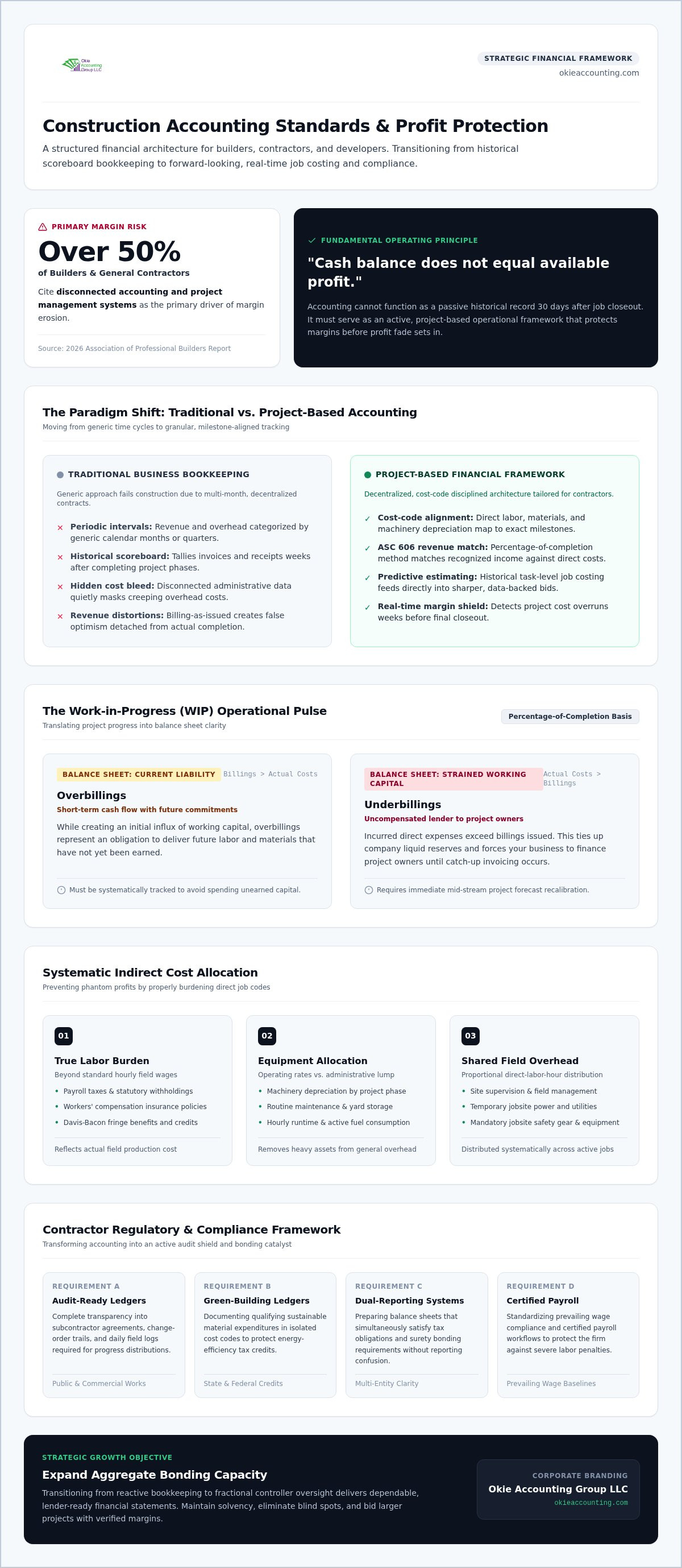
Over 50% of builders and general contractors cite disconnected accounting and project management systems as the primary driver of margin erosion, according to the 2026 Association of Professional Builders report. In construction, accounting can no longer function as a passive historical record; it must serve as an active framework for real-time profit protection. Implementing modern construction accounting best practices 2026 is critical to maintaining financial control. You already know the frustration of reviewing job cost reports that arrive thirty days late, only to discover untracked indirect costs or complex prevailing wage compliance issues have quietly compromised your bottom line.
Operating with blind spots is no way to run a firm. By mastering specialized, project-based financial strategies, you can establish clear real-time visibility across every project, generate dependable lender-ready financial statements, and protect your margins before profit fade sets in. This strategic guide details the core accounting methodologies, compliance frameworks, and cash flow forecasting workflows required to scale your business with confidence this year.
The Evolution of Construction Accounting Standards in 2026
Modern construction accounting moves far beyond the basic general ledger. For years, contractors treated financial records as a historical scoreboard, tallying invoices and receipts weeks after completing a job. Adopting specialized construction accounting best practices 2026 requires shifting to a forward-looking operational architecture. This framework recognizes that cash balance does not equal available profit, and disconnected administrative bookkeeping will quickly mask creeping overhead costs.
Small and mid-sized contractors face tighter scrutiny around revenue recognition under ASC 606. Recognizing revenue as bills are issued distorts actual project health because cash flow rarely coincides with progress. Instead, applying the percentage-of-completion method allows firms to match recognized income directly against cumulative direct costs. Modern cloud platforms now calculate these ratios automatically. This data-first structure feeds predictive analytics into your estimating process, turning historical job costing into sharper future bids rather than educated guesses.
Project-Based vs. Traditional Accounting
Standard business bookkeeping categorizes revenue and operational overhead across general time intervals, such as monthly or quarterly cycles. This generic approach fails construction firms because profits hinge entirely on decentralized, multi-month contracts. In a project-based environment, every direct expense, including labor, material deliveries, and heavy machinery depreciation, must align to specific project milestones and cost codes. Building a structural framework for your financial records ensures your balances reflect actual performance, keeping your working capital solvent.
The 2026 Regulatory Landscape for Contractors
Regulatory compliance has tightened significantly for both public works and commercial developments. Meeting modern standards demands precision across several core areas:
Audit-Ready Ledger Systems: Federal and state agencies expect complete transparency into subcontractor agreements, change-order trails, and daily field logs before approving progress distributions.
Clean Green-Building Ledger Accounts: Documenting qualifying sustainable material expenditures in isolated cost codes protects your eligibility for state and federal energy-efficiency credits.
Dual-Reporting Capability: Preparing balance sheets that support both tax obligations and lender bonding requirements prevents multi-entity reporting confusion.
Mastering these regulatory baselines transforms accounting from a tax-time scramble into an active shield that protects your balance sheet against sudden audit penalties.
Mastering Job Costing and WIP Accounting for Profit Protection
Software alone cannot protect project margins if job costing lacks structural discipline. A high-performing job costing system tracks labor, materials, subcontractor commitments, and equipment runtime down to specific cost codes. Work in progress (WIP) accounting serves as the operational pulse of construction profitability, providing an objective measure of financial health across every active job. Aligning field production metrics with ledger activity lies at the core of construction accounting best practices 2026, ensuring that profit fade is detected weeks before final closeout.
The WIP Report: Your Most Important Financial Tool
A reliable WIP schedule translates project progress into balance sheet clarity by contrasting costs incurred against contract billings. Overbillings create short-term cash flow, but they represent a current liability that signals future unbilled commitments. Underbillings tie up working capital by turning your firm into an uncompensated lender for project owners. Implementing dedicated construction bookkeeping services allows you to evaluate percentage-of-completion data continuously and recalibrate project forecasts mid-stream.
Allocating Indirect Costs and Equipment
Unallocated overhead remains the silent killer of construction margins. Direct job costs are straightforward, yet indirect expenses create massive distortions when left unassigned. Protecting profitability requires systematic allocation across three critical operational areas:
True Labor Burden: Hourly wages represent only a fraction of field costs. Calculations must include payroll taxes, workers' compensation insurance, benefits, and statutory fringe credits required under Davis-Bacon prevailing wage regulations.
Equipment Cost Allocation: Machinery depreciation, routine maintenance, fuel, and storage should be billed against project phases using hourly operating rates rather than lumped into general administrative overhead.
Shared Field Overhead: Site supervision, temporary utilities, and safety equipment must be distributed systematically across active jobs based on total direct labor hours.
Disciplined indirect cost allocation prevents phantom profits from masking systemic job losses. If your current reporting fails to deliver this level of clarity, you can schedule a discovery call to evaluate your firm's job costing architecture.
Optimizing QuickBooks Online for Construction Workflows
Enterprise software vendors frequently argue that mid-sized builders must migrate to complex enterprise resource planning (ERP) suites to maintain financial control. That assumption is costly and outdated. For the vast majority of growing commercial and residential builders, QuickBooks Online serves as the operational baseline when configured with structural precision. Adopting construction accounting best practices 2026 means transforming off-the-shelf software into a specialized job costing engine. This setup coordinates field logs, digital time-tracking, and vendor commitments directly into a tailored Chart of Accounts.
Advanced QuickBooks Setup for Contractors
Agile firms running regional jobs across states like Tennessee and Florida rely heavily on two native QBO features: Projects and Classes. Assigning classes by geographic market or division surfaces regional gross profit margins instantly. Meanwhile, the Projects module isolates individual jobs, tracking change orders and cost codes against original estimates. Automated bank feeds accelerate high-volume reconciliations, but rules must require job tags before transactions clear. Contractors seeking to modernize their configuration can leverage dedicated QuickBooks Training for Contractors to ensure staff follow disciplined cost-entry standards.
Solving Common QuickBooks Mistakes
Generalist bookkeepers routinely make errors in QBO that obscure profitability and complicate long-term reporting. Watch out for these three major pitfalls:
Commingling Project Cash: Shuffling funds between projects to cover vendor balances hides underperforming jobs and invalidates job-level margin tracking.
Plugging Unreconciled Adjustments: Forcing general journal entries to balance job balances bypasses sub-ledgers, distorting cost-to-cost metrics governed by IRC Section 460 long-term contract rules.
Ignoring Retainage Accounts: Omitting separate accounts for retained receivables and payables skews working capital and prevents accurate credit assessments under ASC 326.
Eliminating these common mistakes ensures that your software setup actively supports predictable Construction Cash Flow Management instead of obscuring cash obligations behind messy reconciliations.
Navigating Payroll Compliance and Regional Requirements
Construction payroll is fundamentally different from standard corporate payroll. Between prevailing wage determinations, craft classifications, multi-state tax withholding, and union fringe benefit packages, payroll errors can quickly trigger devastating fines. The maximum civil assessment penalty under Davis-Bacon regulations reaches $13,508 per violation. Worker misclassification remains the number one audit risk for contractors in 2026, as both state labor departments and the IRS aggressively audit 1099 independent contractor arrangements. Integrating disciplined labor oversight into your construction accounting best practices 2026 framework is vital to protect operating cash flow.
Steps to a Compliant Construction Payroll
Managing public works or federally assisted jobs with contract values above the $2,000 threshold requires systematic operational controls. Contractors must maintain rigorous compliance across three core administrative checkpoints:
Wage Determination Verification: Match job site trades against current Department of Labor county wage determinations before work begins. Assign correct base rates for journey-level workers versus registered apprentices.
Fringe Benefit Tracking: Track third-party trust contributions, bona fide benefit funds, and cash-in-lieu payments separately to satisfy total hourly compensation requirements.
Automated Certified Reporting: Standardize weekly certified payroll submissions on federal Form WH-347, ensuring trade classifications, gross hours, and authorized employee deductions align perfectly with field sign-in sheets.
Tennessee and Florida Specific Considerations
Contractors expanding across regional corridors, such as running projects between Tennessee hubs and the Jacksonville, FL market, encounter distinct compliance demands. While neither state levies a personal income tax, their regulatory environments differ significantly regarding corporate franchise taxes, state unemployment registrations, and workers' compensation requirements. Florida strictly enforces workers' compensation coverage for construction employers with one or more employees, including corporate officers, unless a valid state exemption certificate is filed. In contrast, Tennessee mandates coverage for construction enterprises with five or more workers or those operating as commercial general contractors.
Failing an annual workers' comp audit can erase months of project margins through retroactive premium adjustments. A structured financial infrastructure separates payroll classes cleanly, records verified certificates of insurance for every sub-tier contractor, and isolates payroll records by state. If your firm is expanding across regional lines, partner with specialized construction payroll services to safeguard your operations. To evaluate your firm's current certified payroll processes and state tax compliance, book a discovery call today.
The Strategic Shift: Moving to Fractional Controller Oversight
Generalist bookkeepers focus on basic data entry, logging receipts and issuing invoices weeks after field operations conclude. In contrast, high-level financial leadership evaluates the story behind the numbers to safeguard future solvency. Adopting modern construction accounting best practices 2026 requires moving beyond entry-level administration into structured oversight. A dedicated fractional controller actively translates monthly work-in-progress metrics into actionable bidding guardrails, protects your aggregate bonding line, and ensures your financial data serves as a forward-looking management tool.
When to Hire a Fractional Controller
Most contractors hit a distinct operational ceiling once annual volume reaches multiple millions across concurrent jobsites. Managing multiple project teams, equipment allocations, and complex vendor commitments quickly overwhelms a traditional bookkeeper. You should consider bringing in high-level oversight when specific operational bottlenecks appear:
Stagnant Bonding Capacity: Sureties demand verified percentage-of-completion reports and clean balance sheets before writing larger performance bonds.
Persistent Cash Surprises: Inability to forecast liquidity leads to panic over payroll obligations or material deposits, despite having profitable contracts on paper.
Bidding Without True Historical Costs: Estimating teams lack feedback loops to know which trade codes yielded acceptable gross margins.
Leveraging remote Fractional Controller Services gives your growing company executive-level financial management, internal controls, and strategic budgeting without the overhead of a full-time corporate executive.
Building Your 2026 Growth Roadmap
Disciplined growth requires consistent forward planning. A fractional controller leads monthly financial reviews to examine project variance, evaluate job fade, and align billing schedules. This ongoing analysis feeds directly into rolling cash flow forecasting models. When you have clarity over expected working capital six to twelve months out, you can schedule capital asset acquisitions confidently or decide when to self-perform versus subcontract work. Preparing lender-ready financial statements ensures banks view your enterprise as low risk during credit reviews. Ready to build a scalable financial foundation? Contact Okie Accounting Group to establish proactive financial reporting and controller-level oversight for your construction firm.
Build a Resilient Financial Foundation for 2026
Protecting your firm's profitability requires more than reactive bookkeeping; it demands structural financial discipline. Implementing modern construction accounting best practices 2026 ensures your job costs reflect reality, your WIP schedules expose profit fade early, and your payroll remains fully compliant across state lines. When your financial data operates in real time, you gain the confidence to bid competitively, secure critical bonding lines, and preserve cash flow.
You don't have to tackle this operational shift alone. Okie Accounting Group provides specialized insight for regional construction markets in Tennessee and Florida, paired with cloud-based remote leadership and expert QuickBooks training nationwide. By establishing proactive cash flow forecasting, disciplined payroll management, and project-level reporting, we help contractors turn complex data into clear strategic direction. Ready to protect your margins and scale sustainably? Gain Financial Clarity with Okie Accounting Group today.
Frequently Asked Questions
What is the most important accounting practice for construction companies in 2026?
Maintaining an active Work in Progress (WIP) schedule tied directly to task-level job costing is the most critical practice. This is the cornerstone of construction accounting best practices 2026 because bank balances alone provide a misleading sense of financial health. Tracking real-time percentage of completion exposes underbillings that drain working capital and overbillings that distort solvency before projects reach completion.
How does job costing differ from standard business bookkeeping?
Standard bookkeeping records operational expenses across calendar periods, while job costing assigns every direct dollar to specific project cost codes. General bookkeeping cannot reveal which projects generated target margins or where profit fade occurred. Precise job costing isolates performance by task, equipping contractors managing jobs across Tennessee and Florida to bid future contracts with historical mathematical accuracy.
Can QuickBooks Online handle complex construction accounting needs?
Yes, when properly configured with specialized project-based workflows. Mid-sized contractors don't necessarily need expensive enterprise suites. Utilizing QuickBooks Online Advanced alongside integrated time-tracking tools allows firms to run multi-state operations smoothly. Customized charts of accounts enable contractors operating between Jacksonville, FL, and Tennessee to manage progress billings, retainage balances, and overhead allocations with structural clarity.
What are the 2026 Davis-Bacon payroll compliance requirements?
Federal and federally assisted public works contracts exceeding $2,000 mandate weekly certified payroll reporting on Department of Labor Form WH-347. Contractors must track base hourly wages, registered apprenticeship statuses, and bona fide fringe benefits separately. Misclassifying labor or misreporting fringe credits can trigger civil penalties up to $13,508 per violation, making specialized payroll management essential.
Why do construction firms need a Work in Progress (WIP) report?
A WIP report adjusts your balance sheet to reflect true earned revenue rather than cash collected. It reveals whether you are overbilled, having billed ahead of actual field progress, or underbilled, which means you are financing the client's project out of pocket. Surety bonding agents and commercial lenders require accurate monthly WIP schedules to evaluate working capital and assign bonding capacity.
How does a fractional controller help a contractor scale?
A fractional controller delivers executive-level financial leadership without the significant overhead of a full-time hire. They translate operational data into rolling cash flow forecasts, optimize true labor burden calculations, enforce internal controls, and build lender-ready statements. For regional contractors expanding between markets like Tennessee and Florida, fractional leadership bridges the gap between field management and strategic growth.
What is the best way to track construction cash flow across multiple projects?
Implement rolling, multi-week cash flow forecasting that isolates project receipts, vendor commitments, and retainage release schedules from general operational overhead. Looking only at current cash reserves leads to liquidity shortages when multiple vendor payments hit simultaneously. Applying construction accounting best practices 2026 requires tracking committed costs and billing milestones dynamically across all active jobs.
Is outsourced construction accounting more cost-effective than an in-house team?
Outsourcing specialized accounting provides immediate access to construction-focused professionals without the recruiting friction, benefits overhead, or turnover risks of an in-house department. Full-time controllers demand substantial compensation packages that burden mid-sized builders. Outsourcing monthly bookkeeping, payroll management, and fractional controller oversight delivers disciplined frameworks and strategic reporting tailored to your current project pipeline.


Comments