
Local CPA vs. Remote Fractional Controller: 2026 Guide

Why does your bank account feel empty when your project pipeline is full? For many contractors, the gap between high revenue and actual cash flow is a source of constant anxiety. With typical industry net profit margins hovering between 2% and 4%, there is zero room for error in your job costing. You don't just need someone to file your returns; you need a system that protects your profit before the project wraps up. The decision of hiring local CPA vs remote fractional controller for contractors is one of the most critical choices you'll make for your firm's 2026 growth strategy.
We understand the pressure of managing complex WIP schedules while trying to keep your bonding lines open. You deserve a financial partner who acts as a strategic mentor rather than just a compliance historian. This guide clarifies which role drives the highest ROI for your specific stage of growth. You'll learn how to transition from reactive bookkeeping to a predictive financial framework that provides total clarity. We will preview how a remote fractional controller builds the structural integrity your back-office needs to scale without the overhead of a physical office or a full-time executive salary.
Compliance vs. Strategy: The Contractor's Accounting Dilemma
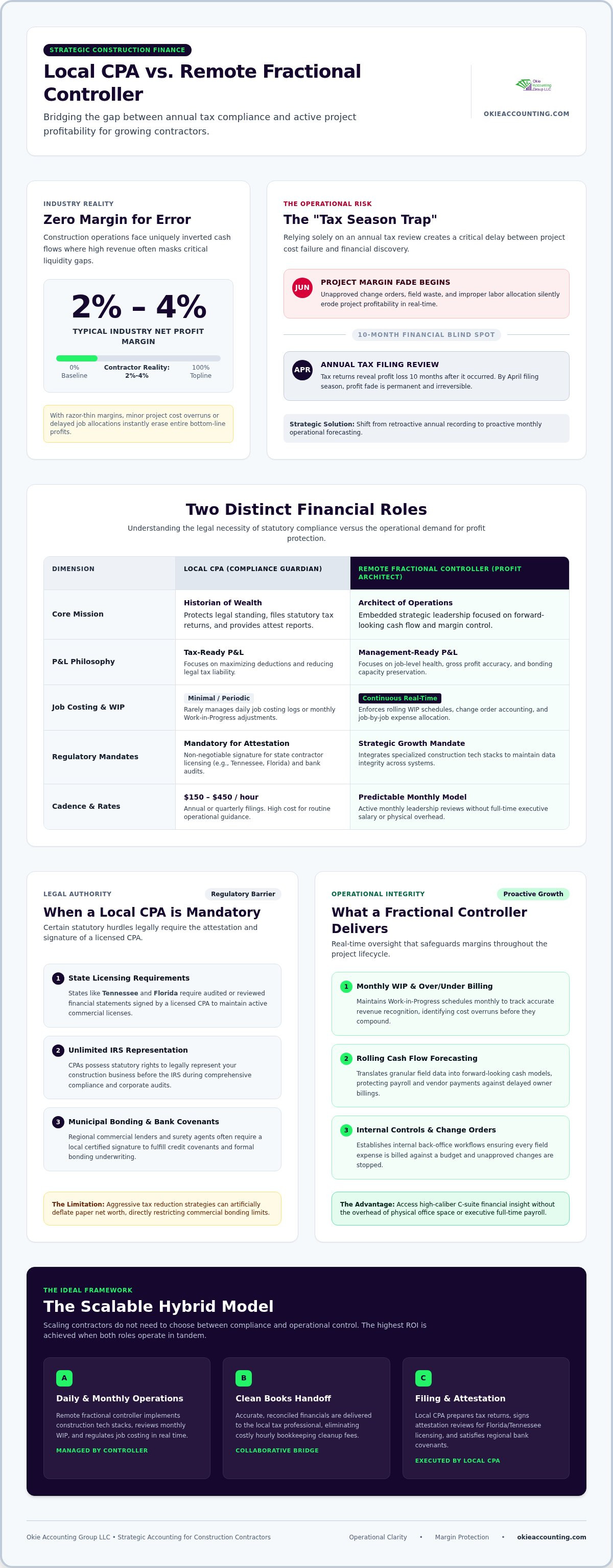
Many construction firms operate under the assumption that a clean tax return equals a healthy business. This misconception often leads to the "Tax Season Trap," where owners only receive a financial health check once a year. By the time your tax professional reviews the books in April, the project margin fade that started last June is already permanent. The fundamental challenge in hiring local CPA vs remote fractional controller for contractors lies in distinguishing between historical reporting and forward-looking strategy. You need to know where your cash is going today, not just where it went last year.
As your firm scales, you'll likely hit a complexity ceiling. Basic bookkeeping and annual tax filings are no longer sufficient to manage the inverted cash flow typical of modern construction projects. You need a system that translates granular project data into actionable intelligence. Cloud-based accounting has bridged the gap, allowing firms to maintain a local tax presence for compliance while accessing specialized, remote strategic oversight to drive growth.
What Your Local CPA Actually Does
A local CPA is your primary guardian for tax compliance and attestation. Their role is defined by the Certified Public Accountant credential, which grants them the legal authority to represent your firm before the IRS and perform certified audits. In states like Tennessee and Florida, a local CPA’s signature is often non-negotiable for meeting specific contractor licensing financial requirements or satisfying regional bank covenants. They ensure your federal and state filings are accurate, but they rarely have the capacity to manage your daily job costing or change order logs. They are historians of your wealth, not the architects of your operations.
What a Fractional Controller Brings to the Job Site
A remote fractional controller functions as an embedded member of your leadership team. Rather than just recording history, they focus on the future through monthly financial reviews and rolling cash flow forecasting. This role involves strategic oversight of your monthly bookkeeping to ensure job costs are allocated correctly in real-time. By establishing rigorous internal controls, a controller prevents waste in the field and ensures that every dollar spent is tracked against a specific budget. Okie Accounting Group LLC specializes in this proactive partnership, providing the executive-level insight needed to protect your profit margins without the burden of a full-time executive salary. It's about moving from simple data entry to high-level profit protection.
The Local CPA: Guardian of Tax Compliance and Audits
The decision regarding hiring local CPA vs remote fractional controller for contractors often starts with understanding legal necessity. A local CPA serves as your primary shield against regulatory scrutiny. When you are navigating the complexities of state-specific regulations, their presence is often mandatory. In Tennessee and Florida, for instance, maintaining a valid contractor license frequently hinges on submitting financial statements reviewed or audited by a licensed professional. This local expertise ensures you meet IRS standards for licensed tax professionals, providing you with unlimited representation rights during a compliance review.
Bonding agents and commercial lenders also prioritize the "local" signature. If you are bidding on large-scale municipal projects or seeking a high-level line of credit, these institutions require the historical assurance that only a certified professional can provide. Physical presence still matters for document audits or local government contracting where regional proximity builds the necessary trust with local boards. However, a gap exists. While they protect your legal standing, most generalist firms lack the granular focus required for construction bookkeeping services, often overlooking the nuances of project-level cost tracking.
Tax Planning vs. Strategic Management
Your tax professional’s primary goal is to minimize your liability. While aggressive tax planning saves money in the short term, it can inadvertently cripple your bonding capacity by artificially lowering your net worth on paper. A tax-ready P&L focuses on deductions; a management-ready P&L focuses on project health. Okie Accounting Group LLC recognizes that most CPAs don't manage your Work in Progress (WIP) schedule monthly, which means they might miss project margin fade until it’s too late to course-correct.
The Cost of a Local Generalist
When weighing the investment of hiring local CPA vs remote fractional controller for contractors, look at the frequency of the interaction. Generalist CPAs typically bill between $150 and $450 per hour in 2026. While this is appropriate for annual filings, paying these rates for operational advice is rarely cost-effective. A generalist understands the broad strokes of business but may struggle with the specific mechanics of retainage or AIA billing. You need a partner who understands these complexities before they become liabilities. If you're unsure how your current setup stacks up, consider scheduling a discovery call to evaluate your needs.
Ultimately, a local CPA protects your past while a controller manages your present.
The Remote Fractional Controller: Strategic Leadership for Contractors
While a tax professional focuses on the external requirements of the government, a controller focuses on the internal mechanics of your operations. By utilizing fractional controller services, you gain access to high-level financial oversight without the $155,000 annual burden of a full-time executive hire. The U.S. Bureau of Labor Statistics defines the responsibilities of financial controllers as directing the preparation of financial reports and developing strategies for long-term goals. For a contractor, this means moving from basic data entry to a disciplined system that protects every point of your profit margin.
The remote model allows you to hire based on niche expertise rather than proximity. You don't need a physical office to manage your financial data. Okie Accounting Group LLC leverages cloud-based systems to provide real-time job costing and WIP management for firms across the country. When you are weighing the benefits of hiring local CPA vs remote fractional controller for contractors, the remote option provides a deeper bench of construction-specific knowledge. We use QuickBooks Online as a centralized engine to bridge the gap between your field operations and your back-office strategy.
Job Costing and Profit Protection
Job costing is the foundation of structural integrity in your business. It moves beyond basic expense tracking to provide detailed project-based analytics. If you only see your numbers at year-end, you've already lost the opportunity to fix a losing project. We identify "profit bleed" in real-time by comparing actual costs against your estimates. Through specialized QuickBooks training for contractors, we empower your field team to provide better data, ensuring your reports reflect reality rather than guesswork.
WIP Accounting: The Secret to Construction Scaling
A healthy bank balance is often a deceptive metric in the construction industry. Retainage and front-loaded expenses can mask your true financial health. WIP accounting calculates over-billings and under-billings to reveal your actual cash position. Your bank and bonding agent care more about your WIP schedule than your current balance because it proves you understand your cost-to-complete. A controller’s role is to clean up the balance sheet, ensuring you have lender-ready financials that reflect your firm’s true capacity for growth.
Decision Matrix: Choosing the Right Partner for Your Firm
Choosing between hiring local CPA vs remote fractional controller for contractors isn't a one-time event; it's a strategic shift that follows your firm's growth curve. Your financial needs evolve as your project volume increases. Identifying your current stage allows you to allocate resources toward the specific expertise that will actually protect your bottom line.
Stage 1: The Solopreneur. If you're managing a small crew with revenue under $1 million, your primary focus is compliance. A local tax preparer and basic bookkeeping are usually sufficient to keep the IRS satisfied.
Stage 2: The Growing Subcontractor. Once you hit the $1 million to $5 million range, basic numbers aren't enough. You need construction payroll services and job costing to ensure you aren't losing money on change orders or labor inefficiencies.
Stage 3: The Scaling General Contractor. Above $5 million in revenue, the stakes are higher. You need a fractional controller for strategic oversight, WIP management, and bonding preparation.
The most successful firms utilize a hybrid model. They retain a local CPA for annual tax filings and certified audits while partnering with a remote controller for the weekly operational heavy lifting. This ensures you have both historical compliance and future-focused strategy.
When to Hire Local (Tennessee/Florida Context)
A Tennessee or Jacksonville-based CPA is essential when state-specific licensing requirements are the priority. In Florida, for example, contractors must often provide specific financial statements to maintain their license. Local professionals also hold valuable regional bank relationships that can streamline your lending process. They understand the nuances of local sales tax on labor versus materials, which varies significantly by jurisdiction. If you need physical document audits or local government contracting support, the proximity of a regional firm is a distinct advantage.
When to Go Remote for Strategy
You should go remote when your local talent lacks specialized construction accounting knowledge. Many generalist CPAs don't understand the inverted cash flow of a project or how to properly book retainage. A remote partner provides a proactive rhythm, checking in weekly to monitor your 13-week cash forecast rather than waiting for tax season. When evaluating the ROI of hiring local CPA vs remote fractional controller for contractors, consider the depth of industry-specific knowledge. Research indicates that hiring a fractional controller can save a growing contractor 60% to 75% compared to the fully loaded cost of a full-time in-house hire. If you're ready to build a more resilient financial structure, book a discovery call today to discuss your scaling strategy.
The Okie Accounting Approach: Remote Strategy, Local Heart
At Okie Accounting Group LLC, we believe geographic proximity shouldn't limit the quality of your financial oversight. While we are based in Tennessee and Jacksonville, Florida, our cloud-based systems allow us to serve contractors nationwide with the same precision as an in-house team. The transition from a simple bookkeeper to a strategic partner is what defines our methodology. We don't just record transactions. We build the structural frameworks that support long-term growth and profit protection.
Sarah O'Quinn’s specialized focus on the construction and real estate sectors ensures that your advisor speaks your language. She understands the specific mechanics of progress billings, retainage, and lien waivers. By implementing rigorous management accounting practices, we remove the friction often associated with remote work. When you're weighing the choice of hiring local CPA vs remote fractional controller for contractors, our approach offers the best of both worlds: specialized industry knowledge delivered through a modern, efficient digital interface.
Building Your Financial Infrastructure
We begin by establishing a foundation through QuickBooks setup and field team training. It's vital that your team in the field provides accurate data so your reports reflect reality. We establish a monthly reporting rhythm that moves beyond simple balance sheets to include project-level analysis. Our team works alongside your existing local CPA, ensuring they have the clean, adjusted data they need for a seamless tax season. This collaboration ensures your compliance is met without sacrificing operational insight.
Your Next Steps for Financial Clarity
The biggest mistake a contractor can make is waiting until year-end to address accounting bottlenecks. If you don't have job-costing data in real-time, you're flying blind. Waiting to fix the books during tax season is a reactive strategy that costs you project profit today. You need a system that predicts profit rather than just recording history. If you're ready to gain control over your cash flow, you should schedule a consultation with Okie Accounting Group LLC to evaluate your fractional controller needs. We help you move from financial complexity to operational confidence.
Securing Your Firm's Financial Future
Your firm’s growth depends on shifting from reactive tax filing to proactive financial leadership. While your local tax professional ensures you remain in good standing with the IRS, a fractional controller provides the visibility needed to protect your project margins in real-time. The choice of hiring local CPA vs remote fractional controller for contractors shouldn't be about choosing one over the other. Instead, it’s about building a hybrid system that leverages the strengths of both compliance and strategy.
Okie Accounting Group LLC combines deep construction and real estate expertise with nationwide remote support. We bridge the gap between your field operations and your financial health using specialized cloud-accounting systems. With roots in Tennessee and Florida, we understand regional industry nuances while providing the high-level oversight required to scale. It’s time to move beyond the uncertainty of year-end reporting and start making data-driven decisions today. You deserve a partner as invested in your success as you are.
Ready to scale your construction firm? Book a discovery call with Okie Accounting Group LLC today.
Frequently Asked Questions
What is the difference between a CPA and a Fractional Controller for a construction company?
The primary difference lies in the focus of the relationship. A CPA handles federal and state tax compliance and year-end filings from an external perspective. A Fractional Controller manages your internal financial operations, such as job costing and cash flow forecasting. While a CPA reports on your past, a controller builds your future by establishing internal controls. This distinction is vital when hiring local CPA vs remote fractional controller for contractors to ensure you have both legal protection and operational clarity.
Can a remote controller really understand my local construction market in Tennessee or Florida?
Geographic boundaries don't limit financial insight in a cloud-based environment. We maintain deep roots in Tennessee and Jacksonville, Florida, which gives us specific knowledge of regional licensing requirements and local sales tax nuances. By utilizing real-time access to your QuickBooks data, we provide the same level of oversight as an in-house hire. Our nationwide remote capability ensures you receive specialized construction expertise regardless of your physical project locations, focusing on your specific market mechanics.
Do I have to fire my local CPA if I hire a remote fractional controller?
You don't need to fire your CPA. In fact, we prefer to work alongside them. Okie Accounting Group LLC does not provide income tax preparation or certified audits; we focus on strategic management and monthly bookkeeping. By hiring local CPA vs remote fractional controller for contractors, you create a powerful financial team. We ensure your books are clean and adjusted throughout the year, making your CPA’s year-end tax filing process significantly more efficient and accurate.
How much does a fractional controller cost compared to a full-time in-house hire?
A fractional controller provides executive-level insight at a fraction of the cost of a full-time hire. According to 2026 industry benchmarks, the fully loaded cost of an in-house construction controller can exceed $155,000 annually. A fractional model allows you to pay only for the high-level strategy you need. This approach eliminates the overhead of benefits, payroll taxes, and office space while providing the strategic oversight necessary to protect your profit margins and stabilize your cash flow.
What software do I need to work with a remote fractional controller?
QuickBooks Online serves as the primary engine for our remote collaboration. We also integrate specialized construction management tools like Procore, Buildertrend, or Sage to ensure your field data flows seamlessly into your accounting system. Our team provides QuickBooks training to ensure your staff uses these platforms effectively. This cloud-based infrastructure allows us to monitor your job costs and cash flow in real-time without ever needing to step onto your job site or physical office.
How does a fractional controller help with construction bonding and bank loans?
Bonding agents and lenders evaluate your firm based on the accuracy of your Work-in-Progress (WIP) schedules. A fractional controller ensures that over-billings and under-billings are recorded monthly, preventing artificial inflation of your liabilities. We produce clean, lender-ready financial reports that demonstrate your firm's true capacity for growth. By maintaining structural integrity in your balance sheet, we help you secure higher bonding limits and more favorable terms on bank facilities through consistent data-driven reporting.
What are the specific benefits of job costing for specialty contractors?
Job costing allows specialty contractors to identify exactly where they are losing money on labor or materials. It moves beyond simple expense tracking to provide detailed analytics for every project. We track change orders and labor productivity to ensure you aren't suffering from undetected margin fade. This granular data empowers you to bid more accurately on future work and establishes a disciplined system for profit protection that generalist bookkeepers often overlook in complex projects.
Can Okie Accounting Group LLC help with my year-end income tax filing?
Okie Accounting Group LLC does not provide income tax preparation services. Our specialization is in fractional controller services, monthly bookkeeping, and strategic advisory. We act as your internal financial team, preparing your records so they are audit-ready and tax-compliant. We maintain a clear boundary between our operational strategy and your CPA's tax filing duties. This ensures you have specialized experts focused on every aspect of your firm's financial health and long-term stability.


Comments