
Real Estate Bookkeeping Benefits: 2026 Investor Guide

A standard bookkeeper merely records past expenses, but specialized financial architecture actively engineers portfolio valuation and debt readiness. Understanding the strategic benefits of specialized bookkeeping for real estate begins with recognizing that rental properties and syndications aren't conventional businesses. When your holdings span multiple legal entities, generic accounting templates inevitably collapse under commingled LLC funds, misclassified capital improvements, and distorted property-level net operating income that conceals actual performance per door.
You already know the friction of untangling messy records at tax time or scrambling to produce verified balance sheets when an attractive acquisition emerges. You shouldn't have to guess your true equity or risk underwriting delays due to fragmented data. In this guide, discover how industry-specific financial systems protect profit margins, unlock tax advantages, and scale your real estate portfolio. We'll examine the structural frameworks that turn complex multi-property books into lender-ready clarity and robust cash flow visibility.
Why General Bookkeeping Fails Active Real Estate Portfolios
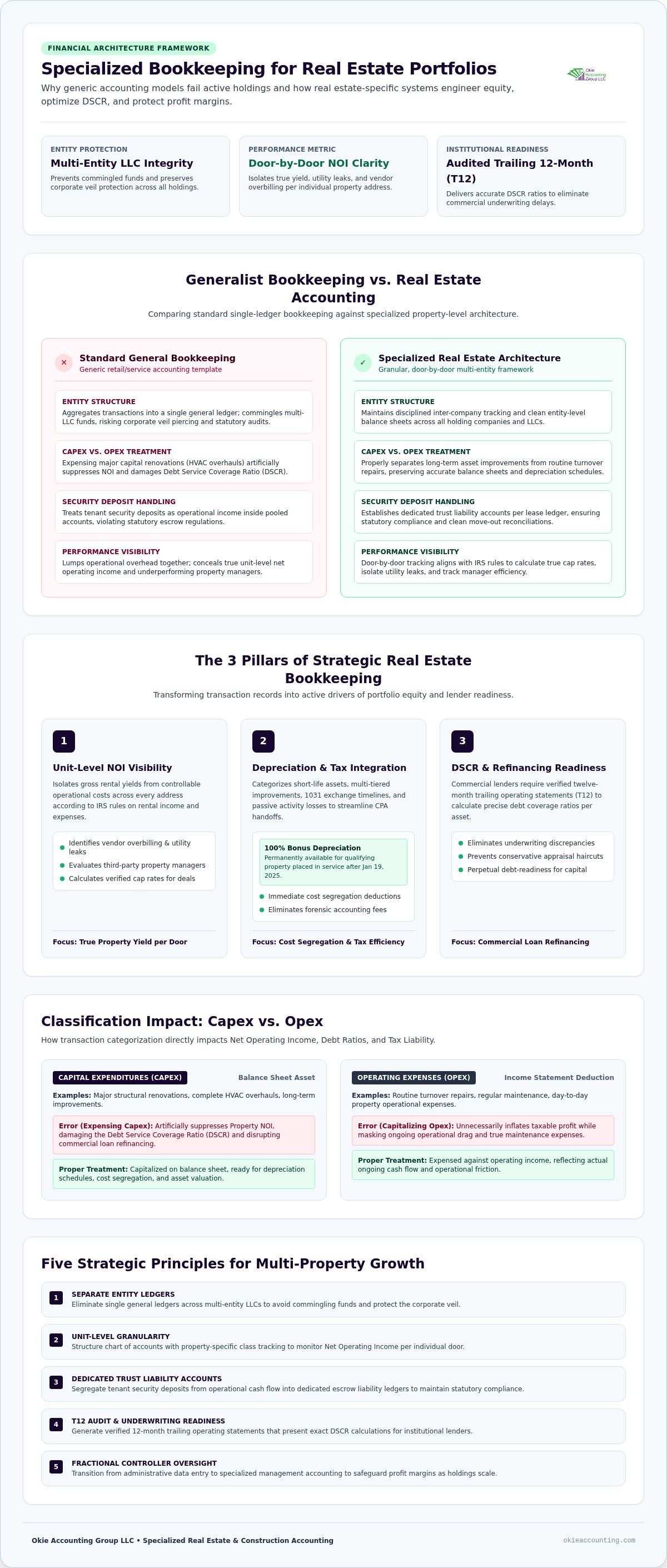
Traditional accounting systems aggregate transactions into a single general ledger, an approach built for single-entity retailers or service providers. For an active investor managing properties across several LLCs, this standard method creates operational disorder. Commingling expenses across separate entities pierces the corporate veil, strips away structural liability protection, and creates an audit nightmare. Real estate requires granular, door-by-door accounting to evaluate actual yield. Understanding the operational benefits of specialized bookkeeping for real estate starts with recognizing that single-bucket reporting hides the financial reality of your holdings.
The Structural Danger of Misclassified Capex Versus Opex
Generic bookkeepers routinely fail to understand the functional boundary between operational expenses (Opex) and capital expenditures (Capex). Expensing a major capital improvement, such as an HVAC overhaul or structural renovation, artificially suppresses your net operating income (NOI). This unforced error damages your debt service coverage ratio (DSCR) and disrupts commercial loan refinancing.
Conversely, capitalizing routine turnover repairs unnecessarily inflates taxable profit while masking ongoing operational drag. A specialized accounting architecture properly classifies transactions from day one. This keeps maintenance entries separated from long-term asset improvements, establishing accurate balance sheet records ready for depreciation schedules and tax-planning analysis.
Trust Accounting and Security Deposit Compliance Risks
Tenant security deposits represent legal liabilities, not operational income. Holding tenant funds inside standard operational accounts breaches statutory escrow regulations in several states, exposing owners to severe statutory penalties. When an unsegregated tenant vacates, untangling pooled funds creates administrative bottlenecks and potential disputes.
Specialized property accounting integrates disciplined escrow controls into everyday lease administration. By establishing dedicated liability accounts for each lease ledger, you keep tenant deposits insulated from operating cash flow. This clean separation ensures statutory compliance, simplifies move-out reconciliations, and guarantees that your entity-level balance sheets accurately reflect what you own versus what you hold in trust.
The Core Strategic Benefits of Specialized Bookkeeping for Real Estate
Managing real estate through retail-style accounting blinds investors to genuine asset performance. When you implement an architecture designed specifically for multi-entity LLC structures and holding companies, your records transform from reactive expense logs into active drivers of portfolio equity. Capturing the true benefits of specialized bookkeeping for real estate means turning day-to-day transaction records into verified data that proves property valuation, safeguards cash margins, and unlocks institutional financing.
Accurate Unit-Level Net Operating Income (NOI) Visibility
Isolating gross rental yields from controllable operating costs reveals the operational health of each address. Standard retail bookkeeping lumps operational overhead together. In contrast, property-specific ledgers align with official IRS rules on rental income and expenses, isolating operational friction before it compounds. Investors pinpoint utility leaks, vendor overbilling, and underperforming third-party property managers across individual doors. Defensible net operating income tracking gives you the verified metrics required to calculate true cap rates when executing acquisitions or dispositions.
Seamless Tax Season Integration and Depreciation Readiness
Clean balance sheets streamline annual handoffs to external tax professionals, eliminating expensive forensic accounting fees. Specialized tracking categorizes multi-tiered asset improvements, 1031 exchange timelines, and passive activity losses. With 100% bonus depreciation permanently available for qualifying property placed in service after January 19, 2025, properly categorizing short-life assets ensures your CPA can apply cost segregation deductions immediately. Leveraging disciplined management accounting systems keeps these entity-level records audit-ready throughout the year.
Optimizing the Debt Service Coverage Ratio (DSCR)
Commercial lenders and private underwriters don't accept fragmented landlord spreadsheets. When pursuing portfolio expansion or debt refinancing, institutional capital requires audited, twelve-month trailing operating statements (T12). Specialized real estate books calculate exact debt service coverage ratios per property, eliminating discrepancies that delay underwriting or trigger conservative appraisal haircuts. If you're ready to replace disconnected records with structural clarity across your holdings, you can schedule a discovery call to review your current reporting framework.
Comparing Generalist Bookkeepers vs. Real Estate Accounting Specialists
Hiring a generalist bookkeeper often looks cost-effective on paper, but standard accounting methods falter when applied to real estate investment portfolios. A generalist treats tenant revenue like retail sales, dropping receipts into a flat general ledger without segregating base rent, utility reimbursements, late fees, or pet rent. This rudimentary approach leaves owners blind to recovery leakage and operational expenses. In contrast, evaluating the benefits of specialized bookkeeping for real estate demonstrates how custom-built tracking protocols protect yield across syndications and multi-family units.
Architectural Differences in the Chart of Accounts
Generalists build flat charts of accounts that lump multiple properties into generic utility, repair, and revenue categories. This forces investors to manually sift through ledgers to assess individual property performance. Specialized accountants engineer hierarchical, parent-sub-account frameworks powered by class and tag tracking in QuickBooks. Every parcel, building, and door maintains its own segmented operational profile. Incorporating high-level fractional controller services gives leadership real-time clarity on capital allocations, project phases, and operational reserves without bloated internal payroll.
Managing Investor Equity, Draws, and Capital Calls
Syndications and multi-member LLCs introduce structural complexities that baffle general practitioners. A common disaster occurs when a generalist mistakenly records partner equity infusions or capital calls as taxable operating revenue, triggering unearned tax burdens. Real estate accounting requires precise reconciliation of equity classes, distributions, and member capital accounts.
Capital Contribution Tracking: Properly categorizes debt versus equity infusions across parent and subsidiary entities.
Waterfall Distribution Mechanics: Accurately tracks preferred returns and sponsor promotes before disbursements take place.
Member Equity Reconciliation: Maintains accurate basis calculations per partner to ensure frictionless tax handoffs.
Specialists implement structured workflows that log each partner contribution directly to balance sheet equity. When you maintain precise accounting across distinct legal structures, you eliminate internal partner friction and ensure compliance across the board.
How to Implement an Investor-Ready Accounting System
Scaling a multi-property portfolio requires transitioning from reactive spreadsheets to a structured financial infrastructure. Capturing the operational benefits of specialized bookkeeping for real estate depends on establishing clean data pipelines that commercial underwriters and lenders respect. Implementation requires a disciplined, four-step sequence:
Balance Sheet Reconciliation: Audit historical inter-company loans and clear balance sheet variances across all active entities.
Ledger Restructuring: Implement hierarchical parent-sub accounts paired with property-specific class and tag tracking in QuickBooks.
Tech Stack Integration: Synchronize third-party property management tools directly with your core general ledger.
Monthly Closing Rhythms: Enforce strict month-end reconciliation deadlines to generate timely, decision-ready financial packs.
Reconciling Inter-Company Loans and Due-To/Due-From Accounts
Real estate investors frequently move capital between entities to fund earnest money deposits, complete renovations, or cover temporary cash shortages. When you shift funds without offsetting balance sheet clearing entries, these transfers look like taxable distributions or unearned revenue. Unreconciled inter-company movements raise red flags during debt underwriting and pierce corporate liability protections. Monthly reconciliation audits ensure every transfer between LLCs balances out, documenting exactly which entity borrowed funds and which entity holds the note.
Integrating Property Management Tech Stacks with QuickBooks
Manual journal entries between rent payment software and your accounting software introduce recurring errors. A specialized setup links property management platforms directly to QuickBooks Online. This automated pipeline tracks gross rent collections, payment processing merchant fees, and tenant chargebacks in real time.
Specialized accounting partners configure these integrations and provide customized software training for your internal staff. Training ensures your team records tenant transactions, utility reimbursements, and maintenance invoices consistently across every door.
Executing this structural setup gives you automated cash flow visibility while keeping every holding compliant. If your books need structural remediation before your next acquisition, book a strategic discovery session to evaluate your accounting workflow.
Scaling Your Real Estate Business with Okie Accounting Group
Growing an investment portfolio requires more than basic administrative data entry; it demands robust accounting systems that scale smoothly alongside new acquisitions. Okie Accounting Group builds customized financial architectures designed specifically for active real estate operators. Whether you manage residential portfolios across Tennessee, multi-family units in Jacksonville, Florida, or commercial holdings nationwide, our monthly bookkeeping services deliver accurate door-by-door metrics without internal overhead. Experiencing the true benefits of specialized bookkeeping for real estate means stepping away from manual ledger cleanup and reclaiming your time to focus on sourcing deals and evaluating capital.
Comprehensive Financial Oversight from Bookkeeping to Controller Advisory
Led by specialized accounting professional Sarah O'Quinn, our firm delivers disciplined financial management built for property asset mechanics. We bridge day-to-day transaction reconciliations with proactive leadership through tailored controller services. Detailed monthly reporting packages give investors uninterrupted visibility into cash burn, operating reserves, and door-level net yields. This structured oversight protects profit margins, aligns holding entities, and creates transparent records ready for tax advisors and private equity partners alike.
Taking the Next Step Toward Financial Command
Disorganized books and unverified balance sheets should never jeopardize a financing approval or stall an acquisition timeline. Unlocking the operational benefits of specialized bookkeeping for real estate starts with an efficient onboarding process that addresses historical errors. We transition fragmented records into an optimized, cloud-managed QuickBooks architecture without causing operational downtime for your staff. Connect with our team today by scheduling a strategic discovery session to build an institutional-grade financial foundation.
Take Command of Your Real Estate Financial Future
Sustainable portfolio growth requires institutional-grade financial discipline rather than spreadsheet guesswork. Moving past generic administrative tracking protects your corporate veils, isolates true net operating income across individual doors, and ensures your balance sheets remain perpetually lender-ready. Leveraging the strategic benefits of specialized bookkeeping for real estate transforms routine ledger reconciliations into an active management framework that shields cash margins across shifting market cycles.
Led by specialized accounting professional Sarah O'Quinn, Okie Accounting Group builds tailored, cloud-based financial infrastructures engineered specifically for real estate portfolios and construction frameworks nationwide. You don't have to tackle multi-entity inter-company balances, capital contribution records, or complex lender reporting packs alone. Bring structural clarity to your holdings and scale with complete operational confidence. Schedule a discovery call with Okie Accounting Group today to build a resilient foundation for your enterprise.
Frequently Asked Questions
How does real estate bookkeeping differ from standard small business bookkeeping?
Standard small business bookkeeping consolidates income and expenses into a single general ledger, whereas real estate accounting requires granular tracking per door, unit, or legal entity. One of the core benefits of specialized bookkeeping for real estate is separating operating expenses from capital expenditures and managing escrow liabilities. In competitive rental markets across Tennessee and Jacksonville, Florida, this door-level visibility isolates underperforming assets that generic retail accounting routinely obscures.
Can specialized bookkeeping help me secure financing from commercial lenders?
Yes, institutional lenders require trailing twelve-month operating statements and verifiable balance sheets before issuing debt term sheets. Commercial underwriters evaluate precise Debt Service Coverage Ratios and clear equity positions. Specialized bookkeeping ensures your property-level net operating income is defensible, eliminating the disaggregated landlord spreadsheets that cause delayed loan approvals or conservative appraisal discounts during debt refinancing.
Why is trust accounting so important for landlords holding tenant security deposits?
Tenant security deposits are statutory liabilities that belong to the tenant, not operating revenue for the property. Holding these funds in an operating checking account violates escrow laws in Tennessee, Florida, and most other states. Trust accounting segregates deposits into dedicated escrow liability sub-accounts per lease ledger. This setup shields you from statutory commingling penalties and streamlines accurate deductions during tenant turnover and lease terminations.
What is the difference between a real estate bookkeeper and a CPA?
A specialized real estate bookkeeper or fractional controller manages everyday transactional data, monthly account reconciliations, and internal financial reporting throughout the calendar year. Certified Public Accountants or tax preparers typically step in annually to execute income tax preparation or statutory audits. Firms like Okie Accounting Group don't prepare tax returns; instead, they deliver clean, reconciled year-end financial packs so your CPA can file without costly forensic cleanup.
How does specialized bookkeeping handle multiple properties held in separate LLCs?
Specialized bookkeeping establishes distinct general ledgers for each holding entity while maintaining structured parent-subsidiary charts of accounts in QuickBooks. Capital transfers between LLCs are routed through balance sheet clearing accounts rather than booked as taxable revenue or distributions. This disciplined inter-company tracking preserves the legal corporate veil for your entities across Tennessee and Florida while delivering consolidated performance reporting.
What software is best suited for managing real estate investment bookkeeping?
Cloud-based QuickBooks Online remains the industry standard when properly architected with real estate class tracking and project tags. While property management platforms like Buildium or AppFolio track tenant rent rolls, they lack robust double-entry general ledger mechanics. The full benefits of specialized bookkeeping for real estate emerge when you integrate your property management software directly with a customized QuickBooks environment for seamless balance sheet management.
When should an investor transition from DIY bookkeeping to a specialized service?
You should transition the moment you acquire your second property, form multiple LLC entities, or prepare for commercial refinancing. Managing manual spreadsheets or generic accounting software quickly consumes hours better spent underwriting acquisitions. Partnering with a specialized firm frees you from administrative overhead, eliminates commingling risks, and ensures your financial reporting meets the rigorous underwriting expectations of commercial lenders nationwide.


Comments