
2026 House Flipping: Strategic Accounting and Job Costing for Profit

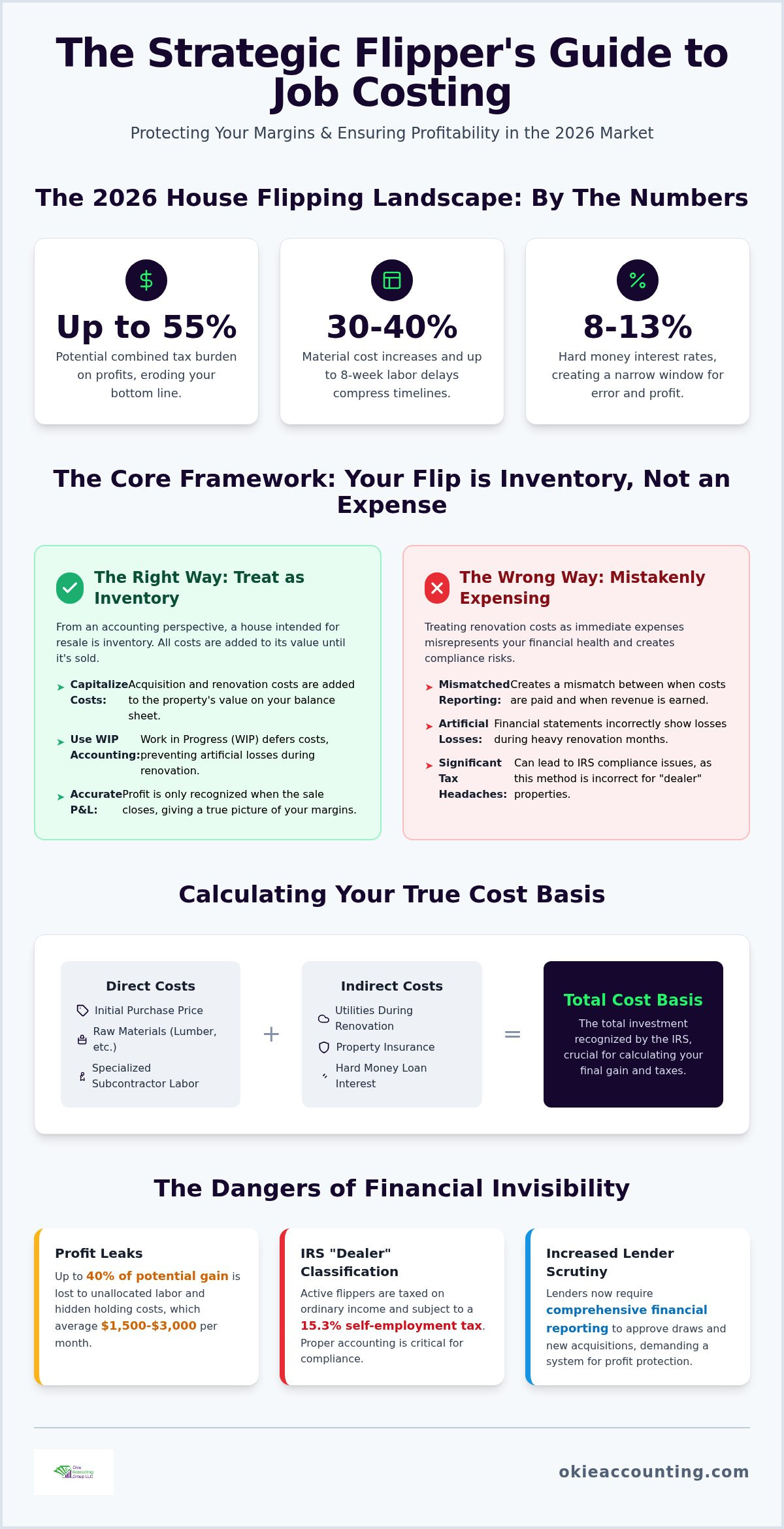
With the combined tax burden for house flippers potentially consuming up to 55% of your profits in 2026, the difference between a successful exit and a financial disaster often comes down to a single decimal point. You likely recognize that managing a renovation is about more than just picking the right finishes; it's about rigorous financial oversight. Implementing a precise system for job costing for house flipping is no longer optional if you want to protect your margins against 40% material cost increases and persistent labor shortages that delay your timelines.
It's frustrating to reach the end of a project only to realize your actual profit was eroded by hidden holding costs or misclassified expenses. You deserve a financial system that offers clarity rather than confusion. This article provides the structural accounting frameworks and job costing methods required to maintain real-time visibility into your project margins. We'll move beyond basic bookkeeping to establish a scalable, lender-ready system that ensures your business is prepared for growth and remains compliant with strict IRS dealer classifications in the current market.
The 2026 House Flipping Landscape: Why Tactical Accounting is the New Standard
The 2026 house flipping market demands a level of precision that goes far beyond basic data entry. With material costs remaining 30% to 40% higher than pre-2020 levels and labor shortages adding up to eight weeks to renovation timelines, your margins are under constant pressure. Hard money interest rates, currently hovering between 8% and 13%, create a narrow window for error. Traditional spreadsheets often fail to capture the cumulative impact of these delays. Relying on manual tracking leads to spreadsheet fatigue, where errors in one cell cascade through your entire projection. Successful scaling requires a transition from simply "doing the books" to building a robust financial infrastructure that treats each property as a distinct business unit.
This is where job costing for house flipping becomes your most valuable tool. By applying fundamental job costing principles, you can track direct costs like lumber and electrical permits alongside indirect costs like utilities and insurance. Lenders in 2026 have increased their scrutiny, often requiring comprehensive financial reporting before approving subsequent draws or new acquisitions. They want to see that you have a system for profit protection, not just a bank balance. A disciplined accounting framework provides the transparency these institutions require to continue funding your growth.
The Shift from Passive Investing to Active Flipping
The IRS generally classifies active house flippers as "dealers" rather than investors. This distinction is critical because it changes how your income is taxed; profits are treated as ordinary income and are subject to a 15.3% self-employment tax. Because your properties are technically inventory, your accounting must reflect active business operations rather than passive capital gains. We discuss this in detail in our guide on Accounting for Real Estate Investors, emphasizing the need for a structural framework that supports high-volume flipping and long-term stability.
The Cost of Financial Invisibility
Financial invisibility leads to profit leaks that can account for up to 40% of a flip's potential gain. These leaks often hide in unallocated labor or monthly holding costs, which average between $1,500 and $3,000 per property in 2026. Inaccurate 1099 reporting for subcontractors also poses a significant risk, as compliance audits for independent contractors have become more frequent. Precise data allows you to identify which contractors are exceeding their budgets and which phases of the renovation are lagging. This visibility ensures you make decisions based on actual project health rather than intuition, allowing you to pivot before a project stalls.
Inventory vs. Expense: The Structural Framework of Flip Accounting
Many investors treat their flips like long-term rental investments, but from a technical accounting perspective, a house intended for resale is inventory. This distinction is fundamental. You don't depreciate a flip; instead, you carry the acquisition and renovation costs on your balance sheet until the asset is sold. Utilizing job costing for house flipping ensures that every dollar spent is either capitalized into the basis of the property or identified as a legitimate period expense. Capitalization refers to the process of adding costs to the value of the property on your balance sheet rather than deducting them from your income immediately.
To manage this effectively, you must implement Work in Progress (WIP) accounting. WIP accounting is the process of deferring project costs until the sale occurs. This method prevents your financial statements from showing artificial losses during the heavy renovation months. It ensures that your profit and loss statement accurately reflects your margins only when the revenue from the sale is actually realized. This structural approach provides a clear view of your equity and debt at any stage of the project.
Determining Your Cost Basis for 2026 Flips
Your cost basis is the total investment the IRS recognizes in the property. Direct costs are the most obvious components, including the initial purchase price, raw materials, and specialized subcontractor labor. However, indirect costs also play a significant role. These often include utilities, property insurance, and the interest paid on hard money loans during the construction period. Maintaining a clean audit trail for tracking project costs is essential for defending your basis during a tax review. Every invoice and receipt should be digitally archived and linked to a specific project to ensure nothing is missed when it's time to calculate your final gain.
Active Business Classification and Tax Implications
Because the IRS typically classifies active flippers as dealers, your profits are taxed as ordinary income rather than lower capital gains rates. A common mistake is expensing materials or contractor fees in the year they're paid, even if the house hasn't sold yet. This creates a mismatch in your financial reporting and can lead to significant tax headaches. Proper accounting ensures these costs stay on the balance sheet as part of the inventory value until the closing date. Preparing your books for management accounting review allows you to see the true health of your operation without the noise of these timing differences. If you're concerned your current system isn't capturing these nuances, you can schedule a strategy session to evaluate your framework.
Configuring QuickBooks Online for House Flipping in 2026
QuickBooks Online remains the definitive cloud tool for national flipping operations in 2026. Its accessibility allows your field teams, project managers, and accounting partners to collaborate within a single source of truth, regardless of where your properties are located. For a flipping business to scale, you need more than just a list of expenses; you need a specialized Chart of Accounts designed for real estate development. This structure ensures that every transaction flows correctly into your balance sheet as inventory rather than being lost in a generic expense category. By utilizing the Projects feature, you can implement job costing for house flipping with surgical precision, viewing the specific profitability of each property at a glance.
Automation is the cornerstone of a modern financial system. Linking your bank feeds and using mobile receipt capture for field expenses eliminates the manual data entry that often leads to errors. This real-time synchronization allows you to monitor your budget versus actuals while the renovation is still in progress. Maintaining this level of detail is not just about internal efficiency; it's about compliance. The IRS Construction Industry Audit Technique Guide outlines the rigorous standards expected for project-based businesses. Adhering to these established accounting methods protects your business during audits and provides the professional reporting that 2026 lenders demand.
Step-by-Step: Setting Up Your 2026 Flip Project
To establish a clean financial framework, follow these essential configuration steps within your QuickBooks Online environment:
Step 1: Enable Projects and Classes in your account settings to allow for multi-dimensional reporting across different property types.
Step 2: Create a unique Project for every property address, ensuring all related income and costs are sequestered from other business activities.
Step 3: Map your Chart of Accounts to reflect Inventory and Work in Progress (WIP) assets, keeping your balance sheet accurate throughout the renovation.
Step 4: Tag every single transaction, from large contractor draws to small hardware store runs, to its specific project for granular reporting.
Advanced Tracking: Job Costing and Labor Allocation
As your business grows, tracking internal labor costs becomes just as vital as tracking material invoices. If you employ your own crew, you must allocate their hours specifically to each flip to understand your true cost of production. This prevents overhead from quietly eroding your margins. For teams looking to refine these technical workflows, our guide on Mastering QuickBooks for Contractors offers deeper insights into complex project management. Investing in professional software training for your internal team ensures that your data remains clean and your financial systems stay scalable as you add more properties to your portfolio.
Managing Cash Flow and Profit Protection for Scaling Investors
Cash flow is the heartbeat of your flipping operation. In a market where hard money interest rates reach up to 13%, even a minor delay in a renovation schedule can turn a profitable deal into a liability. Many investors fail not because they lack equity, but because they run out of liquid capital during the renovation phase. Implementing job costing for house flipping provides the visibility needed to anticipate these bottlenecks. By tracking your actual spend against your initial budget in real-time, you can identify margin creep before it consumes your projected profit.
Reading a Profit and Loss statement by Project is a fundamental skill for scaling. It allows you to see exactly where your capital is tied up and which specific projects are underperforming. Rigorous internal controls, such as requiring dual approval for large vendor payments, further protect your margins from unauthorized expenses. This oversight ensures that your business maintains the structural integrity required to survive market fluctuations. When you understand your data, you stop reacting to bank balances and start managing your equity.
Forecasting for the 2026 Real Estate Cycle
The current cycle requires accounting for longer holding periods than in previous years. Monthly carry costs, which average between $1,500 and $3,000 in 2026, must be factored into your long-term projections. We recommend allocating a 10% to 15% contingency fund within your accounting framework to handle supply chain surprises or labor delays. This buffer protects your liquidity and ensures you don't stall during the final stages of a project. For a deeper dive into these strategies, explore our guide on Mastering Construction Cash Flow Management.
Monthly Financial Reviews: The Strategic Advantage
Monthly bank reconciliations are more than an administrative task; they are a strategic necessity. They ensure your data is accurate and up-to-date, allowing you to pivot your strategy mid-renovation if costs begin to spiral. Consistent reporting makes your business lender-ready, ensuring you can raise capital quickly when the next acquisition opportunity arises. This proactive approach builds trust with financial partners and provides the clarity needed for sustainable growth. If you want to build a more resilient financial system, schedule a discovery call to discuss your cash flow forecasting needs.
Transitioning to Strategic Financial Oversight with a Fractional Controller
Scaling a house-flipping business requires a fundamental shift in perspective. While basic bookkeeping keeps your records straight, it doesn't provide the high-level insights necessary to navigate a volatile 2026 economy. You eventually reach a point where you need more than just a history of what happened; you need a roadmap for what comes next. Transitioning to controller services marks the evolution from a reactive operator to a proactive strategist. A fractional controller doesn't just manage your job costing for house flipping; they use that data to evaluate the structural health of your entire business model.
The ROI of professional financial leadership is found in the prevention of costly errors. In a sector where hidden costs can consume 40% of your profits, having an expert who monitors your debt-to-equity ratios and project-specific margins is invaluable. Okie Accounting Group LLC focuses on building these comprehensive structural frameworks, ensuring that investors can manage national operations with the same precision as a single local flip. This disciplined approach moves your business away from administrative guesswork and toward long-term stability.
Administrative Tasks vs. Strategic Growth
Basic bookkeeping focuses on the "what": recording transactions and reconciling accounts. While essential, these administrative tasks don't protect your firm from sudden market shifts or rising capital costs. Strategic growth requires interpreting your financial health to make data-driven acquisition choices. By moving beyond simple record-keeping, you gain a mentor who understands the nuances of real estate inventory and WIP accounting. This level of oversight is detailed in our framework for Fractional Controller Services, which helps you move from transactional chaos to disciplined management. You stop simply tracking costs and start optimizing your capital allocation.
Partnering for Long-Term Stability
Remote financial leadership is particularly effective for investors managing nationwide real estate portfolios. Cloud-based systems allow a controller to provide oversight across multiple states, ensuring consistency in how every project is tracked. This partnership offers the value of proactive financial readiness, keeping your business prepared for lender audits or IRS inquiries regarding your dealer status. When you have real-time visibility into your margins, you gain the quiet confidence needed to scale without losing control of your cash flow. The transition from financial complexity to operational clarity is the final step in securing your business's success in the 2026 market.
Securing Your Competitive Edge in the 2026 Market
The 2026 house flipping market requires a deliberate departure from basic administrative bookkeeping. You've seen how success depends on a structural accounting framework that treats every property as inventory and utilizes precise job costing for house flipping. By implementing Work in Progress (WIP) accounting and configuring QuickBooks Online for granular project tracking, you protect your margins from rising material costs and volatile interest rates. This methodical approach ensures your business remains lender-ready and IRS-compliant while you scale your nationwide portfolio.
Moving from financial complexity to operational clarity is a journey best taken with a strategic partner. Okie Accounting specializes in real estate investor bookkeeping and provides the fractional controller services needed for scaling firms. Our remote financial leadership experience allows us to support your operations across the country, providing the data-driven insights you need to thrive. Book a discovery call to gain financial clarity with Okie Accounting. You have the vision to transform properties; let's build the financial system that transforms your business into a resilient enterprise.
Frequently Asked Questions
Is house flipping considered a business or an investment by the IRS in 2026?
The IRS generally classifies active house flippers as dealers rather than investors. This means your properties are viewed as inventory held for sale in the ordinary course of business. Consequently, your profits are taxed as ordinary income and are subject to self-employment tax. This classification prevents you from using long-term capital gains rates or 1031 exchanges; this makes precise accounting essential for managing your effective tax rate and operational cash flow.
How do I properly track renovation expenses for a house flip in QuickBooks?
To track renovation expenses effectively, you should enable the Projects feature in QuickBooks Online. Create a unique project for each property address and map your transactions directly to that specific job. By using job costing for house flipping, you can categorize every material purchase and subcontractor payment as a Work in Progress (WIP) asset. This ensures your balance sheet reflects the true value of your inventory throughout the entire renovation lifecycle.
What is the difference between capital improvements and repairs in house flipping?
In a standard rental, repairs are expensed while improvements are capitalized. However, for house flippers, almost all renovation costs are capitalized as part of the property's cost basis. Since the house is inventory, costs that increase value or adapt the property for sale are added to the balance sheet. These costs are only recognized as an expense once the property is sold. This ensures the proper matching of revenue and expenses.
Do I need to pay self-employment tax on my house flipping profits?
Yes, because the IRS typically views house flipping as an active business, you're required to pay the 15.3% self-employment tax on your net profits. This is a significant distinction from passive real estate investing, where income is generally exempt from this tax. Understanding this burden is crucial for accurate profit forecasting. Proper job costing helps you identify every deductible business expense to ensure you aren't overpaying on your total tax liability.
What accounting method is best for house flipping: Cash or Accrual?
The accrual method is the preferred standard for house flipping because it aligns costs with the revenue they generate. While cash accounting is simpler, it often creates a misleading financial picture by showing large losses during renovation months and massive profits at closing. Accrual accounting uses the Work in Progress framework to defer costs until the sale. This provides the real-time visibility needed to manage multiple projects without distorting your financial health.
How can I ensure my house flipping financials are ready for a bank loan?
Lenders in 2026 require high-level transparency before approving renovation draws or new acquisition loans. To stay lender-ready, you must provide a clean balance sheet showing your inventory value and a Profit and Loss statement broken down by project. Utilizing fractional controller services ensures your internal controls are robust and your reporting is accurate. Monthly bank reconciliations and documented job costs demonstrate the professional discipline that banks look for when evaluating creditworthiness.
What are the most common accounting mistakes house flippers make?
The most frequent mistake is expensing renovation costs in the year they're paid instead of capitalizing them until the sale occurs. Flippers also often overlook indirect costs like utilities, insurance, and interest carry; these can erode up to 40% of projected profits. Many businesses also struggle with job costing for house flipping and inaccurate subcontractor reporting. Transitioning to a specialized structural framework helps eliminate these errors and ensures you have a clear view of your actual project margins.


Comments