
2026 Residential Job Costing: Profit Protection Guide
- Wendy Okie

- Aug 15
- 11 min read
Updated: Aug 18
What if the record-breaking contract you signed this morning is actually the project that erodes your company’s stability? It's a sobering thought, but in 2026, high revenue often masks a dangerous reality of shrinking margins. You likely feel the pressure of copper wire prices jumping 36% and labor rates climbing toward $87 per hour. Even when the work is steady, failing to implement precise job costing for residential construction makes your bank balance feel like it's in a constant state of retreat. You understand the frustration of inaccurate estimates and the confusion that comes with allocating indirect overhead across multiple sites.
You deserve a business that offers more than just high-pressure projects. By mastering a disciplined framework, you can eliminate margin fade and regain total financial control over every build. This guide provides the strategic methodology needed to transform your accounting from a source of stress into a professional asset. We'll examine how to gain real-time visibility into project profitability, prepare lender-ready financial statements, and establish a scalable system that doesn't require you to be the primary bookkeeper. It's time to move beyond basic administrative tasks and build a foundation for long-term health.
Why Residential Job Costing is the Foundation of Your Firm’s Profitability
Job costing is the systematic process of assigning every dollar of material, labor, and overhead to a specific project. While general financial accounting provides a bird's eye view of your firm's overall health, job costing for residential construction offers the granular detail needed to identify exactly where profit is leaking. It's the difference between knowing your company made money last year and knowing which specific custom home build actually contributed to that growth. For residential builders, this isn't just an administrative chore; it's a structural framework designed for profit protection. It ensures that your revenue isn't just passing through your hands to pay vendors, but is actually staying in the business as net income.
The High Cost of Guesstimating in 2026
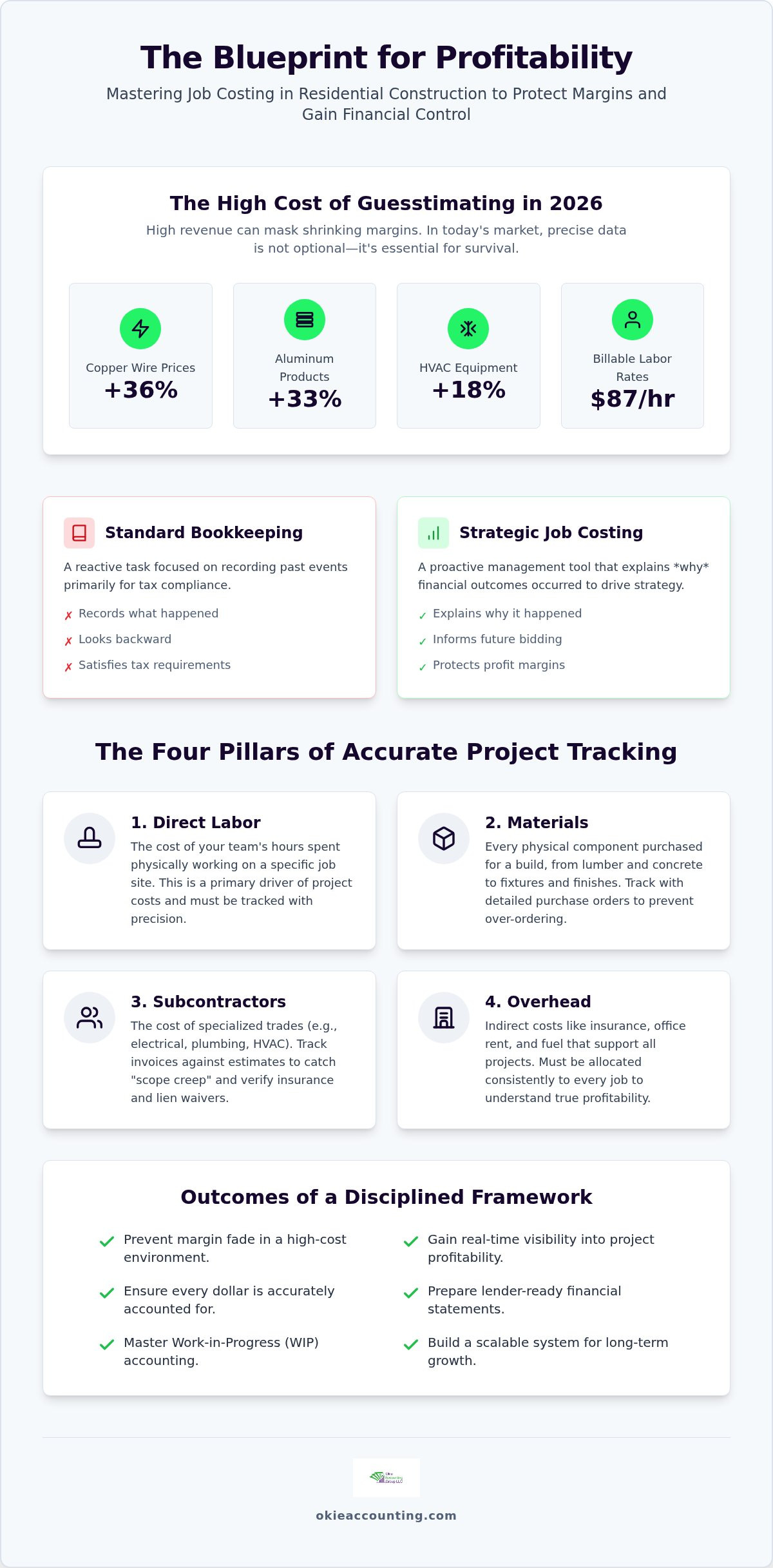
In the current 2026 market, "mental math" is a recipe for business failure. With copper wire up 36% and aluminum products increasing by 33% year over year, a slight miscalculation in your initial estimate can quickly lead to margin fade. When billable labor rates are hitting $87 per hour, even a two day delay on a framing crew can evaporate your projected profit. Accurate data creates a foundational system for your finances. It ensures you aren't undercapitalized mid build or forced to pull from one project to finish another. When materials like HVAC equipment increase by 18%, your system must be sensitive enough to capture that change immediately. Relying on gut feelings leads to cash flow crunches that jeopardize your reputation and your long term stability.
The Difference Between Bookkeeping and Strategic Job Costing
Standard bookkeeping is a reactive task. It records what happened in the past to satisfy tax requirements. In contrast, strategic job costing is a proactive management tool that explains why those financial outcomes occurred. If a project comes in over budget, job costing reveals whether the issue was a material price spike, an inefficient subcontractor, or a change order that wasn't properly billed. This clarity informs your future bidding, allowing you to adjust your estimates with surgical precision. Partnering with a fractional controller transforms this raw data into actionable strategy. They help you interpret these project reports to protect your margins and ensure every residential project remains a profitable endeavor. This level of oversight moves you from simply "doing the books" to leading a data driven construction firm. Establishing this foundation is the first step toward building a business that scales without sacrificing your personal time or financial security.
The Four Pillars of Accurate Residential Project Tracking
To achieve total financial control, your system must categorize every expenditure into four specific pillars: Direct Labor, Materials, Subcontractors, and Overhead. In 2026, the complexity of job costing for residential construction lies in the distinction between direct and indirect costs. Direct costs are those easily traced to a specific build, such as the lumber for a framing package or the hours your lead carpenter spends on site. Indirect costs, or overhead, are the shared expenses that keep your firm operational but don't belong to just one project. Failing to distinguish these leads to a distorted view of project health.
Real-time data entry is non-negotiable. Waiting for a month-end catch-up session creates a lag that hides overruns until it's too late to course-correct. This includes tracking equipment usage as a project expense rather than just a firm asset. When a skid steer sits on a site for three weeks, its depreciation, fuel, and maintenance costs belong to that project's budget. If you're unsure how to categorize these pillars within your current system, you can schedule a discovery call to review your structural framework.
Managing the Subcontractor "Black Box"
Subcontractors often represent the largest portion of a residential budget, yet they can become a financial "black box" without proper oversight. You must track every subcontractor invoice against your original estimate to catch "scope creep" before it erodes your margin. A disciplined system ties lien waivers and up-to-date insurance certificates directly to the job cost record. Using detailed purchase orders for material tracking ensures that you aren't paying for surplus items that never made it to the job site. This level of rigor prevents disputes and protects your firm from unexpected liabilities.
Solving the Overhead Allocation Puzzle
Distributing indirect costs like general liability insurance, office staff salaries, and fuel across active builds is a common hurdle for contractors. You can allocate these using labor hours or a percentage of total project costs. The choice depends on your firm's specific workflow, but the method must be consistent. Unallocated overhead is a hidden profit killer. If your project reports show a 20% margin but your bank account is empty, your overhead allocation is likely missing the mark. A structured approach ensures every build carries its fair share of the firm's operational weight, resulting in lender-ready financial statements that reflect true profitability.
Implementing a Structural Framework in QuickBooks Online
QuickBooks Online has established itself as the industry standard for cloud-based construction accounting. It provides the mobility required for 2026 residential builds where data must move from the job site to the office instantly. However, the software’s utility depends entirely on the structural framework you build within it. A generic Chart of Accounts won't suffice. You need a specialized list of accounts tailored for residential projects to ensure expenses are categorized correctly from day one. This foundational setup prevents the common "garbage in, garbage out" scenario that plagues many builders.
Within QuickBooks, the "Projects" feature is your primary tool for isolating build data. It allows you to track income and costs for each specific address in a dedicated dashboard. "Classes" can further segment your data, perhaps by build type or geographic division. This isolation is critical for effective job costing for residential construction. Without it, your financial data becomes a tangled web of unrelated costs. To ensure your team actually uses these features correctly, professional software training is essential. It moves your staff from manual entry to a disciplined, automated workflow that protects your data integrity.
The Power of Standardized Cost Codes
Standardized cost codes, often based on CSI divisions, provide a universal language for your financial reporting. These codes allow you to compare performance across multiple projects with surgical precision. If your framing costs consistently exceed estimates across three different builds, the data will highlight the trend immediately. Cost codes are the DNA of your financial reporting system. By using them, you move away from guesswork and toward a methodical understanding of your production costs. This standardization makes it easier to spot inefficiencies and adjust your bidding for future projects.
Automating Data Flow from the Field
Modern job costing relies on speed and accuracy. Connecting time-tracking and expense apps directly to your accounting software eliminates the "Friday afternoon paperwork" bottleneck. Tools that offer automated receipt capture and direct bank feeds reduce the administrative burden on your field supervisors and project managers. This ensures that your project data is always current, reflecting real-time labor and material expenditures. For a deeper dive into these technical configurations, see our guide on Mastering QuickBooks for Contractors. Reducing manual entry minimizes human error and allows you to focus on strategic oversight.
Beyond the Basics: WIP Accounting and Profit Protection
Work in Progress (WIP) accounting is the structural safeguard that separates elite builders from those perpetually chasing their next deposit. For projects that span several months, standard cash-basis reporting often paints a deceptive picture of your firm's health. You might see a high bank balance and assume profitability, only to realize later that you’ve over-billed and are essentially borrowing from the future to pay today’s vendors. Implementing job costing for residential construction at the WIP level ensures that revenue is recognized only as work is actually performed. This visibility prevents the under-billing traps that cause sudden cash flow crunches during the critical mid-stages of a build.
The most common objection to this level of oversight is a perceived lack of time. However, the return on investment for this accuracy is measured in the thousands of dollars saved from avoided errors and better resource allocation. This shift requires a psychological transition. You are no longer just working for a paycheck; you are managing a portfolio of high-value assets. If you're ready to implement these advanced systems, you can request a strategic financial review to see where your current process stands.
Taming the Change Order Profit Leak
Undocumented change orders are the fastest way to lose money on a custom home. When a client requests a different tile or an extra outlet, the field crew often executes the work without a formal record. Without a system that integrates these approvals into your job costing, you’re footing the bill for the client’s upgrades. A disciplined framework requires every change to be approved and recorded before work begins. For more on building this type of infrastructure, explore our insights on WIP Accounting: Tracking Work in Progress for Profit. This ensures that every deviation from the original estimate is captured and billed, protecting your final margin.
Lender-Ready Financials and Bonding Capacity
Accurate job costing does more than protect profit; it builds institutional trust. Banks and bonding agents look for project-level data that connects directly to your firm's overall balance sheet. When you can present a WIP schedule that matches your financial statements, you demonstrate a level of professional discipline that generalist providers cannot match. These clean financials become a powerful marketing tool. High-end residential clients and lenders alike are more likely to partner with a builder who shows total financial control. This transparency increases your bonding capacity, allowing you to take on larger, more profitable projects with confidence.
Scaling Your Firm with Strategic Financial Oversight
Scaling a construction firm requires a fundamental shift in how you view your time and your data. You cannot lead a multi-million dollar enterprise while remaining buried in the granular details of every receipt and invoice. Transitioning from "doing the books" to "leading the business" is the hallmark of a mature residential builder. This evolution is supported by a Fractional Controller, who acts as a strategic partner rather than a mere administrator. They provide the high-level oversight necessary to turn raw job costing for residential construction data into a clear roadmap for your firm’s future.
Monthly financial reviews are the pulse of this strategic roadmap. During these sessions, you move beyond looking at what was spent to analyzing how those expenditures align with your long-term goals. Okie Accounting Group acts as the strategic mentor in this process, building the financial infrastructure that allows you to step away from administrative tasks. By establishing these foundational systems, you gain the freedom to focus on client relationships and project quality without losing sight of your bottom line.
The Move to Management Accounting
Management accounting is the engine of growth for modern builders. Unlike tax-only bookkeeping, which focuses on historical compliance for the IRS, management accounting provides the real-time data needed to make high-stakes operational decisions. This discipline allows you to use your data to decide which types of projects are actually fueling your growth. For instance, your reports might reveal that while custom new builds generate the most revenue, high-end remodels provide a higher net profit when adjusted for overhead. Understanding these nuances is what separates a profitable firm from one that is merely busy.
Your Next Steps for Financial Clarity
Assessing your current system is the first step toward financial readiness in 2026. You must ask whether your current setup provides real-time visibility or if you are still relying on month-end surprises. The value of a professional cleanup and specialized setup cannot be overstated. It ensures your accounting environment is optimized for the unique mechanics of the residential market. This structured approach makes the information easy to digest and reinforces your position as an organized, methodical partner. You can schedule a strategy session with Okie Accounting Group to begin constructing a financial framework that supports your firm's long-term stability.
Securing Your Firm’s Financial Future
Mastering job costing for residential construction is more than an accounting requirement; it's the structural integrity of your business. By implementing the four pillars of project tracking and adopting a disciplined WIP framework, you move beyond reactive bookkeeping toward proactive profit protection. You've seen how standardized cost codes and automated field data can transform your firm's visibility. These systems ensure that your revenue translates into actual wealth rather than disappearing into unallocated overhead or undocumented change orders.
You don't have to build this financial infrastructure alone. Okie Accounting Group provides specialized construction financial oversight and QuickBooks certified training and setup to help you regain control. As your nationwide remote strategic partner, we're dedicated to helping you scale without the stress of manual data entry. It's time to transition from working in the business to leading it with quiet confidence. Build your financial foundation with Okie Accounting Group and ensure every project you take on in 2026 is a profitable success. Your firm’s long-term stability starts with accurate data and expert guidance.
Frequently Asked Questions
What is the difference between job costing and process costing in construction?
Job costing tracks costs for unique, specific projects, such as a custom home or a large scale remodel. Process costing tracks costs for mass produced, identical items like shingles or nails. In the residential sector, every build has unique variables, making job costing essential for tracking specific profitability. Process costing focuses on the average cost of a large batch, which doesn't provide the granular detail needed for custom construction.
Can I do job costing in the basic version of QuickBooks Online?
No, the basic versions like Simple Start and Essentials don't include the "Projects" feature required for effective job costing for residential construction. As of August 2026, you need at least the QuickBooks Online Plus tier to access project tracking. The Advanced tier offers even more robust features, including native progress billing and retainage tracking, which are critical for managing the financial complexity of multi month residential builds.
How often should I review my job cost reports?
You should review your job cost reports at least once a week to maintain real time visibility into your project health. Waiting until the end of the month often means identifying profit leaks when it's too late to course correct. Weekly reviews allow you to catch labor overruns or material price spikes immediately. This disciplined rhythm ensures that your financial data remains an active management tool rather than a historical record of losses.
What are the most common mistakes contractors make with job costing?
The most frequent errors include failing to allocate indirect overhead, ignoring undocumented change orders, and neglecting to track labor burden. Many contractors only look at direct material and subcontractor costs, which leaves a significant portion of their operational expenses unassigned. This leads to "phantom profits" where a project looks successful on paper but the bank account remains stagnant. Accurate job costing for residential construction requires capturing every dollar spent on the firm's behalf.
Do I need a specialized construction bookkeeper for residential projects?
Yes, a generalist bookkeeper often lacks the technical knowledge required for complex construction accounting tasks like WIP reporting and labor burden calculation. Construction financial oversight requires an understanding of progress billing, retainage, and specialized cost codes. Partnering with an expert ensures your system is built on a structural framework that protects your margins. This specialized approach moves your accounting from basic administration to a strategic partnership that supports scaling your firm.
How do I handle owner-supplied materials in my job costing?
Owner-supplied materials should be tracked as zero cost items in your project records to ensure they're excluded from your billing while still being accounted for in the project scope. If you charge a markup on materials, you must decide how to recoup that lost revenue when the client provides their own fixtures. Clearly documenting these items prevents confusion during final reconciliations and ensures your profitability reports reflect the actual work performed.
What is a "burdened" labor rate and why does it matter for costing?
A burdened labor rate includes the worker's base wage plus all associated costs, such as payroll taxes, workers' comp insurance, and benefits. In 2026, billable rates for contractors often range between $46 and $87 per hour when these burdens are included. If you only track the hourly wage, you're underestimating your true labor costs by 20% to 30%. Using a fully burdened rate provides an accurate picture of project profitability.
How do I allocate my salary as an owner-operator to specific jobs?
You should track your time spent on site just like any other crew member and allocate those hours to the specific project at a burdened rate. If you spend time on general administration, that cost belongs to your indirect overhead. Splitting your time ensures that each build carries the actual cost of your leadership and physical labor. This precision allows you to see if a project would still be profitable if you hired a manager.


Comments