
Accounting for Home Builders: A Strategic Framework for Project Profitability
- Wendy Okie

- 2 days ago
- 12 min read
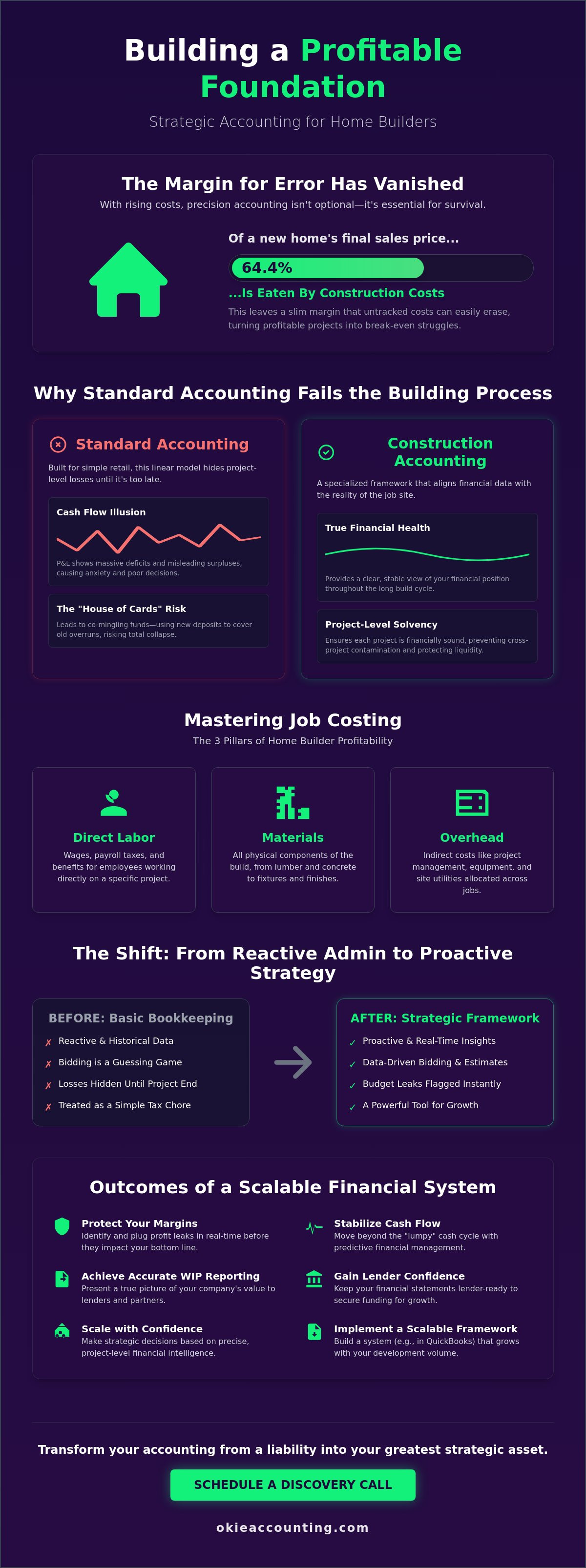
With construction costs now accounting for a record 64.4% of a new home's sales price, your margin for error has effectively vanished. You likely recognize the anxiety of managing long-term builds where untracked costs slowly erode your bottom line, turning what looked like a profitable project into a break-even struggle. It's frustrating when bidding feels like a guessing game because your job costing lacks the precision required for today's volatile market.
We're here to change that narrative. You'll learn how to transform your accounting for home builders from simple record-keeping into a high-level strategic asset that protects your margins and stabilizes your cash flow. By shifting from basic administrative tasks to a comprehensive structural framework, you can gain the financial control necessary to scale your development volume with confidence.
This article provides a roadmap to achieving project-level clarity on every build while ensuring your financial statements are always lender-ready. We will examine how to navigate modern challenges, such as the $32 million small contractor exception threshold and shifting material prices, to build a system that prioritizes long-term stability, rigorous management, and profit protection.
Key Takeaways
Identify why generalist bookkeeping fails to capture the nuances of multi-month builds and how to bridge the gap between cash outlays and revenue recognition.
Establish a precise foundation for accounting for home builders by mastering the three pillars of job costing: direct labor, materials, and overhead.
Understand the mechanics of Work-in-Progress (WIP) reporting to ensure your balance sheet accurately reflects project reality for lenders and partners.
Implement a scalable QuickBooks framework using customized items and charts of accounts to track granular data across your entire development portfolio.
Recognize when your volume requires a shift from basic administrative tasks to strategic financial oversight and high-level data interpretation.
Why Standard Accounting Fails the Home Building Process
Standard accounting models are built for businesses that sell a product today and collect payment tomorrow. For residential developers, this linear approach is fundamentally broken. Effective accounting for home builders requires a departure from traditional retail logic. You aren't just selling inventory; you're managing a complex manufacturing process that spans months or years. This unique cycle demands a specialized framework that aligns your financial data with the physical reality of the job site.
When you rely on generalist bookkeeping, your financial statements often hide project-level losses until the final walk-through. A standard Profit and Loss (P&L) statement might show a massive deficit during the framing phase and a misleading surplus upon closing. This lack of visibility makes it impossible to know if your margins are actually protected or if you're simply "robbing Peter to pay Paul." Transitioning to a model rooted in Construction accounting principles allows you to transform your raw data into project intelligence, moving beyond simple tax compliance toward true operational control.
The Complexity of Long-Term Project Cycles
Home building cash flow is notoriously "lumpy." You might face six-figure outlays for land development and materials long before a vertical build even begins. Without a specialized framework, these expenses appear as current-month losses on a standard report, distorting your true financial health and causing unnecessary anxiety for owners and lenders alike.
The most dangerous habit in this cycle is the co-mingling of project funds. When cash flow gets tight, it's tempting to use a deposit from a new contract to cover a cost overrun on a trailing project. This creates a house of cards that collapses the moment your sales volume slows. A standard P&L doesn't flag this risk; only a project-specific ledger can reveal the truth about your liquidity and project-level solvency.
Moving from Administrative Tasks to Strategic Frameworks
Many builders treat their books as a chore for tax season. However, there's a massive gulf between basic data entry and building a scalable financial architecture. Strategic construction bookkeeping services go beyond recording transactions. They establish a structural framework that mirrors your actual build phases, from site prep to final finish out.
Your general ledger should function as the nervous system of your development ecosystem. It must be configured to track every dollar against specific job codes, allowing you to see exactly where your budget is leaking in real-time. This level of oversight moves you from a reactive stance to a proactive partnership with your financial data. It ensures your accounting for home builders remains a reliable foundation for growth, even as material costs and interest rates fluctuate.
Mastering Job Costing: The Foundation of Homebuilder Profitability
Job costing is the process of tracking every dollar of expense back to a specific construction project. While general accounting tells you how much money the company made last year, job costing tells you if you actually made a profit on the lot at 123 Maple Street. For residential developers, this granular data is the difference between sustainable growth and sudden insolvency. Effective accounting for home builders relies on three primary pillars: direct labor, materials, and overhead. Without these data points, your estimates are merely educated guesses rather than strategic financial targets.
The relationship between your initial estimate and your final actuals provides a feedback loop that is vital for long-term health. If your job costing reveals that your framing costs are consistently 10% over budget, you can adjust your next bid to protect your margins. This disciplined approach ensures that your pricing reflects the current market reality, including the 7.0% year-over-year increase in construction material costs reported in early 2026. To better understand these structures, many professionals consult the NAHB financial management guide to align their internal processes with industry standards.
Direct vs. Indirect Costs in Home Building
Precision starts with proper classification. Direct costs are easily assigned to a specific build, such as lumber deliveries, subcontractor invoices, and municipal permits. These are the "bones" of your project budget. However, indirect costs require more careful allocation. Project management salaries, equipment depreciation, and temporary site utilities must be distributed across your active builds to ensure a true reflection of profitability. Job costing is the primary mechanism for profit protection. If you find these complexities difficult to manage alongside your daily operations, you might consider how professional financial oversight can bring clarity to your cost structures.
The Impact of Real-Time Cost Tracking
Waiting until a project is closed to review your costs is a terminal mistake. By the time the house is finished, you've lost any opportunity to correct course. Real-time cost tracking allows you to identify "scope creep" or unexpected material price spikes while the project is still in progress. When you integrate job costing into your monthly financial reporting, you gain the ability to make data-driven choices. You can see if a specific subcontractor is consistently exceeding their budget or if your overhead allocation is too low. This proactive stance transforms your accounting for home builders from a historical record into a forward-looking tool for project success.
WIP Accounting and Revenue Recognition for Developers
Work-in-Progress (WIP) is more than a line item; it's the heartbeat of your balance sheet. In the context of accounting for home builders, WIP represents the total costs incurred on projects that haven't yet reached completion. Unlike a retail business where inventory is static, your WIP is a dynamic asset that requires constant calibration. Without accurate WIP tracking, your financial statements will likely fluctuate wildly, showing "false profits" during heavy billing cycles and deep losses during mobilization phases. This creates a disconnect between your bank balance and your actual financial health.
Choosing the right revenue recognition method is a high-stakes decision that impacts your tax liability and lender relationships. The Percentage of Completion (PCM) method recognizes revenue based on project progress, while the Completed Contract method deferral waits until the keys are handed over. For the 2026 tax year, the gross receipts threshold for the small contractor exception to PCM is $32 million based on a rolling three-year average. Understanding the nuances of accounting for long-term contracts is essential for maintaining tax efficiency and ensuring your cash flow aligns with your reporting. Lenders prioritize these WIP schedules because they provide an unfiltered view of your operational capacity and project-level solvency.
Calculating Percentage of Completion
The standard formula for PCM is straightforward: divide your costs incurred to date by your total estimated costs. This percentage is then applied to the total contract price to determine your earned revenue for the period. However, this system only functions if your estimates are accurate. If your budget is outdated or fails to account for material price volatility, your revenue recognition will be flawed. Regular estimate updates are non-negotiable for maintaining the structural integrity of your financial data and avoiding year-end surprises.
Managing Over-Billings and Under-Billings
Discrepancies between what you've billed and what you've earned appear as over-billings or under-billings on your financial statements. Over-billings occur when your billings exceed the work performed, creating a liability on your balance sheet. Conversely, under-billings represent work completed but not yet invoiced, which functions as an asset. Excessive under-billing often signals a breakdown in your invoicing process, while heavy over-billing can mask a cash flow crisis. Utilizing specialized management accounting helps you track these metrics in real-time, protecting your bonding capacity and reinforcing lender trust through transparent, data-driven reporting.
Building a Scalable QuickBooks Framework for Home Builders
Establishing a resilient digital ledger is the next step in securing your profitability. While the principles of accounting for home builders provide the theory, your software configuration provides the execution. A generic setup inevitably leads to data silos and manual workarounds. By following a structured implementation, you ensure that every transaction flows directly into your project intelligence framework. This transition is especially critical as Intuit ends support for QuickBooks Desktop 2023 on May 31, 2026, pushing the industry toward cloud-based automation.
The Chart of Accounts: A Developer’s Blueprint
A standard QuickBooks Chart of Accounts is insufficient for residential construction. It lacks the depth required to separate direct construction costs from general administrative overhead. You must reorganize your accounts to prioritize Cost of Goods Sold (COGS) categories that mirror your build phases. This allows you to see your gross margin clearly before operating expenses erode the remaining profit. For a detailed walkthrough on these specific configurations, see our guide on QuickBooks for contractors.
Once your accounts are structured, you must set up "Items" or "Products and Services" for granular job costing. These items act as the bridge between your accounting software and your project estimates. When you map every expense to a specific item, you gain the ability to run detailed reports that compare estimated vs. actual costs. This level of detail is what transforms a simple tax record into a strategic asset for future bidding.
Automating Data Flow to Reduce Errors
Manual data entry is the primary source of financial errors in the construction industry. Integrating bank feeds and utilizing receipt capture tools allows your team to focus on analysis rather than transcription. However, technology is only as effective as the people operating it. Investing in professional software training ensures your staff understands the logic behind the workflows, which reduces the likelihood of co-mingled funds or misclassified expenses.
Utilizing the "Projects" feature in QuickBooks Online centralizes your income, expenses, and labor costs into a single dashboard. This tool eliminates the need for complex spreadsheets by providing real-time profitability snapshots. When you pair this with a rigorous accounts payable process, you ensure that no subcontractor invoice is paid without a valid W-9 and an up-to-date insurance certificate on file. This discipline protects you from audit risks and ensures that your financial data remains reliable. If you need assistance cleaning up your current ledger or implementing these systems, you can schedule a discovery call to discuss a customized setup for your business.
Transitioning to Strategic Financial Oversight
Scaling your development volume introduces a level of complexity that basic bookkeeping can't resolve. While your ledger might be clean, it's likely missing the predictive insights required to navigate a high-interest environment. Effective accounting for home builders must eventually evolve from a historical recording process into a forward-looking strategic framework. This shift ensures that your capital is deployed efficiently and that your margins remain protected against the "lumpy" cash flow cycles inherent in residential construction.
Strategic oversight allows you to move from a reactive stance to a proactive one. Instead of simply seeing what you spent last month, you gain the ability to model how a 15% increase in steel prices or a shift in interest rates will impact your overall solvency. This data-driven approach is what distinguishes a builder who is merely busy from one who is building a sustainable, scalable enterprise. It provides the financial readiness required to attract sophisticated lenders and partners as you move into larger development phases.
The Power of Fractional Controller Services
Many builders find that they've outgrown their current administrative setup but aren't ready for the high overhead of a full-time executive. Utilizing Fractional Controller Services offers a middle path, providing high-level strategy and internal controls without the full-time salary commitment. A controller doesn't just manage data; they interpret it. They focus on budgeting, cash flow modeling, and the implementation of rigorous internal checks that prevent the co-mingling of project funds.
Forecasting Your Next Build
With construction loan interest rates currently ranging from 6.5% to 12% for professional builders, the cost of carry has never been more significant. Mastering construction cash flow management allows you to anticipate these costs well before they impact your liquidity. By leveraging your historical job costing data, you can create realistic forecasts that account for current market volatility and material inflation. This foresight is the final piece of the structural framework, positioning your firm for stable, long-term growth.
Your financial systems should be as resilient as the homes you construct. If you're ready to transition from basic administrative tasks to a strategic partnership that prioritizes your profitability, schedule a consultation with Okie Accounting Group LLC. Our team, led by Sarah O’Quinn, provides the specialized expertise and national coverage required to secure your firm's financial future.
Securing Your Financial Foundation for Long-Term Growth
Developing a robust financial framework is the ultimate safeguard for your development pipeline. By moving beyond basic record-keeping and embracing specialized accounting for home builders, you gain the project-level clarity required to protect your margins in a volatile market. The systems we've discussed, from granular job costing to disciplined WIP reporting, function as the structural integrity of your business, ensuring that every build contributes to your long-term stability rather than draining your working capital.
Okie Accounting Group LLC, led by Sarah O’Quinn, provides the specialized expertise necessary to navigate these niche-specific complexities. We focus on building structural financial frameworks that empower US-based home builders with national service coverage and a proactive approach to profit protection. Our team is dedicated to transforming your financial data from a source of anxiety into a strategic asset that supports your firm's growth.
Your commitment to quality on the job site should be matched by the precision of your financial management. We look forward to partnering with you to build a more predictable and profitable future.
Frequently Asked Questions
Is cash or accrual accounting better for home builders?
Accrual accounting is generally superior for home builders because it matches revenue with the actual expenses incurred during a specific period. This method provides a more accurate picture of project profitability during long term builds. While cash accounting is simpler for small firms to manage, it fails to capture the reality of Work in Progress (WIP) and outstanding liabilities that define the construction cycle.
What is the most important KPI for a residential developer to track?
Gross Margin per Project is the most critical metric for residential developers to monitor. This KPI reveals if your pricing strategy and cost controls are functioning as intended on a lot by lot basis. Tracking this alongside your absorption rate ensures you aren't just moving inventory, but actually generating the profit needed to sustain your development pipeline and fund future land acquisitions.
How do I handle subcontractor 1099s in my accounting system?
You should track subcontractor 1099 eligibility from the moment they are set up in your ledger. Request a signed W-9 before issuing the first payment and ensure your software is configured to flag 1099 NEC payments automatically. This proactive approach prevents a year end scramble and ensures your accounting for home builders remains compliant with federal regulations while protecting you during audits.
Can I use general QuickBooks for home building, or do I need specialized software?
You can use general QuickBooks Online for home building, provided you customize the framework for residential construction. While specialized construction management software offers field specific tools, a properly configured QuickBooks setup using the Projects feature is often sufficient for mid sized developers. It provides a scalable foundation that integrates well with other financial reporting tools without the high cost of niche platforms.
What is the difference between a construction bookkeeper and a controller?
A construction bookkeeper focuses on administrative accuracy, such as recording invoices and reconciling bank accounts. In contrast, a controller provides strategic oversight by interpreting data, managing internal controls, and overseeing cash flow forecasting. Moving beyond basic data entry to high level analysis is what transforms your financials from a simple tax record into a growth oriented strategic asset.
How often should a home builder review their financial statements?
Home builders should review their project level financial statements at least once a month. This cadence allows you to identify budget variances and scope creep before they become unmanageable. For high volume developers, a weekly review of accounts payable and cash flow forecasts is recommended to maintain tight control over working capital and ensure project timelines remain financially viable.
What are the most common accounting mistakes made by developers?
The most common mistakes include co mingling project funds and failing to update cost to complete estimates. When developers borrow cash from one project to fund another, it creates a dangerous liquidity gap that is often invisible until sales slow down. Additionally, relying on outdated material prices leads to inaccurate bidding and eroded margins that are difficult to recover once a contract is signed.
How does job costing impact my ability to get construction loans?
Accurate job costing is essential for securing and maintaining construction loans. Lenders require detailed WIP schedules and budget to actual reports to verify that their capital is being used appropriately. Demonstrating a rigorous accounting for home builders framework signals to banks that you are a low risk borrower with a disciplined approach to project management and debt service obligations.


Comments