
Payroll Services for Construction Companies: A Strategic Framework for Profit Protection in 2026
- Wendy Okie

- 1 day ago
- 12 min read
If your current payroll process only focuses on cutting checks, you are likely leaking profit through every job site you manage. Most owners view administrative tasks as a necessary evil, yet the gap between a simple paycheck and a fully burdened labor rate is where your margin often disappears. We understand that manual certified payroll reporting and the $2,000 reporting threshold for 1099-NEC forms can consume hours of valuable office time, leaving you reactive rather than strategic. Using specialized payroll services for construction companies is no longer just about outsourcing; it is about building a foundation for financial clarity.
You deserve a system that offers more than just basic compliance. You need a structural framework that protects your bottom line. This guide will show you how to leverage specialized expertise to turn these administrative headaches into a strategic asset for accurate job costing. We will explore the transition to automated, audit-ready reporting and explain how real-time visibility into your true project costs can safeguard your business in 2026. By the end, you will see a clear path toward reclaiming your time and focusing on the field operations that drive your growth.
Key Takeaways
Understand why generalist payroll providers often fail to meet the specific demands of Davis-Bacon compliance and multi-jurisdictional reporting.
Discover how specialized payroll services for construction companies provide the granular data needed for precise job costing and profit protection.
Learn to calculate fully burdened labor rates to ensure your Work-in-Progress (WIP) schedules reflect true project costs.
Evaluate the long-term financial benefits of a managed payroll partnership versus the hidden risks of in-house software administration.
Identify the steps to transition your payroll from a compliance chore into a strategic framework that supports long-term business health.
The Unique Complexity of Payroll Services for Construction Companies
Construction accounting is fundamentally different from retail or professional services. While a standard business simply tracks hours worked, your payroll is a multi-dimensional grid that connects specific trades, varying jurisdictions, and granular project codes. This level of detail is essential for maintaining your structural integrity. When you manage payroll services for construction companies, you aren't just calculating net pay; you're allocating every cent to a specific phase of a build. This precision allows you to protect your margins from the start.
Generalist providers often lack the architecture to handle these nuances. They excel at standard salary distributions but struggle when a single employee works across three different job sites with three different prevailing wage requirements in a single week. Errors in these calculations do more than frustrate employees. They directly impact your project bonding capacity and can lead to inflated insurance premiums. If your data integrity is compromised, your ability to secure large-scale contracts diminishes, as sureties and insurers rely on your financial reports to assess risk.
Beyond the Paycheck: Why Generalist Payroll Fails Contractors
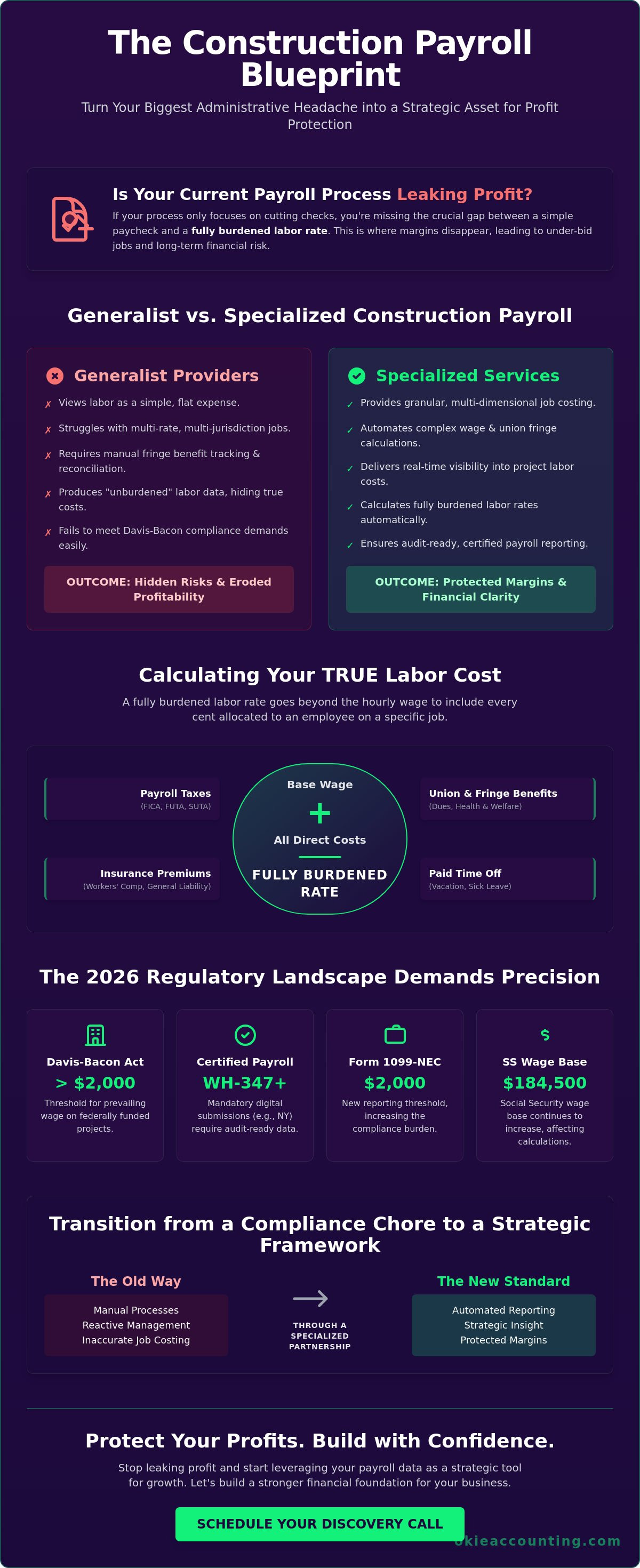
Standard payroll systems typically fail because they view labor as a flat expense. In reality, contractors often manage multi-rate projects where workers perform different tasks at different rates throughout the day. Without automated fringe benefit tracking, you're forced to manually reconcile union dues or health and welfare contributions. This manual intervention creates "unburdened" labor data. If you don't account for the full cost of taxes, insurance, and benefits in real-time, you'll likely under-bid future projects and erode your long-term profitability.
The 2026 Regulatory Landscape for National Contractors
The 2026 environment demands a higher level of digital precision. With the Social Security wage base increasing to $184,500 and the reporting threshold for Form 1099-NEC rising to $2,000, the margin for error has narrowed. Many states are now mandating electronic certified payroll submissions through centralized portals to ensure transparency. This shift requires strict adherence to the Davis-Bacon Act for federally funded projects, where prevailing wages are verified with surgical accuracy. Modern technology has transformed payroll from a quiet back-office task into a high-stakes compliance priority that dictates your firm’s financial health.
Navigating Compliance: Certified Payroll, Prevailing Wage, and Union Fringes
Compliance in the construction sector is a moving target that requires constant vigilance. For any project exceeding the $2,000 threshold established by the Davis-Bacon Act, your payroll data must be beyond reproach. This involves more than just paying the right hourly rate; it requires a deep understanding of prevailing wage and compliance requirements that vary significantly by trade and geographic location. We view compliance as the structural reinforcement of your financial house. Without it, the entire project is at risk of failure during a Department of Labor audit.
Managing these variables manually is a recipe for disaster. When your crew moves between jurisdictions or trades, their pay rates and fringe benefit obligations shift in real-time. Specialized payroll services for construction companies provide the necessary oversight to ensure these transitions are recorded accurately, protecting you from back-pay liabilities and liquidated damages. This level of precision is essential for maintaining your reputation with prime contractors and government agencies alike.
Certified Payroll Reporting (WH-347 and Beyond)
A certified payroll report is a signed statement of compliance that validates your adherence to labor laws. For 2026, these reports must include specific employee details, work classifications, and a breakdown of both cash wages and fringe benefits. While the federal WH-347 form remains a standard, many states have moved toward mandatory digital portals. For example, as of January 1, 2026, New York requires contractors to submit records electronically every 30 days. Inaccurate submissions don't just trigger audits; they often lead to immediate payment freezes from the project owner. Keeping your reports audit-ready ensures that your cash flow remains uninterrupted.
Managing Prevailing Wage and Union Complexity
The true challenge lies in tracking fringe credits. To meet prevailing wage mandates, you must account for the total compensation package, including health insurance, vacation pay, and apprenticeship contributions. If you operate in a multi-union environment, the administrative burden of managing different benefit funds can be overwhelming. A disciplined framework for payroll services for construction companies ensures that rate tables are verified before the first check is cut. This eliminates the need for retroactive corrections and keeps your labor costs predictable. If you find the weight of these regulations is pulling your focus away from the field, you might benefit from a discovery call to discuss your compliance strategy.
The Strategic Link: Integrating Payroll with Job Costing and WIP
Payroll is the heartbeat of your project’s cash flow. It is often the largest and most unpredictable variable on your profit and loss statement. While materials have fixed costs, labor efficiency fluctuates daily. Specialized payroll services for construction companies bridge the gap between raw hours and actionable financial intelligence. When you partner with experts for payroll services for construction companies, you ensure that every hour worked is tied directly to a cost code. By integrating these details into your Work in Progress (WIP) reports, you gain the clarity needed to identify where money is being made or lost before a project reaches completion.
Fully Burdened Labor Rates: Seeing the True Cost of a Project
You cannot manage what you don't accurately measure. A "fully burdened" labor rate is the only way to see the true cost of your field operations. This calculation includes the base hourly wage plus all associated employer costs. For 2026, this must account for the 7.65% FICA tax on wages up to the $184,500 Social Security limit, the 6.0% FUTA tax on the first $7,000 of wages, and your specific state unemployment (SUTA) rates. It also incorporates Workers’ Compensation premiums and General Liability (GL) insurance allocations.
When you use unburdened rates, your job costing is fundamentally flawed. You might think a project is performing well, only to realize at the end of the quarter that taxes and insurance have erased your margin. Accurate data allows you to learn how management accounting turns data into profit by highlighting which specific trades or crews are exceeding their estimated labor budgets. This level of detail prevents you from bidding on projects that look profitable on paper but lose money in the field.
Payroll Data as a Tool for Fractional Controller Oversight
High-level financial management relies on the integrity of your payroll systems. A fractional controller doesn't just look at history; they use payroll trends to forecast your future cash requirements. By analyzing labor productivity through hour variances, they can spot red flags in project management early. If a crew consistently requires 20% more hours than estimated for a specific phase, it indicates a structural issue in bidding or field execution that needs immediate correction.
This proactive approach is essential for long-term health. Utilizing payroll data for strategic oversight ensures that your firm remains resilient against market shifts. You can see how fractional controller services scale construction firms by providing the roadmap needed to transition from basic check-cutting to sophisticated financial planning. This level of insight is what separates growing contractors from those who struggle to maintain stability.
Outsourcing vs. Software: Finding the Right Payroll Framework
Choosing between a "Do-It-Yourself" software approach and a managed partnership is a decision that impacts your firm's structural integrity. While software provides the tools to process a check, it does not provide the oversight required to protect your profit. Many contractors start with a basic subscription, only to realize that the administrative burden scales faster than their revenue. Managing payroll services for construction companies requires more than just a login; it requires a disciplined methodology for tracking multi-state taxes and complex union fringes.
The hidden costs of in-house management are often substantial. You must account for the hundreds of hours spent on data entry, the recurring expense of staff training, and the high risk of human error. As your firm expands into national projects, the complexity of jurisdictional compliance grows exponentially. A managed service provider acts as a strategic partner, offering a scalable framework that allows you to focus on field operations while experts handle the granular details of financial readiness.
The Hidden Risks of the DIY Payroll Model
One of the most significant dangers of the DIY model is "key person dependency." If your office manager is the only individual who understands your specific reporting nuances, your business is vulnerable to immediate disruption if they leave. Additionally, the cost of a single Department of Labor penalty for a missed certified report can far exceed the annual fees of professional payroll services for construction companies. Even when you choose to outsource, maintaining a high level of internal data literacy is vital. We recommend professional QuickBooks training to ensure your internal team can still navigate your financial records with confidence.
Evaluation Criteria for a Managed Payroll Partner
When selecting a partner, you must look beyond basic administrative capabilities. Use this checklist to evaluate potential providers:
Industry Specialization: Do they speak the language of construction, or are they generalists who struggle with prevailing wage logic?
Technical Integration: Does their data flow seamlessly into your QuickBooks for contractors setup to ensure your WIP reports are accurate?
Strategic Advisory: Do they provide fractional controller-level insights, or are they simply performing data entry?
A true partner doesn't just process checks; they build a system that alerts you to labor cost variances before they become crises. If you're ready to transition from a manual burden to a managed framework, you can schedule a discovery call to evaluate your current payroll system.
Building a Resilient Payroll System with Okie Accounting Group LLC
Okie Accounting Group LLC doesn't just offer administrative support; we build the financial infrastructure your firm needs to thrive. Our specialized payroll services for construction companies are designed to eliminate the friction between the field and the office. We operate as a national partner, utilizing cloud-based systems to provide real-time oversight regardless of where your job sites are located. This approach transforms payroll from a recurring headache into a strategic asset that fuels your growth. By establishing a rigorous payroll framework, we create the essential foundation for our broader fractional controller services.
Our Proactive Approach to Profit Protection
Our partnership begins with a comprehensive onboarding process. We don't just pick up where your last provider left off. We dive into your historical data to clean up inconsistencies and establish robust job costing codes that align with your specific trades. This ensures that every labor hour is accounted for and assigned to the correct project phase from day one. Our team provides ongoing oversight to maintain compliance with evolving regulations. Okie Accounting Group LLC focuses on your "financial readiness," ensuring you're always prepared for audits and positioned for sustainable growth.
Ready to Scale? Your Next Steps for Payroll Excellence
Scaling a construction firm requires more than just winning bigger bids. It requires a backend system that can handle the increased complexity of multi-state reporting and union fringe benefits. If you're still relying on manual spreadsheets or generalist software, you're likely ignoring hidden inefficiencies that drain your cash flow. We encourage you to review your current workflows to identify these leaks. High-quality financials aren't just for internal use; they're vital for securing the project bonding required for large-scale contracts. Lenders and sureties need to see disciplined, accurate data before they back your expansion.
Your payroll system should be a source of confidence, not a source of stress. When your labor data is integrated, burdened, and audit-ready, you can focus on the field operations that drive your success. We are here to help you bridge the gap between basic bookkeeping and high-level financial strategy. Contact Okie Accounting Group LLC for a strategic financial review and let us build the framework your business deserves.
Securing Your Firm’s Financial Future in 2026
Building a resilient business requires moving beyond the administrative burden of basic check-cutting. The transition from unburdened labor rates to a fully burdened financial model is essential for protecting your margins. By integrating automated certified reporting and real-time job costing, you gain the clarity needed to scale your operations with confidence. Choosing specialized payroll services for construction companies is the first step toward establishing a foundation of financial readiness.
Okie Accounting Group LLC provides the specialized expertise required to navigate the unique complexities of the construction and real estate sectors. Our proactive approach offers Fractional Controller-level oversight for every client, ensuring your data is not just accurate but strategically useful. With our cloud-based systems, your firm gains national scalability and constant access to vital financial data. It's time to transform your back-office operations into a high-level strategic framework. If you're ready to secure your profit and reclaim your time, schedule your strategic payroll and bookkeeping consultation with Okie Accounting Group LLC. We are committed to your long-term stability and look forward to building a stronger foundation for your business together.
Frequently Asked Questions
What is the difference between general payroll and construction payroll services?
Construction payroll involves multi-dimensional tracking of trades, prevailing wages, and project codes that general payroll often ignores. While generalist providers focus on flat salaries, specialized payroll services for construction companies manage workers moving between different job sites and pay rates in a single week. This level of granular detail is necessary to satisfy certified reporting requirements and ensure accurate job costing for every project phase.
How does certified payroll work for federal construction projects in 2026?
Certified payroll for federal projects requires the submission of Form WH-347 or an equivalent electronic record to verify compliance with the Davis-Bacon Act. In 2026, many agencies mandate digital submissions through centralized portals to improve transparency and enforcement. These reports must include a signed statement of compliance and a detailed breakdown of work classifications, hours, and fringe benefits for every worker on the project site.
Can specialized payroll services help with union fringe benefit reporting?
Yes, specialized services automate the tracking and allocation of complex union fringe benefit packages. They ensure that health, welfare, vacation, and apprenticeship contributions are calculated accurately based on the specific union contract and hours worked. This eliminates the manual administrative burden of managing multiple benefit funds and reduces the risk of costly reporting errors or payment disputes with union representatives.
What are the risks of using standard QuickBooks for construction payroll?
Standard QuickBooks often lacks the native architecture to handle complex construction requirements like automated certified reporting or multi-rate project tracking. Relying on basic settings can lead to unburdened labor data, which obscures the true cost of your projects. Without specialized setup or professional oversight, you risk missing critical compliance updates or failing to allocate labor costs to the correct job codes.
How much does it cost to outsource payroll for a construction company?
The cost of outsourcing depends on the complexity of your reporting needs, the number of employees, and the frequency of your pay cycles. While generalist providers might offer lower entry-level fees, they often charge extra for certified reports or union tracking. It's important to evaluate the total value of the service, including the potential savings from avoided compliance penalties and the strategic advantage of accurate financial data.
What is a "fully burdened" labor rate and why does it matter for my profit?
A fully burdened labor rate is the total cost of an employee, including their base wage plus taxes, insurance, and benefits. In 2026, this includes the 7.65% FICA tax, FUTA, SUTA, Workers’ Compensation, and General Liability insurance. Using this rate is vital because it reveals your true project costs, allowing you to identify which jobs are actually profitable and which are eroding your margins through hidden expenses.
How do payroll services integrate with construction job costing?
Specialized services integrate by mapping every labor hour and associated burden directly to specific project cost codes in your accounting system. This data flows into your Work in Progress (WIP) reports, providing real-time visibility into labor productivity and budget variances. This integration allows you to spot cost overruns early and make data-driven adjustments to your field operations before they impact your final profit.
What should I look for in a construction payroll partner?
Look for a partner with deep industry expertise who understands the nuances of prevailing wage laws and project-based accounting. Ensure they offer seamless technical integration with your existing software and provide high-level advisory services, such as fractional controller oversight. A reliable partner like Okie Accounting Group LLC acts as a strategic mentor, focusing on your long-term financial health and audit readiness rather than just administrative data entry.


Comments