
Accounting for Land Development: A Strategic Framework for Profit Protection in 2026
- Wendy Okie

- 8 hours ago
- 12 min read
Your ledger isn't just a record of past transactions; it's a structural framework that determines the viability of your entire project. With construction loan rates for traditional financing currently ranging from 6.5% to 9.5% in 2026, the margin for error in your financial reporting has never been thinner. Mastering accounting for land development is no longer a back-office chore. It's a strategic necessity for any developer who wants to protect their equity and maintain total credibility with lenders.
It's common to feel overwhelmed by the complexity of cost capitalization or the fear that a messy balance sheet will stall your next bank draw. You deserve a system that reflects the true value of your assets while keeping your cash flow predictable. This article promises to clarify the nuances of revenue recognition and financial oversight so your projects remain profitable and investor-ready. We will walk through the specific workflows for job costing in QuickBooks and the foundational systems required to turn your financial data into a tool for long-term stability. From pre-development costs to final reporting, you'll gain the clarity needed to manage your projects with absolute confidence.
Key Takeaways
Learn the critical distinction between capitalizing and expensing costs to ensure your balance sheet accurately reflects project value and remains GAAP-compliant.
Master the categorization of hard and soft costs to streamline your budget tracking and simplify bank draw requests.
Evaluate revenue recognition methods like Percentage of Completion to provide investors with a transparent view of long-term project progress.
Implement a specialized Chart of Accounts within QuickBooks Online to build a scalable foundation for advanced accounting for land development.
Discover how fractional controller oversight moves beyond basic bookkeeping to protect your capital stack and ensure compliance with debt covenants.
The Foundation of Land Development Accounting: Capitalization vs. Expensing
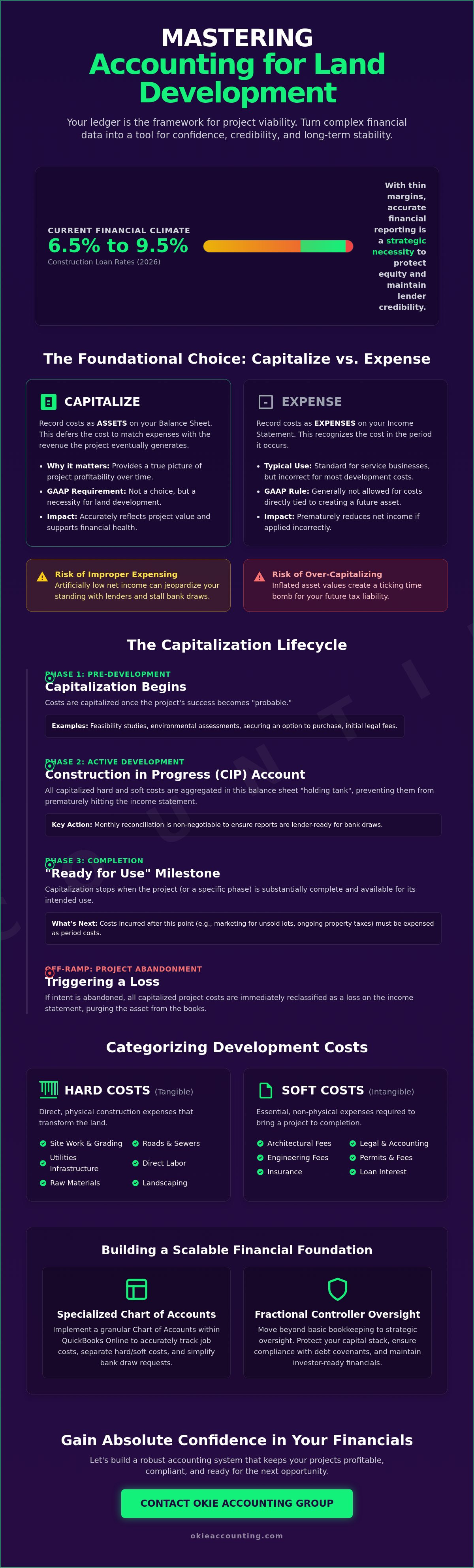
Effective accounting for land development begins with a precise understanding of cost capitalization. Unlike standard service businesses that expense costs as they occur, developers must treat most expenditures as investments in a future asset. Capitalization is the process of recording these costs as assets on your balance sheet rather than immediate expenses on your income statement. This isn't just a choice; it's a requirement under Generally Accepted Accounting Principles (GAAP). By deferring these costs, you match the expenses of the project with the revenue it eventually generates, providing a truthful picture of your project’s profitability.
For those seeking a broader Land development overview, the process involves a complex interplay of economic cycles and regulatory hurdles that dictate how these assets are valued. Improper capitalization creates a distorted view of your financial health. If you expense costs that should be capitalized, your net income looks artificially low, which can jeopardize your standing with lenders. Conversely, over-capitalizing costs that should be expensed inflates your asset values and creates a ticking time bomb for your tax liability. Maintaining this balance is the hallmark of a disciplined development firm.
When to Start Capitalizing Costs
You can't capitalize costs indefinitely. Capitalization generally begins when a project's success becomes "probable." This threshold is often met once you've secured an option to purchase or completed initial feasibility studies that confirm the project's viability. Costs incurred during the due diligence phase, such as environmental assessments and option payments, are typically capitalized because they're directly tied to the acquisition of the specific asset.
However, you must remain vigilant about the status of your pipeline. The abandonment of intent triggers an immediate reclassification of all capitalized project costs into a loss on the income statement, effectively purging the asset from your general ledger. This is why many firms utilize strategic controller services to regularly audit their "Construction in Progress" accounts to ensure every dollar listed still represents a viable future profit.
The "Ready for Use" Milestone
The transition from Construction in Progress (CIP) to a completed asset is a critical accounting event. This "ready for use" milestone occurs when the project is substantially complete and available for its intended use, regardless of whether final sales have closed. For phased developments, this milestone is reached on a phase-by-phase basis. You must stop capitalizing interest and taxes for a specific phase once it's ready, even if other sections of the larger development are still under active construction.
Costs incurred after this point, such as ongoing property taxes or marketing expenses for unsold lots, must be expensed as period costs. Accurate tracking during this phase ensures your balance sheet doesn't become bloated with "stale" costs that should have been recognized as expenses. This level of granular detail is what keeps your financial statements lender-ready during long project cycles.
Categorizing Development Costs: Hard Costs vs. Soft Costs
Precision in accounting for land development requires a disciplined approach to cost categorization. It isn't enough to simply record an invoice; you must assign every dollar to its proper place within a structural framework. This distinction ensures that your job costing is accurate and that your financial statements provide the transparency lenders demand. By separating costs into tangible and intangible buckets, you create a data-driven environment where project profitability is visible in real-time.
Hard costs represent the tangible, physical components of your development. These are the direct construction expenses that physically transform the land. Key examples include:
Site work and grading
Infrastructure such as roads, sewers, and utilities
Direct labor and raw materials
Landscaping and hardscaping
Soft costs are the intangible but essential expenses required to bring a project to life. While they don't result in a physical structure, they're often incurred long before the first shovel hits the ground. These include architectural and engineering fees, legal services, permits, insurance, and interest. Without a granular chart of accounts to track these, your project's true cost basis becomes obscured, leading to potential cash flow crises.
Managing Construction in Progress (CIP) Accounts
During the active development phase, all capitalized costs should aggregate within a Construction in Progress (CIP) account. Think of the CIP as a holding tank on your balance sheet. It prevents these costs from hitting your profit and loss statement prematurely, which would incorrectly signal a loss. Reconciling these accounts monthly is a non-negotiable practice. It ensures that your lender-ready reports reflect the actual value of work performed, maintaining the trust necessary for smooth bank draws. If you're unsure how to structure your specific project categories, you can schedule a brief discovery call to discuss your framework.
Indirect Costs and Overhead Allocation
One of the most complex areas of accounting for land development is the allocation of indirect costs. You must determine which administrative expenses, such as project management salaries or regional office rent, can be legally attributed to a specific project. Utilizing advanced management accounting strategies allows you to distribute these overhead costs based on a logical methodology, such as a percentage of direct costs or labor hours. This ensures that every development bears its fair share of the firm's operational burden, protecting the profit margins of your most successful projects.
Navigating Revenue Recognition and Interest Capitalization
Revenue recognition is the point where the operational progress of a project meets the formal reality of your ledger. For those managing accounting for land development, choosing the right recognition method is a strategic decision that affects how investors perceive your project's health. While the Completed Contract Method is straightforward, recognizing revenue only when the project is finished, it often creates "lumpy" financial statements that don't reflect the daily value creation on-site. This is why many developers prefer the Percentage of Completion Method. By recognizing revenue based on the ratio of costs incurred to total estimated costs, you provide a transparent, real-time view of progress that keeps stakeholders informed and confident.
Beyond revenue, interest capitalization represents a significant component of your project's total cost basis. Under ASC 835-20, interest on construction loans shouldn't be expensed as it's paid. Instead, it must be added to the cost of the asset during the active development period. This treatment aligns the cost of financing with the eventual sale of the developed lots. However, you must be aware of the "suspension of capitalization" rules. If active development stops for an extended period due to permit delays or funding gaps, you're required to stop capitalizing interest and begin expensing it immediately. Failing to catch these pauses can lead to an over-inflated asset value that won't pass a rigorous audit.
Choosing a Revenue Recognition Method
Selecting a method depends on your project duration and your specific reporting goals. Short-term projects might favor the simplicity of the Completed Contract Method to minimize administrative overhead. However, for developments spanning several years, the Percentage of Completion Method is essential for maintaining steady financial ratios. This choice directly impacts your cash flow forecasting and how you manage tax liabilities over the project lifecycle. For those balancing development with rental holdings, understanding the broader accounting for real estate investors can provide the necessary context for long-term equity growth.
The Mechanics of Interest Capitalization
The core of interest capitalization is the concept of "avoidable interest." This is the amount of interest expense you could have avoided if you hadn't spent the money on development. You begin capitalizing interest when three conditions are met: expenditures for the asset have been made, activities to get the asset ready are in progress, and interest cost is being incurred. A common error in accounting for land development is capitalizing interest on land held for future use without active development plans. If you aren't actively moving the project forward, that interest must be expensed, protecting the structural integrity of your balance sheet from artificial inflation.
Building a Scalable System: QuickBooks for Land Developers
Executing high-level financial theory requires a robust technological foundation. While many developers start with spreadsheets, the complexity of 2026 interest rates and evolving GAAP standards makes manual tracking a liability. QuickBooks Online has emerged as the industry standard for mid-sized developers because it bridges the gap between basic record-keeping and sophisticated financial oversight. It provides the flexibility to integrate with third-party tools for bank draws and document management, ensuring your digital paper trail is always audit-ready. A well-configured system doesn't just record history; it protects your future profit margins by providing immediate visibility into every dollar spent.
The secret to effective accounting for land development within QuickBooks lies in the "Projects" and "Classes" features. By assigning every transaction to a specific project, you isolate the financial health of individual land parcels. This prevents the "blended reality" where a highly profitable development masks the inefficiencies of a struggling one. Classes can then be used to track overhead across different entities or regions, giving you a multi-dimensional view of your firm's performance. If your current software feels like a disorganized digital shoebox, you can request a specialized QuickBooks setup assessment to bring order to your data.
Configuring Your Chart of Accounts
Your Chart of Accounts (COA) must be a structural mirror of your project budgets. This alignment allows for effortless variance analysis, showing you exactly where costs are deviating from the plan. We recommend setting up parent accounts for Land Acquisition, Site Improvements (Hard Costs), and Indirect Costs (Soft Costs). This hierarchy ensures your balance sheet remains clean while allowing you to drill down into granular details like engineering fees or utility infrastructure. For those who need a professional roadmap for this configuration, our QuickBooks training for contractors provides the specialized knowledge required to build this framework correctly from day one.
The Monthly Reporting Cadence
Lenders don't want excuses. They want data. A disciplined monthly reporting cadence is what separates a professional developer from a hobbyist. Every month, you should produce three essential reports: a Project P&L to monitor profitability, a Balance Sheet by Project to track asset value, and a Budget vs. Actual report to identify potential cash flow crises before they happen. This level of transparency makes bank draws seamless and builds immense trust with your investors. To understand how these reports fit into a broader operational strategy, explore our guide on construction bookkeeping services to see how to build a scalable financial infrastructure that supports long-term growth.
Strategic Financial Oversight: The Role of a Fractional Controller
Basic bookkeeping tells you where your money went, but strategic financial leadership tells you where your project is going. In the specialized field of accounting for land development, the transition from administrative recording to controller-level oversight is often the difference between a project that breaks even and one that thrives. A fractional controller doesn't just reconcile accounts; they manage the complex layers of your capital stack, ensuring that debt covenants are monitored and equity is protected against the rising costs of construction financing. With traditional construction loan rates currently ranging from 6.5% to 9.5% in 2026, the margin for financial mismanagement has vanished.
Professional financial leadership provides a significant return on investment by preventing cost overruns before they erode your margins. Instead of reacting to a cash flow crisis after it occurs, a controller identifies the early warning signs in your budget variances. This proactive stance is the core of Okie Accounting Group LLC’s Fractional Controller services. We act as a strategic mentor for growing firms, moving beyond basic administrative tasks to build a comprehensive structural framework that ensures your business remains lender-ready and resilient throughout the multi-year development cycle.
Budgeting and Cash Flow Forecasting
Proactive 12-month cash flow modeling is the heartbeat of a successful development. Unlike historical recording, which looks in the rearview mirror, forecasting allows you to anticipate the precise timing of investor distributions and loan repayments. It ensures you have the liquidity to handle unexpected site issues without stalling progress. This level of foresight is a primary marker of a fractional controller services pillar, providing the data-driven clarity needed to scale your firm with confidence in a volatile market.
Internal Controls and Risk Mitigation
Rigorous internal controls are essential for protecting your project's capital. Implementing disciplined approval workflows for large vendor payments and change orders prevents the small, unmonitored expenses that eventually sink a budget. You must also maintain strict oversight of subcontractor compliance, ensuring every partner meets payroll and insurance requirements before they step on-site. This disciplined approach minimizes your liability and creates a culture of accountability across your entire vendor pool. Clean data is the ultimate defense during a financial audit or lender review, providing an unshakeable foundation of truth for your business.
Securing a Resilient Future for Your Development Projects
Building a structural framework is the ultimate defense against the market volatility of 2026. By mastering the nuances of cost capitalization and implementing a specialized QuickBooks environment, you transform your financial data from a static record into a strategic asset. We've explored how precise revenue recognition and disciplined interest tracking protect your project's margin, while fractional controller oversight ensures your capital stack remains secure. This proactive approach to accounting for land development allows you to focus on what you do best: building the physical landscape of the future.
At Okie Accounting Group LLC, we bring specialized expertise in QuickBooks Online for complex real estate projects and a dedicated focus on the construction and development sectors. Our fractional controller services offer the high-level financial leadership required to navigate long project cycles with ease. Replacing financial uncertainty with data-driven control isn't just a goal; it's a necessity for scaling your firm. Gain financial clarity with specialized accounting for land development. Your next successful project starts with an unshakeable financial foundation.
Frequently Asked Questions
What is the difference between land development and construction accounting?
Land development accounting focuses on the horizontal phase of a project, whereas construction accounting typically handles vertical structure costs. Development involves capitalizing costs related to site transformation, such as grading and utilities, into a long-term asset account. Construction accounting deals with the direct labor and materials for building the units themselves. Distinguishing between these two is vital for accurate asset valuation on your balance sheet.
Can I expense property taxes and insurance during the development phase?
Property taxes and insurance must be capitalized into the cost of the project during the active development period rather than expensed. GAAP requires these carrying costs to be added to the asset's basis because they're necessary to bring the land to its intended use. Once the project reaches the "ready for use" milestone, you must stop capitalization and begin expensing these items as period costs on your profit and loss statement.
How do I account for land that is being held for future development?
Land held for future development should be recorded as a long-term investment at its original acquisition cost. You shouldn't capitalize interest, taxes, or other carrying costs during this holding phase because active development hasn't started. These costs are expensed as incurred until you begin the formal planning and site work. This prevents the artificial inflation of asset values for projects that are currently stagnant.
What are the most common accounting mistakes real estate developers make?
The most frequent errors in accounting for land development include expensing soft costs that should be capitalized and failing to suspend interest capitalization during project delays. Many developers also struggle with improper overhead allocation, which obscures the true profitability of individual parcels. These mistakes can lead to lender distrust or unexpected tax liabilities. Maintaining a disciplined structural framework prevents these common pitfalls from eroding your equity.
How does the Percentage of Completion method affect my taxes?
The Percentage of Completion method generally accelerates the recognition of taxable income compared to the Completed Contract method. Because you're recognizing profit as work progresses, you may owe taxes on paper gains before you've actually closed sales on the lots. While this provides a more transparent view for investors, it requires meticulous cash flow forecasting to ensure you have the liquidity to cover those tax obligations.
Why do lenders require specific accounting formats for land development?
Lenders require specific formats to verify that their collateral value is increasing in line with the loan draws they're funding. They specifically look for a clean Balance Sheet by Project and a detailed Construction in Progress (CIP) report. These formats allow the bank to monitor debt covenants and ensure that capitalized costs are legitimate improvements to the land, protecting the bank’s security interest in the development.
What software is best for tracking land development costs?
QuickBooks Online is the preferred choice for mid-sized developers because it offers robust project-based tracking and seamless integration with specialized development tools. It allows you to build a customized Chart of Accounts that mirrors your project budget for easy variance analysis. When configured correctly, it provides the lender-ready financials needed for bank draws without the complexity of enterprise-level software that often exceeds the needs of most firms.
When should a developer hire a fractional controller instead of a full-time CFO?
You should consider a fractional controller when your project complexity outpaces your current bookkeeping but your revenue doesn't yet support a full-time CFO. A fractional controller provides the strategic oversight needed to manage your capital stack and monitor debt covenants at a fraction of the cost. This model offers the high-level expertise required for accounting for land development while maintaining the lean operational structure necessary for growing firms.


Comments