
Bookkeeping for Commercial Roofing: 2026 Framework
- Wendy Okie

- Aug 14
- 12 min read
Why does your bank balance so often feel disconnected from the high-value contracts your team is actually executing? For many owners, the gap between winning a bid and seeing the profit is a direct result of financial systems that weren't built for the unique pressures of the roofing industry. When you're managing 10% retainage, fluctuating material costs, and the rigor of AIA billing, standard administrative records simply won't cut it. Specialized bookkeeping for commercial roofing contractors requires a structural framework designed to turn raw data into a strategic engine for growth.
You've likely felt the stress of a bidding process that feels like a guessing game or the frustration of being denied bonding because your reports lacked the necessary depth. We understand that your financials should be a source of confidence, not a cause of anxiety. This guide provides a comprehensive 2026 roadmap to move your business beyond basic record-keeping and into strategic oversight. You'll learn how to achieve real-time visibility into project margins, secure lender-ready financial statements, and build a scalable system that protects your profits against labor inflation and shifting regulatory requirements.
Beyond Basic Books: Why Commercial Roofing Demands Specialized Financial Infrastructure
Commercial roofing isn't just about installing systems; it's about managing complex financial liabilities over time. Standard bookkeeping for commercial roofing contractors is a specialized subset of construction accounting that requires more than just tracking expenses. While residential roofing often relies on simple receipt tracking for quick turnaround jobs, the commercial sector operates on a model of contract management. You're dealing with projects that span months, involve multiple stakeholders, and require precise revenue recognition to remain profitable.
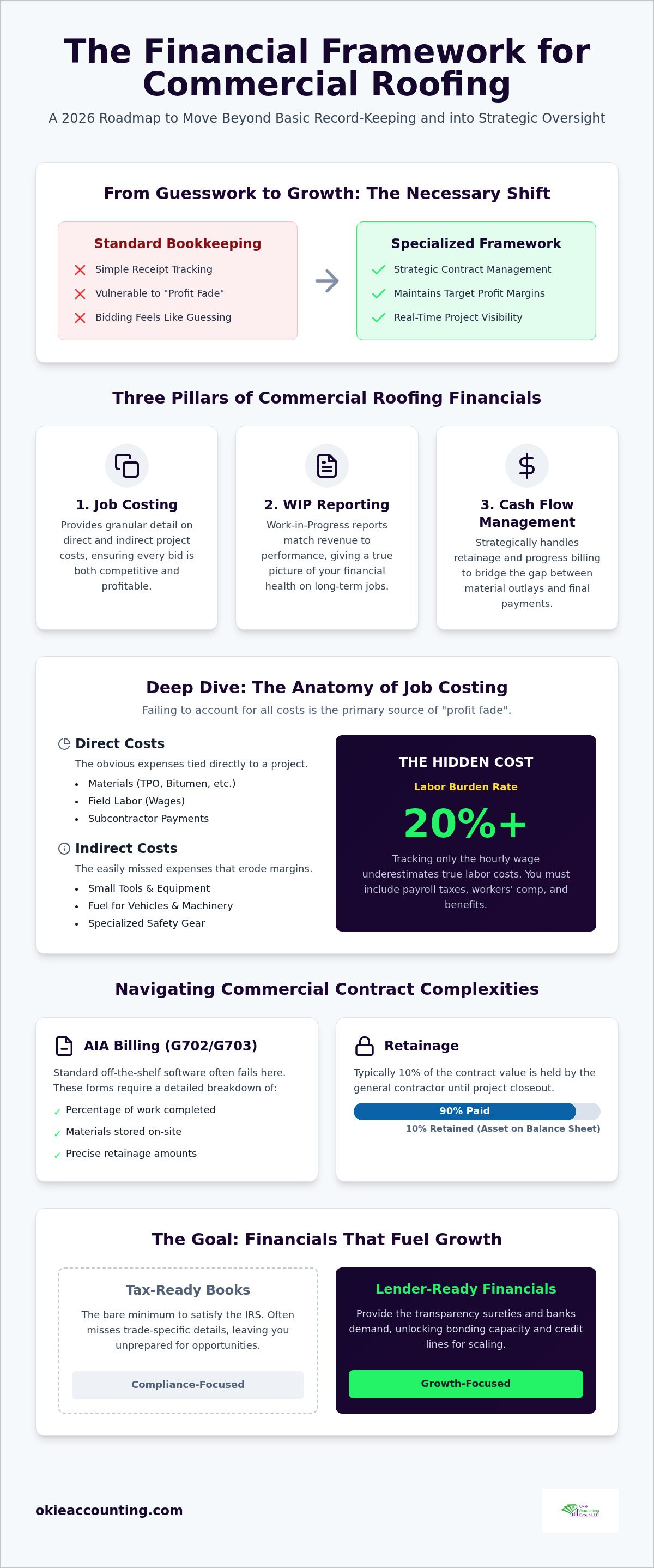
A robust financial system for this industry rests on three pillars: Job Costing, Work-in-Progress (WIP) reporting, and Cash Flow management. Without these, your business is vulnerable to "profit fade." This occurs when the estimated margin at the start of a project slowly erodes due to unrecorded labor hours, rising material costs, or overlooked indirect expenses. A structural framework prevents this by creating a feedback loop between your field operations and your office, ensuring every dollar spent is accounted for in real time.
The Complexity of Commercial Contracts
Commercial projects often require AIA (American Institute of Architects) billing, specifically the G702 and G703 forms. These documents demand a level of detail that breaks standard off-the-shelf bookkeeping setups. They require you to report the percentage of work completed, materials stored on-site, and the exact amount of retainage held back by the general contractor. Retainage, often 10% of the contract value, stays on your balance sheet as an asset you can't touch until the project's final closeout. The accrual method of accounting is the gold standard for commercial contractors because it matches revenue to the period in which the work was actually performed, providing a true picture of your financial health.
Compliance vs. Strategic Oversight
There's a significant difference between "tax-ready" books and "lender-ready" financials. Tax-ready books are the bare minimum needed to satisfy the IRS at year-end. In contrast, lender-ready financials provide the transparency that sureties and banks demand to extend bonding capacity or credit lines. Generalist bookkeepers often miss the trade-specific nuances of roofing, such as how to properly allocate the cost of specialized equipment or safety compliance across multiple jobs. This is where a Fractional Controller becomes essential. They provide high-level strategy, moving you from simply recording history to predicting your company's future. They help you interpret complex data so you can bid with confidence and protect your bottom line against market volatility.
Mastering Job Costing: The Foundation of Commercial Roofing Profitability
Job costing is the operational heartbeat of a successful roofing business. While basic bookkeeping for commercial roofing contractors might focus on high-level income and expenses, true profitability is found in the granular details of every project. If you don't know exactly what it costs to install a TPO system on a specific warehouse versus a modified bitumen roof on a retail center, your bidding process is essentially a guessing game. Precise job costing eliminates this uncertainty by providing a clear view of your direct and indirect costs.
Direct costs like materials and field labor are usually obvious, but indirect costs often erode margins from the shadows. These include small tools, fuel, and specialized safety equipment that aren't tied to a single invoice. You must also account for the labor burden rate for your W-2 crews. This rate includes payroll taxes, workers' compensation, and benefits. If you only track the hourly wage, you're underestimating your actual labor expense by 20% or more. Accurate data from past projects allows you to adjust your estimating software, ensuring future bids are both competitive and profitable.
Setting Up a Construction-Ready Chart of Accounts
A generic chart of accounts is insufficient for the complexities of commercial roofing. You need a structure that organizes data by project phase and cost type. In QuickBooks Online, utilizing the "Projects" and "Classes" features is the most effective way to isolate job performance. This setup allows you to run a Profit and Loss report for a single contract without wading through company-wide overhead. For a detailed walkthrough of this technical configuration, review our guide on QuickBooks for contractors.
Tracking Labor and Subcontractor Costs
Managing a mix of in-house crews and subcontractors requires rigorous oversight. For 1099 partners, your system must track W-9 compliance and expiration dates for general liability and workers' comp certificates. Real-time labor tracking is equally critical to prevent budget overruns before they become irreversible. When scope changes occur on-site, your accounting system should capture change orders and potential back-charges immediately. This ensures that every hour of additional work is billed and collected. If your current system leaves you guessing about your true margins, you can schedule a discovery call to discuss building a more resilient financial framework.
Navigating the Commercial Cash Flow Gap: Retainage and Progress Billing
Commercial roofing operates on a significantly different financial timeline than residential work. This creates the "Commercial Cash Gap," where contractors must fund massive upfront material purchases and weekly payroll long before the first progress payment arrives. Effective bookkeeping for commercial roofing contractors centers on managing this gap through precise tracking of retainage. Typically, 10% of your contract value is withheld by the general contractor or owner until substantial completion. This shouldn't be treated as a simple discount; it's a specific asset on your balance sheet that must be tracked separately from standard accounts receivable to ensure it's collected at project closeout.
Managing this gap also requires a disciplined approach to the "over-billing" and "under-billing" trap. Over-billing occurs when you bill for more work than you've actually completed. While this provides a temporary cash influx, it can mask a shortage by using tomorrow's money to pay for today's costs. Conversely, under-billing means you are essentially acting as a bank for the project owner by financing the work yourself. A structured framework ensures your vendor payments and overhead are aligned with project milestones, protecting your liquidity throughout the entire construction cycle.
Mastering AIA G702 and G703 Billing
Preparing the Schedule of Values (SOV) is the first step in successful commercial billing. This document breaks the contract into granular line items that the architect or owner can verify against site progress. If your internal bookkeeping doesn't match the architect's certification, your payment application will likely be rejected. Incorrect billing is the leading cause of payment delays in the industry. Your records must mirror the G702 Summary and G703 Detail sheets to ensure that what you claim as work completed is exactly what you are paid for, without administrative friction.
The Role of WIP (Work in Progress) Reports
A Work in Progress (WIP) report acts as the bridge between your physical project site and your financial statements. It calculates "earned revenue" by comparing actual costs incurred against the total estimated budget. This prevents the distortion often found on a standard P&L, where a large material purchase might make a month look unprofitable despite the project being ahead of schedule. By identifying these variances early, you can take corrective action before your margins start to fade. For a deeper look at these structural strategies, explore our guide on construction cash flow management. This high-level oversight ensures that your cash stays where it belongs: in your business.
Structural Frameworks: Preparing Your Financials for Bonding and Scaling
To secure the large-scale contracts that define the commercial sector, you must demonstrate more than just operational skill; you must prove financial stability. Sureties and banks require GAAP-compliant construction financials because they need an objective view of your firm's risk profile. Standard bookkeeping for commercial roofing contractors often fails here because it lacks the structural rigor required by external stakeholders. When your financials are organized within a professional framework, you aren't just recording history. You are building a case for increased bonding capacity and a lower cost of capital, which directly impacts your ability to bid on multi-million dollar projects.
Specialized bookkeeping for commercial roofing contractors provides the clarity needed to satisfy these rigorous requirements. By maintaining a clean set of books, you signal to lenders that your business is managed with discipline. This transparency reduces the perceived risk of your firm, often leading to better interest rates on equipment loans and more favorable terms on lines of credit. It transforms your accounting department from a back-office expense into a strategic asset that fuels your expansion.
Lender-Ready Financial Reporting
A lender-ready package goes beyond a simple profit and loss statement. You must provide a cohesive set of the three essential reports: the Balance Sheet, the Income Statement, and the Statement of Cash Flows. These documents work together to show your liquidity, debt-to-equity ratio, and operational efficiency. Presenting detailed aging reports for both accounts receivable and accounts payable builds significant trust with lenders. If a high percentage of your AR is over 60 days, it signals a collection problem that could threaten your ability to pay back a loan. This level of transparency is also the key to a successful business exit. Since 2026 EBITDA multiples for roofing companies with mixed recurring revenue range from 6.0x to 7.5x, clean books are the difference between a premium valuation and a failed deal.
Implementing Internal Controls
Scaling safely requires internal controls that protect your profit from human error and fraud. A primary control is the separation of duties in the accounting process. The person who authorizes vendor payments shouldn't be the same person who reconciles the bank accounts. Regular bank reconciliations act as a final safety net, ensuring that every transaction matches your real-world activity. Utilizing a monthly financial review service provides an additional layer of oversight from a strategic partner who understands the roofing industry. This disciplined approach ensures that your data is accurate and your business is protected from double-billed materials or incorrect labor allocations. If you're ready to transition from administrative bookkeeping to a comprehensive financial engine, you can schedule a discovery call today.
The Strategic Advantage: Fractional Controller Oversight for Commercial Roofers
Success in the commercial roofing sector requires a shift from purely administrative record-keeping to data-driven business management. While foundational bookkeeping for commercial roofing contractors ensures your transactions are categorized, it doesn't inherently tell you how to navigate a volatile market. Strategic oversight is the bridge between having organized data and using that data to drive growth. By moving beyond the "rearview mirror" approach of traditional accounting, you gain the ability to anticipate market shifts, protect your margins, and make informed decisions about your firm's future.
A Fractional Controller provides high-level CFO insights without the overhead of a full-time executive salary. This role is particularly vital in a high-risk industry where a single miscalculated bid or a poorly managed cash gap can jeopardize years of stability. Unlike generic software dashboards that merely display numbers, a strategic partner interprets the nuances of your WIP reports and job costing data to identify hidden inefficiencies. This level of oversight ensures that every financial move you make is aligned with long-term profit protection and structural integrity.
Cash Flow Forecasting and Budgeting
Proactive financial management begins with moving away from reactive "bank balance" decision-making. A 12-month rolling forecast allows you to visualize your cash position long before material orders are placed or crews are mobilized. This foresight is essential for identifying the precise "break-even" point for major capital expenditures, such as purchasing a new crane or expanding your sales team. By modeling different scenarios, you can determine exactly how much liquidity you need to maintain to survive seasonal lulls while remaining ready to pounce on high-margin opportunities. This disciplined budgeting process transforms your financials from a compliance burden into a roadmap for sustainable scaling.
Building a Scalable Partnership
Okie Accounting Group LLC serves as a strategic mentor for construction firms nationwide, providing the remote financial leadership necessary to compete at a high level. We don't just "do the books"; we build the frameworks that support your operational goals. This includes providing professional QuickBooks training for your in-house team to ensure data integrity at every level of your organization. When your internal staff is empowered with the right tools and your leadership has access to expert analysis, your business becomes a resilient, lender-ready engine. If you're ready to gain total clarity over your project margins and cash flow, you can book your discovery call today to start building a more profitable future.
Scaling with Structural Financial Integrity
Transforming your commercial roofing business from a project-based service provider into a scalable enterprise requires more than just high-quality craftsmanship on the roof. It demands a financial engine built on precision, transparency, and strategic foresight. By implementing rigorous job costing and mastering the complexities of AIA billing, you move beyond basic record-keeping. You create a system where profit protection is proactive rather than reactive.
Specialized bookkeeping for commercial roofing contractors is the starting point for this transformation, ensuring your financials are always lender-ready and your bonding capacity reflects your true potential.
Okie Accounting Group LLC provides the nationwide expertise in construction accounting necessary to build these structural frameworks. We don't just record your history; we help you write your future through specialized Fractional Controller services and high-level strategy. You deserve a partner as invested in your success as you are. Let's build a financial system that supports your growth and secures your legacy.
Frequently Asked Questions
What is the difference between residential and commercial roofing bookkeeping?
Residential bookkeeping focuses on high-volume, short-cycle transactions and simple receipt tracking. Commercial roofing involves long-term contract management, progress billing, and retainage tracking. You must account for complex revenue recognition and job-specific indirect costs that aren't typically present in residential repair or re-roofing projects. This shift requires moving from basic cash-flow tracking to a more robust accrual-based system that matches expenses to project milestones.
How do I handle retainage in QuickBooks Online for commercial projects?
You should create a specific Other Current Asset account named Retainage Receivable on your balance sheet. When you invoice a general contractor, allocate the 10% withheld amount to this account rather than standard Accounts Receivable. This ensures your books accurately reflect the cash you're owed but haven't received yet. This practice prevents you from overstating your immediate liquidity and ensures you don't lose track of final payments during project closeout.
Why do I need a WIP (Work in Progress) report for my roofing company?
A Work in Progress (WIP) report is essential for identifying over-billing and under-billing on active projects. It calculates earned revenue based on actual costs incurred versus the total budget. This gives you a true picture of project profitability in real time, allowing you to catch profit fade before a job concludes. It's a critical tool for specialized bookkeeping for commercial roofing contractors who need to manage multiple long-term contracts simultaneously.
How does AIA billing work for commercial roofing contractors?
AIA billing uses standardized G702 and G703 forms to request payment based on a Schedule of Values. You break the project down into specific line items and bill for the percentage of work completed for each. The architect or owner must certify this progress before payment is released. This method provides the transparency required for large-scale commercial contracts and ensures that your internal records match the owner's expectations for project progress.
Can my tax accountant handle my monthly construction bookkeeping?
Tax accountants focus on year-end compliance and liability reduction, which is different from the daily operational oversight required in construction. Monthly bookkeeping for commercial roofing contractors needs to handle job costing, payroll burden, and contract management. While a tax professional is necessary for filings, they often lack the specialized systems needed to manage project-level profitability and real-time cash flow. You need a partner who understands the mechanics of your trade.
What financial reports do I need to increase my bonding capacity?
Sureties typically require a full set of GAAP-compliant financial statements, including a Balance Sheet, Income Statement, and a Statement of Cash Flows. You will also need a current WIP schedule and detailed aging reports for accounts receivable and payable. These documents prove your liquidity and project management track record. A clean set of books gives bond producers the confidence to extend higher credit limits, allowing you to bid on larger projects.
How much does specialized bookkeeping for commercial roofers cost?
The investment for specialized bookkeeping varies based on your company's revenue volume, the number of active projects, and the level of controller-level oversight required. While we don't provide fixed industry rates, the value is found in profit protection and increased bonding capacity. You should view this as a strategic investment in your firm's infrastructure. It is a necessary foundation for any roofing contractor looking to scale their operations safely and profitably.
Is QuickBooks Online suitable for a $10M commercial roofing firm?
QuickBooks Online is highly effective for $10M firms when it's configured correctly with construction-specific classes and project tracking. It offers the cloud-based flexibility needed for field-to-office communication and integrates with specialized roofing estimating software. With professional setup and fractional controller oversight, it provides the robust reporting and internal controls necessary to manage a high-revenue roofing enterprise. It remains a scalable solution that grows alongside your firm's contract volume.


Comments