
Bookkeeping for Electrical Contractors: 2026 Profit Guide

Why is it that your firm is consistently booked with high-value commercial projects, yet your bank account feels like it's running on a blown fuse? It's a frustrating paradox many owners face. You've mastered the complexities of high-voltage systems, but the intricate demands of bookkeeping for electrical contractors often remain a source of persistent stress. Between managing accurate job costing and navigating the 25% to 40% labor burden on every journeyman, it's easy to feel like you're losing control of your margins while your workload only increases.
We understand that you need more than just a record of past transactions; you need a disciplined partner to help build a stable financial foundation. This 2026 guide will show you how to transform your raw data into a structural framework that drives sustainable growth. You'll learn how to move beyond basic administrative tasks to achieve real-time project visibility and lender-ready financial statements. We will outline the exact steps to optimize your QuickBooks setup, manage rising overhead costs, and implement the scalable systems required to protect your profits in a competitive market.
Why Generic Bookkeeping Short-Circuits Electrical Contractor Profits
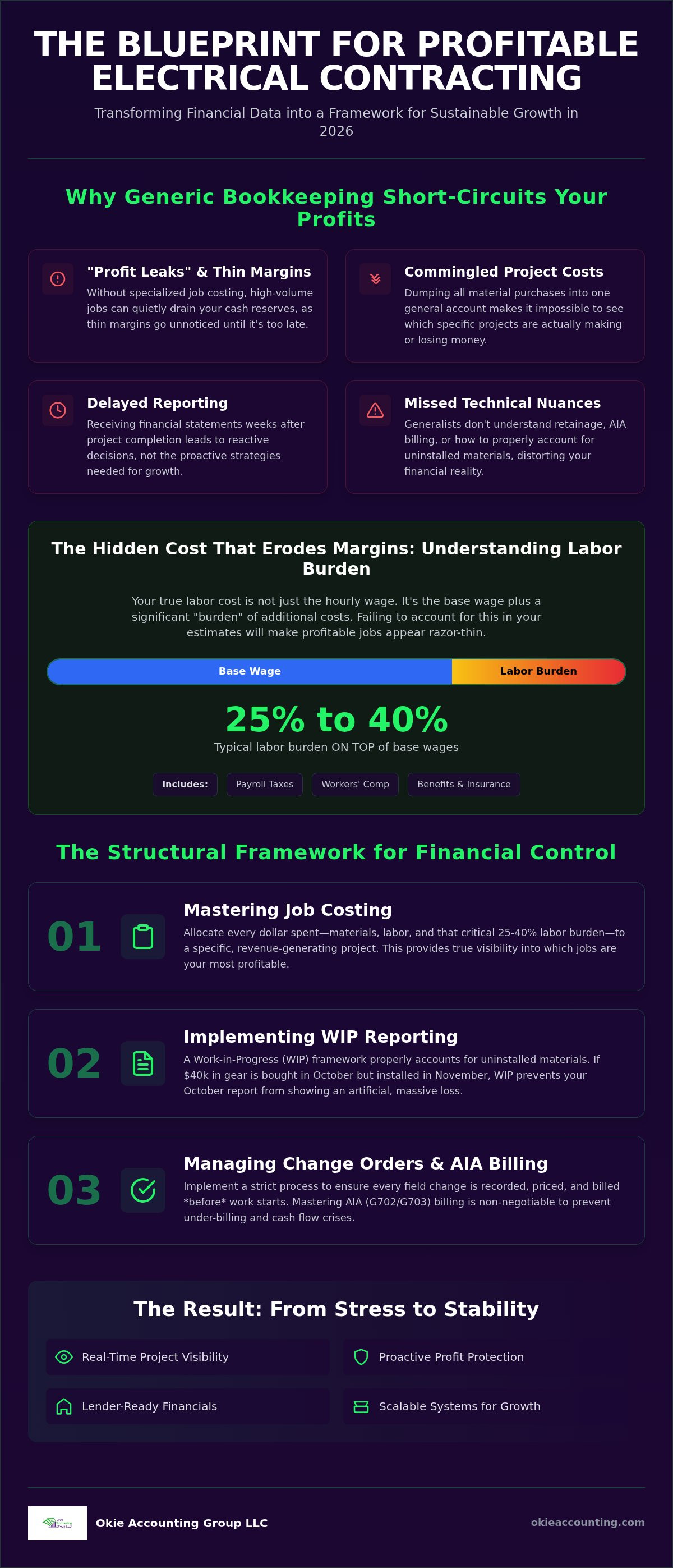
Generic bookkeeping often fails because it treats your electrical firm like a retail shop or a standard service business. In reality, your profitability depends on the precise allocation of materials, labor, and overhead to individual projects. While standard methods of bookkeeping focus on balancing the books, they don't account for the specialized requirements of the trade. This gap creates a "Profit Leak," highlighting why dedicated bookkeeping for electrical contractors is essential. You might see revenue flowing in, but without real-time data visibility, thin margins on high-volume jobs can quietly drain your cash reserves. This is particularly dangerous in 2026. Material costs remain volatile. Labor burden can add up to 40% on top of base wages.
A common misconception is that a tax-only focus is enough for operational growth. If you only look at your financials once a year for tax readiness, you're missing the chance to build a structural framework. This framework separates a simple administrative task from a strategic asset that helps you scale with confidence. It moves your business beyond survival and toward long-term stability.
The Limitations of Generalist Bookkeeping
Generalist bookkeepers often miss the technical nuances of electrical work. They might not understand how to track uninstalled materials or the impact of retainage on your cash flow. One of the biggest dangers is commingling project costs. When you dump all material purchases into a single general ledger account, you lose the ability to see which projects are actually making money. Delayed reporting is another hurdle. If you receive your financial statements weeks after a project ends, you're making reactive decisions instead of proactive ones. Without accurate job costing, you won't know if a specific commercial contract is eroding your overall profit until it's too late.
Moving Toward a Strategic Structural Framework
To scale, you need a strategic partner who understands the mechanics of your market. This transition involves moving from basic data entry to a system of rigorous management. By utilizing specialized bookkeeping for electrical contractors and Construction Bookkeeping Services, you create a scalable financial infrastructure. This level of organization is essential for securing bonding and presenting lender-ready financials. Clean, accurate books prove to stakeholders that your firm is managed with discipline. It provides clarity. It ensures stability. It turns your financial data from a source of stress into a tool for proactive profit protection.
The Structural Framework of Electrical Project Accounting
Building a profitable electrical firm requires more than just high-quality field work; it demands a rigid financial structure. Specialized bookkeeping for electrical contractors relies on three core pillars: Job Costing, Work-in-Progress (WIP) reporting, and Change Order management.
Without these systems, you're essentially flying blind. One critical area often overlooked is the tracking of "uninstalled materials." If you purchase $40,000 in specialized gear or conduit in late October but don't install it until November, your October profit and loss statement will show a massive, artificial loss. Properly accounting for these items ensures your monthly reports reflect the actual progress and profitability of your projects.
Maintaining these records isn't just for internal clarity. Following IRS guidelines on record-keeping ensures that every material purchase and labor hour is documented for compliance and audit readiness. This level of detail is what separates a professional operation from a struggling one. It provides the data necessary to secure bonding and scale your operations with confidence.
Mastering Job Costing for Electrical Projects
Effective job costing requires you to categorize every spool of wire, length of conduit, and specialized panel to a specific project. Job costing is the allocation of every dollar spent to a specific revenue-generating project. In the electrical trade, you must also master "burdened labor" to protect your margins. Your true cost isn't just the hourly rate you pay an electrician; it includes payroll taxes, workers' comp, and benefits. In 2026, these costs typically add 25% to 40% on top of base wages. If your bookkeeping for electrical contractors doesn't factor in this burden, your projected margins will be dangerously thin before the job even starts.
Managing Change Orders and AIA Billing
Change orders are where profits often go to die. You must have a strict accounting process to ensure every field change is recorded, priced, and billed before the work begins. For commercial contracts, mastering AIA (G702/G703) billing is a non-negotiable skill. These standardized forms require you to track the percentage of completion accurately. Under-billing is a silent killer; it creates a hidden cash flow crisis where your firm is effectively acting as a bank for the general contractor. If you need help refining these processes, schedule a discovery call to see how we can strengthen your financial infrastructure.
Monthly Project Review Checklist:
Compare actual labor hours against your original estimates to spot productivity drops early.
Verify that all signed change orders are entered into your accounting system and billed.
Adjust the ledger for materials delivered to the site but not yet installed to keep reports accurate.
Review your WIP report to identify jobs that are significantly over or under-billed.
QuickBooks Online: Moving from Data Entry to Strategic Visibility
QuickBooks Online serves as the foundational engine for modern bookkeeping for electrical contractors. It's no longer just a place to record expenses; it's a cloud-based hub that provides real-time visibility into your firm's health. By centralizing your data, you move away from the "shoebox" method and toward a structured framework that supports scaling. However, the value of the software is entirely dependent on its initial configuration. A professional setup prevents the high costs associated with financial cleanup later in the year. It ensures that your data is accurate from day one, allowing you to focus on high-voltage projects rather than troubleshooting ledger errors.
Effective financial oversight requires more than just basic entry. According to Small Business Administration financial management principles, maintaining organized records is the first step toward securing capital and managing growth. For electrical firms, this means integrating your accounting core with field service management tools. When your field data flows seamlessly into QuickBooks, you eliminate manual entry errors and gain a single source of truth for your project margins. This integration is essential for tracking labor hours and material usage without the lag of paper-based systems.
Customizing Your QuickBooks Chart of Accounts
A generic Chart of Accounts is a recipe for confusion. Electricians require specific sub-accounts to distinguish between high-volume service calls and long-term contract work. By utilizing Classes and Locations, you can track the profitability of different divisions, such as residential solar installations versus commercial maintenance. This level of granularity is vital for identifying which sectors of your business are truly driving profit. For those who need expert assistance in building these systems, our Software Training services provide the specialized configuration guidance necessary for a disciplined financial structure.
Automating Data Flows for Real-Time Accuracy
Automation is the key to maintaining a clean general ledger without spending hours on administrative tasks. By leveraging bank feeds and receipt capture, you ensure that every transaction is recorded as it happens. Automated rules can then categorize these expenses based on your custom Chart of Accounts, reducing the risk of human error. This disciplined approach to bookkeeping for electrical contractors ensures that your financial statements are always lender-ready. It allows you to transition from wondering what happened to strategically planning for what will happen next. You gain the confidence to make data-driven choices that protect your long-term stability.
Managing Payroll and Cash Flow in a High-Volume Trade
The electrical trade operates on a significant delay. You pay for high-cost materials and skilled labor today, but you might not see a check for 60 or 90 days. This "cash gap" is the primary reason why even busy firms fail. Specialized bookkeeping for electrical contractors must account for this cycle by aligning your accounts payable with your project draws. Payroll represents your largest variable expense. With the median electrician wage at $61,590 in 2026, and labor burden adding up to 40% on top of that, a single miscalculation in your weekly run can evaporate your project's net profit. Protecting your cash requires a disciplined approach to both timing and compliance.
Compliance adds another layer of complexity, especially for firms pursuing federal or public works projects. Prevailing wage rates currently range from $45 to $85 per hour, including fringe benefits. Failing to track these rates accurately leads to more than just thin margins; it invites heavy penalties and back-pay liabilities. A strategic partner ensures that your payroll systems are built to handle Davis-Bacon requirements and certified payroll reporting without disrupting your operational flow.
The Cash Flow Forecast: Your Survival Map
There's a dangerous difference between profit on a P&L and cash in the bank. You can be profitable on paper while your bank account is empty because of uncollected receivables or front-loaded material costs. Building a 13-week cash forecast allows you to anticipate "dry spells" before they become crises. This tool helps you decide when to pull from a line of credit or when to negotiate better terms with suppliers. For a deeper look at tactical strategies, review our guide on Construction Cash Flow Management. Having this foresight ensures you can always meet your obligations, including the next payroll run.
Payroll Compliance and Profit Protection
Accuracy in time-tracking is the foundation of profit protection. Every hour must be integrated with your job costing system to ensure your "actual vs. estimated" labor reports are valid. This discipline also simplifies workers' comp audits. Since rates for electricians can range from $4.00 to $8.00 per $100 of payroll, having pristine records ensures you aren't overpaying for coverage. Utilizing a dedicated Construction Payroll Services framework allows you to automate these complex calculations. It shifts the burden of compliance away from your office staff and onto a system designed for the trade.
If you're ready to move from reactive bookkeeping to proactive financial management, book a discovery call today to discuss how we can stabilize your cash flow.
Scaling Your Electrical Firm with Fractional Controller Services
Transitioning from basic bookkeeping for electrical contractors to Fractional Controller services marks the shift from administrative recording to strategic oversight. While bookkeeping focuses on "what happened" in the past month, a controller analyzes that data to predict "what will happen" next quarter. This high-level advisor interprets your financial reports to drive informed business decisions, ensuring that your growth is both sustainable and profitable. It's the final step in building a lender-ready, scalable organization that operates with professional discipline rather than reactive stress. You gain a partner who's as invested in your structural integrity as you are in the systems you install.
When to Graduate from Bookkeeping to Controller Services
Many electrical firms hit a "growth plateau" where standard administrative tools no longer provide the clarity needed for complex operations. This is the moment to transition to Controller Services. At this stage, you need more than just balanced books; you need a strategic partner to interpret key performance indicators (KPIs). A Fractional Controller analyzes metrics like your "Quick Ratio" to ensure liquidity and "Gross Profit per Man-Day" to measure field efficiency. These data points allow you to identify which crews are most productive and which project types offer the highest returns. It moves you away from guesswork and toward data-driven choices.
Building a Structural Foundation for Long-Term Health
A Fractional Controller implements rigorous internal controls that protect your firm from financial mismanagement and potential fraud. These systems provide a layer of security that generalist providers often overlook. By acting as a strategic mentor, the controller assists with detailed budgeting and overhead analysis, ensuring that your pricing models remain accurate as your firm expands. For a comprehensive look at this methodology, explore our full framework on Fractional Controller Services. This disciplined approach ensures that your financial infrastructure is robust. It provides the clarity required to secure larger contracts and the stability needed to navigate the evolving market of 2026. You aren't just managing a business; you're building a legacy backed by financial strength.
Power Your Firm's Growth with a Strategic Financial Framework
Transforming your financial data from a source of stress into a structural framework is the key to scaling in 2026. By moving beyond generic administrative tasks and implementing specialized bookkeeping for electrical contractors, you gain the real-time project visibility and lender-ready financials necessary for long-term health. We've explored how mastering job costing, WIP accounting, and disciplined cash flow forecasting protects your margins against rising labor and material costs.
Okie Accounting Group LLC provides this specialized oversight on a national level. Led by Sarah O’Quinn, a dedicated construction accounting professional, our team offers strategic mentorship that goes far beyond basic data entry. We are committed to building the foundational systems that allow your electrical contracting firm to thrive in a competitive market. It's time to stop reacting to your bank balance and start driving your business with data-driven confidence.
Gain financial clarity with specialized bookkeeping from Okie Accounting Group. We look forward to helping you build a more profitable and stable future for your firm.
Frequently Asked Questions
Why do electrical contractors need specialized bookkeeping instead of a generalist?
Electrical contractors face unique financial hurdles like high-volume material tracking and 40% labor burdens. A generalist often treats your firm like a retail business, which leads to inaccurate margin tracking and missed project costs. Specialized bookkeeping for electrical contractors ensures that every spool of wire and hour of labor is allocated to the correct project. This specialized approach prevents profit leaks and provides the data-driven clarity needed to scale a high-voltage trade business successfully.
How does job costing help an electrical firm increase its profit margins?
Job costing provides a granular view of your project expenses by linking every material purchase and labor hour to a specific contract. By comparing these actual costs against your original estimates, you can identify productivity drops or material waste in real time. This visibility allows you to adjust your bidding strategy for future projects, ensuring you only take on work that meets your firm's profitability targets and long-term health goals.
What is WIP accounting, and why is it essential for electricians?
Work-in-Progress (WIP) accounting is a method that matches your project revenue with the actual costs incurred during a specific period. It's essential for electricians because it identifies over-billing and under-billing scenarios that can distort your profit and loss statements. Without a WIP report, you might think you're profitable simply because you have cash from a large down payment, even if you haven't yet performed the work or paid for the materials.
Can QuickBooks Online handle the complex needs of an electrical contracting business?
QuickBooks Online is a powerful foundation for electrical accounting when configured with a custom Chart of Accounts and proper class tracking. It integrates seamlessly with field service management tools to automate data flow from the job site to the back office. However, the software requires a professional setup to handle industry-specific complexities like retainage and progress billing. When managed correctly, it provides the real-time strategic visibility required to protect your firm's margins.
What is the difference between a bookkeeper and a Fractional Controller for a contractor?
A bookkeeper focuses on the administrative recording of daily transactions and monthly reconciliations. In contrast, a Fractional Controller acts as a strategic mentor who interprets that data to drive high-level business decisions. While the bookkeeper ensures your records are accurate, the controller implements internal controls, manages budgeting, and analyzes overhead. This transition is vital for contractors moving from simple data entry to a structural framework designed for scaling and financial stability.
How often should an electrical contractor review their financial statements?
You should conduct a comprehensive review of your financial statements at least once a month. This includes analyzing your Profit and Loss by Job and your WIP report. For high-volume trades, weekly reviews of labor hours and cash flow forecasts are also recommended. Regular oversight ensures that you catch slipping margins or payroll compliance issues before they become crises. This disciplined rhythm keeps your business lender-ready and operationally sound throughout the year.
How does specialized bookkeeping help with securing construction bonding?
Suretyship requires high levels of financial transparency and accuracy. Specialized bookkeeping for electrical contractors produces the detailed WIP reports and project-level data that bonding agents demand to assess your firm's capacity. When your books are organized into a structural framework, it demonstrates professional discipline and stability. This builds trust with lenders and sureties, allowing you to secure the bonding limits necessary for larger commercial and industrial contracts.


Comments