
Bookkeeping for Plumbers: Protecting Your Profits

What if the "profitable" $15,000 project you just closed actually drained your cash flow through hidden overhead and untracked truck stock? It's a frustrating reality for many owners who find themselves buried under a mountain of receipts while trying to implement bookkeeping for plumbing contractors that actually works. You likely started your business because you're a master of your craft, not because you wanted to spend your nights untangling why FieldEdge or ServiceTitan isn't syncing correctly with QuickBooks. We understand that the daily grind of service calls often pushes financial oversight to the back burner, leaving you with "gut-feeling" margins instead of hard data.
Effective financial management is about more than just staying compliant; it's about building a structural framework that protects your hard-earned profits. This article will show you how to transform your financial records into a strategic tool for growth. We'll examine how to achieve real-time visibility into your job costing, automate your payroll systems, and prepare lender-ready statements that prove your business's health. By the end, you'll have a clear roadmap to move from administrative chaos to the disciplined financial control required for a truly scalable operation.
The Unique Financial Challenges of Plumbing Contracting
Plumbing contractors don't just fix leaks; they manage a complex web of logistics and financial variables that generalist bookkeepers often overlook. Effective bookkeeping for plumbing contractors requires more than recording invoices. It demands a system that accounts for the invisible costs that erode margins. Many owners operate with a field-first mindset, focusing on the quality of the install while leaving the financial data for later. This delay creates a disconnect between the work performed and the actual cash available in the bank. Moving toward a data-driven financial framework is the only way to ensure your business remains resilient against market shifts.
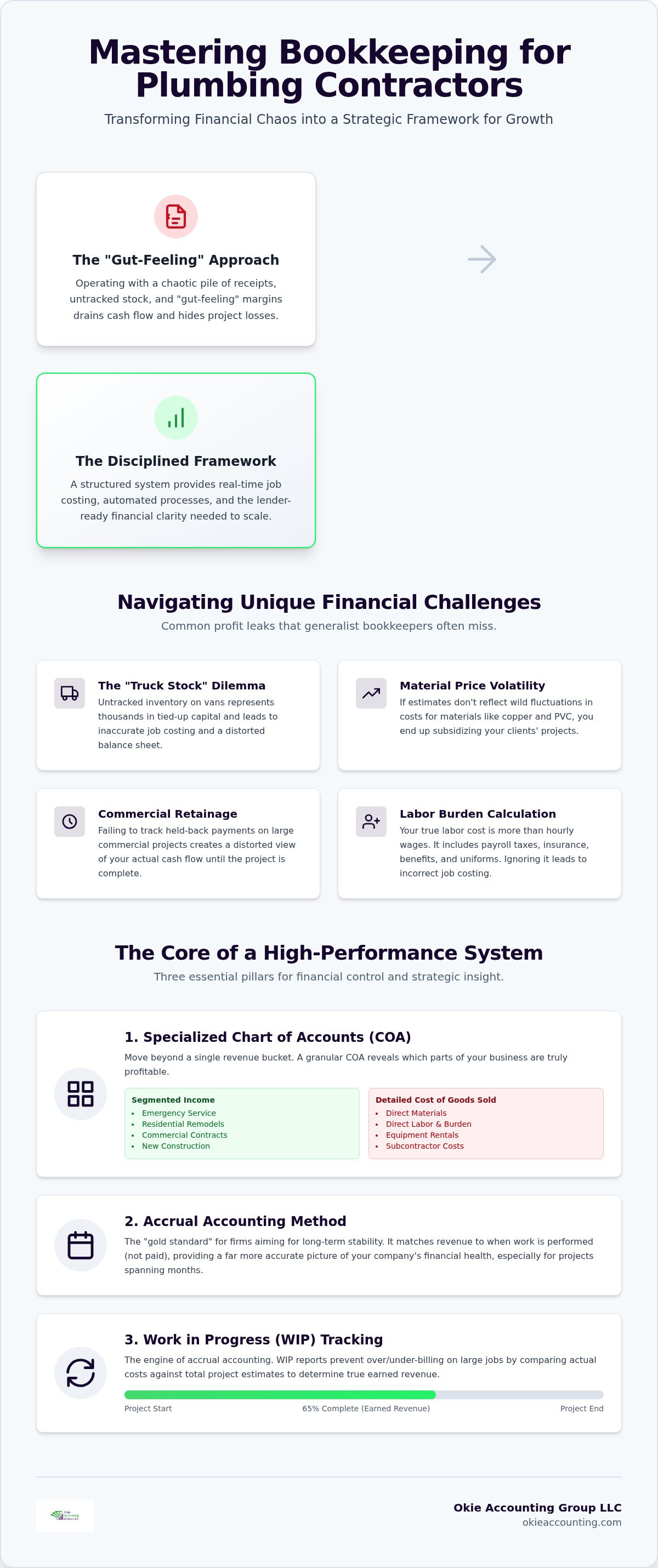
One of the most common profit leaks is the "Truck Stock" dilemma. When inventory sits on a van without being tracked to a specific job, your balance sheet becomes a work of fiction. These unrecorded materials represent thousands of dollars in tied-up capital. Without a disciplined system to log parts used on-site, you'll find yourself wondering why your bank account doesn't reflect your high volume of service calls.
Managing Material Price Volatility and Retainage
Material costs for essentials like copper and PVC can fluctuate wildly within a single quarter. If your estimates don't reflect these shifts, you're essentially subsidizing your clients' projects. For those in the commercial sector, retainage adds another layer of complexity. Since a portion of your payment might be held back until the end of a project, failing to track this separately creates a distorted view of your cash flow. Following established Construction Accounting Principles ensures that these lumpy payments are handled with the same rigor as your daily service calls. Proper management accounting allows you to identify profit bleed in long-term contracts before it becomes a terminal issue for your firm.
Labor Burden: More Than Just Hourly Wages
Your payroll expenses go far beyond the hourly rate you pay an apprentice or journeyman. To maintain job costing accuracy, you must calculate your labor burden. This includes payroll taxes, workers' compensation insurance, health benefits, and even the cost of the uniforms your team wears. Labor burden for plumbing contractors is the total cost of employment divided by billable hours. Ignoring these variables means your job costing will always be optimistic and ultimately incorrect. When you understand the true cost of every hour your team spends on a job site, you can price your services with the confidence that every contract is contributing to your bottom line.
Core Components of a Plumbing Bookkeeping System
While the field challenges discussed previously are unique, the solution lies in building a specialized structural framework. Generalist bookkeeping often fails because it treats all plumbing revenue as a single, undifferentiated bucket. To gain true control, you need a system that mirrors the operational reality of your job sites. This starts with a foundation that moves beyond basic data entry and into high-level project tracking.
The Plumbing Chart of Accounts
A robust system for bookkeeping for plumbing contractors starts with a specialized Chart of Accounts (COA). You must categorize income by service type to understand where your firm actually makes money. We recommend segmenting revenue into Emergency Service, Residential Remodels, Commercial Contracts, and New Construction. This level of detail reveals which departments are driving growth and which are draining resources.
Your Cost of Goods Sold (COGS) must be equally granular. It should reflect direct materials, direct labor, and equipment rentals for every project. If you are looking for specific QuickBooks for contractors setup tips, aligning your COA with these categories is the first step toward financial clarity. This structure ensures that your profit and loss statement provides actionable insights rather than just a summary of historical spending.
Accrual Accounting and WIP Management
Many firms start with cash-basis accounting because it's simple. However, accrual accounting is the "gold standard" for plumbing firms aiming for long-term stability. It matches revenue to the period when the work was actually performed, which is vital when projects span several months. This method provides a more accurate picture of your business's health by accounting for earned revenue before the cash hits your bank account.
Work in Progress (WIP) tracking is the engine of this approach. WIP reports prevent you from falling into the trap of over-billing or under-billing on large jobs. By comparing actual costs incurred against your total project estimates, you gain a realistic view of your earned revenue. Following established SBA contracting rules often requires this level of project accounting, particularly if you are pursuing government or large-scale commercial contracts. Monthly reconciliations are essential to protect the integrity of your WIP data, ensuring that labor hours and material costs are correctly mapped to their respective jobs.
Building these systems requires precision and a deep understanding of the trade's specific mechanics. If your current setup feels like a house of cards, you might benefit from a professional diagnostic of your financial systems to identify and fix structural weaknesses.
Job costing: The Heart of Plumbing Profitability
Job costing is the process of tracking every dollar of expense to a specific project. It's the difference between guessing your margins and knowing them. For specialized bookkeeping for plumbing contractors, this isn't an optional administrative task; it's the core of your financial integrity. When you know exactly how much labor and material went into a specific repipe or water heater install, you can stop relying on gut feelings and start making data-driven choices that protect your bottom line.
Reconciling Field Software with Your Books
Many plumbing firms struggle with the integration between ServiceTitan and QuickBooks Online. The most critical task for your bookkeeper is the daily reconciliation of these two systems. A common pitfall occurs within the "Pricebook." If your field software pricebook isn't perfectly mapped to your QuickBooks Chart of Accounts, your financial reporting will be skewed from the start. You'll see income in the wrong categories or material costs that don't align with the reality of your purchases. We focus on ensuring that field invoices match actual bank deposits with 100% accuracy. This prevents "phantom" revenue from appearing on your books while the cash is actually missing from your bank account.
Analyzing Project Margins and Tech Performance
Once your data is clean, you can begin analyzing gross profit per technician. This isn't about micromanagement; it's about identifying your top performers and understanding why some trucks are more profitable than others. In 2026, with apprentice rates around $22 per hour and master plumbers often commanding $135 per hour or more, using a single blended labor rate will destroy your job costing accuracy. You must account for these tiered costs to see your true margins. You should set target gross margins for different work types, such as 60% for service calls and 35% for larger installations. Using QuickBooks classes or tags allows you to track profitability by truck or specific crew in real time.
This granular visibility is essential for construction cash flow management. When you protect your margins at the job level, your overall cash position stabilizes. You can then use this historical job costing data to refine your bidding process. If the data shows you consistently lose money on certain commercial contracts due to labor overruns or unrecorded truck stock, you can adjust your future estimates. This proactive approach ensures every new contract is a strategic win for your firm's growth.
Implementation: Building Your Cloud-Based Financial Infrastructure
Establishing a robust system for bookkeeping for plumbing contractors requires a deliberate, step-by-step implementation strategy. You cannot build a reliable financial house on a foundation of messy historical data. The first step in our methodology is a comprehensive QuickBooks diagnostic and cleanup. We identify unreconciled merchant fees, miscategorized material purchases, and orphaned invoices that distort your true financial position. Once the historical data is accurate, we transition to training your internal office team. Providing your staff with personalized QuickBooks training ensures that daily data entry remains clean, preventing the "garbage in, garbage out" cycle that plagues many growing firms.
Selecting the Right Tech Stack
QuickBooks Online serves as the preferred financial hub for mobile plumbing firms because it allows for real-time data access from the field. However, the software only works if it's part of a construction-specific tech stack. This stack must include your field service management software and a sophisticated payroll provider. In the plumbing trades, your payroll system must do more than just cut checks; it needs to handle multi-state compliance and integrate directly with your job costing reports. This integration allows you to see the true labor burden of every service call or installation without manual spreadsheets. By automating these connections, you reduce administrative overhead and eliminate the risk of human error in your financial reporting.
The Monthly Financial Review Process
Structural financial oversight is maintained through a disciplined monthly reporting rhythm. We believe every plumbing business owner should receive a "Board Package" by the 15th of each month. This package includes your Profit and Loss statement, Balance Sheet, and Statement of Cash Flows. These documents aren't just for your files; they are tools for strategic decision-making. We help you interpret the "So What?" behind the numbers, such as why your material costs as a percentage of revenue spiked or why your cash position isn't matching your high sales volume.
This process shifts your mindset from looking back at last month's performance to looking forward with cash flow forecasting. When you have lender-ready financial statements and a clear view of your upcoming obligations, you can make expansion choices with quiet confidence. You stop reacting to bank balances and start managing your firm's growth trajectory. If you're ready to move from administrative chaos to a strategic financial framework, you can schedule a discovery call to discuss your firm's infrastructure needs.
Strategic Partnership: Elevating Your Firm with Fractional Oversight
Many plumbing owners mistake basic data entry for comprehensive financial management. While recording transactions is a necessary administrative task, it doesn't provide the strategic insights required to scale a specialty trade business. Moving beyond standard bookkeeping for plumbing contractors means finding a partner who understands the specific mechanics of your trade. A strategic partner doesn't just look at where your money went; they analyze where it should go next. This transition allows you to shift from being the "chief plumber" who manages every operational leak to a "strategic CEO" who manages a growing enterprise with quiet confidence.
Profit Protection and Financial Readiness
High-level fractional controller services offer the analytical depth of a full-time financial officer without the associated salary and benefits. This level of oversight is critical for building a "lender-ready" financial package. Whether you're seeking a line of credit for material purchases or an equipment loan for a new fleet, banks require more than just basic tax returns. They want to see accurate WIP reports and consistent project margins that prove your business's health. Strategic oversight also serves as a shield for your firm. It identifies internal control weaknesses and fraud risks, ensuring that the profits you work so hard to generate actually stay in your bank account rather than leaking through unmonitored systems.
Scaling with Confidence
Growth in the plumbing industry is capital-intensive. You can't hire a new crew or buy a new truck based on a gut feeling. Disciplined cash flow forecasting provides the data you need to make these choices with certainty. By looking forward rather than backward, you can predict cash shortages before they happen and plan for expansion during peak seasons. This structural financial framework replaces anxiety with operational clarity. You gain the peace of mind that comes from knowing your business is built on a stable, predictable foundation. When you're ready to build this framework for your firm, schedule a consultation with Okie Accounting Group to begin your transformation from a service provider to a strategic market leader.
Securing Your Firm's Financial Future
Transforming your financial records from a source of stress into a tool for growth is the most significant investment you can make in your firm's longevity. By implementing a disciplined framework for bookkeeping for plumbing contractors, you move beyond simple data entry and into the realm of strategic oversight. You've seen how precise job costing and automated field software syncs protect your margins from hidden leaks. These systems don't just keep you compliant; they provide the real-time visibility needed to make confident hiring and expansion choices.
The transition from "chief plumber" to "strategic CEO" requires a partner who understands the unique mechanics of the construction trades. As a QuickBooks Certified ProAdvisor with specialized construction industry expertise, Okie Accounting Group provides the nationwide remote support your business needs to thrive. We are dedicated to building the structural systems that ensure your firm is always lender-ready and profit-protected.
Gain Financial Clarity with Okie Accounting Group today. It's time to take control of your data and build the stable foundation your hard work deserves.
Frequently Asked Questions
Do plumbing contractors really need specialized bookkeeping?
Plumbing contractors need specialized bookkeeping because generalist providers often miss industry-specific nuances like labor burden and truck stock inventory. Specialized bookkeeping for plumbing contractors ensures that every material purchase and labor hour is mapped to the correct project. This level of detail is necessary for accurate job costing. Without it, you can't see your true gross profit per service call, which leads to "hidden" losses that erode your cash flow.
How does job costing help my plumbing business grow?
Job costing drives growth by providing a data-driven roadmap for your bidding strategy. When you track every dollar of expense to a specific project, you identify which types of work are most profitable. This allows you to stop taking on low-margin contracts and focus your resources on high-revenue opportunities. With clear visibility into your project margins, you can hire new crews and expand your fleet with confidence.
Which version of QuickBooks is best for plumbing contractors?
QuickBooks Online is the preferred platform for modern plumbing firms due to its cloud-based accessibility and integration capabilities. While Simple Start might work for solo tradespeople, growing firms typically require QuickBooks Online Plus or Advanced. These versions offer advanced features like project tracking and class tracking, which are essential for managing multiple trucks. We specialize in configuring these systems to ensure your financial data flows correctly from the field.
Can you help with ServiceTitan or FieldEdge integration?
Yes, we specialize in reconciling field service management software like ServiceTitan or FieldEdge with your QuickBooks account. These integrations often fail when the Pricebook isn't correctly mapped to your Chart of Accounts. We ensure that your field invoices, material costs, and labor hours sync seamlessly without manual data entry. This creates a single source of truth for your financial reporting, allowing you to trust the monthly data.
What is the difference between a bookkeeper and a fractional controller?
A bookkeeper focuses on the daily recording of transactions and monthly bank reconciliations to ensure data accuracy. In contrast, a fractional controller provides high-level financial strategy and oversight. While the bookkeeper maintains the general ledger, the controller focuses on cash flow forecasting, internal controls, and interpreting financial data to drive business decisions. This strategic partnership moves you beyond basic administration and toward long-term stability and profit protection.
How much does bookkeeping for a plumbing company typically cost?
The cost of bookkeeping services for a plumbing company depends on your transaction volume, the number of employees, and the complexity of your job costing needs. We don't provide flat-rate pricing here, but we focus on delivering a high return on investment through profit protection. Investing in professional oversight is often more cost-effective than the "hidden" costs of inaccurate data, such as missed billables or unrecorded inventory.
Do you provide payroll services for plumbing crews?
We provide comprehensive payroll management services specifically designed for plumbing crews and construction teams. Our system handles the complexities of tiered labor rates for apprentices and master plumbers while ensuring compliance with federal and state regulations. We integrate your payroll data directly with your job costing reports, providing you with real-time visibility into your true labor burden. This automation reduces administrative errors and ensures your team is paid on time.
Can you help me get my books ready for a bank loan?
Yes, we help you build a "lender-ready" financial package to support your next equipment loan or line of credit. Banks and bonding companies require accurate, accrual-basis financial statements that prove your business's health and repayment capacity. We prepare comprehensive financial reporting, including P&L statements and balance sheets, that meet professional standards. This level of financial readiness demonstrates to lenders that your plumbing firm is a disciplined operation.


Comments