
Mastering Construction Accounts Payable: 2026 Guide

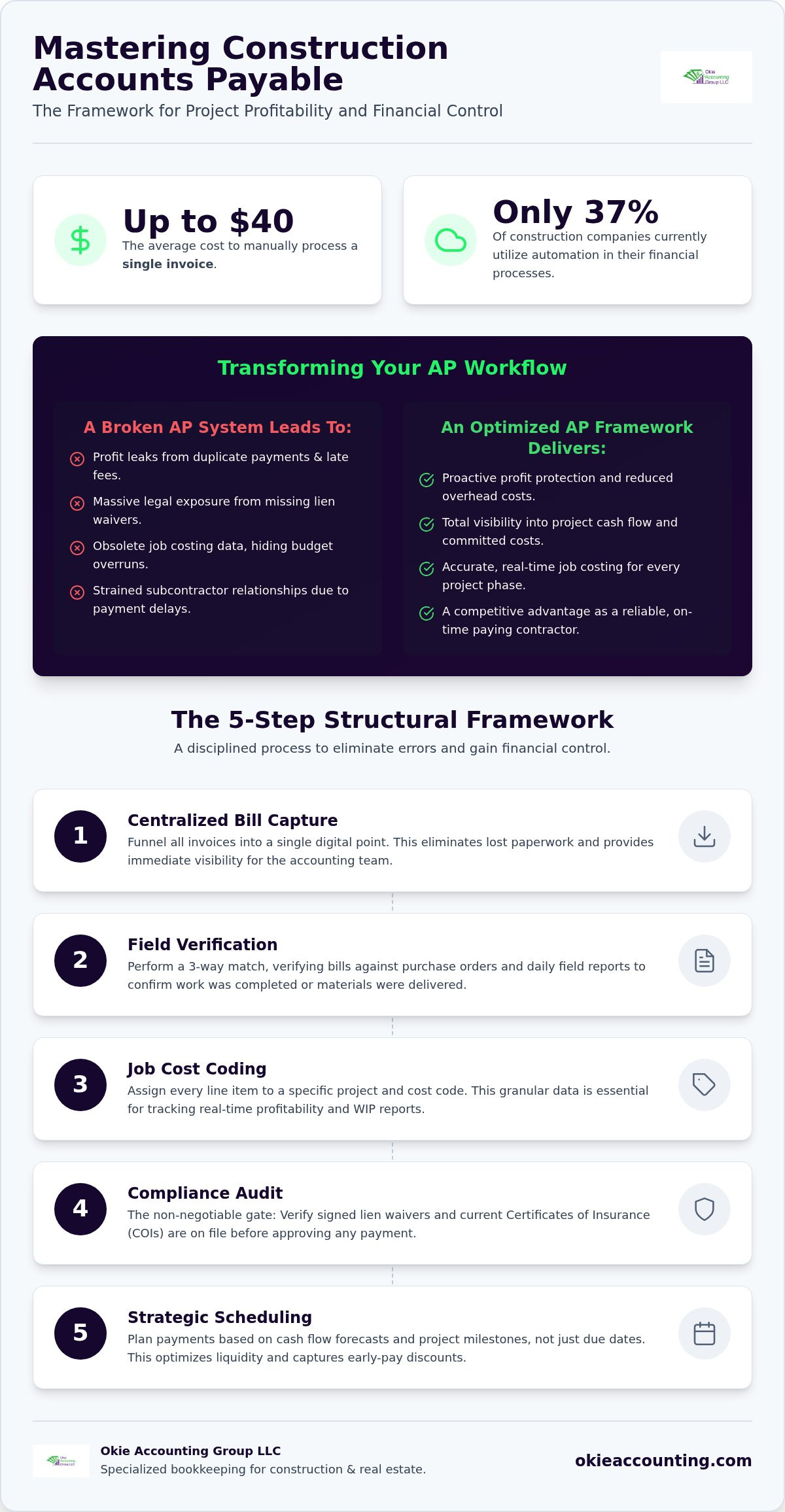
Did you know that manually processing a single invoice can cost your firm up to $40? With only 37% of construction companies currently utilizing automation, most builders are unknowingly leaking profit through administrative inefficiencies. Mastering the accounts payable process for construction company is the difference between project-level clarity and a mountain of stressful paperwork. You're likely tired of manual data entry leading to overpayments and missing lien waivers creating unnecessary legal risks.
You deserve a financial system that works as hard as your field crews. This 2026 guide provides the roadmap to transform your AP workflow from a chaotic chore into a disciplined, automated framework. We'll show you how to achieve accurate job costing for every invoice and gain total visibility into your project cash flow. We are moving beyond basic administrative tasks to establish the strategic oversight and profit protection your business needs to thrive. From leveraging new tax incentives like reinstated bonus depreciation to implementing rigorous internal controls, you'll learn how to build a foundation for long-term stability.
Why Your Construction Accounts Payable Process Dictates Project Profitability
Construction is a project-based industry where financial health depends on granular tracking. While a retail business might group expenses into broad categories, your firm requires a specialized accounts payable process to ensure every dollar is attributed to the correct cost code, phase, and project. This isn't just about administrative compliance; it's about structural integrity. When you optimize the accounts payable process for construction company operations, you move from reactive bill-paying to proactive profit protection.
Disorganized tracking leads to profit leaks that are often invisible until the end of a project. If an invoice sits on a supervisor's truck dashboard for two weeks, your job costing data is already obsolete. This delay prevents you from seeing if a project is trending over budget while there's still time to course-correct. Additionally, maintaining a disciplined system fosters subcontractor trust. In a market where labor is scarce, being the contractor who pays accurately and on time is a competitive advantage. The accounts payable process for construction company must be more than a digital filing cabinet; it must be a structural framework for your business.
The Cost of a Broken AP System
Manual errors carry a heavy price tag. Research shows manual invoice processing costs between $15 and $40 per document. Without a rigid framework, you risk duplicate payments, missed early-pay discounts, and late fees. Perhaps most critically, failing to collect lien waivers before releasing funds creates massive legal exposure in states like Tennessee and Florida. Construction AP is the gatekeeper of project liquidity.
AP as a Strategic Data Source
A high-functioning AP department provides the data necessary for strategic decision-making. By ensuring real-time bill entry, you gain an accurate view of your committed costs versus your actual spending. This visibility is a core component of professional construction bookkeeping services, allowing you to manage cash flow with precision rather than guesswork. When your AP data is clean, your financial reports become reliable tools for growth rather than just historical records. This transition from manual entry to strategic oversight ensures your firm remains financially resilient through every project phase.
A 5-Step Structural Framework for Construction AP
A high-performing accounts payable process for construction company operations depends on more than just software; it requires a rigid, five-step structural framework. This sequence ensures that every invoice is vetted, coded, and verified before a single dollar leaves the bank account. By establishing a predictable rhythm, you eliminate the chaos of missing invoices and the risk of overpayment.
Step 1: Centralized Bill Capture. Funnel all invoices into a single digital ingestion point. This eliminates the "truck dashboard" syndrome and ensures the accounting team has immediate visibility.
Step 2: Field Verification. Match incoming bills against purchase orders and daily field reports. This 3-way match confirms that the materials were actually delivered or the work was performed to standard.
Step 3: Job Cost Coding. Assign every line item to a specific project and cost code. This granular data is the only way to track real-time profitability.
Step 4: Compliance Audit. Verify that lien waivers are signed and subcontractor insurance is current before approving the payment.
Step 5: Strategic Scheduling. Plan payments based on cash flow forecasts and project milestones rather than just the due date.
Verification and Job Cost Coding
Accurate coding is the bedrock of project-based tracking. Invoices must be matched to specific cost codes and project phases to maintain the integrity of your financial reports. When change orders occur, your accounts payable process for construction company must adapt to capture these variations immediately. Failing to code an invoice correctly doesn't just mess up your books; it blinds you to project-specific profit leaks. For a deeper look at industry standards regarding these complexities, consult this comprehensive guide to construction accounts payable.
The Compliance Gate: Lien Waivers and COIs
This step is your primary defense against legal risk and financial exposure. You should never release a payment without a signed lien waiver from the subcontractor. Additionally, tracking Certificates of Insurance (COIs) ensures your firm isn't absorbing the liability of an uninsured vendor. Building internal controls that prevent payment until these compliance documents are verified is a non-negotiable part of a professional framework. If you need help building these rigorous internal controls into your workflow, consider a discovery call to discuss a tailored approach for your business.
Finally, reconciling your AP data weekly ensures that your strategic payment scheduling remains accurate. This disciplined approach moves your firm away from basic administrative tasks and toward a model of strategic financial management. By mastering these five steps, you protect your margins and build a foundation for long-term scalability.
Leveraging QuickBooks Online and Automation for AP Efficiency
Efficiency in the field demands equal efficiency in the back office. For many firms, the accounts payable process for construction company growth is hindered by outdated desktop software or manual spreadsheets. We recommend QuickBooks Online (QBO) because it acts as a centralized hub for project financial data, providing the accessibility required for modern teams. By integrating specialized AP automation tools like Dext or Bill.com, you can eliminate the friction of manual entry and move toward a model of strategic oversight.
Optimizing Your QuickBooks Setup
A generic setup won't suffice for the complexities of job costing. Your chart of accounts must be designed to support project-based AP from the ground up. We utilize 'Classes' and 'Locations' within QBO to track spending across different job sites and departments. This level of detail allows you to see exactly where your capital is deployed at any given moment. If your current system feels disorganized, our software training and setup services can help you build a more robust infrastructure.
The Power of Cloud-Based Ingestion
The transition from paper to digital begins with Optical Character Recognition (OCR) technology. This allows your team to scan or photo-document invoices, which are then automatically read and drafted in your system. It's a significant shift that empowers field supervisors to submit bills instantly from the job site. This real-time ingestion reduces the "paper trail" and ensures you're always audit-ready. Following best practices for managing construction accounts payable means moving away from reactive entry and toward a proactive, cloud-based workflow.
Automated approval workflows further enhance this efficiency. You can set specific rules where project managers only see invoices related to their jobs, saving them hours of administrative work each week. However, software is only as effective as the person operating it. Investing in professional QuickBooks training for contractors ensures your team understands the "why" behind the workflow, not just the "how." This combination of advanced technology and specialized knowledge creates an accounts payable process for construction company resilience that stands up to the demands of a scaling firm.
Preventing Profit Leaks: Compliance, WIP, and Internal Controls
Profit protection in the construction sector requires more than just keeping up with due dates. It demands a rigorous "Three-Way Match" system where every invoice is verified against a purchase order and a field report. This structural framework ensures you only pay for materials received and work performed to your standards. When you implement a disciplined accounts payable process for construction company operations, you close the gaps where capital often disappears through over-billing or vendor fraud.
AP Accuracy and WIP Reporting
Your Work-in-Progress (WIP) report is the most critical document for assessing project health, but it's only as reliable as the data feeding it. Timely AP entry allows for accurate "estimated vs. actual" cost tracking. If bills are entered weeks late, your WIP will show an artificially high profit margin, masking potential losses until it's too late to recover. Our fractional controller services utilize this real-time data to drive construction cash flow management strategies that protect your liquidity. Identifying under-billings is equally vital; if a subcontractor hasn't billed for work completed, your AP data must account for that liability to prevent a sudden cash crunch at project completion.
Establishing Rigorous Internal Controls
Internal controls serve as the defensive line for your firm's bank account. A fundamental rule is the segregation of duties: the person who approves an invoice should never be the same person who authorizes the payment. This simple division significantly reduces the risk of internal theft and vendor collusion. We also recommend setting threshold limits for approvals. For example, invoices under $2,500 might require only a project manager's sign-off, while anything above that amount triggers a mandatory review by a controller or owner. These systems protect your firm from duplicate invoicing and ensure that every dollar spent is a deliberate, authorized choice.
Local compliance also dictates how you manage your workflow. For our clients in Tennessee and Jacksonville, Florida, state-specific lien laws add another layer of complexity. In Florida, tracking "Notices to Owner" within your AP system is essential to avoid double-payment risks. In Tennessee, remote contractors must manage "Notices of Nonpayment" with precision. Failing to integrate these local requirements into your accounts payable process for construction company success can lead to expensive legal disputes that erode your project margins. If you're concerned about profit leaks or compliance gaps in your current system, schedule a discovery call to discuss building a more secure financial framework for your business.
Scaling Your Firm with Professional AP Oversight
Growth in the construction industry is a double-edged sword. As your project list expands, the volume of invoices, compliance documents, and subcontractor payments can quickly overwhelm a DIY bookkeeping approach. There comes a point where the administrative burden of managing the accounts payable process for construction company operations begins to hinder your ability to lead on the job site. Recognizing this transition point is vital for maintaining the structural integrity of your firm's finances.
The Role of a Fractional Controller in AP
A fractional controller does not just ensure that bills are paid on time; they transform your financial data into a strategic asset. By moving beyond basic administrative tasks, our controller services build structural integrity into your workflow. We analyze your AP data to provide accurate cash flow forecasting, which allows you to anticipate funding needs well before they become urgent. This high-level oversight also improves your bidding and estimating accuracy. When you have a precise understanding of your actual material and labor costs from previous projects, you can bid on new work with much higher confidence in your margins. This disciplined approach shifts your focus from reactive firefighting to proactive, data-driven leadership.
Transitioning to a Scalable System
If your current AP history is a collection of messy spreadsheets and overdue notices, the first step toward scaling is a comprehensive system cleanup. Professional oversight provides the methodology needed to reconcile old accounts and establish a fresh, automated workflow. This transition is particularly important if you plan to seek bonding or bank financing. Lenders and sureties require a level of financial transparency that only a rigorous, professional system can provide. They look for clean, project-based tracking that proves your firm is a stable and reliable partner.
The ROI of outsourcing your AP to specialized construction accountants is found in the hours saved and the errors avoided. Generalist providers often struggle with the nuances of retainage, cost codes, and lien waivers, leading to mistakes that can cost your firm thousands. By partnering with experts who understand the unique mechanics of your market, you gain a structural framework for profit protection. You deserve the clarity that comes from professional financial management. Ready to gain clarity? Book your discovery call today to learn how we can help you build a more resilient and scalable financial infrastructure.
Constructing a Foundation for Long-Term Profitability
Mastering the accounts payable process for construction company success requires a transition from manual paperwork to a disciplined structural framework. By implementing centralized digital ingestion and rigorous internal controls, you protect your firm from invisible profit leaks and legal exposure. These systems do more than just pay bills. They provide the real-time data necessary for accurate WIP reporting and proactive cash flow management.
Leveraging cloud-based efficiency through QuickBooks Online optimization ensures your field teams and back office remain perfectly aligned. True stability comes from specialized construction financial expertise and the strategic mentorship from Sarah O'Quinn. With the right systems in place, you can stop fighting administrative fires and start focusing on the high-level growth of your business.
Secure your profit margins with a professional AP framework; schedule your discovery call here. You have the vision to build great things, and we have the structural expertise to help you protect them.
Frequently Asked Questions
What is the difference between accounts payable and job costing in construction?
Accounts payable represents the total amount your firm owes to vendors and subcontractors at any given time. Job costing is the strategic process of assigning those specific costs to individual projects and cost codes. While AP manages your liabilities on the general ledger, job costing provides the granular visibility needed to track project profitability. Every invoice entered into your system must satisfy both functions to ensure your financial reports are accurate.
Why are lien waivers so important in the accounts payable process?
Lien waivers are essential because they provide legal proof that a subcontractor has been paid, preventing them from placing a lien on the project property. In states like Tennessee and Florida, failing to collect these documents can lead to double-payment risks and expensive legal disputes. Integrating waiver collection into your accounts payable process for construction company operations is a non-negotiable internal control. It protects your firm, your clients, and the project's financial integrity.
Can QuickBooks Online handle construction-specific accounts payable needs?
QuickBooks Online is a powerful tool for construction firms when it's configured with a project-based chart of accounts. It handles construction-specific needs like retainage, class tracking, and project profitability reporting quite well. By using cloud-based integrations, you can automate invoice ingestion and ensure that every bill is job-costed in real time. Our specialized QuickBooks training helps contractors in Jacksonville and across Tennessee build these robust systems to maintain total financial control.
How often should a construction company reconcile its accounts payable?
You should reconcile your accounts payable accounts at least once a week. Frequent reconciliation is vital in construction because project costs fluctuate rapidly and material bills arrive constantly. Waiting until the end of the month leaves you with outdated data that can't support proactive decision-making. Weekly checks ensure your Work-in-Progress reports remain accurate and your cash flow forecasts are reliable. This steady rhythm allows you to spot budget overruns before they impact your bottom line.
What are the most common mistakes in construction accounts payable?
Common mistakes include manual data entry errors, failing to match invoices to purchase orders, and missing compliance documents like insurance certificates. Many contractors also struggle with late entries that skew their job costing data, leading to a false sense of project profitability. Another significant error is lack of segregation of duties, where one person handles both approvals and payments. These lapses create profit leaks and increase the risk of internal or vendor fraud.
Should I use a separate software for AP or do it all in my accounting system?
It's best to use automation tools that integrate directly with your core accounting system rather than using a separate, disconnected software. Tools like Dext or Bill.com sync seamlessly with QuickBooks Online, allowing for centralized data management. This approach eliminates the need for double entry and reduces the risk of reconciliation errors. A unified system ensures that your project managers and accounting team are always looking at the same real-time financial data.
How does accounts payable affect my company's bonding capacity?
Bonding companies look closely at your accounts payable aging reports to assess your firm's financial health and management discipline. If your AP is consistently past due, it signals poor cash flow management and reduces your bonding capacity. A clean accounts payable process for construction company operations shows underwriters that you're a low-risk partner with strong liquidity. Maintaining organized financial records and current vendor payments is essential for securing the bonds needed for larger projects.
What is a 'Three-Way Match' and why do contractors need it?
A Three-Way Match is a control process that compares the vendor's invoice against the purchase order and the field receiving report. Contractors need this to verify that the quantities and prices billed match what was actually ordered and received at the job site. This practice prevents over-billing and ensures you aren't paying for defective or missing materials. It's a fundamental part of a rigorous structural framework that protects your project margins.


Comments