
Contractor Accounts Receivable: 2026 Profit Protection

Chasing payments isn't a collection problem; it's a structural failure in your project lifecycle. Most construction firms treat billing as an administrative afterthought, yet they wonder why high Days Sales Outstanding (DSO) creates constant payroll anxiety. If you're tired of unapproved change orders stalling final payments or feeling confused by complex retainage schedules, you're not alone. Managing accounts receivable for contractors requires more than just sending reminders. It demands a rigorous, project-based framework that treats cash flow as a core engineering requirement.
We understand that your expertise lies in building, not in deciphering fragmented financial data. This article promises to show you how to move beyond basic bookkeeping to implement a strategic system that protects your 2026 profit margins. You'll learn how to automate progress billing, reclaim trapped retainage, and establish a predictable cash generation cycle. This guide provides a comprehensive breakdown of the systems required to gain project-level visibility and lower your administrative burden through automated oversight.
What is Accounts Receivable for Contractors and Why Does it Fail?
For construction firms, accounts receivable for contractors represents the entire lifecycle of earned revenue, spanning from the completion of a project milestone to the final bank deposit confirmation. It isn't just a ledger of outstanding invoices; it's a dynamic project-based asset that reflects the structural financial health of your operations. Unlike standard B2B sectors where a sale leads directly to an invoice and payment, construction involves a multi-layered approval process. You're dealing with long payment cycles, complex third-party inspections, and contractual holdbacks that can delay cash for months.
Accounts receivable for contractors represents a dynamic project-based asset that measures the structural integrity of a firm's billing lifecycle, rather than serving as a simple list of unpaid invoices.
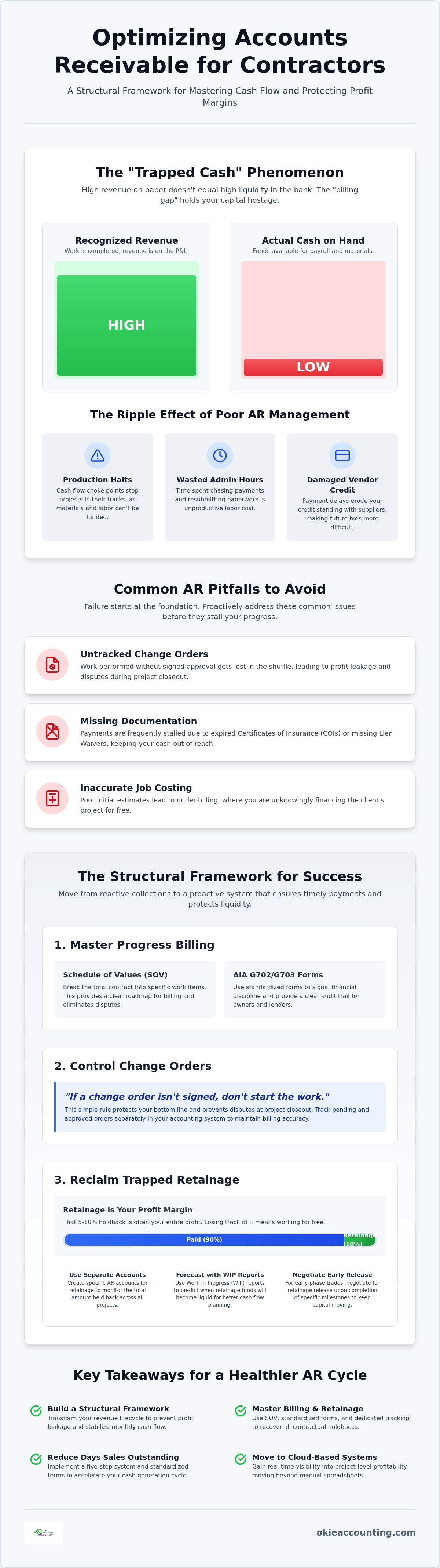
A common frustration for growing firms in 2026 is the "trapped cash" phenomenon. You might see millions in revenue on your profit and loss statement, yet struggle to meet Friday's payroll. This happens because revenue is recognized as work is performed, but liquidity is held hostage by unapproved change orders or slow-moving general contractors. High revenue doesn't equal high liquidity if your capital is tied up in the "billing gap."
The Ripple Effect of Poor AR Management
When collections slow down, the impact is immediate and damaging. Choking project-level cash flow often brings production to a grinding halt, as you can't fund the materials or labor needed for the next phase. There's also a significant hidden cost in administrative chasing. Every hour your team spends on follow-up calls or resubmitting lost paperwork is an hour of wasted labor that should have been spent on strategic growth. For contractors in the Tennessee and Jacksonville, Florida markets, these delays can quickly erode your credit standing with local vendors, making it harder to secure the terms you need for future bids.
Common AR Pitfalls in the Construction Industry
Failure usually starts at the foundation. Inaccurate job costing often leads to under-billing, where you're essentially financing the client's project for free. If you don't track change orders in real-time, they often get lost in the shuffle of a busy site; this leads to disputes during final closeout. Perhaps the most avoidable pitfall is missing documentation. Payment releases are frequently stalled because of expired Certificates of Insurance (COIs) or missing Lien Waivers. Without a rigorous system to manage these requirements, your cash remains out of reach. Managing accounts receivable for contractors effectively requires a proactive stance that addresses these complexities before they stall your progress.
The Structural Framework: Mastering Progress Billing and Retainage
A reliable system for accounts receivable for contractors begins with the Schedule of Values (SOV). This document breaks the total contract sum into specific work items, providing a roadmap for progress billing. By aligning every invoice with the SOV, you eliminate the guesswork that often leads to payment disputes. Professionalizing this process through AIA G702 and G703 forms signals to general contractors and owners that your firm operates with high-level financial discipline. These forms provide a standardized audit trail that simplifies the approval process for architects and lenders alike. Managing accounts receivable for contractors requires this transition from simple invoicing to a disciplined, structural financial infrastructure.
Managing Change Orders to Prevent Payment Stalls
Unapproved change orders are a primary cause of profit leakage. If a change isn't signed, don't start the work; this simple rule protects your bottom line and your sanity. Within your QuickBooks Online environment, you can track pending change orders separately from approved ones. This keeps your progress billing accurate and ensures you never lose sight of unbilled work that has already consumed labor and materials. Strategic tracking prevents the common project closeout scramble where you're forced to negotiate for work performed months ago without proper documentation.
Retainage: The 'Hidden' Profit Protection
Retainage management is where many firms lose their grip on liquidity. That 5-10% holdback is often your entire profit margin on a project. To prevent this cash from vanishing, you must set up separate accounts receivable accounts specifically for retainage. This visibility allows you to monitor the total amount held back across all active projects rather than letting it sit in a general pool. Using Work in Progress (WIP) reports helps you forecast exactly when these funds will become liquid, allowing for better cash flow forecasting. You should also consider negotiating for the early release of retainage once specific milestones are met, especially for early-phase trades like excavation or foundation work. This proactive approach keeps your capital moving rather than sitting idle on a client's balance sheet.
If your current billing process feels like a constant uphill battle, it may be time to move from basic administrative tasks to a comprehensive structural framework that scales with your growth.
Transitioning from Manual Invoicing to Strategic Cash Generation
Scaling a construction firm past the $1M revenue threshold often reveals the inherent fragility of manual systems. While spreadsheets might suffice for a handful of small projects, they quickly become a liability when managing multiple complex contracts simultaneously. Static documents can't provide the real-time visibility required to protect your margins. Transitioning to a cloud-based ecosystem like QuickBooks Online allows you to move from reactive chasing to strategic cash generation. This shift ensures that your accounts receivable for contractors is backed by live data rather than outdated manual entries.
Success in 2026 depends on integrating every project touchpoint into your billing cycle. By linking field reports and time-tracking data directly to your accounting software, you eliminate the lag between work performed and invoices sent. This connectivity provides a clear audit trail, which is essential for Mastering QuickBooks for Contractors and maintaining a healthy cash flow. When your office staff has instant access to field data, the entire billing process becomes a streamlined extension of your project management.
Automating the Mundane, Strategizing the Complex
Automation serves as the first line of defense against late payments. Setting up automated reminders ensures that clients stay informed without straining the professional relationship. Incorporating 'Pay Now' buttons on digital invoices further reduces friction, allowing for immediate ACH or credit card processing. However, automation is not a total solution. Complex disputes or contractual nuances still require the professional oversight of a Fractional Controller. This high-level guidance ensures that while the system handles the routine, an expert handles the exceptions that could otherwise stall your revenue.
The Role of Software Training for Your Office Staff
A structural framework is only as strong as the people operating it. Standardizing your data entry process is vital to prevent the 'garbage in, garbage out' scenario that leads to inaccurate financial reporting. Investing in specialized QuickBooks Online training for your team ensures they understand construction-specific workflows, such as job costing and sub-ledger reconciliation. When your staff is proficient in these tools, they can identify and resolve errors before they escalate into billing disputes. This precision reduces the administrative burden on ownership and builds a foundation of reliability that supports long-term growth.
5 Steps to Reduce Days Sales Outstanding (DSO) in 2026
Reducing DSO requires moving from a passive collection mindset to a proactive operational strategy. In 2026, managing accounts receivable for contractors is won or lost during the contract negotiation and project execution phases, not just at the invoice due date. By treating the billing cycle as a core part of project delivery, you can eliminate the friction that leads to payment delays. Follow these five steps to build a more resilient cash flow structure:
Step 1: Standardize contract language. Be explicit about payment windows, late fees, and mobilization costs to set expectations before the first shovel hits the ground.
Step 2: Implement a rigorous Lien Waiver process. Use these documents as strategic leverage to ensure timely payment releases from GCs and owners.
Step 3: Conduct weekly AR aging reviews. Identify "stuck" invoices early to resolve disputes before they become critical cash flow gaps.
Step 4: Align the field team with the back office. Ensure daily logs and field reports feed directly into your billing cycle to prevent missing data.
Step 5: Partner with a Fractional Controller. Gain the high-level oversight needed to manage complex financial health and long-term stability.
Lien Waivers: The Currency of Trust
Lien waivers are essential tools for maintaining momentum with General Contractors and owners. You must distinguish between conditional waivers, which are provided before payment is received, and unconditional waivers, which confirm payment has cleared. A clean, automated waiver process speeds up the release of funds by removing legal friction. For contractors operating in the high-growth markets of Jacksonville, Florida, and Tennessee, staying current with local 2026 lien laws is mandatory. This protects your right to payment while providing the security your clients require to release funds.
Weekly AR Reviews: The Pulse of Your Profit
Your AR Aging Report is a diagnostic tool, not just a list of late payers. During weekly reviews, look for trends such as specific clients who consistently delay approvals or internal bottlenecks in your document submission process. Implementing a "pre-billing" meeting allows you to review project milestones and necessary documentation before the invoice ever goes out. This reduces the chance of rejection and ensures that accounts receivable for contractors stays current. Setting clear KPIs for your office manager, such as a target DSO range, creates accountability and ensures that cash generation remains a top priority.
Establishing these systems creates the structural integrity your business needs to thrive. If you're ready to transition from chasing payments to strategic financial leadership, schedule a discovery call today to explore how our fractional controller services can stabilize your cash flow.
Scaling Your Firm with Fractional Controller Oversight
As your construction firm scales, the administrative burden of managing accounts receivable for contractors often becomes a bottleneck for growth. Basic bookkeeping serves a purpose, but it's fundamentally reactive. It records historical data without providing the foresight needed to navigate complex, multi-phase projects. To achieve long-term stability, you need a transition from simple data entry to strategic financial leadership. A Fractional Controller provides this high-level oversight by constructing a structural framework that integrates your billing cycle with your broader business goals. This approach ensures that your financial systems are built for scalability, allowing you to manage larger contracts without increasing your administrative stress.
The difference between a bookkeeper and a controller lies in the application of data. While a bookkeeper ensures that invoices are sent, a controller ensures those invoices represent a healthy, predictable cash cycle. At Okie Accounting Group LLC, we focus on building the foundational systems that move your firm beyond basic administration. This specialized oversight is the strategic framework for scaling your firm, providing the clarity you need to make data-driven choices about your company's future.
From Service Provider to Strategic Partner
A strategic partner doesn't just list unpaid invoices; they interpret AR data to inform accurate cash flow forecasting. By analyzing client payment history, a controller can offer critical advice on project selection. This helps you avoid general contractors who habitually delay payments or projects with unfavorable retainage terms. This level of insight is particularly vital for firms in Tennessee and Florida, where managing profit margins requires constant vigilance against material price volatility. When you understand the pulse of your accounts receivable for contractors, you can pivot your strategy to protect your bottom line before market shifts impact your liquidity.
Ready for Financial Clarity?
Achieving financial clarity means having lender-ready financials and clean books at your fingertips. This readiness is essential when seeking bonding for larger projects or securing lines of credit for expansion. If your current AR process is a fragmented mix of spreadsheets and manual follow-ups, it's time to transition into a streamlined, automated system. This transformation provides the peace of mind that comes from knowing your revenue lifecycle is managed with professional discipline. You can move away from the anxiety of "trapped cash" and toward a future of operational confidence. To begin optimizing your systems, book a Discovery Call with Sarah O'Quinn to discuss how we can stabilize your firm's financial health.
Building a Resilient Financial Future
Scaling a construction firm requires more than quality craftsmanship; it demands a disciplined approach to your revenue lifecycle. By moving away from fragmented spreadsheets and adopting a structural framework for progress billing, you transform your financial data into a strategic asset. Mastering accounts receivable for contractors is the essential final step in ensuring your firm's long-term health and operational confidence. When you treat your billing cycle with the same precision as your project engineering, you eliminate the anxieties of "trapped cash" and payroll uncertainty.
Our team at Okie Accounting Group LLC brings specialized construction and real estate expertise to every partnership. We combine deep Tennessee and Florida local market knowledge with proactive fractional controller oversight to help you navigate complex billing cycles and material volatility. You don't have to manage these financial pressures alone. With the right systems in place, you can move from chasing payments to leading a scalable, profit-protected business. We're here to help you build the foundational systems that turn your revenue into realized profit.
Secure Your Profit Margins: Book Your Discovery Call Today. We're ready to help you build a more stable and predictable future for your firm.
Frequently Asked Questions
What is a good Days Sales Outstanding (DSO) for construction companies?
A healthy DSO for construction firms typically ranges between 45 and 55 days. While the industry average often trends higher due to contractual holdbacks, staying within this window ensures you have the liquidity to fund labor and materials for upcoming phases. In high-growth markets like Jacksonville, Florida, monitoring this metric is vital for maintaining strong vendor relationships and avoiding the "trapped cash" phenomenon that stalls project momentum.
How do I track retainage in QuickBooks Online for my contracting business?
You should track retainage by creating a specific "Retainage Receivable" account under the Other Current Asset category in your Chart of Accounts. When you generate an invoice, use a dedicated service item linked to this account to record the 5% or 10% holdback as a negative line item. This structural approach keeps the funds visible on your balance sheet without inflating your current cash expectations until the project reaches closeout.
Should I charge late fees on construction invoices?
Yes, charging late fees is an authoritative way to protect your profit margins and encourage timely payments. You must explicitly state these terms in your initial contract and display them clearly on every invoice sent. For contractors in Tennessee, having a standardized fee structure provides necessary leverage during the collection process. It signals to your clients that you value professional discipline and expect your payment terms to be respected.
What is the difference between progress billing and milestone billing?
Progress billing is based on the percentage of completion for specific tasks within a Schedule of Values. Milestone billing triggers an invoice only after a major project stage is entirely finished. Progress billing is generally the preferred method for accounts receivable for contractors because it provides steady cash infusions throughout the project lifecycle. This prevents your firm from financing labor and material costs out of pocket for months at a time.
How do lien waivers affect my accounts receivable process?
Lien waivers serve as the currency of trust in the construction billing cycle. Providing a conditional waiver with your invoice proves that you're prepared to release your lien rights once payment is received. This removes legal friction and speeds up the approval process from general contractors and owners. A rigorous waiver management system is a cornerstone of a structural framework that prevents administrative delays and protects your cash flow.
When is it time to move from a bookkeeper to a fractional controller?
You should move to a fractional controller when your firm outgrows basic data entry and requires strategic financial leadership. If you're managing multiple large-scale projects but lack clear visibility into project-level profitability or cash flow forecasting, a bookkeeper isn't enough. We provide the high-level oversight needed to interpret complex data and build the foundational systems that support long-term stability and scalability for your growing business.
Can Okie Accounting help with my existing QuickBooks cleanup?
Yes, Okie Accounting Group specializes in QuickBooks setup and training, which includes the comprehensive cleanup of fragmented or inaccurate financial data. We help contractors in the Florida and Tennessee markets fix historical errors in job costing and sub-ledger reconciliation. Our team establishes a clean, reliable foundation so your financial reports provide the immediate clarity required to make data-driven choices for your firm's future.
What are the common reasons construction invoices get rejected?
Invoices are frequently rejected because of missing lien waivers, expired insurance certificates, or discrepancies with the approved Schedule of Values. If the billing amount doesn't perfectly align with the project milestones, the client's accounting system will stall the payment release. Managing accounts receivable for contractors effectively requires a meticulous review of all supporting documentation before submission. This proactive stance ensures that your revenue moves quickly from earned to collected.


Comments