
Residential Construction Accounting: Profit Protection

Most residential builders don't lose their margins during the build; they lose them in the ledger long before the first shovel hits the dirt. You've likely felt the sting of profit fade on a long-term custom project or the headache of reconciling complex bank draws and retainage. It's exhausting to manage a high-stakes site while feeling like you're guessing at your actual project profitability. We understand that your expertise is in building homes, not wrestling with spreadsheets that never seem to balance.
Professional accounting for residential construction is the structural framework that protects your business's long-term health. By moving beyond basic administrative tasks, you can implement a disciplined system that provides real-time data and lender-ready financial statements. This guide will show you how to master job costing and navigate critical updates like IRS Revenue Procedure 2026-32. You'll learn to manage cash flow with precision, eliminate the chaos of mixed expenses, and build a scalable financial engine that supports your growth without sacrificing your sanity.
Why Residential Construction Accounting Requires a Specialized Structural Framework
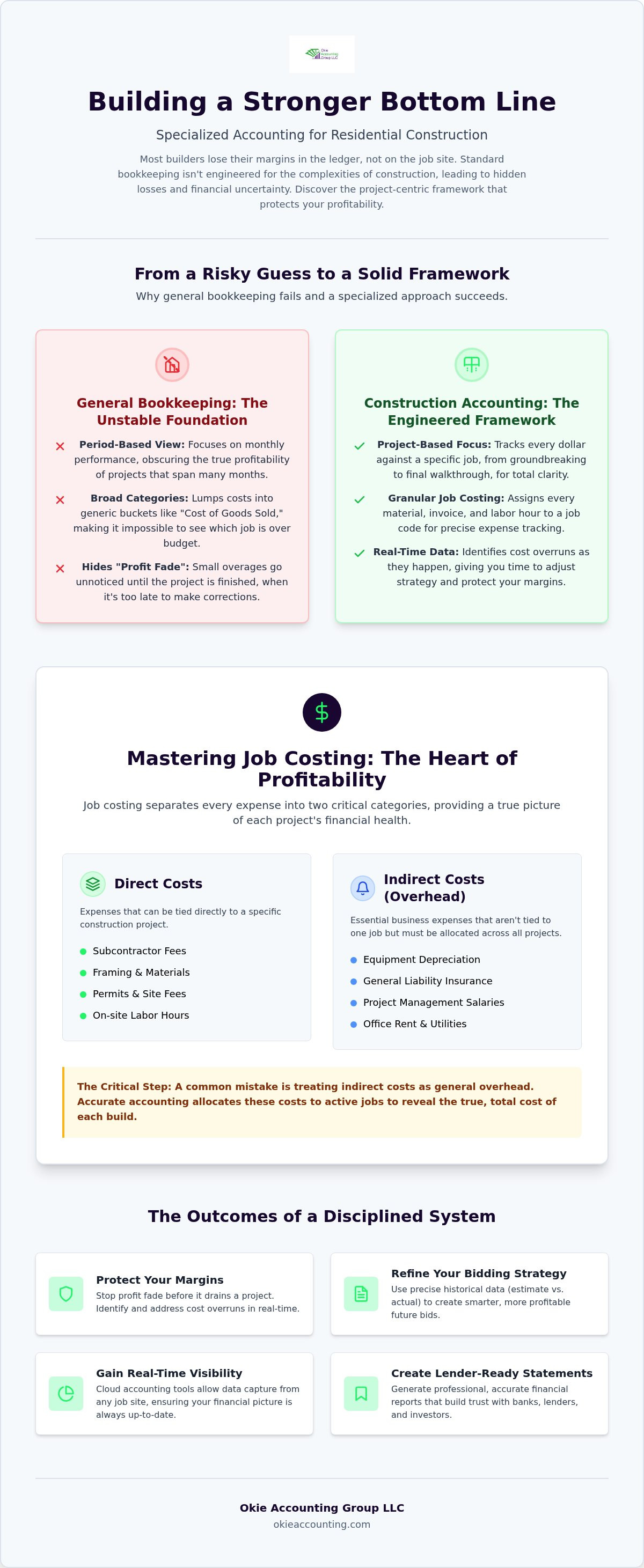
You wouldn't attempt to frame a custom home using the same structural requirements as a backyard shed. The scale, complexity, and risk involved demand a higher level of engineering. The same logic applies to your financial records. General bookkeeping treats your business as a single entity moving through time, but effective accounting for residential construction is a project-centric discipline. It tracks every material delivery, subcontractor invoice, and labor hour against an individual build rather than a simple monthly calendar.
Standard bookkeeping often fails because it lacks the granularity required to manage the unique mechanics of the building sector. When your data is lumped into broad categories like "Cost of Goods Sold" without being tied to a specific job, you lose visibility. You might see that you spent $50,000 on lumber this month, but without a specialized construction accounting framework, you can't tell which project consumed those resources or if that spend aligns with your original estimate. This lack of detail is where profit margins begin to erode.
We view your accounting system as a structural framework that should mirror the physical integrity of the homes you build. Just as a load-bearing wall supports the weight of the roof, your financial systems must support the weight of your operational decisions. This requires a shift from centralized office accounting to a system that accounts for decentralized production across multiple job sites. Your office is the hub, but your financial reality is being created out in the field.
Project-Based vs. Period-Based Accounting
Traditional accounting is period-based, meaning it focuses on what happened between the first and last day of the month. While this is necessary for tax compliance, it's insufficient for managing a build that spans six to eighteen months. Project-based accounting serves as the cornerstone of profit protection by ensuring every dollar spent is tied directly to a specific revenue-generating build. This approach allows you to identify "profit fade" early in the construction cycle. If your foundation costs exceeded the estimate by 15%, you'll know immediately, giving you the chance to adjust your strategy for the remaining phases rather than discovering the loss after the keys have been handed over.
The Role of Decentralized Production
Managing costs across various job sites in Tennessee or Florida presents a unique logistical challenge. Unlike a factory where all production happens under one roof, your production is scattered. This decentralized nature makes mobile-ready cloud accounting non-negotiable for modern builders. You need the ability to capture data at the source, whether that's a site supervisor approving a change order or a subcontractor submitting an invoice from their truck. To build this kind of operational clarity, you must invest in Construction Bookkeeping Services that prioritize real-time data entry and cloud-based accessibility. This ensures that your accounting for residential construction remains as agile and mobile as your crews on the ground.
Mastering Job Costing: The Foundation of Residential Profitability
Job costing is the pulse of your business. In the specialized field of accounting for residential construction, it's the mechanism that transforms raw data into actionable intelligence. Without a rigorous job costing system, you're essentially building in the dark, hoping that the final check from the homeowner or lender covers the accumulated costs. Precision starts with categorizing every dollar into specific buckets to ensure no expense goes untracked.
Refining your bidding strategy is the ultimate goal of this process. By comparing estimated costs against actual expenditures at the end of every project, you create a vital feedback loop. This data-driven approach allows you to spot patterns, such as consistently underestimating site prep or specialized plumbing fixtures. It turns your accounting from a historical record into a strategic tool for future growth. If you're struggling to get this level of detail from your current books, you might benefit from a professional review of your job costing systems.
Direct vs. Indirect Cost Allocation
Every nail, board, and labor hour must be assigned to a specific project code. Direct costs like subcontractor fees and framing materials are usually easy to identify. However, indirect costs often slip through the cracks and quietly erode your margins. Equipment depreciation, general liability insurance, and project management salaries must be allocated across your active builds to reflect true profitability. A common mistake is treating these as general overhead, which hides the real cost of a high-maintenance custom home. Accurate allocation ensures your financial statements align with professional standards like Revenue recognition for contractors, providing a clear view of your financial health.
Managing Change Orders and Residential Draws
Change orders are the most frequent source of profit fade in residential work. If you don't account for them in real-time, they quickly eat your margin. Each change should be documented, priced, and billed before the work begins to maintain clarity with the client. Similarly, your bank draws must align perfectly with project milestones. Tracking these draws against actual costs allows you to maintain a healthy cash position throughout the build. This is where fractional controller services become invaluable. They provide the professional oversight needed to verify draw requests against real-time data, ensuring you aren't funding the bank's project with your own hard-earned capital.
Revenue Recognition and WIP: Navigating Complex Financial Statements
Revenue recognition is where many builders stumble because it requires looking past the bank balance to see the true financial health of a project. In accounting for residential construction, you don't simply record revenue when a check arrives. You must match that revenue to the specific costs incurred during a reporting period. Most custom home builders utilize the Percentage of Completion Method (PCM), which recognizes revenue based on the progress made toward finishing a build. This ensures your profit and loss statement reflects the actual work performed, rather than just the timing of client payments.
While PCM is the industry standard for long-term builds, the Completed Contract Method (CCM) might be appropriate for smaller, short-term projects that wrap up within a single tax year. Regardless of the method, you must account for retainage, which is the 5% to 10% withheld by a client or lender until the final walkthrough is approved. Retainage isn't just "lost money"; it's a contract asset that must be tracked meticulously on your balance sheet to ensure your eventual payout is protected.
The WIP Schedule: Your Profitability Pulse
The Work in Progress (WIP) schedule is likely the most important report your general bookkeeper isn't running. This report compares your total estimated costs and billings against your actual costs and billings to date. It reveals whether you are over-billed (holding the client's money for work not yet done) or under-billed (funding the project out of your own pocket). Lenders in Jacksonville and across Tennessee demand these schedules because they show a builder's ability to manage a project's lifecycle without running out of cash. To master these reports, you can explore our guide on Understanding Construction Financial Statements, which breaks down the reporting infrastructure needed for growth.
ASC 606 and Residential Revenue Recognition
The ASC 606 standard introduced a five-step model that changed how contractors recognize revenue. It starts by identifying the contract and specific performance obligations, such as the foundation, framing, and finishing phases. By allocating the transaction price to these milestones, you can recognize revenue as each obligation is satisfied. For a custom home build, this might mean recognizing a portion of the total contract value once the "dried-in" phase is complete. ASC 606 ensures reporting consistency by providing a standardized framework for recognizing revenue across all construction contracts regardless of project size or duration. This level of discipline makes your financial statements lender-ready and provides the clarity needed for high-level strategic planning.
Building Your Financial Infrastructure: QuickBooks Setup for Home Builders
While massive enterprise systems are often marketed to heavy highway firms, they're usually overkill for the residential sector. QuickBooks Online serves as the ideal structural base for accounting for residential construction because it balances user-friendly accessibility with professional reporting. It provides the cloud-based flexibility your field teams need while maintaining the rigorous data integrity your lenders demand. Establishing this infrastructure requires a methodical setup that aligns your digital records with your physical builds.
Customizing Your Chart of Accounts
Your Chart of Accounts (COA) is the foundation of your entire ledger. You must distinguish clearly between "Cost of Goods Sold" (direct project costs) and "Expenses" (general business overhead). Residential builders need specific categories for land acquisition, permits, and vertical construction costs to ensure accurate project tracking. If these are lumped together, you'll never truly know your margin on a specific house. For a detailed roadmap and templates, refer to our guide on Mastering QuickBooks for Contractors.
Once the COA is established, you must configure your "Products and Services" to map to these accounts. This allows you to record granular details like framing labor or plumbing fixtures without cluttering your main financial statements. Integrating field-management tools with your accounting software further streamlines this process. By syncing site data directly with QuickBooks, you eliminate double-entry and ensure your job costs are updated in real-time. Finally, you must establish a monthly financial review process to verify that every transaction is coded correctly and project milestones are being met.
Fractional Oversight vs. Basic Data Entry
Software setup is only half the battle; the real value lies in strategic oversight. A well-configured system can still produce "garbage in, garbage out" data if your team lacks the proper discipline. This is why we emphasize QuickBooks Training for Contractors to ensure your staff understands the "why" behind the data entry. A disciplined system allows you to transition from reactive bookkeeping to proactive financial leadership. If you're unsure if your current system is working for you or against you, it's time for a professional assessment. Schedule a Discovery Call to audit your current QuickBooks setup and ensure your financial foundation is as solid as your builds.
Scaling Your Firm with Strategic Oversight: The Role of a Fractional Controller
Many builders begin their journey with a reactive "shoebox of receipts" approach, where accounting is a chore handled at the end of the month. As your firm grows, this administrative habit becomes a strategic liability. Transitioning to high-level financial leadership requires a shift from simply recording what happened to planning what comes next. Effective accounting for residential construction at scale involves proactive oversight that protects your margins by catching coding errors or budget overruns before they manifest as bottom-line losses.
A fractional controller acts as a strategic mentor, helping you interpret the complex data generated by your job costing and WIP reports. They ensure your financial engine is running efficiently, which allows you to focus on the job site rather than the ledger. By maintaining rigorous cash flow forecasting, you can confidently ensure you have the capital required for your next project in Tennessee or Florida. Building this lender-ready financial history is what separates a local builder from a scalable construction enterprise.
From Bookkeeper to Strategic Partner
Bookkeeping is the act of recording history; controller services are about planning the future. While a bookkeeper ensures your transactions are coded correctly, a fractional controller analyzes that data to identify trends, risks, and opportunities. This partnership provides CFO-level strategy at a fraction of the cost of a full-time executive hire. Through specialized Management Accounting, you gain the oversight necessary to make data-driven choices regarding equipment acquisitions, labor scaling, and project selection.
Preparing for Construction Loans and Bonding
Lenders and bonding agents look for structural integrity in your financial statements. They don't just want to see a profitable year; they're looking for liquidity, healthy debt-to-equity ratios, and consistent reporting. In the residential sector, a balance sheet that demonstrates your ability to cover short-term obligations is essential for securing favorable construction loan terms. A controller ensures your records are transparent and accurate, providing the professional confidence lenders need to back your expansion. This disciplined approach to accounting for residential construction transforms your books from a tax requirement into a growth asset.
Engineer a Financial Foundation for Sustainable Growth
Protecting your margins requires the same level of structural discipline you bring to your job sites. We've explored how a specialized framework and real-time job costing turn messy data into a strategic asset. By mastering WIP schedules and optimizing your QuickBooks environment, you ensure that every project phase contributes to your financial health rather than eroding it. High-level accounting for residential construction isn't just about tracking the past; it's about engineering a future where your firm is lender-ready and poised for expansion.
As you scale your operations in the Tennessee or Florida markets, you need a partner who understands the unique mechanics of the building sector. Our mentor-led approach provides the cloud-based strategic oversight necessary to catch errors before they become losses. This transition from basic bookkeeping to strategic financial leadership gives you the clarity to make data-driven decisions with confidence. You've built a reputation for quality in the field; it's time your financial systems reflected that same standard of excellence. We're here to help you move from operational chaos to disciplined control.
Book Your Discovery Call for Specialized Construction Accounting Support
Frequently Asked Questions
How is construction accounting different from regular accounting?
Construction accounting is project-based rather than just period-based. Unlike traditional retail, accounting for residential construction tracks costs and revenue for each individual build over its entire lifecycle. This specialized framework ensures that labor, materials, and subcontractor fees are assigned to specific jobs. This granularity is essential for protecting margins on long-term projects in Tennessee and Florida, where costs can fluctuate during the construction cycle and don't always align with monthly reporting periods.
What is the best accounting software for residential construction?
QuickBooks Online is the preferred structural base for home builders due to its cloud-based accessibility and robust reporting. While enterprise software exists, it's often overkill for custom builds. QuickBooks allows your field teams to capture data on job sites while providing the professional financial statements lenders demand. We specialize in QuickBooks setup and training to ensure your data is clean and actionable from the start, providing a solid foundation for your firm's growth.
What are the common accounting methods for construction projects?
The two primary methods are the Percentage of Completion Method (PCM) and the Completed Contract Method (CCM). PCM recognizes revenue as work progresses, which is the industry standard for custom builds spanning several months. CCM recognizes revenue only when the project is finished, which might suit smaller, short-term renovations. Choosing the right method affects your financial presentation and is a critical decision for builders seeking financing or bonding. We help you select the method that best reflects your operational reality.
What is job costing and why is it important for builders?
Job costing is the process of assigning all direct and indirect expenses to a specific project. It's the only way to determine if a house is actually profitable. Within the scope of accounting for residential construction, tracking materials, labor, and overhead at the job level allows you to identify profit fade early. This level of detail transforms your accounting from a simple tax record into a powerful management tool that helps you refine future bidding strategies and protect your bottom line.
Why do residential builders need a WIP schedule?
A Work in Progress (WIP) schedule provides a real-time view of your project's financial health by comparing actual costs and billings against your estimates. It reveals whether you're over-billed or under-billed on a project. Lenders in Jacksonville and across Tennessee require these schedules to verify that you have enough cash to finish the build. Without a WIP schedule, you risk running out of capital before a project is complete, which can stall your production and damage your reputation.
How do I handle retainage in my accounting records?
Retainage should be recorded as a separate line item on your balance sheet to distinguish it from standard accounts receivable or payable. It represents the portion of a contract price withheld until the final walkthrough is approved. Meticulous tracking ensures you don't lose sight of these funds during the final stages of a build. Properly managing retainage protects your cash flow and ensures your project's final payout is fully accounted for when the job is finally closed out.
What is a fractional controller and do I need one for my construction business?
A fractional controller is a strategic mentor who provides high-level financial oversight on a part-time basis. You need one if your firm is growing and you've moved beyond basic bookkeeping needs. They help with cash flow forecasting, internal controls, and interpreting complex data to drive business decisions. This service offers CFO-level expertise at a fraction of the cost, ensuring your financial foundation is solid as you scale your operations and manage more complex residential projects.
How can I make my construction financial statements lender-ready?
To make your statements lender-ready, you must maintain clean balance sheets and accurate WIP schedules that demonstrate liquidity. Lenders in Tennessee and Florida look for healthy debt-to-equity ratios and consistent revenue recognition. Providing transparent, professional reports signals that your business is well-managed and structurally sound. Our fractional controller services focus on building this financial history, making it easier for builders to secure construction loans and bonding for future growth and larger-scale residential developments.


Comments