
Bookkeeping for Real Estate Developers: A 2026 Strategic Framework

Real estate development accounting isn't just administrative maintenance; it's the structural framework for profit protection and lender trust. Specialized bookkeeping for real estate developers requires moving beyond basic data entry to build a system that can withstand the scrutiny of 2026's complex lending environment. You've likely felt the frustration of inaccurate project cost tracking or the stress of a lender draw that doesn't align with your actual field reports. Managing multiple LLCs and capital calls shouldn't be the bottleneck that prevents you from scaling your portfolio.
We understand that your financial data needs to be as robust as your physical builds. This guide provides a strategic framework to help you master job costing, streamline lender draws, and gain the clarity needed to grow your development portfolio with confidence. You'll learn how to build a specialized financial infrastructure that provides lender-ready statements and clear visibility into cash flow for every project phase. We'll examine the transition from basic administrative tasks to a disciplined accounting system that acts as a strategic partner in your long-term success.
The Unique Challenges of Bookkeeping for Real Estate Developers
Real estate development involves a multi-year lifecycle that demands a level of financial precision far beyond standard business operations. Unlike retail or service industries where revenue and expenses align within a monthly cycle, developers manage massive capital outlays today for returns that may not materialize for years. This disconnect creates a fundamental need for specialized bookkeeping for real estate developers that prioritizes long-term asset value over short-term cash flow statements.
Most generalist bookkeepers attempt to apply a "one-size-fits-all" approach to your books. This fails because it doesn't account for the structural framework required to manage multiple entities, complex debt structures, and the granular tracking of every dollar spent on a job site. You aren't just selling a product; you're building a capitalized asset through a series of high-stakes financial maneuvers.
Why General Accounting Systems Fall Short
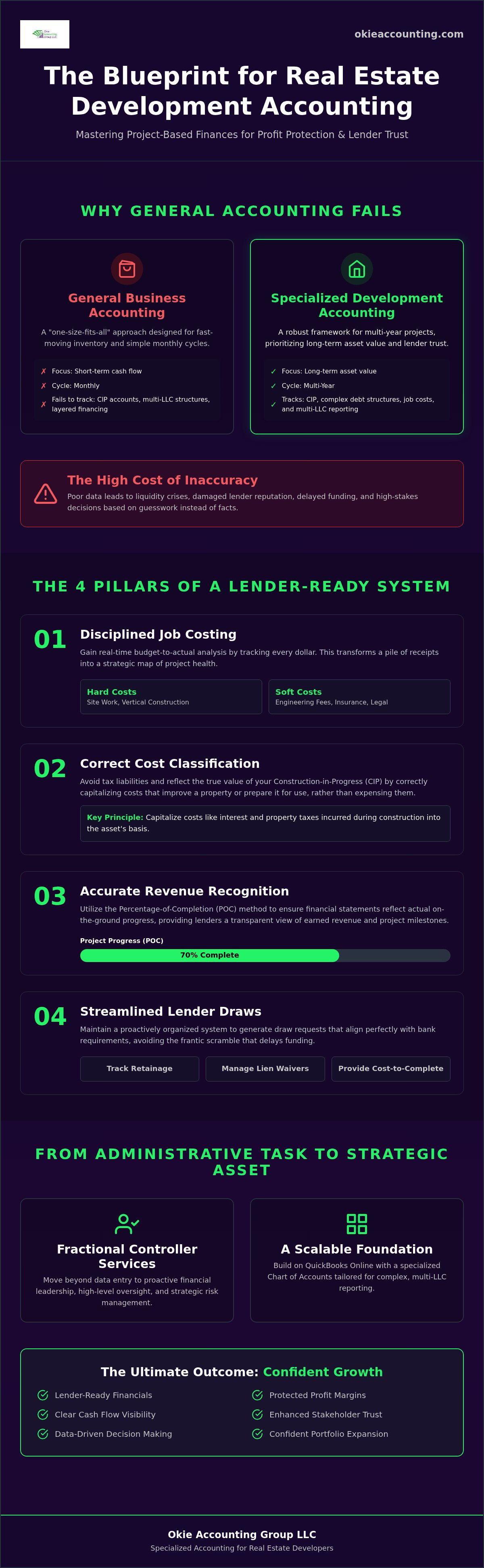
Standard "widget-based" accounting systems are designed to track inventory that moves quickly. They often fail to capture the nuances of construction-in-progress (CIP) accounts, where costs must be capitalized rather than expensed. Generalists frequently struggle with layered financing and equity structures, which is why specialized bookkeeping for real estate developers is non-negotiable for multi-phase projects. Without a specific framework, your software won't reflect the true health of your balance sheet, leaving you with a distorted view of your equity position. This gap in tracking costs by project phase and property simultaneously makes it impossible to provide the granular reporting that modern lenders demand.
The Financial Risks of Inaccurate Development Data
Misallocated costs and inaccurate project tracking create a direct path toward liquidity crises and eventual project failure.
Beyond the immediate risk of insolvency, poor reporting damages your reputation with lenders and equity partners. In 2026, lenders are more cautious than ever. If your financial statements don't provide clear, project-level visibility, you'll find it difficult to secure the draws or capital calls necessary to keep construction moving. This is where fractional controller services become essential, providing the high-level oversight needed to manage these complexities. This lack of clarity triggers immense stress, forcing you to make high-stakes decisions based on guesswork rather than data-driven insights. Establishing a robust financial infrastructure is the only way to protect your profit and maintain the trust of your stakeholders.
Mastering Project-Based Financial Tracking and Job Costing
Rigorous job costing is the heartbeat of successful bookkeeping for real estate developers. It transforms a pile of receipts and invoices into a strategic map of project health. By tracking every dollar by specific project phase, you gain the ability to conduct real-time budget-to-actual analysis. This granular visibility allows you to distinguish between hard costs, such as site work and vertical construction, and soft costs like engineering fees and insurance. Without this distinction, your cost-to-complete projections remain guesswork, jeopardizing your ability to manage capital calls effectively.
Accurate revenue recognition often relies on the Percentage-of-Completion (POC) method. This approach ensures that your financial statements reflect the actual progress on the ground rather than just cash movements. It provides lenders with a transparent view of project milestones and earned revenue, which is vital for maintaining the "lender-ready" state required for continuous funding. If you're struggling to organize these complex layers, you might consider scheduling a discovery call to discuss a more structured approach.
Capitalizing vs. Expensing: Classifying Costs Correctly
One of the most common errors in development accounting is the misclassification of costs. Costs that improve a property or prepare it for its intended use must generally be capitalized into the asset basis rather than expensed immediately. This includes capitalized interest and property taxes incurred during the construction period. Incorrect classification doesn't just skew project profitability; it creates significant tax liability risks. Developers should stay informed on guidelines like IRS Revenue Procedure 2023-9, which provides a safe harbor for certain common improvement costs. Classifying these correctly ensures your balance sheet reflects the true value of your construction-in-progress (CIP).
Navigating Lender Draws and Funding Requirements
The monthly lender draw process is often the most stressful period for a developer. Your accounting system must be organized to generate draw requests that align perfectly with bank requirements. This includes tracking retainage, managing lien waivers, and providing updated cost-to-complete reports. When your bookkeeping for real estate developers is handled proactively, you avoid the frantic scramble for documentation that delays funding. By maintaining a clean trail of hard and soft costs, you demonstrate the financial discipline that builds long-term trust with your capital partners. This structural integrity is what allows you to scale from a single project to a diverse portfolio.
Scaling Through Strategic Fractional Controller Oversight
Scaling a real estate development firm requires a shift in perspective. You've likely reached a point where basic data entry no longer provides the insights you need to make high-stakes decisions. This is where Fractional Controller Services become the bridge between administrative tasks and strategic growth. A fractional controller acts as a dedicated mentor, moving your business beyond reactive bookkeeping to proactive financial leadership. They establish the internal controls necessary to protect your assets as you move from managing two projects to ten. This oversight ensures that your financial readiness is never in question when a new opportunity arises.
Standard bookkeeping for real estate developers often stops at the entry level. It doesn't always account for the strategic implications of your financial data. By implementing rigorous oversight, you ensure that every financial move supports your long-term stability rather than just meeting a monthly deadline. This structural integrity is what distinguishes a lifestyle business from a scalable development powerhouse. It's about building a foundation that can withstand the pressures of rapid growth and market fluctuations.
Managing Multi-Entity Structures and Intercompany Transfers
Developers rarely operate through a single legal entity. Most projects require a dedicated LLC to isolate risk and manage specific equity partners or lender requirements. This structure creates a significant administrative burden. You must maintain separate books for every development LLC while ensuring that intercompany loans and management fee allocations are recorded with precision. Without this discipline, you risk "piercing the corporate veil" or creating tax complications that could have been avoided with better oversight. A controller ensures these transfers are documented and that you have access to consolidated reporting. This provides a clear, unified view of your total portfolio health, allowing you to assess liquidity across all entities simultaneously.
Cash Flow Forecasting for Long-Term Development Cycles
Long-term development cycles mean that cash outflows happen months or years before the first dollar of revenue arrives. Relying on your current bank balance is a recipe for a liquidity crisis. Strategic forecasting uses historical data and project timelines to predict future capital requirements, ensuring you're never caught off guard by a sudden expense. Forecasting acts as "profit protection" for developers by identifying potential cash crunches before they stall a job site. A monthly financial review keeps your strategic direction aligned with your actual performance. It allows you to adjust your pace or seek additional funding with confidence because you're working from data, not intuition.
Building Your Financial Infrastructure on QuickBooks Online
QuickBooks Online (QBO) has solidified its position as the foundational tool for modern development accounting, holding over 62% of the accounting software market as of February 2026. For developers, QBO isn't just a ledger; it's a dynamic platform that supports the multi-entity structures and project-based tracking essential for bookkeeping for real estate developers. By integrating your accounting software with specialized project management tools, you create a single source of truth that bridges the gap between field operations and financial reporting. Professional QuickBooks setup and training ensures your team isn't just entering data, but building a strategic asset that supports your long-term health.
A generic software setup is the primary cause of financial "blind spots" in development. You must move beyond default settings to create a system that mirrors your physical operations and provides immediate clarity. This structural framework allows you to move from granular operational details to the broader implications of your financial health without the need for manual reconciliation.
Professional QuickBooks Setup for Development Projects
Establishing a specialized environment within QuickBooks requires a methodical three-step approach. First, you must configure Classes and Locations for multi-entity tracking. This feature is non-negotiable for developers, as it allows you to run profit and loss statements by project or specific LLC without relying on external spreadsheets. Second, map the Chart of Accounts to match lender and investor reporting needs. Your accounts must capture construction-in-progress (CIP), retainage, and equity draws with precision. Third, establish automated bank feeds for real-time data accuracy. With the QuickBooks Online Plus plan at $140 per month and the Advanced plan at $340 as of August 2026, leveraging these automated features is critical to ensuring your investment provides the necessary data-driven insights.
Training Your Team for Data Integrity
The most sophisticated system will fail if the data entering it is flawed. Empowering your staff to understand the technical nuances of data entry is the first step in maintaining system integrity. Standardized workflows are essential for preventing common bookkeeping mistakes, such as miscoding soft costs or failing to reconcile lender draw accounts. When your team follows a disciplined process, you protect your profits and ensure your financial statements are always lender-ready. For deeper technical insights into managing these workflows, refer to our Mastering QuickBooks for Contractors guide. Building this level of infrastructure requires a partner who understands the unique mechanics of your market. If you're ready to transition from administrative chaos to operational clarity, schedule a discovery call today to discuss your specialized setup.
Partnering for Profit: The Okie Accounting Framework
Okie Accounting Group LLC provides the specialized financial leadership required to move from basic transaction recording to comprehensive profit protection. We understand that bookkeeping for real estate developers is a high-stakes discipline where accuracy directly impacts your ability to secure future project financing. By choosing a partner that understands the mechanics of land acquisition and horizontal construction, you eliminate the learning curve associated with generalist providers. This partnership allows you to focus on sourcing new deals while we maintain the structural integrity of your financial data. For a broader perspective on growth frameworks, review our guide on Accounting for Real Estate Investors.
Our methodology is built on a proactive stance that prioritizes your long-term stability over simple compliance. We adopt a supportive partnership model, ensuring you feel that your complex multi-LLC needs are managed by experts who are as invested in your business's success as you are. This atmosphere of trust is essential when navigating the capital-intensive nature of the development industry. We don't just act as a vendor; we function as a strategic mentor for your firm's financial health.
Transitioning from Data Entry to Strategic Oversight
The onboarding process at Okie Accounting Group LLC begins with a deep dive into your existing project structures to identify any reporting blind spots. We don't just take over your ledger; we reconstruct it to support high-level decision-making. Our monthly bookkeeping and fractional controller services work in tandem to ensure that every project phase is accounted for with precision. This collaborative approach provides the reassurance that your financial readiness is never in doubt, allowing you to move from granular operational details to broader strategic implications with ease. It's a disciplined transition that replaces guesswork with data-driven certainty.
Your Roadmap to Lender-Ready Financials
The ultimate outcome of our framework is the production of clear, professional, and lender-ready financial statements. In a market where capital is increasingly selective, the quality of your reporting can be the deciding factor in your next big development deal. Our systems ensure you have clear visibility into cash flow per project phase, giving you the data-backed confidence to scale your portfolio. We provide the disciplined oversight needed to protect your profit margins and maintain the trust of your equity partners. To start building your foundation for growth, schedule a consultation with Okie Accounting Group LLC to gain control over your project financials.
Securing Your Development Legacy Through Financial Precision
Real estate development is a high-stakes game of margins and timing. Implementing specialized bookkeeping for real estate developers isn't just a back-office requirement; it's a defensive strategy for your capital and a roadmap for your growth. By moving from disconnected spreadsheets to a centralized structural framework, you ensure that every lender draw and capital call is backed by verifiable data. This level of organization builds the trust necessary to move from individual projects to a scalable, nationwide portfolio.
Okie Accounting Group LLC provides the specialized construction and real estate expertise required to navigate these complex environments with quiet confidence. Our remote-first national service delivery ensures you have access to Sarah O Quinn’s strategic financial leadership regardless of where your next project breaks ground. We focus on profit protection and financial readiness so you can focus on the physical build. Your legacy depends on the strength of your financial foundation. Gain financial clarity for your next project with Okie Accounting Group LLC and start building with certainty.
Frequently Asked Questions
What is the difference between general bookkeeping and real estate development accounting?
General bookkeeping tracks monthly income and expenses for standard operations, while development accounting focuses on long-term project lifecycles. Real estate development requires tracking construction-in-progress (CIP) and capitalizing costs rather than expensing them immediately. This specialized approach ensures that the balance sheet accurately reflects the growing value of the physical asset. Without these distinctions, a developer's financial health can look misleadingly poor during the heavy outflow phases of construction.
How does job costing help real estate developers track project profitability?
Job costing provides a granular view of every dollar spent by project phase, allowing developers to compare actual spending against the original budget. It helps identify cost overruns in real-time, such as unexpected site work expenses or materials price hikes. By maintaining this level of detail in bookkeeping for real estate developers, you can make informed decisions about future phases. This visibility is essential for protecting profit margins and ensuring that every project remains financially viable.
Why do lenders require specialized financial reports from developers?
Lenders require specialized reports to verify that their funds are being used appropriately and that the project is progressing according to the loan agreement. They specifically look for Percentage-of-Completion (POC) data and detailed draw requests that align with field inspections. These reports provide the transparency needed to manage risk across multi-million dollar loans. Professional reporting demonstrates that the developer has the financial discipline required to manage complex capital structures and meet debt service obligations.
Can QuickBooks Online handle multiple real estate development entities?
QuickBooks Online is highly capable of managing multiple entities when configured correctly by a specialized professional. Using the "Classes" and "Locations" features allows you to isolate transactions for each specific LLC while maintaining a unified chart of accounts. This structure supports the multi-entity reality of modern development where each project is a separate legal unit. It enables clear reporting for individual equity partners while allowing the developer to see consolidated portfolio health.
What are the benefits of hiring a fractional controller for a development firm?
A fractional controller provides high-level financial strategy and oversight that goes far beyond basic data entry. They help establish internal controls, manage complex intercompany transfers, and lead monthly financial reviews to drive data-backed decisions. For a growing development firm, this strategic mentor offers the expertise of a high-level advisor at a fraction of the cost of a full-time hire. This leadership is vital for navigating the transition from administrative tasks to a comprehensive structural framework.
How often should a real estate developer review their financial statements?
Developers should conduct a comprehensive review of their financial statements at least once per month. This frequency ensures that you catch budget variances before they become insurmountable and that your cash flow projections remain accurate. Monthly reviews allow you to align your physical construction milestones with your financial data, providing the clarity needed to manage capital calls effectively. Regular oversight builds a culture of accountability and ensures that the business remains lender-ready at all times.
What costs should be capitalized during the development phase?
Costs that improve the property or prepare it for its intended use must generally be capitalized into the asset basis. This includes direct hard costs like materials and labor, alongside soft costs such as engineering, permits, and capitalized interest. During the construction phase, property taxes and insurance are also typically capitalized. Accurate classification is critical for both project profitability analysis and financial reporting, as misclassifying these as immediate expenses can distort your true equity position.
How can cash flow forecasting prevent project delays?
Cash flow forecasting acts as an early warning system by predicting future capital requirements months before they occur. It prevents project delays by identifying potential funding gaps that could stall a job site or lead to missed contractor payments. By analyzing historical data and project timelines, developers can ensure they have the liquidity needed for upcoming phases. This proactive approach protects your reputation with vendors and ensures that your construction schedule remains on track throughout the development cycle.


Comments