
Bookkeeping for Remodelers: 2026 Strategic Framework

Most remodeling firms don't fail because of poor craftsmanship; they fail because their financial foundation is built on sand. You've likely felt the sting of a project that looked profitable on paper but left your bank account empty after the final punch list. Between untracked change orders and the constant shuffle of subcontractor insurance certificates, the administrative weight of bookkeeping for remodeling contractors often feels heavier than the demolition phase itself. We understand that your expertise is in transforming spaces, not wrestling with spreadsheets that never seem to balance.
Implementing a specialized accounting system isn't just about recording history. It's about building a structural framework that protects your margins and gives you the clarity to scale with confidence. By mastering the nuances of project-level tracking and the updated 2026 regulatory environment, such as the new $2,000 1099-NEC reporting threshold, you can reclaim control over your firm's future. This strategic framework provides a roadmap to move beyond messy records and into a state of financial readiness. We'll explore how to automate your administrative burden, generate lender-ready financial statements, and finally see the true profitability of every job you touch.
The Unique Landscape of Bookkeeping for Remodeling Contractors
Remodeling isn't a simple retail transaction; it's a complex, long-term production cycle. Unlike a standard service business that collects payment upon completion, your firm manages high material costs and staggered progress payments over months. This volatility makes a standard business ledger insufficient. Professional bookkeeping for remodeling contractors requires a system that captures the granular reality of every site. Remodeling bookkeeping is the systematic tracking of project-specific income and expenses to ensure net profitability.
Effective financial management requires a shift from merely "keeping the books" to building a comprehensive financial infrastructure. While basic administration records history, a robust infrastructure predicts the future. It provides the structural integrity your firm needs to survive tight margins and unexpected site conditions.
Project-Based vs. Traditional Accounting
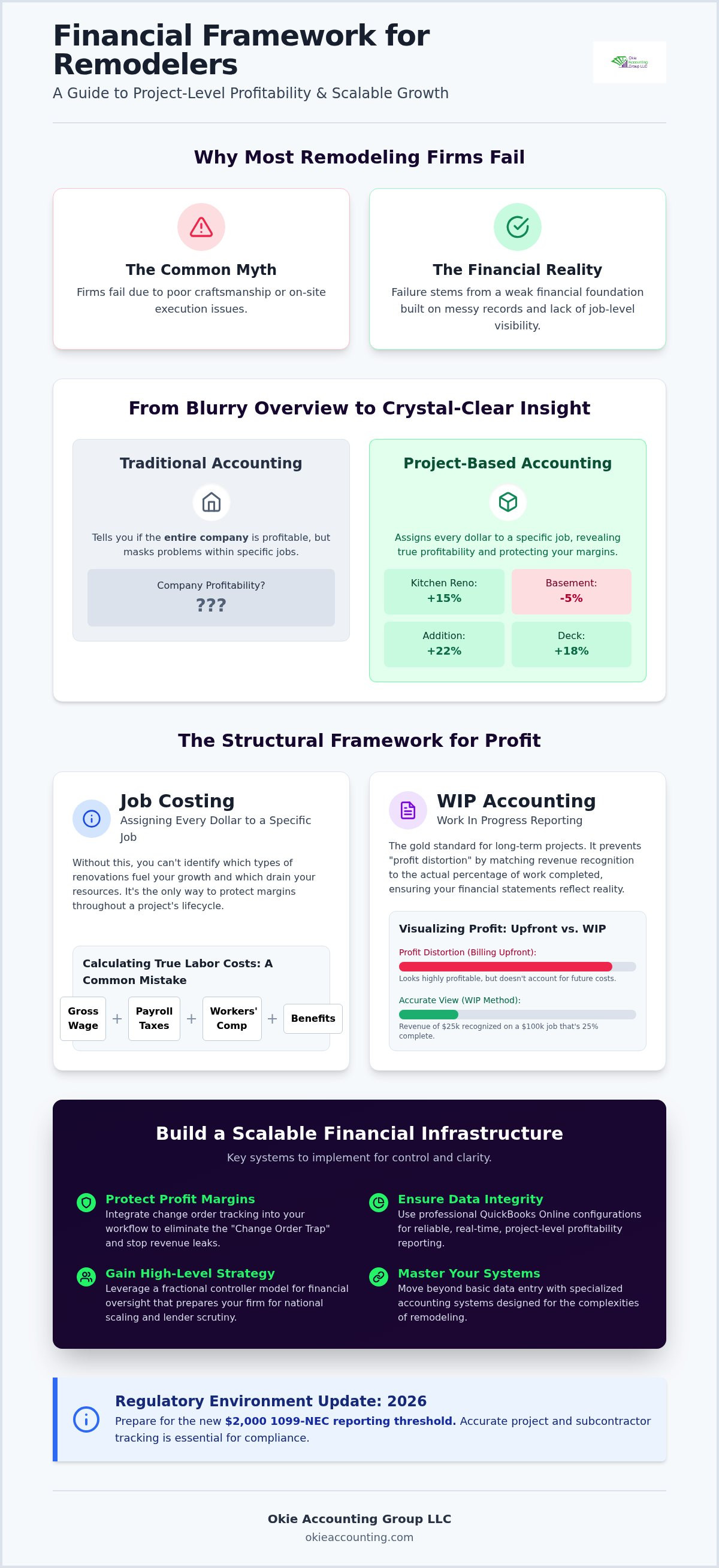
A general ledger tells you if your company is profitable, but it doesn't tell you which projects are draining your cash. Growing remodeling firms often outgrow traditional accounting because they lack visibility into individual job performance. By adhering to specialized Construction accounting principles, you can transition from a "shoebox" method to a professional, cloud-based system. This transition requires a customized Chart of Accounts designed specifically for the construction industry. Professional QuickBooks Setup & Training is the first step in ensuring your data is clean, reliable, and actionable from day one.
The Emotional and Strategic Stakes of Accuracy
Financial clarity does more than satisfy a lender; it alleviates the "anxiety of the unknown" that keeps many contractors awake at night. When you know your exact numbers, you stop guessing and start leading. This accuracy directly influences your bidding strategy. If you don't know your historical costs for a kitchen gut-reno, you can't price the next one with confidence. We position ourselves as a strategic partner in your profit protection. Accurate data allows you to make bold decisions about scaling, hiring, or taking on larger contracts. It moves you from a state of reactive stress to one of proactive, data-driven control.
Job Costing and WIP: The Structural Framework for Profit
Commingling project funds is a silent killer of profitability in the remodeling industry. When you treat your bank account as one big bucket, a surplus from a new deposit can easily mask a loss on a finishing project. Professional bookkeeping for remodeling contractors replaces this guesswork with job costing, the practice of assigning every dollar of labor, material, and subcontracted service to a specific job. Without this granular level of detail, you can't identify which types of renovations are actually fueling your growth and which are draining your resources.
We view job costing not as an administrative chore, but as the structural framework for your firm's financial health. It's the only way to ensure that your margins remain protected throughout the lifecycle of a project. By implementing these systems, you gain the ability to spot red flags in real-time, allowing for course corrections before a project concludes.
Mastering Job Costing in 2026
Accurate job costing requires a deep dive into your labor burden. It's a common mistake to only track the gross hourly wage of your crew. To see your true costs, you must account for payroll taxes, workers' compensation insurance, and benefits. These indirect costs must be allocated proportionally to each project to maintain accuracy. The IRS Audit Technique Guide for Construction provides a foundational look at how these methods should be structured for compliance and operational clarity. Using cloud-based tools like QuickBooks, we can automate this project-level reporting, ensuring your data is always current and lender-ready.
Understanding WIP (Work in Progress) Accounting
Work in Progress (WIP) accounting is the gold standard for firms managing long-term renovations. It prevents "profit distortion" by matching revenue recognition to the actual percentage of completion. If you bill a client $50,000 upfront but have only completed $10,000 worth of work, your books should reflect that liability. WIP reporting helps you spot "under-billed" projects where your costs outpace your invoices, which is a critical step in building construction bookkeeping services that support national scalability. This level of oversight ensures your financial statements reflect reality rather than just your current bank balance. If you're ready to move beyond basic data entry, you might consider scheduling a discovery call to discuss a more strategic approach to your firm's oversight.
Managing Change Orders and Subcontractor Compliance
Remodeling projects are inherently dynamic. Unlike new construction, where you begin with a clean slate, renovation work often reveals hidden structural issues or plumbing defects once the walls are opened. These surprises lead to the "Change Order Trap," a scenario where undocumented field work erodes your profit margins before you even realize a leak has occurred. If you perform work without an approved and recorded change order, your bookkeeping for remodeling contractors quickly becomes a work of fiction. A change order is a formal amendment to the project scope that must be reflected in the budget and the books immediately.
Integrating this tracking into your daily workflow is essential for profit protection. When a change occurs, it shouldn't just live in a foreman's notebook or an email thread. It must be codified within your financial infrastructure to ensure every hour of additional labor and every extra fixture is billed and accounted for. This structured approach transforms your bookkeeping from a passive recording of the past into an active tool for project management.
The Bookkeeping Workflow for Change Orders
Effective change order management requires real-time updates within your accounting software. By updating the project estimate as soon as a change is signed, you maintain an accurate view of your projected final margin. This allows you to match incoming vendor invoices to specific change order line items, ensuring that no costs are "orphaned" or buried in the original budget. This level of granularity is vital for your cash flow forecast. If you don't know the exact impact of a $10,000 scope increase on your materials budget, you can't accurately predict your firm's liquidity for the next quarter.
Subcontractor Management and 1099 Readiness
Compliance is a non-negotiable pillar of financial stability. You must ensure that every subcontractor payment is tied to current compliance documents, including W-9 forms and Certificates of Insurance (COI). We recommend automating the collection of W-9s before the first payment is issued to avoid the stress of chasing documents during tax season. Tracking insurance expiration dates is equally critical to mitigate your firm's liability and avoid unexpected workers' compensation audit premiums.
Staying ahead of regulatory changes is a core part of our strategic mentorship. For payments made on or after January 1, 2026, the 1099-NEC filing threshold has increased to $2,000, up from the previous $600. While this change reduces the number of filings, it doesn't reduce the need for meticulous record-keeping. Integrating these requirements into a broader construction payroll services framework ensures that your labor costs are always compliant and your margins remain secure. By establishing these foundational systems, you protect your business from administrative bottlenecks and legal exposure.
From Admin Tasks to Strategic Oversight: The Fractional Controller Edge
Many contractors view their finances through the rearview mirror. They see what was spent only after the job is done. Standard bookkeeping for remodeling contractors often stops at data entry, but scaling a firm requires more than just recording receipts. A data-entry bookkeeper focuses on accuracy in the past. A Fractional Controller focuses on the structural health of your future. This distinction is the difference between surviving tax season and building a sustainable, profitable enterprise.
High-level oversight provides the internal controls necessary to prevent fraud and identify waste. A controller doesn't just categorize transactions; they interpret them. They spot trends in rising material costs or declining labor efficiency before these issues become catastrophic. By investing in Fractional Controller Services, you gain a strategic mentor who helps you optimize debt and manage cash reserves. This level of professional discipline ensures that your financial data serves as a roadmap for growth rather than a list of chores.
Budgeting and Cash Flow Forecasting
Relying on your bank balance to make business decisions is a dangerous gamble. A true financial infrastructure includes cash flow forecasting that looks 3 to 6 months into the future. This foresight allows you to decide exactly when to hire a new lead carpenter or invest in a new fleet of trucks. Through specialized Management Accounting, we help you predict cash needs based on your current project pipeline and historical burn rates. This proactive stance eliminates the "feast or famine" cycle that plagues many remodeling firms.
Building Lender-Ready Financials
When you're ready to scale, you'll eventually need a line of credit or a commercial loan. Banks don't look at messy books. They look for consistent, accurate monthly financial reporting that demonstrates a track record of stability. Our Controller Services ensure your balance sheets and P&L statements are always lender-ready. This level of preparation signals to financial institutions that you are a disciplined operator who understands the mechanics of your market. If you are tired of administrative bottlenecks and want to start making data-driven choices, schedule a discovery call today to see how we can strengthen your firm’s foundation.
Implementing a Scalable Accounting System with QuickBooks
QuickBooks Online serves as the digital backbone of modern bookkeeping for remodeling contractors. Its cloud-based nature supports the nationwide remote delivery model necessary for firms looking to expand beyond their local markets. However, the software's effectiveness depends entirely on the structural integrity of its initial configuration. Many contractors suffer from "garbage in, garbage out" data because they rely on a generic setup that doesn't account for the unique lifecycle of a renovation project. A professional implementation ensures that your financial data is accurate, accessible, and ready for high-level analysis.
Beyond the core ledger, your accounting system must communicate with the tools your team uses on the job site. Seamlessly leveraging integrations with project management platforms like Procore or Buildertrend eliminates the need for manual double entry. This connectivity ensures that site-level updates, such as material deliveries or labor hours, flow directly into your financial reporting without administrative delays. For a technical deep dive into these configurations, you can explore our guide on Mastering QuickBooks for Contractors.
QuickBooks Setup for Success
A scalable system requires a Chart of Accounts tailored specifically for remodeling. This includes accounts for Work in Progress (WIP) and Customer Deposits to maintain a clear balance sheet, as discussed in our framework for profit protection. We focus on setting up Products and Services that map directly to your job costing codes, allowing you to track profitability at every stage of the build. Our specialized QuickBooks Setup & Training provides the foundational knowledge your office staff needs to maintain these systems with professional discipline.
Training Your Team for Data Integrity
Financial clarity isn't just an office task; it's a team effort that begins in the field. Your project managers and lead carpenters are the primary sources of data integrity, responsible for real-time receipt capture and accurate time tracking. Without their consistent input, even the most advanced software cannot reflect the true state of your projects. We help you establish a rigorous monthly close process to verify every transaction before the books are finalized. Okie Accounting Group LLC acts as your strategic mentor in this process, providing the training required to master these complex systems. This collaborative approach ensures that your firm remains in a state of financial readiness, prepared for any audit or expansion opportunity.
Building a Foundation for Sustainable Growth
Implementing a disciplined financial framework is the ultimate safeguard for your firm’s longevity. By moving beyond the "shoebox" method and embracing professional bookkeeping for remodeling contractors, you protect your margins and gain the transparency needed to bid with absolute confidence. This strategic framework has outlined the roadmap from basic data entry to high-level oversight, ensuring your business is ready for the scrutiny of lenders and the demands of national growth.
Okie Accounting Group LLC serves as a dedicated partner in this transformation, offering specialized construction accounting and fractional controller services nationwide. We don't just record transactions; we build the foundational systems that allow your firm to thrive in a complex market. If you're prepared to move from administrative complexity to operational control, Gain financial clarity with Okie Accounting Group LLC today. Your expertise builds the projects; our expertise protects the profit.
Frequently Asked Questions
What is the best accounting method for remodeling contractors: cash or accrual?
Accrual accounting is the superior choice for remodeling firms because it matches revenue with the actual expenses incurred during a project. While cash accounting is simpler, it often leads to profit distortion by showing a surplus when you receive a deposit before paying for materials. The accrual method provides the structural integrity needed to see your true financial position, especially during long renovation cycles that span multiple months.
How do I track change orders in my bookkeeping software?
You should update the project estimate within your accounting software as soon as a change order is signed. This ensures your project-level profitability reports reflect the amended scope in real-time. By matching vendor invoices directly to change order line items, you prevent additional costs from being buried in the original budget. This disciplined workflow is essential for protecting your margins and maintaining accurate cash flow forecasts.
Do I need a specialized construction bookkeeper or can a generalist handle my remodeling firm?
A specialized construction bookkeeper is vital because generalists often lack experience with job costing, labor burden, and WIP reporting. Specialized bookkeeping for remodeling contractors ensures that industry-specific complexities, such as tracking subcontractor insurance certificates and managing progress billings, are handled with precision. This expertise transforms your financial data from a simple list of transactions into a strategic tool for firm growth and profit protection.
What is WIP accounting and why is it important for contractors?
Work in Progress (WIP) accounting recognizes revenue based on the actual percentage of project completion rather than just when you send an invoice. This method is critical for remodelers because it prevents financial statements from being skewed by large upfront deposits or delayed billings. WIP reporting helps you identify under-billed projects where costs are outpacing revenue, allowing you to make course corrections before a project concludes.
How can I automate my subcontractor 1099 compliance?
You can automate compliance by using cloud-based systems to collect W-9 forms digitally before issuing the first payment to a vendor. For payments made on or after January 1, 2026, the 1099-NEC reporting threshold has increased to $2,000. Implementing an automated bookkeeping for remodeling contractors workflow ensures you also track expiration dates for Certificates of Insurance, which mitigates your firm's liability and simplifies the year-end reporting process.
What financial reports should a remodeling contractor review every month?
Every month, you should review your Project Profitability report, your WIP report, and an Accounts Receivable Aging report. Additionally, a cash flow forecast looking at least three to six months ahead is necessary for proactive planning. These reports allow you to spot margin erosion early and ensure your firm maintains the liquidity required for upcoming material purchases or payroll. Consistent review of these documents builds financial readiness.
How much should I expect to pay for professional construction bookkeeping?
Fees for professional oversight typically depend on the complexity of your firm's operations and the volume of your monthly transactions. Most specialized firms offer tiered monthly retainers for ongoing bookkeeping or hourly rates for targeted QuickBooks training and setup. While costs vary, investing in specialized financial leadership often pays for itself by identifying hidden waste, optimizing cash flow, and providing the clarity needed to scale safely.
Can QuickBooks handle job costing for complex home renovations?
QuickBooks Online is a powerful tool for job costing when it is configured with a construction-focused Chart of Accounts. It allows you to set up specific Products and Services that map directly to your project categories. When integrated with your project management software, it creates a scalable infrastructure that tracks every dollar of labor and material assigned to a specific renovation. This setup provides the granular data needed for confident bidding.


Comments