
Bookkeeping for Short-Term Rentals: A Strategic 2026 Framework

The most dangerous mistake in property management isn't a bad guest review; it's the invisible erosion of trust caused by commingling owner funds with company capital. You likely feel the weight of this risk every time an OTA batch payout arrives and doesn't quite match your booking records. Reconciling these discrepancies while trying to track true property-level profitability can feel like a full-time job in itself. Mastering bookkeeping for short-term rentals in 2026 requires moving past simple data entry and into a specialized, three-layered structural framework designed for trust compliance and scalable growth.
This guide promises to provide the strategic clarity you need to protect your margins and maintain audit-ready financial statements. We'll show you how to move from basic administrative tasks to constructing a comprehensive system that handles complex multi-layered property accounting with ease. We'll preview the essential separation of tenant, property, and company accounting layers, providing a roadmap to transform messy manual reconciliations into a streamlined, automated workflow. By the end of this article, you'll have the framework necessary to ensure financial readiness and long-term stability for your management firm.
The Unique Complexity of Bookkeeping for Short-Term Rentals
Short-term rental management is often marketed as a hospitality business, but at its core, it's a sophisticated financial stewardship role. When you manage properties for third-party investors, you're acting as a fiduciary. Every dollar that enters your bank account isn't necessarily yours to keep. Effective bookkeeping for short-term rentals requires a system that can isolate guest payments from management fees and owner payouts with surgical precision. Standard retail accounting solutions often fail because they treat every deposit as company revenue, creating a distorted view of your firm's actual financial health.
Professional managers in 2026 can't afford the "plug-and-play" approach. These generic tools lack the structural depth to handle the velocity of transactions inherent in the vacation rental space. Without a specialized framework, you risk the "commingling trap" where guest cleaning fees or occupancy taxes are accidentally used to cover company overhead. This isn't just a clerical error; it's a foundational risk to your business's stability and reputation.
Why Standard Small Business Accounting Fails STR Managers
General accounting software is built for linear sales cycles, not the high-volume, low-duration nature of the modern rental market. A single property might generate fifteen distinct bookings in a month, each with its own set of platform fees, cleaning costs, and tax liabilities. You aren't just tracking sales; you're managing a complex flow of pass-through expenses like linens and maintenance. Because Short-term rental regulations have become increasingly focused on financial transparency, using a basic ledger often leaves managers exposed during a deep-dive review. The commingling trap is the primary regulatory risk where guest funds are mixed with company operating capital, creating a liability that is difficult to untangle.
The Three-Layer Financial Responsibility Model
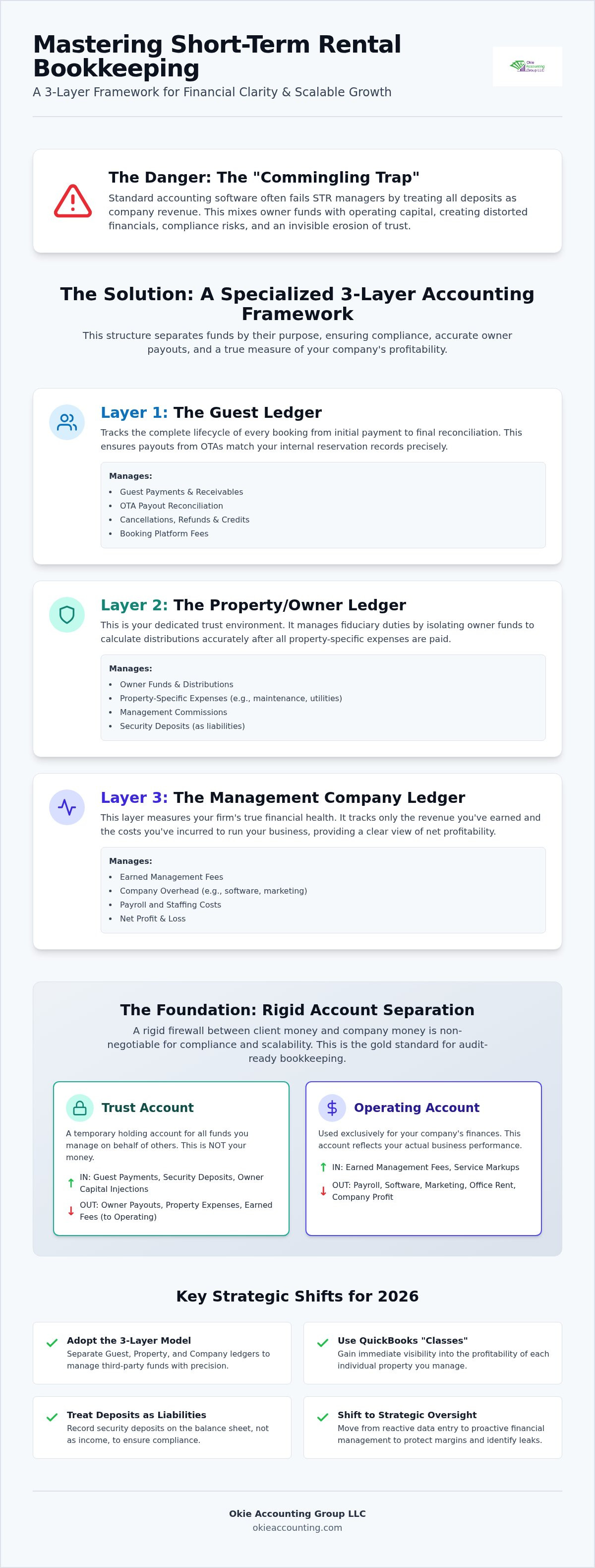
To maintain structural integrity and protect your profit margins, we implement a three-layer framework. This methodology ensures that every transaction is categorized by its ultimate purpose rather than just its point of entry. It moves your firm from basic administrative tasks toward a more robust management accounting standard.
Layer 1: The Guest Ledger. This layer tracks the lifecycle of every booking, including receivables, cancellations, and credits. It ensures that payouts from OTAs match your internal reservation records.
Layer 2: The Property/Owner Ledger. This is your trust environment. It manages your fiduciary duties, ensuring that owner distributions are calculated accurately after deducting property-specific expenses and your management commission.
Layer 3: The Management Company Ledger. This is where your firm's actual health is measured. It tracks your payroll, marketing, and the net profit earned from your services.
By adopting this layered approach to bookkeeping for short-term rentals, you gain the strategic clarity needed to scale. You'll stop wondering if your bank balance represents true profit or just a temporary holding of someone else's money. This level of oversight is what distinguishes a high-performing management firm from a reactive hobbyist.
Structural Integrity: Separating Operating Accounts from Trust Accounts
Building a scalable management firm requires a rigid firewall between your money and your clients' money. In 2026, the legal necessity of a dedicated Trust Account cannot be overstated. This account acts as a temporary holding pen for guest payments, security deposits, and owner funds. By maintaining this separation, you ensure that your firm's operating capital is never inflated by liabilities. Managing the flow of funds through a Trust Account is the gold standard for bookkeeping for short-term rentals, providing the transparency required to survive a regulatory audit.
Handling owner draws and contributions often trips up less experienced managers. When an owner needs to inject capital for a large repair, those funds must hit the Trust Account, not your operating account. Similarly, payouts to owners should originate from the trust. This prevents owner activity from appearing as company revenue or expense on your management firm's profit and loss statement. For firms scaling past ten properties, engaging Fractional Controller Services can provide the high-level oversight needed to audit these fund movements regularly and ensure structural health.
Managing the Company Books: Revenue and Operational Expenses
Your management company's books should reflect the actual performance of your service business. Revenue includes earned management fees, cleaning markups, and damage waivers once the guest stay is complete. It's vital to differentiate between reimbursable property expenses, such as a one-time plumbing fix, and company overhead like software subscriptions or guest support staff payroll. For accurate reporting on rental income and allowable deductions, refer to IRS Publication 527. This ensures your operational expenses stay distinct from property-level costs, protecting your firm's true profit margins.
Managing the Property Books: Fiduciary Duty and Owner Distributions
The "Net to Owner" calculation is the heartbeat of your client relationships. Your system must automatically calculate distributions by subtracting management fees, taxes, and maintenance costs from the gross rental income. Transparency is paramount here. You must also maintain property-level reserves within the trust account to handle emergency repairs or seasonal dips in occupancy. This structured approach mirrors the frameworks discussed in our guide on Accounting for Real Estate Investors. If you find your current system lacks this level of separation, it may be time to schedule a discovery call to review your structural integrity and build a more resilient foundation.
Optimizing Your Tech Stack: QuickBooks Online for STR Management
While some entry-level software providers claim QuickBooks is too cumbersome for the hospitality niche, professional management firms know that a robust general ledger is indispensable for scalable growth. Using QuickBooks Online allows you to build a foundation that handles the technical tax implications for short-term rentals with precision. To move beyond simple data entry, your team needs a structured implementation plan that prioritizes data integrity and reporting depth.
Step one involves setting up "Classes" or "Locations" to track individual property performance. This configuration allows you to generate a Profit and Loss statement for every asset in your portfolio. Step two requires designing a Chart of Accounts that mirrors industry standards. In step three, you should integrate third-party channel managers to automate the flow of guest data directly into your ledger. Finally, step four establishes a routine for reconciling OTA batch payouts against individual bookings. If your staff struggles with these advanced configurations, our QuickBooks Software Training can bridge the gap between basic administrative tasks and strategic financial management.
Designing a Purpose-Built Chart of Accounts
Your Chart of Accounts must distinguish between Rental Income and Security Deposit Liabilities. This ensures your balance sheet remains accurate and compliant with fiduciary standards. In 2026, distinguishing between Capital Improvements and deductible maintenance is especially critical for owner reporting. With the restoration of 100% bonus depreciation for qualifying assets placed in service after January 19, 2026, accurate tracking of furnishings and appliances is vital for owner tax readiness. For managers with internal maintenance arms, our guide on Mastering QuickBooks for Contractors provides additional structural insights for project-based expense tracking.
Automating the OTA Payout Reconciliation
The primary headache in bookkeeping for short-term rentals is matching Airbnb or VRBO gross payouts to the net deposits hitting your bank account. We recommend the "Clearing Account" method to maintain accuracy. This workflow records the gross revenue and platform fees separately, ensuring no income is lost in transit or buried in a net deposit. By using bank feeds to match guest payments to specific open invoices, you create a closed-loop system. This methodology provides the strategic clarity needed to verify that every stay is accounted for and every platform fee is accurately recorded. It transforms a messy manual process into a disciplined, audit-ready workflow that supports your firm's long-term health.
Compliance and Risk Management: Security Deposits and Reporting
Effective bookkeeping for short-term rentals is not just about tracking income; it's about protecting your firm from legal and financial exposure. One of the highest risk areas in property management is the mishandling of security deposits. In 2026, regulatory scrutiny of guest funds has intensified, making a rigorous workflow for collection and holding essential. You must treat these funds with an unwavering fiduciary discipline, ensuring they remain on the Balance Sheet as a liability until they are either returned or legally forfeited. They are never company income, and treating them as such creates a dangerous distortion of your firm's actual liquidity.
Beyond simple compliance, your accounting systems should serve as a tool for your clients' growth. By generating "lender-ready" financials, you provide your owners with the structural evidence they need to secure financing for further portfolio expansion. Professional investors prioritize managers who can deliver transparent, monthly owner statements that build long-term trust. When your books are clean and your reporting is consistent, you move from being a vendor to a strategic partner in your clients' success.
Navigating the Legal Minefield of Security Deposit Accounting
Managing the lifecycle of a security deposit requires a precise paper trail. When a guest stay concludes, your system must handle deposit forfeitures or repair deductions with documented accuracy. This process is best managed through a Security Deposit Liability reconciliation report, which matches the cash held in your trust account to the individual guest balances on your ledger. The escrow mindset requires you to treat every dollar of guest collateral as a strictly temporary liability held in trust until the final property inspection is cleared and documented. If you need to ensure your team is following these high-level protocols, you can schedule a discovery call to review your current risk management framework.
Generating Transparent Financial Statements
To provide true value to your owners, you must offer data that goes beyond a basic summary of payouts. A Profit and Loss (P&L) statement by property allows owners to see the specific performance of each asset, identifying which units are high-performers and which require operational adjustments. We also recommend a monthly Rent Roll reconciliation to match the guest ledger against physical occupancy, ensuring no revenue slips through the cracks. This level of detail is a core component of Management Accounting for Growth, providing the clarity needed to identify portfolio-wide trends. When you provide this level of oversight, you alleviate the stress of financial ambiguity for your clients, reinforcing your position as a disciplined and reliable management partner.
Scaling Your Portfolio with Strategic Financial Oversight
Scaling a management firm requires more than just adding listings to a channel manager. It demands a shift from reactive data entry to proactive financial leadership. As you expand, the manual processes that worked for five properties will inevitably break at fifty. High-level bookkeeping for short-term rentals must evolve into a strategic framework that protects your company’s profit margins while ensuring fiduciary integrity for a growing list of owners. This transition allows you to move away from day-to-day administrative tasks and focus on the high-level growth of your firm.
This is where Fractional Controller Services become essential. Unlike a standard bookkeeper who records past events, a controller looks forward. They identify portfolio-wide leakage, such as cleaning costs that have quietly outpaced guest fees or maintenance markups that don't cover internal labor costs. By analyzing these trends across your entire portfolio, a strategic partner helps you identify which property types or owner profiles are actually driving your firm's success. This level of oversight ensures you're doubling your door count without doubling your administrative overhead.
When to Transition to Fractional Controller Services
Most firms hit a "Unit Threshold" where the sheer volume of transactions creates a persistent bottleneck. If you're experiencing cash flow gaps, reporting delays of more than ten days after month-end, or a general sense of audit anxiety, your complexity has outpaced your current capacity. Strategic oversight isn't just a luxury; it's a defensive measure. It ensures your management company’s specific profit margins are protected against the rising operational costs expected in 2026. This transition is explored further in our guide on Fractional Controller Services for Scaling.
Building a Scalable Financial Infrastructure for 2026
To scale efficiently, you must standardize your financial workflows across multiple properties and owners. This involves creating uniform reporting templates and automated reconciliation routines that function regardless of which OTA the booking originated from. Beyond property-level tracking, you need robust cash flow forecasting for the management firm’s own growth. This allows you to time your next hire or software upgrade with confidence, ensuring you have the capital to support your expansion. Standardizing these bookkeeping for short-term rentals workflows creates a predictable, repeatable system that appeals to high-value investors.
Moving from a service provider to a strategic partner is the core identity of a successful management firm. By investing in foundational systems today, you build a business that is both resilient and attractive to the market. To begin constructing your 2026 financial roadmap and protecting your margins, schedule a strategy session with Okie Accounting Group LLC to discuss how we can support your firm's expansion.
Constructing Your 2026 Roadmap for Financial Clarity
Professional property management in 2026 requires more than basic data entry; it demands a rigid structural framework that protects both your firm and your clients. By implementing the three-layer accounting model and maintaining a strict separation between operating and trust accounts, you establish the fiduciary integrity necessary for long-term stability. This disciplined approach to bookkeeping for short-term rentals transforms your financial data from a source of stress into a strategic asset for growth. You've already learned how to optimize your tech stack and manage security deposit liabilities; now it's time to apply that oversight to your entire portfolio.
Okie Accounting Group provides specialized real estate and STR financial oversight with nationwide remote support to help you move beyond administrative bottlenecks. We focus on building the foundational systems that protect your profit margins and ensure your portfolio is ready for rapid expansion. It's time to transition from a reactive manager to a strategic leader with data-driven confidence. Secure Your STR Financial Infrastructure with Okie Accounting Group. Your path to operational clarity and scalable growth starts with a foundation built on accuracy and trust.
Frequently Asked Questions
Is it necessary to have separate QuickBooks files for every short-term rental property?
No, you don't need separate QuickBooks files for every property; instead, use the "Classes" or "Locations" features in QuickBooks Online Plus or Advanced. This allows you to track individual property performance within a single ecosystem, which is much more efficient for bookkeeping for short-term rentals. It ensures you can run consolidated reports for your entire portfolio while still providing owners with property-specific Profit and Loss statements.
How do I handle Airbnb payouts that include multiple reservations in one deposit?
Use a "Clearing Account" method to reconcile batch payouts containing multiple reservations. You record the gross revenue and platform fees for each guest stay as separate line items, matching them to the specific booking ID. When the net deposit hits your bank feed, you simply transfer the total from the clearing account to your bank account. This methodology ensures that platform fees are never hidden and every dollar is accounted for.
What is the best way to track security deposits in STR bookkeeping?
Security deposits should always be recorded as a liability on your Balance Sheet, not as income. You must hold these funds in a dedicated Trust Account to maintain fiduciary integrity. In 2026, it's vital to reconcile this liability account monthly against your guest ledger to ensure you have enough cash on hand to cover all potential returns. This "escrow mindset" protects your firm from accidentally spending guest collateral on operating expenses.
How do I account for cleaning fees without inflating my company revenue?
Treat cleaning fees as pass-through liabilities or offset them directly against your cleaning contractor expenses. If you are a management company, these fees are technically the owner's expense or a direct reimbursement to your cleaning crew. By categorizing them correctly, you avoid artificially inflating your company’s top-line revenue, which provides a more accurate view of your actual management margins and simplifies your bookkeeping for short-term rentals.
Can I use QuickBooks Online for short-term rental management instead of specialized software?
Yes, QuickBooks Online is the industry standard for the general ledger, even if you use specialized property management software for bookings. While niche tools handle guest communication, they often lack the robust double-entry accounting features required for clean financial statements. Using QuickBooks Online allows you to maintain a professional structural framework that is ready for lender review and supports complex multi-layered property accounting as your portfolio scales.
What are the most important financial reports for short-term rental owners?
The three most critical reports are the Profit and Loss by Property, the Rent Roll reconciliation, and the Owner Distribution Statement. The P&L by Property allows you to identify specific assets that are underperforming or leaking costs. The Rent Roll matches your guest ledger to physical occupancy to ensure all stays are billed. Finally, the Owner Distribution Statement provides the transparent detail owners need to trust your financial stewardship.
How do I handle maintenance expenses that are billed back to the property owner?
Maintenance expenses should be recorded as billable expenses that are reimbursed from the owner's funds held in your trust account. When you pay a vendor for a repair, you tag that transaction to the specific property and owner. This ensures the cost is deducted from the gross rental income before the final owner payout is calculated. This workflow maintains a clear audit trail and ensures your management company isn't absorbing property-level costs.
What is the difference between an STR manager operating account and a trust account?
Your operating account holds the company’s earned income, such as management fees and markups, used to pay firm expenses like payroll and marketing. In contrast, a trust account is a fiduciary account that holds money belonging to others, including guest security deposits and owner rental income. Maintaining this rigid separation is a legal and ethical requirement that protects your firm's structural integrity and ensures you never commingle operating capital with client funds.


Comments