
Bookkeeping for Specialty Contractors: A How-To Guide for Profit Protection
- Wendy Okie

- May 23
- 11 min read
What if the biggest threat to your specialty trade business isn't a lack of work, but the invisible profit leaks buried in your own ledger? You've likely finished a major project only to realize the actual margins were significantly thinner than your initial estimate. Implementing a disciplined system for bookkeeping for specialty contractors is the only way to stop guessing and start protecting your bottom line. It's the difference between simply maintaining a set of books and building a structural framework for long-term financial stability.
We understand that managing niche complexities, like tracking field technician time or separating service revenue from contract draws, is a constant struggle. With the U.S. construction sector needing an estimated 499,000 additional workers in 2026, your focus belongs on high-level strategy, not manual data entry. This guide will show you how to build a specialized bookkeeping framework that masters job costing and scales your specialty trade business. We'll walk through the steps to achieve accurate reporting and lender-ready financial statements, ensuring you have the clarity needed to make data-driven choices for your company's future.
Key Takeaways
Discover how to implement a hybrid accounting system that balances high-volume service calls with complex, long-term contract requirements.
Master precise job costing by identifying direct project costs and calculating the true labor burden beyond simple hourly wages.
Build a robust framework for bookkeeping for specialty contractors using QuickBooks 'Classes' and 'Locations' to segment trade-specific data.
Learn to utilize cash flow forecasting as a strategic tool to avoid the common 'growth trap' and maintain liquidity during rapid expansion.
Understand the transition to the Percentage of Completion method to ensure your financial statements remain accurate and lender-ready for 2026.
The Unique Challenges of Bookkeeping for Specialty Contractors
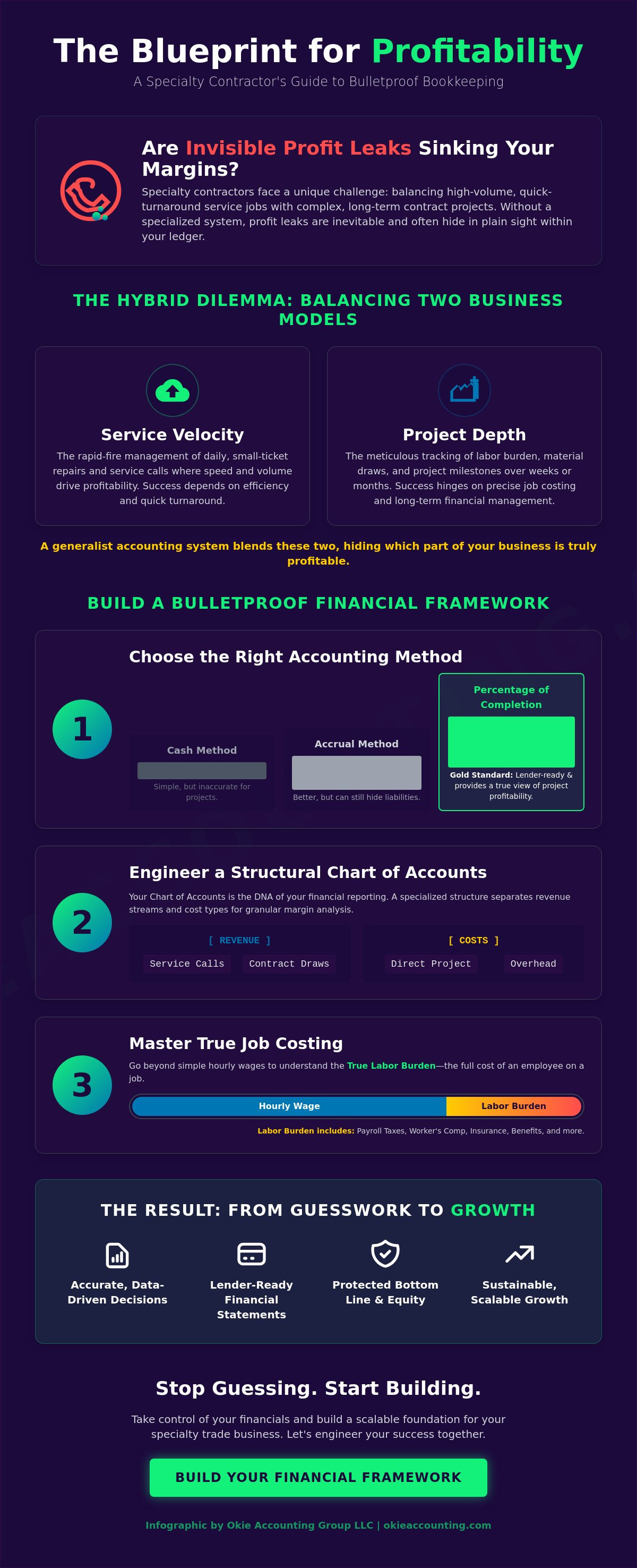
Specialty contractors operate in a high-stakes environment where thin margins are the norm. Effective bookkeeping for specialty contractors isn't merely about balancing a checkbook; it's about constructing a specialized financial framework that mirrors the physical work you do in the field. While a general contractor might manage a handful of large-scale projects, a specialty trade firm often juggles hundreds of service tickets alongside several multi-month installations. This dual nature creates a level of complexity that standard accounting methods simply can't handle. Without a system designed for these nuances, profit leaks become inevitable.
These leaks often hide in plain sight. A generalist bookkeeper might record a bulk electrical supply invoice as a generic expense, but a specialist knows that invoice must be tied to a specific job to determine true profitability. When labor costs and material draws aren't allocated with precision, you lose the ability to see which jobs are actually putting money in the bank. You need more than basic data entry; you need management accounting that reflects the reality of your trade.
Why General Construction Accounting Fails Specialists
Most construction accounting resources focus on the general contractor's perspective. However, specialists face entirely different financial risks. Project-based revenue recognition works well for a three-month HVAC install, but it's often too cumbersome for a two-hour repair call. The danger lies in "blended" margins. When you mix different revenue streams without a tailored Chart of Accounts, your financial health becomes a muddy average. You won't know if your service department is subsidizing an underperforming contract line until it's too late to pivot.
The Hybrid Dilemma: Service Velocity vs. Project Depth
The core challenge for trades like plumbing, electrical, or roofing is managing "Service Velocity" alongside "Project Depth." Service velocity refers to the rapid-fire management of daily small-ticket repairs where speed and volume drive profit. Conversely, project depth requires meticulous tracking of labor burden and material draws over many months. Managing both requires a dual-tracking system within your general ledger. If your system isn't built to handle this hybrid model, your financial reporting will always feel reactive. You'll spend your time looking at what happened last month instead of using your data to bid more accurately on the next big contract.
Designing a Hybrid Accounting System for Specialty Trades
Building a scalable trade business requires moving beyond basic data entry. You need a structural framework that protects your equity and provides a clear path for growth. Many owners view bookkeeping for specialty contractors as a monthly chore to satisfy the IRS, but it's actually the blueprints for your financial house. Without a solid foundation, you can't produce the lender-ready statements required for bonding, equipment financing, or large-scale expansion. Transitioning from simple administrative tasks to a disciplined financial system is the first step toward true profit protection.
A specialized system must handle the friction between cash flow and project timelines. For 2026 financial readiness, your system should be robust enough to withstand the scrutiny of lenders who look for consistency and accuracy. This isn't about just recording checks; it's about building a system that allows you to step away from the daily data entry while maintaining total control over your margins.
Choosing the Right Accounting Method for Scalability
While the Cash method is simple for very small operations, it often fails to reflect the true state of your projects. Accrual accounting is a step up, yet the Percentage of Completion (POC) method is the gold standard for trade specialists managing multi-month installations. POC matches revenue to the actual costs incurred, providing a clear view of your Work in Progress (WIP). This methodology is a central pillar of Construction Bookkeeping Services, serving as the parent framework for a scalable business. It prevents the "growth trap" where high bank balances hide mounting project liabilities. For those seeking deeper technical guidance on these standards, the AICPA construction contractor resources offer extensive guidance on industry-specific reporting requirements.
Building a Structural Chart of Accounts
Your Chart of Accounts is the DNA of your financial reporting. It dictates how data is captured and eventually analyzed. Specialists should categorize revenue by trade line, separating high-velocity service calls from long-term new construction contracts. Similarly, you must isolate direct project costs from general overhead. This separation allows for granular margin analysis, revealing exactly where your money is going and which divisions are most profitable. If you're unsure if your current setup is capturing this level of detail, consider scheduling a discovery call to review your system's integrity. A well-organized ledger doesn't just track history; it predicts your company's future stability.
Mastering Job Costing: Tracking Profitability by Trade
Job costing is the pulse of any trade business. While general accounting tracks the health of the company as a whole, bookkeeping for specialty contractors requires a more granular lens to ensure every project contributes to the bottom line. Without a disciplined approach to job costing, you're essentially flying blind, relying on bank balances rather than actual performance data. Mastering this process allows you to identify high-margin work and eliminate the projects that drain your resources.
A rigorous job costing workflow follows a logical progression of data collection and analysis. To protect your profits, follow these five essential steps:
Step 1: Identify direct costs. This includes all materials, permits, and trade-specific equipment rentals that are unique to a single project.
Step 2: Calculate true labor burden. You must look beyond the hourly wage to include the full cost of keeping a technician in the field.
Step 3: Allocate indirect costs. Use a consistent, percentage-based formula to distribute costs like small shop supplies or vehicle maintenance.
Step 4: Reconcile to the general ledger. Perform a monthly reconciliation to ensure your job costs match your total company expenses.
Step 5: Review Profit vs. Estimate reports. Analyze the variance between your initial bid and the final cost to refine your future bidding strategy.
Allocating Indirect Costs and Labor Burden
The "labor burden" is often the most misunderstood metric in bookkeeping for specialty contractors. It represents the total cost of an employee, including payroll taxes, workers' compensation insurance, health benefits, and non-billable time like training or travel. For 2026, ensure you're factoring in updated IRS mileage rates, such as 72.5 cents per mile for business use, when calculating vehicle-related labor costs. Indirect costs, such as small tools or consumables that aren't easily tracked to one job, should be applied using a standard overhead rate. For a structured approach to these monthly tasks, refer to our Construction Bookkeeping Checklist.
Real-Time Mobile Data Entry for Field Technicians
Accurate job costing depends on the quality of data coming from the field. Implementing mobile time tracking and receipt capture eliminates "glovebox accounting," where paper records are lost or forgotten. When technicians log their hours and upload material receipts in real-time, the office can process job costs daily rather than waiting for the end of the week. This reduces the gap between field work and office billing, significantly improving your cash flow and ensuring that no billable expense is left behind. Digital transformation in the field is no longer optional; it's a requirement for maintaining structural integrity in your financial reporting.
Leveraging QuickBooks and Compliance Frameworks
QuickBooks Online serves as the central nervous system for your financial data. However, a generic setup often fails to capture the intricate details required for bookkeeping for specialty contractors. To achieve structural integrity in your reporting, you must configure the software to mirror your operational reality. Utilizing "Classes" and "Locations" allows you to segment your data by service territory or specific trade types, providing a clear view of which regions or divisions are driving growth. This granular level of oversight is essential for making informed decisions about where to allocate your resources in 2026.
Relying on a default setup leads to "garbage in, garbage out" data that can mislead even the most experienced owners. Investing in Professional QuickBooks Training ensures your team understands how to input data correctly from the start. This transition from basic administration to a disciplined system protects your margins and ensures your financial statements remain lender-ready. It's about moving from a state of financial fog to one of total operational clarity.
Trade-Specific QuickBooks Configuration
Your "Items" list should be a mirror image of your estimating software. This alignment ensures that when a bid is won, the transition to project tracking is seamless and accurate. Automating progress invoicing is another critical step for managing long-term specialty contracts, ensuring you maintain a healthy cash flow throughout the project lifecycle. For a comprehensive roadmap on these settings, explore our guide on Mastering QuickBooks for Contractors. These foundational settings are what allow you to scale without increasing your personal workload.
Navigating Davis-Bacon and Payroll Compliance
Public works projects bring a high level of regulatory scrutiny, specifically regarding Davis-Bacon and prevailing wage requirements. Your bookkeeping system must be capable of tracking hours by specific labor category to generate certified payroll reports accurately. Failure to maintain these records can lead to significant penalties and loss of future contract opportunities. Utilizing specialized Construction Payroll Services provides the oversight needed to manage these complexities without overwhelming your internal staff. This proactive approach ensures you're always ready for an audit or a new bonding application.
If your current software setup feels disorganized or fails to provide the clarity you need, schedule a specialized software review to ensure your system is built for 2026 compliance and growth.
Scaling Your Specialty Firm with Strategic Financial Oversight
Scaling a trade business is a double-edged sword. While increased volume suggests success, it often exposes the structural weaknesses in your financial systems. Many owners fall into the "growth trap," where they take on larger contracts and hire more crews, only to find their cash reserves depleted by the time the project ends. This is why bookkeeping for specialty contractors must evolve from a historical record into a forward-looking strategy. By utilizing cash flow forecasting, you can anticipate capital needs months in advance, ensuring you have the liquidity to support your expansion without risking the firm's stability.
With data center construction spending projected to grow by 17% to 20% in 2026, the opportunities for specialty trades are immense. However, capturing this growth requires more than just skilled labor; it requires financial precision. Establishing a monthly financial review cadence ensures that your business stays on a trajectory of healthy, sustainable growth. This discipline prevents small errors in job costing or labor allocation from compounding into major financial losses that could threaten your company's future.
From Administrative Tasks to Structural Frameworks
Administrative tasks like recording invoices are necessary, but they don't grow your business. Reactive bookkeeping only tells you where your money went; proactive financial management tells you where it's going. When your books are clean and your reporting is accurate, you gain a significant advantage when negotiating with suppliers for better credit terms or with lenders for increased bonding capacity. Profit Protection is the ultimate goal of specialized oversight, acting as a defensive shield that preserves your hard-earned margins through rigorous data management. This structural approach transforms your financial data from a tax obligation into a strategic asset.
The Role of a Fractional Controller in Trade Growth
As your complexity increases, you'll reach a point where you need high-level oversight but aren't ready for a full-time executive. This is when Fractional Controller Services become essential. A controller doesn't just manage the bookkeeper; they analyze the data to identify hidden overhead costs that are eating your margins. They provide the clarity needed to decide which trade lines to expand and which ones to cut based on actual performance data rather than intuition. This high-level partnership allows you to focus on field operations while knowing your financial house is in order.
Building a scalable trade business requires a partner who understands the unique mechanics of your industry. If you're ready to move beyond basic data entry and implement a system built for long-term stability, contact Okie Accounting Group LLC for a Strategic Framework Review today.
Building Your Blueprint for Long-Term Financial Health
Profit protection isn't a passive result; it's a deliberate construction. By mastering job costing and implementing a hybrid accounting system, you move beyond mere survival into a state of total operational control. We've explored how a tailored Chart of Accounts and precise labor burden calculations provide the data needed for accurate bidding and sustainable scaling. Professional bookkeeping for specialty contractors serves as the essential foundation for this transformation, turning your financial data into a strategic roadmap for growth.
Ready to build this framework? Led by Sarah O'Quinn, a Construction Accounting Professional, Okie Accounting Group LLC provides specialized construction expertise and nationwide cloud-based support to help you master your margins and protect your equity. You don't have to manage these complexities alone. Build Your Strategic Financial Framework with Okie Accounting Group LLC today and step into your role as a strategic leader. Your business deserves the clarity and stability that only expert financial oversight can provide.
Frequently Asked Questions
What is the best accounting software for specialty contractors in 2026?
QuickBooks Online Plus remains the standard for most trade firms, especially with the 2026 release of the "Construction Edition" for the Enterprise Suite. However, as firms exceed the $5 million revenue mark, they often migrate to specialized construction ERP systems like Sage Intacct or Foundation Software. The best choice depends on your specific volume and the complexity of your project tracking requirements.
How often should a specialty contractor reconcile their job costs?
You should reconcile your job costs to the general ledger at least once a month. This disciplined practice ensures that every material purchase and labor hour recorded in the field aligns with your actual bank and credit card activity. Regular reconciliation allows you to catch profit leaks early and maintain the accurate financial statements required by lenders or bonding agents.
What is labor burden and why does it matter for plumbers and electricians?
Labor burden is the total cost of an employee beyond their gross hourly wage, including payroll taxes, workers' compensation, benefits, and non-billable travel time. For plumbers and electricians, ignoring this leads to underpriced bids. It's essential to include the 2026 IRS mileage rate of 72.5 cents per mile when calculating the burden of field technicians using company vehicles for service calls.
Can I use the same bookkeeping system for service calls and large projects?
Yes, you can use a single general ledger for both, but it requires a hybrid structural framework. Effective bookkeeping for specialty contractors uses "Classes" or "Locations" in QuickBooks to segment high-velocity service revenue from long-term contract revenue. This dual-tracking approach ensures that small-ticket repairs don't muddy the data of your multi-month installations, providing clarity across all revenue streams.
How do I track materials that are used across multiple small jobs?
Materials used across multiple small jobs are best tracked through an inventory account and then allocated to specific jobs as they are consumed. Alternatively, you can apply a standard percentage-based "indirect cost" to every service call to cover consumables like wire nuts, solder, or fasteners. This ensures these small costs are recovered without the administrative burden of tracking every individual item.
What are the most common bookkeeping mistakes for trade specialists?
The most common mistakes include co-mingling service and contract revenue, failing to update labor burden rates, and neglecting to track change orders in real-time. Many trade specialists also wait until the end of the year to clean up their books. This reactive approach prevents you from seeing project-level profitability and leaves you unprepared for 2026 tax and compliance requirements.
When should a specialty contractor outsource their bookkeeping?
You should consider outsourcing when the owner or field manager is spending more than five hours a week on data entry rather than strategy. Specialized bookkeeping for specialty contractors becomes necessary when your project volume outpaces your internal capacity to track job costs accurately. Outsourcing provides access to high-level expertise and fractional controller services without the overhead of a full-time executive.
How does job costing help with future project bidding?
Job costing provides a historical database of actual costs that you compare against your initial estimates. By reviewing "Profit vs. Estimate" reports, you identify where you consistently underbid labor or materials. This data-driven feedback loop allows you to refine your bidding strategy, ensuring that future contracts are priced for actual profit rather than just winning the work based on low numbers.


Comments