
Common Bookkeeping Mistakes by Contractors: The 2026 Strategic Guide to Profit Protection

Why does your bank account look empty when your project pipeline is full? It's a frustrating reality for many business owners in the construction sector. You're winning bids and keeping crews busy, yet the actual profit seems to vanish before it ever hits your bottom line. You aren't alone in feeling that high revenue doesn't always equal financial stability. Often, the culprit isn't your craftsmanship or your hustle. It's the invisible drain caused by common bookkeeping mistakes by contractors that haven't updated their systems for the 2026 digital landscape.
We understand that you're a builder, not a career accountant. However, treating your finances as a series of administrative tasks rather than a structural framework is a risk your margins can't afford. This guide promises to help you identify the critical errors that lead to year-end tax surprises and poor job costing. You'll learn how to transition from reactive data entry to proactive financial oversight. We'll preview the essential strategies for building a scalable accounting system that provides total clarity, allowing you to focus on the job site while your profit remains protected.
Beyond the Basics: Why Contractor Bookkeeping is a Different Beast
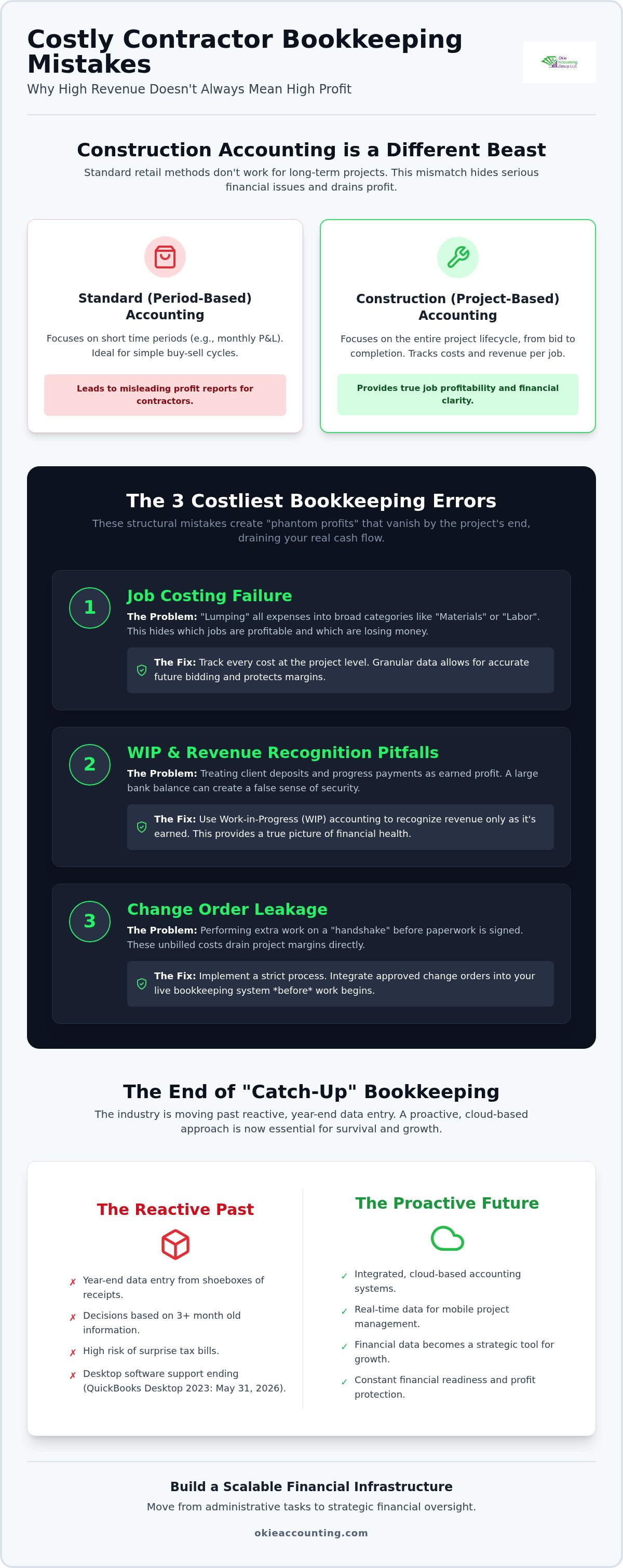
A standard retail business operates on a simple cycle: buy inventory, sell it, and measure the margin. Construction is fundamentally different because revenue is earned over months or years, often involving progress billings, complex labor allocations, and holdbacks. High revenue often masks deep-seated financial structural issues that generalist accounting methods fail to catch. You might see a healthy bank balance today, but without knowing your future liabilities or committed costs, you're essentially flying blind. This lack of project-level clarity is one of the most common bookkeeping mistakes by contractors who treat their business like a simple service shop.
A specialized framework preserves the long-term health of your firm. It moves you away from the stress of "guessing" your profitability and toward a state of constant financial readiness. When you understand the unique mechanics of your specific market, you gain the quiet confidence needed to make bold, data-driven choices. This structural approach makes the information easy to digest while reinforcing your image as an organized and methodical partner to your clients and lenders.
Project-Based vs. Period-Based Accounting
Standard accounting focuses on periods: what happened in January? Construction requires a focus on projects: what is the total cost of the Smith Bridge project across its entire lifecycle? Relying on monthly profit and loss statements alone is misleading because they don't account for the timing of labor, materials, and billings. Understanding construction accounting principles is essential for any firm aiming for structural integrity. Utilizing specialized construction bookkeeping services ensures that your data is categorized by project, not just by date. This granularity allows you to see which jobs are actually contributing to your bottom line and which ones are draining your resources in real-time.
The Myth of 'Catch-Up' Bookkeeping
Many owners treat bookkeeping as a year-end administrative burden. They spend their nights in December trying to reconstruct a year's worth of data from a shoebox of receipts. In 2026, this approach is more than just stressful; it's a liability. With the support for QuickBooks Desktop 2023 ending on May 31, 2026, the industry has shifted toward integrated, cloud-based systems that demand regular maintenance. The compounding cost of delayed data entry means you're making today's decisions based on three-month-old information. Year-end "cleanup" is a reactive strategy that fails to protect your profit. Transitioning to a proactive model turns your accounting into a strategic advantage, providing a structural remedy to financial complexity.
The 3 Costliest Construction-Specific Bookkeeping Errors
While many guides focus on lost receipts or messy filing, the most devastating financial drains are structural. These common bookkeeping mistakes by contractors often manifest as "phantom profits." These are margins that look great on paper during the build but evaporate once the final punch list is signed. Identifying these errors early is the only way to ensure your high revenue actually results in long-term stability and profit protection.
The Job Costing Failure
"Lumping" expenses into broad categories like "Supplies" or "Labor" is a recipe for margin erosion. If you don't know exactly what the Smith project cost in terms of specific materials and subcontractor hours, you can't bid accurately on your next project. Effective management accounting provides the granularity needed to identify where you're losing money before the project ends. You need to track every dollar at the project level to protect your bottom line and ensure each job is pulling its own weight.
WIP and Revenue Recognition Pitfalls
Cash in the bank doesn't always equal profit earned. If you've collected a significant deposit but only completed a fraction of the work, your balance sheet is artificially inflated. Work-in-Progress accounting ensures revenue is recognized only when earned, preventing artificial inflation of profit. Without WIP reports, contractors often face cash flow surprises when they realize they've already spent the money needed to finish the job. Balancing over-billing and under-billing is critical for financial readiness in 2026, keeping your business grounded in reality rather than abstract bank balances.
Change Order Leakage
Performing extra work before the paperwork is processed is a common trap that leads to massive leakage. This "handshake" culture means costs aren't integrated into your live bookkeeping system as they occur. By the time the final invoice is sent, the leverage to collect has diminished, and the costs have already hit your accounts. Profit protection requires disciplined documentation from the field to the office to avoid these common bookkeeping mistakes by contractors. Integrating change orders into your live data prevents these costs from becoming an unrecoverable expense that drains your project margins.
If your current reports don't provide this level of project-specific nuance, it might be time to book a discovery call to review your structural framework and protect your future profits.
The Hidden Risks of the DIY Accounting Trap
Many contractors view bookkeeping as an expense to be minimized. They spend their nights categorizing transactions to save money, but this is a false economy. The opportunity cost of a business owner doing data entry at midnight is staggering. Instead of reviewing bids, refining project schedules, or resting for the next day's site visit, you're performing low-value administrative tasks. This mental fatigue often leads to common bookkeeping mistakes by contractors, such as misclassifying expenses or missing critical deadlines that protect your cash flow.
QuickBooks "Auto-Categorization" features are a recipe for disaster without expert oversight. The software might suggest a category based on a vendor name, but it doesn't understand the nuance of project-based costs. A payment to a supplier could be for a specific client job or general shop overhead. Without a strategic mentor to review these entries, your financial data becomes a mess of "garbage in, garbage out." This lack of precision makes it impossible to track project-level profitability accurately.
Compliance risks are equally dangerous in 2026. Mismanaging 1099-NEC forms, which are due by January 31, 2026, or failing to track payroll taxes accurately can lead to severe penalties. Transitioning from a "service provider" mindset to a "strategic partner" mindset means recognizing that your time is better spent on high-level growth than on fighting software defaults. You need a system that works for you, not a list of tasks that keep you up at night.
Software is a Tool, Not a Strategy
Buying a subscription to QuickBooks Online doesn't solve your financial complexity; it's merely a digital ledger. Without professional software training for your internal team, you're likely repeating the same errors every month. You need a structural framework to ensure data integrity from the moment a receipt is captured. When your software is configured correctly by specialists, it becomes an asset that provides clarity rather than a source of mounting stress.
The High Cost of Cheap Bookkeeping
A generalist bookkeeper might be cheaper per hour, but they often miss industry-specific nuances like WIP adjustments or specialized deductions. Construction-specific experts understand the mechanics of your market. They ensure your books are "bond-ready" at all times, which is essential when seeking lending or larger contracts in 2026. The ROI of accurate, specialized oversight far outweighs the savings of a cut-rate service provider who lacks a deep understanding of common bookkeeping mistakes by contractors. Accurate data isn't just about compliance; it's about profit protection.
Building a Modern Financial Infrastructure for 2026
A resilient construction firm in 2026 requires more than just a digital ledger; it needs a connected ecosystem that bridges the gap between the job site and the back office. One of the common bookkeeping mistakes by contractors is maintaining disconnected legacy systems that create data silos and delayed reporting. This lack of integration forces you to make critical decisions based on outdated information. By centralizing your financial data, you ensure structural integrity and gain the quiet confidence needed to manage complex project lifecycles. Utilizing QuickBooks for contractors as a central hub, integrated with your project management tools, allows for a seamless flow of data that reflects the actual state of your operations.
Real-Time Data Collection
Backlog is the enemy of financial clarity. When receipts and time logs sit in a truck for weeks, your project-level profitability becomes a guessing game. Modern infrastructure relies on mobile capture tools that allow your team to document expenses and hours in real-time. In 2026, the role of AI has shifted from simple automation to sophisticated validation. These systems flag anomalies in labor allocations or material costs before they become permanent errors in your ledger. Establishing a disciplined documentation workflow ensures that your data is accurate, consistent, and ready for high-level analysis. This proactive stance alleviates the stress of month-end reconciliations and preserves your profit margins.
Structural Frameworks for Cash Flow
Reliable cash flow is the result of a methodical rhythm, not a series of lucky breaks. Implementing a weekly schedule for accounts payable and receivable prevents the dangerous "rob Peter to pay Paul" cycle that plagues many growing firms. Effective construction cash flow management allows you to anticipate upcoming liabilities and maintain a healthy cash reserve. This disciplined approach ensures you have the capital necessary for mobilization on new projects without straining your current operations. When your financial oversight is structured and predictable, you transition from a reactive service provider to a strategic partner capable of long-term stability.
Building this infrastructure is a strategic investment in your business's future. If your current systems feel fragmented or outdated, it's time to build a more robust framework. You can schedule a discovery call to explore how a modernized tech stack can protect your profits and support your growth goals in 2026.
Strategic Financial Oversight: Moving Beyond Data Entry
Many business owners view their financial records as a historical archive. They see bookkeeping as a task to be completed for the sake of compliance. This perspective is one of the most common bookkeeping mistakes by contractors because it ignores the predictive power of accurate data. When you move beyond simple data entry, your finances become a structural framework for growth. Strategic oversight allows you to identify trends, mitigate risks, and protect your profit margins before they erode. It's the difference between looking in the rearview mirror and having a high-definition GPS for your firm's future.
Regular financial reviews are the cornerstone of this proactive approach. By analyzing your reports monthly rather than annually, you catch project slippage early. You can see which crews are most efficient and which project types consistently hit their margin targets. This level of oversight provides the quiet confidence needed to walk away from bad bids and double down on profitable niches. It transforms your accounting department from a cost center into a strategic asset that drives long-term stability.
The Role of a Fractional Controller
A bookkeeper records transactions, but a Fractional Controller interprets them. For firms ready to move to the next revenue tier, specialized controller services bridge the gap between basic record-keeping and high-level business strategy. A controller doesn't just tell you what you spent; they explain how those costs impact your overhead absorption and bonding capacity. They help you interpret Key Performance Indicators (KPIs) to identify underperforming project types that might be draining your resources. This mentorship ensures that your financial infrastructure is robust enough to support rapid scaling without compromising your structural integrity.
Your Path to Financial Clarity
The first steps to cleaning up a legacy bookkeeping mess can feel overwhelming. Many contractors are stuck in a cycle of reactive fixes and year-end panics. Establishing a proactive partnership is the structural remedy to this complexity. At Okie Accounting Group, we focus on building a foundation of financial readiness that serves your business every day of the year. We help you transition from a state of confusion to one of operational clarity. By implementing disciplined systems and rigorous management, we ensure your data is always accurate and your profit is always protected. This methodical approach allows you to focus on building your legacy while we maintain the financial framework that makes it possible.
Securing Your Financial Foundation for Scalable Growth
Identifying the common bookkeeping mistakes by contractors is the first step toward reclaiming your profit margins and protecting your business's future. By moving away from reactive "catch-up" methods and embracing granular job costing and WIP adjustments, you ensure your firm is built on a stable structural framework. In the 2026 landscape, real-time data and modern infrastructure are no longer optional luxuries; they are the baseline requirements for financial stability and competitive bidding.
You don't have to manage this complexity alone. Okie Accounting Group provides specialized expertise in the construction and real estate sectors, offering a structural remedy to financial disorder. With our national reach and fractional controller oversight, we act as a strategic mentor to help you achieve long-term growth and profit protection. It's time to transition from basic administrative tasks to high-level financial readiness. We are as invested in your business's success as you are.
Take the next step toward total financial clarity. Build your firm's financial structural framework with Okie Accounting Group today. You have the vision to build great things; let us provide the disciplined systems you need to scale them with confidence.
Frequently Asked Questions
What is the most common bookkeeping mistake contractors make?
Failing to implement granular job costing is the most frequent error. Many business owners lump labor and material expenses into broad categories, which hides the true profitability of individual projects. This lack of detail makes it impossible to bid accurately on future work. Addressing these common bookkeeping mistakes by contractors requires a shift toward project-based tracking that captures every dollar spent on a specific job site to ensure long-term stability.
How often should a contractor reconcile their project books?
You should reconcile your project books at least monthly, though a weekly rhythm is preferred for active firms. Regular reconciliation ensures that bank feeds match your internal records and that labor allocations are accurate. Waiting until the end of a quarter leads to data backlogs and missed errors. Consistent oversight provides a structural framework for financial readiness, allowing you to catch margin erosion before it impacts your cash flow.
Why is my profit and loss statement different from my bank balance?
Your profit and loss statement reflects earned revenue and incurred expenses, while your bank balance shows actual cash on hand. Timing differences, such as outstanding checks or uncollected invoices, create this gap. Additionally, customer deposits for future work appear in your bank account but are not yet "earned" revenue. This discrepancy is why specialized financial reporting is essential for maintaining a realistic view of your firm's structural integrity and health.
Can QuickBooks handle job costing for construction companies automatically?
QuickBooks does not perform job costing automatically without precise professional configuration and disciplined data entry. While the software provides the necessary fields, it requires a specialized setup to map labor, materials, and subcontractors to specific projects. Professional QuickBooks Setup & Training ensures your internal team avoids "garbage in, garbage out" cycles. Without this structural foundation, the software remains a simple ledger rather than a strategic tool for profit protection.
What is the difference between a bookkeeper and a fractional controller for contractors?
A bookkeeper focuses on the daily recording of transactions and bank reconciliations to ensure data accuracy. In contrast, Fractional Controller Services provide high-level financial strategy and interpret that data to drive business decisions. While the bookkeeper maintains the records, the controller offers the mentorship needed to scale. This oversight bridges the gap between administrative tasks and long-term financial health, focusing on budgeting, internal controls, and project-level KPI analysis.
How do I track change orders in my bookkeeping system?
You must integrate change orders into your live bookkeeping system as soon as the work is authorized. Failing to update project estimates with change order costs leads to inaccurate job costing and "phantom profits." By treating every change order as a budget adjustment, you ensure your financial reporting reflects the actual scope of work. This disciplined approach prevents unrecoverable expenses from draining your margins at the end of a project.
Why is WIP (Work-in-Progress) accounting so important for contractors?
WIP accounting is critical because it ensures revenue is recognized only when it is actually earned. Without WIP adjustments, your financial statements may show artificial profit during periods of heavy billing or losses during periods of high expense. This methodology provides a structural remedy to the volatility of construction cycles. It allows for accurate cash flow forecasting and ensures your firm remains bond-ready for larger national contracts and sustainable growth.
Is it better to hire an in-house bookkeeper or an outsourced specialist?
An outsourced specialist often provides a higher ROI than an in-house generalist who lacks construction-specific expertise. Generalist bookkeepers frequently miss industry-specific nuances like specialized revenue recognition or WIP reporting. By partnering with a specialized firm, you gain access to fractional controller oversight and a national reach of expertise. This remote support builds a more robust financial infrastructure than a single employee who might not understand the unique mechanics of your market.


Comments