
Construction Job Costing Best Practices: A Strategic Framework for Profit Protection

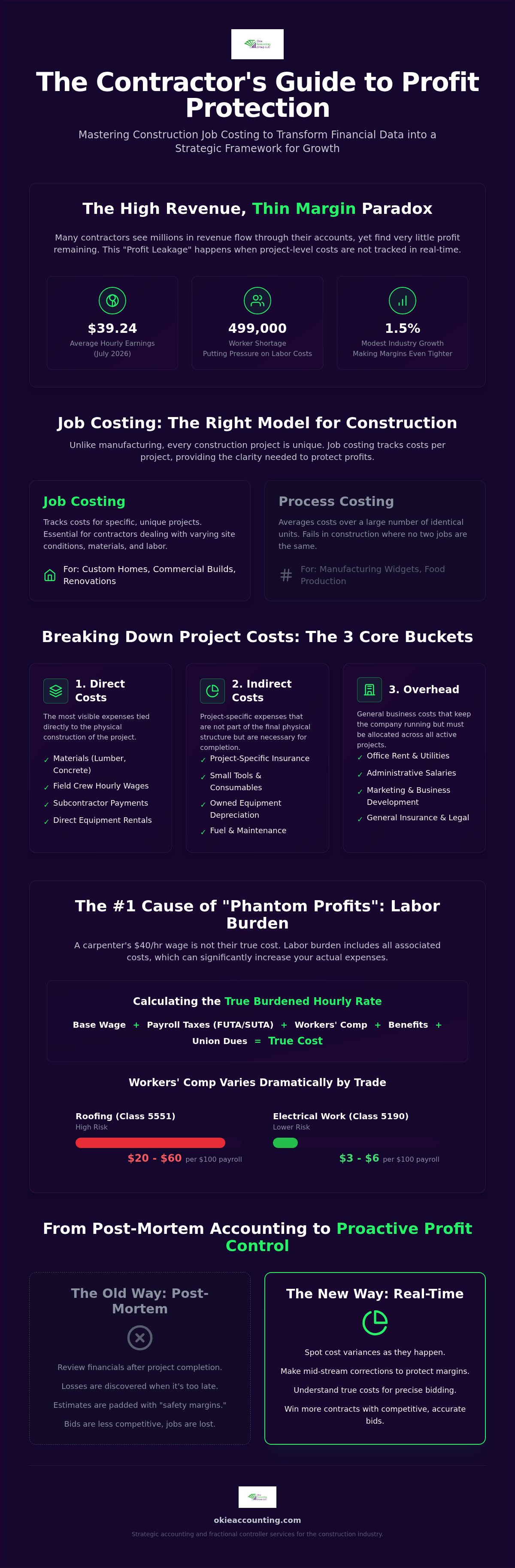
What if your highest-revenue year actually resulted in your thinnest profit margins? It's a frustrating reality for many contractors who see millions flowing through their bank accounts but find very little remaining once the project is complete. You likely feel the weight of rising labor costs, with average hourly earnings reaching $39.24 in July 2026, and the constant pressure of a 499,000-worker shortage. Implementing construction job costing best practices is the only way to stop flying blind on real-time material and labor expenses.
We believe construction accounting shouldn't be a source of stress. It should be a proactive tool for growth. In this guide, we'll master the strategies that transform your financial data into a strategic framework for profit protection. You'll learn how to move beyond basic administrative tasks to build a scalable infrastructure that yields predictable profitability and lender-ready statements. We'll examine how to leverage advanced WIP reporting and real-time tracking to ensure your project estimates are accurate and your margins remain secure in a complex 2026 market.
The Foundation of Construction Job Costing: Why Clarity Equals Cash
Job costing is much more than an administrative chore; it's the heartbeat of a profitable construction company. Job costing is the granular tracking of labor, materials, and overhead for specific projects, allowing owners to see exactly where their capital is deployed. Simply put, job costing is a profit-protection mechanism that transforms raw data into actionable business intelligence. By assigning every dollar to a specific project, you gain the visibility needed to manage your cash flow with confidence.
While a general ledger tracks the overall health of your business, it often hides the "Profit Leakage" that occurs at the project level. You might have high revenue, but if you don't know that your framing labor is consistently 15% over budget, you're losing money on every new contract you sign. Implementing construction job costing best practices allows you to identify these leaks before they become catastrophic. This creates a structural framework for financial readiness in 2026, ensuring your firm is prepared for the modest 1.5% industry growth expected this year while protecting your hard-earned margins.
Job Costing vs. Process Costing: Choosing the Right Model
Construction requires a specialized approach because no two job sites are identical. While process costing works for manufacturing identical widgets, it fails the contractor who deals with varying soil conditions, weather delays, and custom architectural specs. General contractors, specialty trades, and heavy civil firms all rely on a job-centric approach to maintain structural integrity in their financial reporting. This methodology ensures that every expense, from a box of nails to a crane rental, is tied to the correct revenue source rather than being buried in a generic expense category.
The Strategic Advantage of Real-Time Data
Waiting until the end of a project to review your financials is what we call "Post-Mortem Accounting." By the time you see the loss, it's too late to fix the problem. Real-time tracking allows you to spot variances in labor burden or material waste as they happen, giving you the power to make course corrections mid-stream. This clarity doesn't just protect your current projects; it builds a foundation for more competitive bidding. When you understand your true costs, you don't have to pad your estimates with "safety margins" that might cost you the job. Instead, you can bid with precision, knowing exactly where your profit lies. Moving toward this level of oversight often involves transitioning to a fractional controller who can interpret these real-time trends to drive your business forward.
Breaking Down the Components: Direct Costs, Indirect Costs, and Labor Burden
To protect your margins, you must look past surface-level invoices. Implementing construction job costing best practices starts with a rigorous classification of every expense into three specific buckets: direct costs, indirect costs, and overhead. Direct costs are the most visible; they include the lumber delivered to the site, the subcontractor's monthly draw, and the hourly wages of your field crew. These are the foundation of your project budget.
Indirect costs are project-specific but not tied to a single physical component. Examples include project-specific insurance, small tools, and equipment depreciation. While these don't appear on a material takeoff, they're essential for project completion. Finally, you must address overhead allocation. This involves distributing your back-office costs, such as rent and administrative salaries, across all active projects. Without standardized cost codes to categorize these expenses, your data loses its structural integrity, making it impossible to compare performance across different jobs.
The "Hidden" Cost: Mastering Labor Burden Calculation
Failing to track labor burden is the primary reason for "phantom profits" in the construction industry. You might pay a carpenter $40 per hour, but that's not your actual cost. In 2026, the labor burden includes the effective FUTA tax rate of 0.6% on the first $7,000 of wages and state-specific SUTA rates. In certain jurisdictions, the new employer rate for construction can reach 5.4%, which is a significant increase compared to rates for non-construction businesses.
Workers' compensation rates also vary wildly by trade. For instance, roofing (class 5551) can cost between $20 and $60 per $100 of payroll, while electrical work (class 5190) typically ranges from $3 to $6. To calculate a burdened hourly rate, you must sum the base wage, payroll taxes, benefits, and union dues for every field employee. If you're struggling to untangle these variables, schedule a discovery call to see how a structured framework can bring clarity to your labor costs.
Equipment Usage and Depreciation
Owned equipment is never "free" just because it's paid off. Every hour a skid steer runs on a job site, it moves closer to a major maintenance cycle or total replacement. You should differentiate between direct rental fees and the cost of using owned assets. Establishing internal rental rates allows you to allocate equipment costs to specific job sites based on actual usage. This ensures that the project budget covers fuel, maintenance, and the eventual replacement of the machine, rather than allowing these costs to erode your bottom line. Maintaining these construction job costing best practices is a core component of ensuring long-term financial stability and project profitability.
QuickBooks Online for Construction: Building a Scalable System
QuickBooks Online serves as the central nervous system for modern construction firms. It's no longer just a digital ledger; it's a project management powerhouse that enables contractors to implement construction job costing best practices with minimal friction. By utilizing the "Projects" center, you can track income and expenses at a granular level, viewing real-time profitability for every job site in your portfolio. This visibility is enhanced by the August 2026 update to QuickBooks Online Advanced, which introduced a dedicated construction module featuring native AIA-style invoicing and Work-in-Progress (WIP) reporting.
While the software is powerful, its utility depends entirely on the quality of the initial configuration. A professional QuickBooks setup for contractors ensures that your chart of accounts and cost codes are mapped correctly from the start. Without this foundational integrity, your data becomes a tangled mess of unallocated expenses and "phantom profits." Integrating cloud-based time-tracking apps further strengthens this system by automating the flow of field data directly into your accounting hub, ensuring that labor hours are assigned to the correct project without manual entry errors.
QBO vs. Manual Spreadsheets: The ROI of Automation
As a construction firm scales beyond $1M in annual revenue, manual spreadsheets transition from a cost-saving tool into a significant business liability. They're prone to broken formulas and lack the real-time synchronization required for agile decision-making. Transitioning to a cloud-based system provides a single source of truth for both field and office teams.
Integrating Payroll and Job Costing
Labor is often your most volatile expense. When your payroll system is siloed from your project tracking, you're forced to guess your actual labor burden until weeks after the work is performed. By synchronizing these systems, automated payroll feeds directly into project costs, capturing wages and taxes in real-time. Utilizing specialized construction payroll services ensures that complex variables like union dues and state-specific SUTA rates are handled correctly. This integration reduces manual entry errors and provides the structural integrity needed to protect your profit margins as you grow.
5 Best Practices for Precision Job Costing in 2026
Precision in construction accounting is not a matter of luck; it's the result of disciplined execution. As you scale your firm, implementing construction job costing best practices requires a shift from reactive data entry to proactive systems management. These five strategies provide the structural integrity needed to protect your profit margins in a competitive 2026 market where labor shortages and input cost volatility remain constant challenges.
Standardizing Cost Codes and Categories
Consistency is the bedrock of any reliable financial system. You should standardize your Work Breakdown Structure (WBS) using industry-standard CSI (Construction Specifications Institute) codes or a simplified custom version tailored to your specific trades. This uniformity allows you to perform year-over-year profitability analysis across multiple projects, identifying which types of work yield the highest returns. Standardized codes are the DNA of a searchable financial system. Without them, your data remains siloed and unusable for long-term strategic planning.
Beyond coding, you must bridge the gap between the field and the office. Implementing daily field reporting ensures that labor hours and material usage are captured as they happen. When field supervisors submit data daily, you eliminate the "memory lag" that leads to inaccurate reporting. This real-time flow is further protected by automating the approval workflow for subcontractor invoices and material receipts. By digitizing these approvals, you ensure that every expense is verified against the project budget before it's paid, preventing overpayment and budget creep.
The Monthly WIP Review: Your Early Warning System
Work-in-Progress (WIP) accounting is critical for accurate revenue recognition. A monthly WIP review serves as your early warning system, allowing you to spot projects that are over-billed or under-billed before they hit your bottom line. Under-billing often signals that you're financing the project with your own cash, while over-billing can mask a project that's actually losing money. You can explore our WIP accounting for construction guide for deeper technical details on managing these balances.
Finally, you must perform regular "job autopsies" once a project is complete. This involves a rigorous comparison of estimated versus actual costs to identify where your bidding process was accurate and where it fell short. These post-project reviews are essential for refining your future estimates and ensuring that your firm remains competitive without sacrificing profitability. To build this level of oversight into your business, schedule a discovery call today to discuss how we can strengthen your financial infrastructure.
Scaling Your Firm with Fractional Controller Oversight
Data without direction is a liability. You can implement all the construction job costing best practices in the world, but if no one interprets the resulting reports, your profit margins remain at risk. A fractional controller bridges the gap between basic bookkeeping and strategic growth. They don't just tell you what you spent last month; they explain how those costs impact your long-term financial health. This specialized oversight ensures that your financial statements are not just lender-ready, but are actually used as a roadmap for scaling your operations.
In the project-based world of construction, cash flow forecasting is your most critical survival tool. With construction input prices having risen 43% since January 2020, guessing your liquidity is no longer an option. By moving from "doing the books" to "managing the business," you gain the clarity needed to make data-driven choices. This transition ensures that your firm isn't just busy, but consistently profitable. You move from a state of financial blindness to one of quiet confidence, where every new bid is backed by a solid understanding of your current resource allocation.
Moving Beyond Basic Bookkeeping
Basic bookkeeping records the past, but strategic financial leadership prepares you for the future. Building a structural framework involves more than just transaction entry; it requires an understanding of how market volatility in 2026 affects your bottom line. Whether it's navigating the 5.2% year-over-year wage growth or managing the impact of high interest rates on project feasibility, a controller provides the necessary oversight. Those ready to scale their operations should explore management accounting as a way to gain deeper insight into their operational efficiency. This proactive approach protects your capital while your competitors are still struggling to untangle their bank reconciliations.
Strategic Partnership: The Okie Accounting Approach
We act as a disciplined mentor for growing contractors, providing the high-level oversight usually reserved for enterprise-level firms. Our approach focuses on foundational integrity and profit protection, offering a reassuring partnership in an industry often defined by high-stakes stress. We understand that your needs are complex. We treat your business's success with the same level of discipline and dedication you do. We help you move beyond granular operational details to see the broader implications of your financial health. If you are ready to transition from administrative complexity to operational clarity, schedule a consultation to build your financial infrastructure.
Building Your Structural Framework for Profit Protection
Mastering the nuances of labor burden and implementing rigorous monthly WIP reviews are the first steps toward true project clarity. By moving away from manual spreadsheets and adopting standardized cost codes, you create a system that scales alongside your revenue rather than becoming a source of administrative stress. Adopting construction job costing best practices isn't just a choice for the modern contractor; it's the foundation of long-term stability in a 2026 market defined by labor shortages and input cost volatility.
At Okie Accounting, we provide specialized construction financial leadership and serve as QuickBooks Online ProAdvisors. We're dedicated to building the structural framework for profit protection your firm needs to thrive. If you're ready to transition from basic bookkeeping to strategic partnership, we're here to help you navigate your financial data with quiet confidence and professional discipline.
Gain financial clarity with Okie Accounting’s Fractional Controller services. You've built the projects that define our landscape. Now, let's build the financial infrastructure that protects your legacy.
Frequently Asked Questions
What is the most common mistake contractors make in job costing?
The most common mistake is failing to account for the full labor burden, which includes payroll taxes, insurance, and benefits beyond the base hourly wage. Contractors often look at a $40 hourly rate and assume that's their total cost, ignoring the effective FUTA rate of 0.6% or state-specific SUTA rates. This oversight creates "phantom profits" that disappear once overhead and taxes are settled. Successful firms prioritize construction job costing best practices by calculating a fully burdened rate for every field employee.
How do I track labor burden accurately in QuickBooks Online?
To track labor burden in QuickBooks Online, you should utilize the Projects module and integrate a compatible time-tracking application. This automation allows field hours to flow directly into your accounting system, where they're mapped to specific cost codes. By configuring your payroll settings to allocate employer-paid taxes and benefits to the job level, you gain a real-time view of your true labor expenses without manual data entry errors or delayed reporting.
Can I use job costing for small residential projects, or is it only for large commercial work?
Job costing is essential for small residential projects because their thinner margins leave less room for error compared to large commercial contracts. A single material price spike or a two-day labor delay can easily turn a residential renovation into a loss-making venture. Implementing construction job costing best practices on smaller scales ensures that every box of nails and hour of labor is tracked. This granular visibility allows residential contractors to bid more competitively and protect their income.
What are cost codes, and why does every construction company need them?
Cost codes are standardized numerical identifiers, such as those from the Construction Specifications Institute (CSI), used to categorize specific tasks like framing or electrical work. Every company needs them to create a searchable, consistent financial history across all projects. Without cost codes, your data is a disorganized pile of receipts. With them, you can perform year-over-year analysis to see which trades are consistently profitable and which require better estimating or field management.
How often should I review my job cost reports?
You should review job cost reports at two distinct levels: weekly for field operations and monthly for strategic oversight. Weekly reviews allow project managers to spot labor overages or material waste before they derail a budget. Monthly reviews focus on Work-in-Progress (WIP) reports to ensure billings are aligned with actual costs. This dual-layered rhythm provides the structural integrity needed to catch variances in the 2026 market while there's still time to correct them.
What is the difference between job costing and a Profit and Loss (P&L) statement?
A Profit and Loss (P&L) statement provides a high-level view of your entire company's financial health, while job costing offers a granular "P&L" for each individual project. Your company-wide P&L might show you're profitable overall, but job costing reveals if two successful projects are simply masking a third that's actually losing money. While the P&L is used for general business management, job costing is the primary tool for protecting project-specific margins and refining your bidding accuracy.
Do I need a fractional controller to set up my job costing system?
While you can technically set up a system yourself, a fractional controller ensures the framework is strategically aligned with your long-term growth goals. A controller moves beyond basic software setup to build a comprehensive structural framework that includes cash flow forecasting and WIP reporting. They provide the high-level interpretation necessary to turn raw data into actionable business intelligence. This partnership is particularly valuable when transitioning from simple administrative tasks to complex, multi-project financial management.
How does job costing help with construction tax preparation?
Job costing simplifies tax preparation by providing a clear, verifiable audit trail for every project expense and revenue entry. It ensures that your revenue recognition is accurate, which is critical for long-term contracts that span multiple tax years. By having detailed records of direct and indirect costs, your tax professional can maximize allowable deductions and ensure compliance with specific industry regulations. This level of organization reduces the stress and cost of year-end filing while improving your overall financial readiness.


Comments