
Construction Payroll: 2026 Strategic Compliance Guide

Construction payroll is no longer just an administrative back-office task; it's a critical profit-protection framework for your firm. You likely recognize the mounting pressure as manual reporting consumes dozens of hours every week, leaving your team prone to error. Utilizing specialized payroll services for construction companies is no longer optional if you want to avoid the stress of inaccurate job costing or the looming threat of a Davis-Bacon Act violation on projects over the $2,000 threshold. We understand that in this industry, precision is the only foundation for stability.
This guide will show you how to protect your bottom line by ensuring total compliance with prevailing wage and union requirements. You'll discover how to transition from reactive data entry to a structured system of financial oversight that secures your margins. We'll preview the essential 2026 regulatory updates, discussing the broader implications of evolving prevailing wage laws and the increasing emphasis on accurate electronic submission and reporting. By the end of this article, you'll have a clear roadmap for achieving automated, error-free reporting and seamless job costing integration that provides genuine peace of mind.
Why Standard Payroll Services Fail Construction Companies
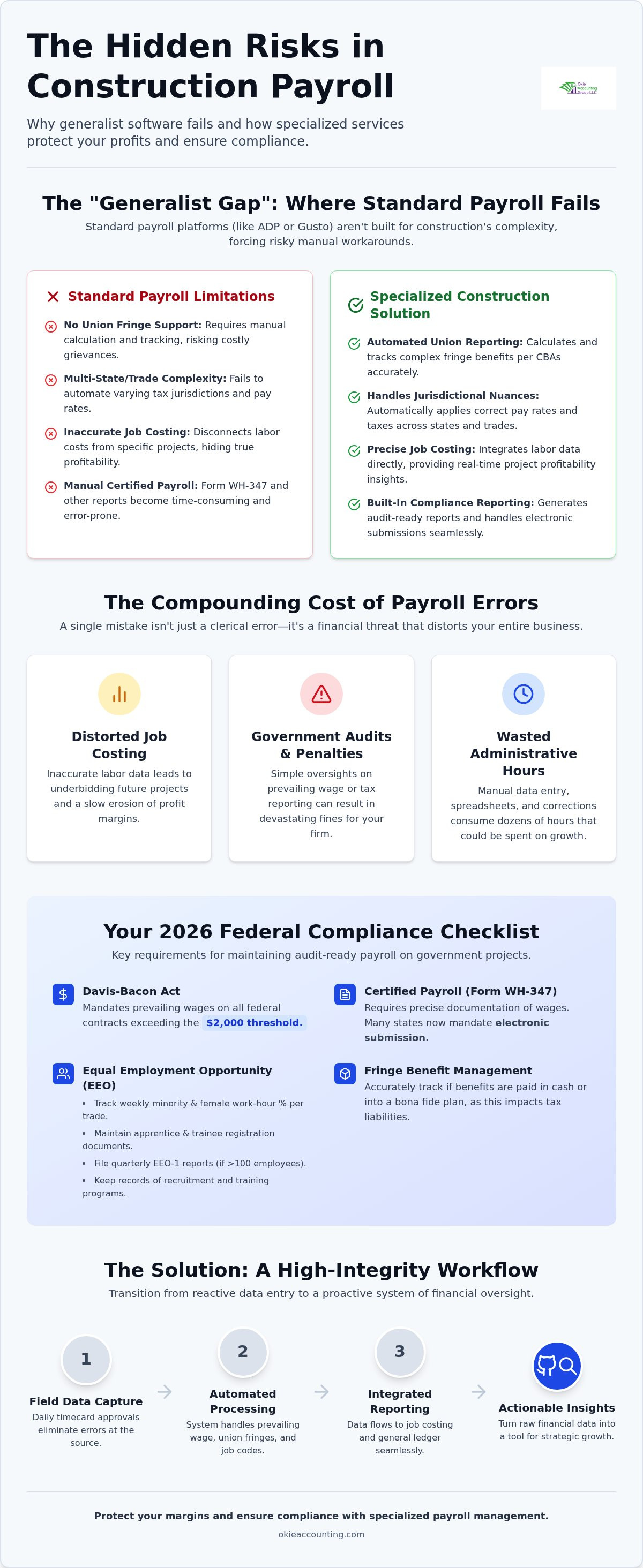
Construction payroll is a multi-dimensional compliance challenge that extends far beyond simply issuing paychecks. While generalist providers like ADP or Gusto perform well for standard office environments, they frequently fall short in the high-stakes world of heavy civil or commercial contracting. Generalist providers often treat payroll as a flat, linear process. In construction, it's a three-dimensional puzzle involving job codes, worker classifications, and shifting site locations. This "Generalist Gap" occurs because standard platforms aren't designed to handle union fringes, complex benefit tiers, or the specific reporting requirements of the construction industry. When you rely on these basic systems, you're often forced to bridge the gap with manual spreadsheets. This manual intervention introduces a high risk of error, which is why specialized payroll services for construction companies are essential. Effective payroll management acts as a core component of comprehensive construction bookkeeping services, ensuring that your financial infrastructure is built on accurate, real-time labor data.
The Complexity of Multi-State and Multi-Trade Projects
Managing labor across different tax jurisdictions creates significant friction for growing firms. For example, a Tennessee-based contractor working on a project in a neighboring state must navigate different withholding rules and local taxes for every hour logged. Trade-specific pay rates further complicate the process, as a single employee might perform multiple roles at different rates throughout the week. If these rates are tied to prevailing wage laws, the margin for error disappears. Basic payroll software rarely handles these nuances without extensive manual workarounds. You need a system that recognizes these regional challenges and automates the trade-specific calculations to keep your field-to-office workflow moving without interruption. This level of specialization prevents the administrative bottlenecks that often stall project momentum.
The Hidden Cost of Payroll Errors
The true cost of a payroll mistake isn't found in a single check; it's found in the distortion of your project profit-and-loss statements. When labor costs are misallocated or inaccurately reported, your job costing data becomes unreliable. This leads to underbidding on future projects and a slow erosion of your profit margins. Beyond internal finances, the threat of government audits is a constant reality. Audit penalties can be devastating for small-to-mid-sized firms, often reaching thousands of dollars for simple clerical oversights. Maintaining "audit-ready payroll" must be your baseline for 2026 success. By utilizing professional payroll services for construction companies, you ensure that every record is precise, every tax is paid, and your business remains positioned for strategic growth rather than just survival.
Mastering Prevailing Wage and Certified Payroll Compliance
Compliance on federal and state projects is a rigorous discipline. For 2026, the Davis-Bacon Act continues to mandate prevailing wages on all federal construction contracts exceeding $2,000. This requirement isn't just about pay rates; it's about the exhaustive documentation that proves your adherence to the law. Central to this process is the Certified Payroll Form WH-347. As of January 1, 2026, several states, including New York, have transitioned to mandatory electronic certified payroll submissions. This shift requires payroll services for construction companies that can handle digital portal uploads with absolute precision.
Managing fringe benefits adds another layer of complexity. You must track whether these benefits are paid in cash or into a bona fide plan, as this distinction affects your tax liabilities and compliance reporting. Beyond wages, you must maintain Equal Employment Opportunity (EEO) records. Use this checklist for your 2026 projects:
Weekly minority and female work-hour percentages per trade.
Apprentice and trainee registration documentation.
Quarterly EEO-1 reports for firms with 100 or more employees.
Records of recruitment efforts and training programs.
Effective management of these variables ensures your firm remains audit-ready. If you're feeling overwhelmed by these administrative demands, you might consider how scheduling a strategic consultation can help clarify your reporting structure.
Navigating Union Fringes and Collective Bargaining
Union environments require a specialized methodology for oversight. Every collective bargaining agreement (CBA) features unique fringe benefit packages that must be calculated and tracked with zero margin for error. Inaccurate reporting often leads to union grievances and costly back-pay settlements. You must reconcile these union reports with your general ledger every month to ensure your financial health remains transparent. A structured approach to these reconciliations prevents the "Generalist Gap" where standard providers often miss the subtle nuances of union-specific pay rules.
Audit Protection through Document Retention
A robust defense against Department of Labor audits starts with a disciplined retention policy. While federal law requires a three-year minimum for certified payroll records, we recommend keeping these files for at least five years to ensure total security. This includes timecards, payroll registers, and proof of fringe benefit payments. Cloud-based systems facilitate instant audit responses by keeping these documents organized and searchable. For a deeper look at setting up these systems, review our QuickBooks for contractors guide. Utilizing specialized payroll services for construction companies ensures your firm transitions from administrative chaos to a state of data-driven confidence.
Software vs. Managed Services: Choosing the Right Payroll Partner
Choosing between a DIY software subscription and a fully managed service is a pivotal decision for your firm's financial health. While modern software offers powerful automation, it remains a tool that requires expert hands to operate. Many contractors find that DIY software alone leaves them vulnerable to the "Generalist Gap" mentioned previously. Managed payroll services for construction companies provide the critical human oversight that software lacks. A managed service doesn't just process checks; it verifies that every hour logged matches the correct job code and worker classification. This distinction is vital because job costing is the bridge between simple payroll and actual project profitability. Without precise allocation of labor costs, your profit-and-loss statements are merely estimates rather than reliable data.
A significant advantage of a managed approach is the integration of high-level strategy. Having a fractional controller review your payroll data ensures that labor burden and overhead are accurately captured in your financial reporting. You might wonder if professional management is worth the investment. When you consider the cost of an audit penalty or the missed profits from inaccurate bidding, the ROI becomes clear. It's the difference between buying a shovel and hiring a crew that knows how to build a foundation.
The Role of Technology in Modern Payroll
Technology should simplify your field-to-office connection, not complicate it. Mobile time-tracking apps allow for real-time labor burden tracking, giving you a daily snapshot of project health. This immediate visibility prevents cost overruns before they escalate. However, technology is only effective when your team knows how to use it. Professional software training empowers your internal staff to manage data entry with confidence, ensuring that the information flowing into your systems is clean and actionable from the start.
Why a Strategic Partner Beats a Dashboard
Dashboards provide data, but strategic partners provide insight. A dashboard won't tell you why your labor costs on a specific trade are trending 10% higher than your estimate. A partner like Sarah O’Quinn identifies these profit leaks by looking beyond the numbers to the operational reality they represent. This proactive financial oversight transforms payroll from a weekly chore into a strategic asset. You gain the peace of mind that comes from knowing a professional is monitoring compliance and protecting your margins while you focus on the build.
Optimizing the Field-to-Office Payroll Workflow
Achieving operational clarity requires a disciplined bridge between your job sites and the back office. A fragmented workflow leads to data gaps that eventually erode your project margins. To ensure precision, we recommend a 5-step workflow for error-free processing: 1. Daily field time entry via mobile apps; 2. Project manager review and approval of hours; 3. Verification of job codes and worker classifications; 4. Compliance check for prevailing wages or union fringes; 5. Final synchronization with your accounting software. This structured approach is a hallmark of elite payroll services for construction companies, transforming raw hours into strategic data.
Managing remote sites introduces additional variables like per diems and travel reimbursements. These must be tracked alongside standard hours to maintain a complete picture of project costs. When this data is captured accurately, it flows directly into your construction cash flow management system. This integration allows you to anticipate funding needs for upcoming payroll cycles, preventing the common "Friday panic" associated with liquid capital shortages. If your current system feels disjointed, book a discovery call to discuss building a more resilient financial framework.
Mobile Time Tracking and Field Reporting
Digital tools have revolutionized how we capture field data. GPS-verified time tracking significantly reduces "buddy punching" and ensures that your labor costs are tied to the actual worksite. It's essential to categorize these hours by job code immediately. This granular detail is the only way to achieve accurate job costing. Syncing field data with QuickBooks daily is the best practice for maintaining a real-time view of your financial health. This daily habit prevents the administrative backlog that often leads to rushed, inaccurate entries at the end of the week.
Reconciling Labor Burden and Project Budgets
Your "Fully Burdened Labor Rate" is the true cost of an employee, including wages, taxes, insurance, and benefits. Bidding without this number is a recipe for project failure. By utilizing specialized payroll services for construction companies, you can easily compare actual labor costs against your initial project estimates. A practical tip for identifying over-budget tasks is to monitor the percentage of completion against the percentage of labor hours consumed. If a specific task reaches 80% of its budgeted labor hours while only 50% complete, you have an early warning signal. This allows you to adjust field operations before the task derails the entire project budget. Strategic oversight means catching these variances in week two, not week ten.
Strategic Payroll Management with Okie Accounting Group
Okie Accounting Group LLC provides more than just administrative relief; we build the structural frameworks that allow your business to scale with confidence. Our specialized payroll services for construction companies go beyond simple check processing. We transform raw labor data into the foundation for high-level decision making. By integrating payroll with our management accounting services, we turn your weekly labor burden into actionable growth insights. This strategic oversight allows you to identify which projects are truly profitable and which are merely consuming capital. While we have deep roots in Tennessee and Florida, our cloud-based systems provide national scalability for contractors ready to expand their footprint.
From Data Entry to Fractional Leadership
The transition from a service provider to a strategic partner is what defines our methodology. Our controller services focus on protecting your firm from financial risk by establishing rigorous internal controls. We don't just react to errors; we build systems that prevent them. This proactive approach to compliance ensures that your profit margins remain protected from both operational leaks and regulatory penalties. We emphasize the distinction between basic administration and the construction of comprehensive financial systems. If you're ready to move from a state of complexity to one of operational clarity, we encourage you to schedule a Discovery Call. We'll assess your current payroll health and identify the specific systems needed to secure your financial future.
Ready for Growth? Building Your Financial Infrastructure
Building a scalable financial infrastructure is the only way to sustain long-term growth in the construction sector. A specialized payroll partner provides the peace of mind you need to focus on project execution and field leadership. We serve as a strategic growth mentor, helping you move beyond basic data entry to a state of data-driven confidence. This structured approach makes your financial information easy to digest while reinforcing your image as an organized and methodical partner to your own clients. Our commitment is to provide the stability and rigorous management your firm deserves. When you're ready to build a business that is as durable as the structures you create, we are here to provide the financial blueprint for your success.
Building a Resilient Financial Foundation
Construction payroll doesn't have to be a source of constant administrative friction or a threat to your profit margins. By moving away from generalist systems and embracing a structured framework, you ensure your firm remains audit-ready and strategically sound. We've explored how the right field-to-office workflow and a dedicated strategic partner can transform raw labor data into actionable growth insights. This transition allows you to move from a state of reactive data entry to one of operational clarity and long-term stability.
Okie Accounting Group offers a specialized focus on the construction and real estate sectors, providing the deep expertise in QuickBooks Online and cloud-based accounting that generalist firms often lack. Our proactive approach to compliance alleviates the specific stresses of multi-state projects and prevailing wage mandates. Utilizing professional payroll services for construction companies ensures your business is built on a foundation of precision and control. We're invested in your success and ready to help you construct a more profitable future.
Book Your Strategic Discovery Call to Simplify Your Construction Payroll. Your path to total financial confidence begins with a single, data-driven choice.
Frequently Asked Questions
What is the difference between regular payroll and construction payroll?
Regular payroll is linear, while construction payroll is multi-dimensional. It involves job costing, prevailing wages, union fringes, and certified reporting. Standard payroll doesn't account for workers shifting between multiple job sites or trades in a single week. Specialized payroll services for construction companies manage these complexities by tying labor hours directly to specific project codes and compliance requirements, protecting your margins from the start.
How do I ensure my firm is compliant with the Davis-Bacon Act in 2026?
Compliance requires paying prevailing wages on federal projects over $2,000 and submitting weekly certified reports. In 2026, you must verify the latest wage determinations for your specific county and trade. Maintaining audit-ready records of fringe benefit payments and worker classifications is essential. We help contractors establish foundational systems that automate these calculations and ensure every report is accurate and submitted to the proper portals.
Can Okie Accounting manage payroll for union and non-union workers simultaneously?
Yes, our payroll management systems are designed to handle mixed labor forces. We track specific union fringe benefits and collective bargaining requirements alongside standard non-union payroll. This dual-track capability ensures that your general ledger remains reconciled and your reporting stays compliant across all project types. Our expertise in specialized payroll services for construction companies allows us to manage these complex labor structures without administrative friction.
What are the most common payroll mistakes that lead to construction audits?
The most frequent errors include misclassifying workers, failing to track fringe benefits accurately, and using incorrect prevailing wage rates for specific trades. Many firms also struggle with manual data entry errors that create discrepancies in certified reports. These mistakes often trigger Department of Labor audits. We mitigate these risks by implementing cloud-based systems that provide strategic oversight and eliminate the gaps common in standard platforms.
How does payroll job costing affect my construction profit margins?
Payroll job costing is the only way to see the true labor burden of a project. When labor hours aren't accurately allocated to specific tasks, your profit-and-loss statements become distorted. This leads to underbidding and shrinking margins. By using precise labor data, you can identify over-budget tasks in real-time. This level of financial oversight allows you to protect your profits and make data-driven choices for your next project bid.
Do you provide certified payroll reports for projects in Tennessee and Florida?
We provide comprehensive payroll management and reporting for contractors in Tennessee and Jacksonville, Florida, as well as nationwide. Our team ensures your firm meets the specific electronic submission requirements and wage determinations for these regions. Whether you're navigating Tennessee's local regulations or Florida's specific project mandates, we deliver the audit-ready documentation needed to maintain compliance and secure your project funding without unnecessary delays.
What software does Okie Accounting recommend for construction payroll?
We specialize in QuickBooks Online combined with construction-specific time-tracking and reporting integrations. This cloud-based stack allows for seamless data flow between the field and the office. We provide QuickBooks setup and training to ensure your team can manage daily entries effectively. This modern infrastructure supports real-time labor burden tracking and simplifies the generation of complex certified payroll reports for both federal and state projects.
How much do specialized construction payroll services typically cost?
The cost of our services is based on a recurring management fee tailored to the complexity and volume of your firm's payroll needs. We don't provide a one-size-fits-all price because every construction business has unique union, prevailing wage, and reporting requirements. Instead of focusing on a flat rate, we emphasize the ROI gained through audit protection, profit margin preservation, and the elimination of costly administrative errors.


Comments