_edited_edited.jpg)

Construction Payroll Services: A Strategic Framework for Profit Protection in 2026

Updated: May 16
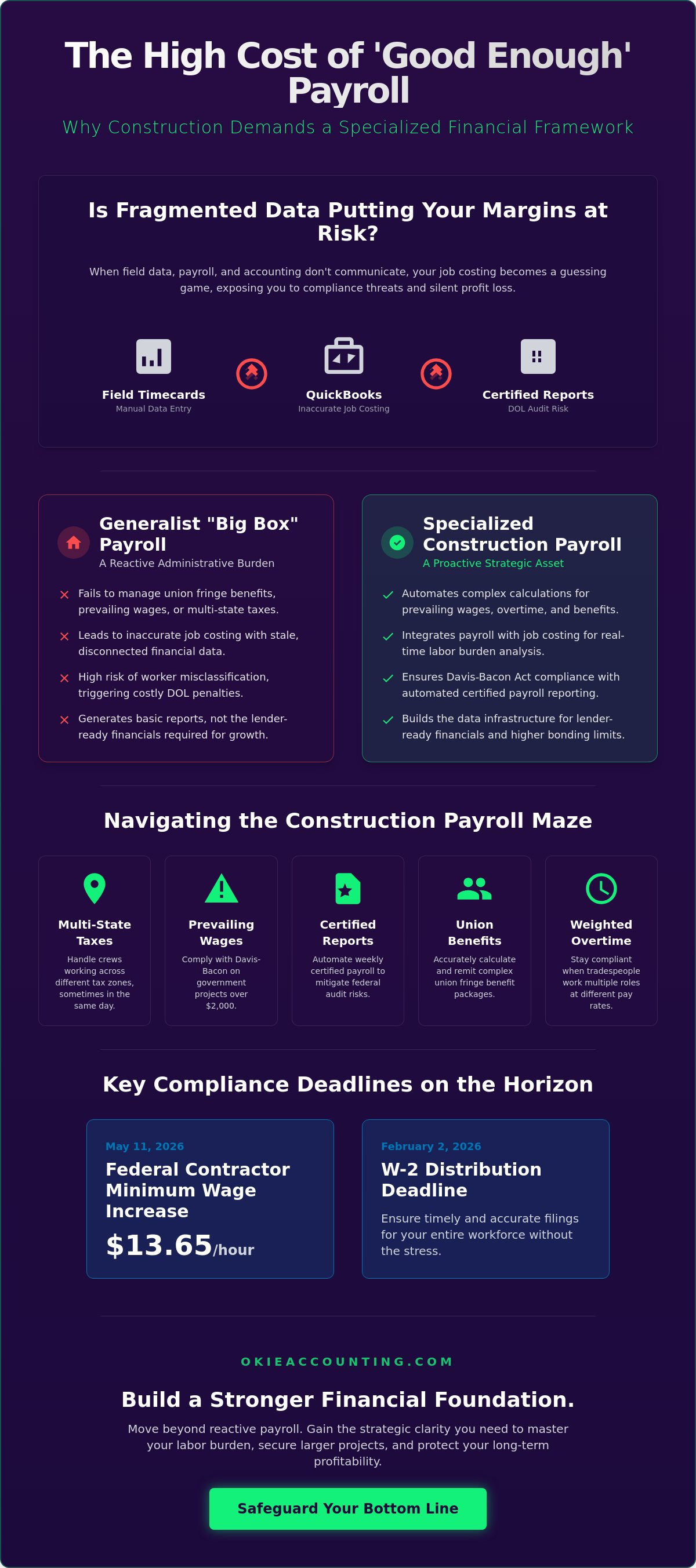
What if the biggest threat to your 2026 profit margins isn't a rising material cost, but the way you're tracking a single hour of labor? Most contractors view payroll as a necessary administrative burden; a series of checks to cut and forms to file. You're likely all too familiar with the stress of manual data entry between field timecards and QuickBooks, or the nagging worry that a minor error on a certified payroll report could trigger a Department of Labor audit. When your data is fragmented, your job costing becomes a guessing game rather than a strategic tool. Specialized construction payroll services bridge this gap, moving beyond basic administration to protect your structural business health.
We understand that managing a mobile workforce across various job sites requires more than a generalist's approach. You need a system that handles the May 11, 2026, federal contractor minimum wage increase to $13.65 per hour and meets the February 2, 2026, deadline for W-2 distribution without missing a beat. This article provides a framework to help you achieve lender-ready financial statements and automated, accurate certified payroll reports. We'll examine how shifting from reactive processing to proactive payroll management provides the strategic clarity you need to master your labor burden and secure long-term profitability.
Key Takeaways
Understand why construction payroll requires a specialized framework to manage multi-state taxes and prevailing wages rather than a basic administrative approach.
Discover how integrated construction payroll services transform raw labor data into accurate job costing and clear insights into your total labor burden.
Evaluate the hidden risks and manual labor costs associated with using generalist payroll providers compared to specialized construction accounting firms.
Learn the disciplined mechanics of certified payroll reporting to ensure total compliance with the Davis-Bacon Act and mitigate audit risks.
Explore how the combination of payroll management and fractional controller services provides the structural oversight needed for lender-ready financial reporting.
Table of Contents
Beyond the Paycheck: Why Construction Payroll Services Require Specialized Oversight
The Intersection of Payroll and Job Costing: Building a Data-Driven Infrastructure
Evaluating Your Options: Specialized Payroll Services vs. Generalist Providers
Navigating Compliance: Certified Payroll, Davis-Bacon, and Risk Mitigation
Strategic Payroll Management: How Okie Accounting Group LLC Safeguards Your Bottom Line
Beyond the Paycheck: Why Construction Payroll Services Require Specialized Oversight
A standard paycheck tells a simple story: hours worked multiplied by a rate. In the trades, that story is rarely so linear. Specialized construction payroll services represent a disciplined system designed to handle the multi-layered financial pressures that generalist providers simply aren't built to manage. While a "big box" payroll company might excel at processing a static office staff, they often falter when faced with union fringe benefits, multi-state tax jurisdictions, and the rigid reporting requirements of public works projects. Basic administrative payroll is a reactive task, but a strategic framework is a proactive asset that secures your project margins.
True oversight isn't about just moving money. It's about building a foundational system that captures every nuance of labor burden. This disciplined approach ensures that your payroll data isn't just an expense on a ledger, but a critical data set for project profitability. By partnering with experts who understand the mechanics of the industry, you replace compliance anxiety with operational control. You gain the peace of mind that your records are accurate, your filings are timely, and your business is prepared for any regulatory scrutiny.
The Complexity of the Construction Ecosystem
Managing a project site involves more than just scheduling crews. You're often balancing workers across different tax zones, sometimes within the same day. If a tradesperson performs two different roles in one week, you must calculate overtime using a weighted average or the highest rate worked to remain compliant. This complexity intensifies when you're bidding on government-funded projects exceeding $2,000, as you're bound by prevailing wage laws under the Davis-Bacon Act. As of May 11, 2026, the federal contractor minimum wage has risen to $13.65 per hour, adding another layer of precision required for your weekly certified reports. Generalist software often lacks the logic to automate these adjustments, leaving you vulnerable to manual errors.
Why "Good Enough" Payroll Leads to Shrinking Margins
Inaccurate job costing is a silent profit killer. If your payroll data is delayed or disconnected from your general ledger, you're making management decisions based on stale information. You can't adjust a project's trajectory if you don't know your true labor burden until the job is finished. Beyond the data lag, "good enough" systems often lead to worker misclassification. Treating a skilled tradesperson as a general laborer to reduce costs might save cents today, but it invites thousands in Department of Labor penalties tomorrow. Professional construction payroll services provide the structural integrity needed to ensure every hour is tracked, every rate is verified, and every margin is protected. This level of precision is only possible when your payroll is managed as a core component of your financial health.
The Intersection of Payroll and Job Costing: Building a Data-Driven Infrastructure
Data is the bridge between a project that looks profitable on paper and one that actually puts cash in the bank. For many contractors, payroll is a siloed administrative task, but in a high-performance firm, it serves as the primary data source for job costing. Specialized construction payroll services don't just process checks; they feed the job costing engine that allows you to see the true health of your projects in real time. When your payroll data flows seamlessly into your general ledger, you move from reactive bookkeeping to proactive financial leadership.
This structural integration is what separates a struggling contractor from a scalable enterprise. Lenders and bonding agents require more than just a balance sheet; they demand "lender-ready" financials that prove you have a granular understanding of your costs. By establishing a disciplined data infrastructure, you demonstrate the stability needed to secure larger projects and higher bonding limits. If you're looking to strengthen these foundations, our team at Okie Accounting Group LLC can help you build the systems necessary for this level of clarity.
Calculating Your True Labor Burden
Labor burden is the total cost of an employee beyond their hourly wage. This metric is the most critical factor in determining your actual project profitability. A gross hourly rate of $30 might actually cost the business $48 once you factor in employer-paid taxes, workers' compensation insurance, health benefits, and retirement contributions. The IRS highlights the complexity of these obligations in their report on the Construction Industry and the Tax Gap, which underscores why precise tracking is mandatory for compliance. When you calculate an accurate burden rate for every trade on every job site, your bidding strategy shifts from guesswork to data-driven precision. You no longer hope for a margin; you engineer it.
Integrating Payroll with QuickBooks Online
A cloud-based accounting system is the backbone of remote financial oversight. By integrating your construction payroll services directly with QuickBooks Online, you eliminate the manual data entry errors that plague many back offices. This integration ensures that labor costs are automatically allocated to the correct project and cost code, providing a clear view of your "actuals" versus your "estimates." This level of technical synchronization is a core component of professional construction bookkeeping services. Avoiding the "data silo" trap means your project managers and your accounting team are finally looking at the same numbers. This unified view allows for mid-project adjustments that can save a failing margin before it's too late.
Evaluating Your Options: Specialized Payroll Services vs. Generalist Providers
Choosing between a high-volume "Big Box" provider and specialized construction payroll services isn't just about comparing monthly fees; it's a choice about the structural integrity of your financial data. Generalist providers operate on a volume-based model designed for environments with minimal variables, such as retail or professional services. In the trades, variables are the standard. When you rely on a generalist, you often encounter hidden costs that never appear on an invoice. These costs manifest as the hours your internal staff spends manually reconciling timecards for certified reports or correcting classification errors that generalist systems aren't programmed to catch.
A specialized partner acts as a strategic mentor rather than a transactional vendor. Instead of simply processing a file, they understand the mechanics of your specific market and the pressures of project-based accounting. This relationship is significantly strengthened by Fractional Controller Services, where a high-level advisor oversees the payroll workflow to ensure it supports your broader business goals. They don't just verify that checks are issued; they ensure the data aligns with your bonding requirements and long-term stability. This disciplined oversight transforms payroll from a weekly administrative chore into a reliable data set for growth.
Software is a Tool, Not a Strategy
Software doesn't think; it calculates based on the logic provided. Even the most advanced accounting platform requires expert configuration to be effective in a construction environment. Relying on automation without professional validation is a recipe for data silos and reporting errors. The difference between simple data entry and true financial oversight lies in the human expertise behind the screen. At Okie Accounting Group LLC, we provide the specialized knowledge required to validate these automated outputs. We ensure your systems are customized to your specific trade classifications and jurisdictional nuances, preventing minor clerical errors from snowballing into major liabilities.
The ROI of Specialized Construction Payroll
The return on investment for specialized construction payroll services is measured in more than just avoided fines. It's found in the time recovered by business owners who can finally stop auditing their own back office and return their focus to project execution and business development. When your payroll is managed with precision, your audit risk drops significantly, saving you from the stress and legal fees of a Department of Labor investigation. Clear, forward-looking labor cost forecasting also improves your cash flow management. By having a granular view of your upcoming expenditures, you can manage your cash reserves with confidence, ensuring you have the liquidity necessary to mobilize for the next major contract without hesitation.
Navigating Compliance: Certified Payroll, Davis-Bacon, and Risk Mitigation
Compliance is often the most significant source of administrative friction for growing contractors. It isn't just about meeting a deadline; it's about maintaining a transparent, defensible record of every dollar paid and every hour worked. Specialized construction payroll services provide a disciplined framework to handle the Davis-Bacon Act, which applies to any federally funded project exceeding $2,000. Under this act, you're required to submit weekly certified payroll reports using Form WH-347. These reports must be accurate and timely, even during weeks when no work is performed on the site. Precision here is non-negotiable because these documents serve as a legal attestation of your compliance with federal law.
Beyond the primary wage rates, you must navigate the complexities of Equal Employment Opportunity (EEO) minority compliance and rigorous new hire reporting. Failure to document these details correctly can lead to project delays or the withholding of payments from the prime contractor. Remember, if you're the prime contractor, you're also responsible for ensuring your subcontractors remain compliant and submit their reports on time. Managing this level of oversight requires a partner who understands that audit readiness is a year-round discipline, not a year-end scramble. If you're ready to move toward a more secure financial foundation, our team can help you implement professional payroll management systems that mitigate these risks.
Mastering Prevailing Wage and Fringe Benefits
Understanding the distinction between bona fide fringe benefits and cash payments is essential for protecting your margins. While paying the fringe amount in cash is often simpler, it increases your payroll tax burden and workers' compensation premiums. A structured approach allows you to track and report varied pay scales for different trades on the same job site without manual recalculations. Staying updated on changing federal and state wage determinations is a constant demand. Our systems ensure you're always operating with the most current data, including the May 2026 federal minimum wage adjustments.
Audit Readiness: Building a Defensible Paper Trail
A Department of Labor auditor will focus on three main areas: timecards, payroll records, and proof of fringe benefit payments. They'll look for consistency between your field data and your final filings. By integrating Fractional Controller Services into your workflow, you establish internal controls that make your records virtually audit-proof. We help you maintain a minimum of three years of detailed records, including hours worked and specific wage rates, as required by law. This proactive oversight ensures that when an audit occurs, you have a complete, organized paper trail ready for inspection.
Don't overlook the importance of accurate class codes for Workers' Compensation. Misclassifying a skilled tradesperson as a general laborer might seem like a minor clerical error, but it's a primary trigger for insurance audits and significant back-payment penalties. Specialized construction payroll services ensure your class codes align perfectly with the actual work performed in the field, protecting your business from unnecessary financial exposure.
Strategic Payroll Management: How Okie Accounting Group Safeguards Your Bottom Line
Effective management in 2026 requires more than just processing a file; it demands a comprehensive structural framework that protects your business from the ground up. At Okie Accounting Group LLC, we've moved past the traditional vendor model to become a strategic mentor for contractors. Our approach to construction payroll services is unique because we don't treat labor costs as isolated data points. Instead, we combine rigorous payroll management with the high-level oversight of Fractional Controller Services. This synergy ensures that every dollar spent on labor is tracked, verified, and aligned with your long-term financial health.
Our cloud-based systems offer the national reach you need for multi-state projects while maintaining the personalized, expert support your business deserves. We understand that your needs as a trade professional are distinct from a retail shop or a tech firm. By providing a disciplined methodology for oversight, we help you transition from the daily stress of administrative burdens to a state of strategic financial clarity. You gain the confidence that your margins are protected and your systems are ready for any growth opportunity that comes your way.
The Okie Accounting Advantage: Beyond Data Entry
We prioritize structural integrity over simple data entry. While many providers focus on the mechanics of the paycheck, we integrate your payroll data into your broader Cash Flow Forecasting and budgeting processes. This allows you to see how current labor spending impacts your future liquidity. Having a partner who speaks the language of the construction sector means we understand the nuances of job costing and labor burden without needing an explanation. We build the foundational systems that allow you to move from reactive bookkeeping to proactive leadership, ensuring your financial reporting is always accurate and actionable.
Next Steps: Securing Your Financial Foundation
The transition from a generalist provider to specialized oversight is a deliberate step toward operational excellence. It begins with identifying the specific gaps in your current labor cost tracking and compliance reporting. We invite you to schedule a consultation to protect your project margins and explore how our construction payroll services can be tailored to your specific trade. During a discovery call, we'll review your current setup and provide a roadmap for achieving lender-ready financial statements. It's time to stop worrying about the mechanics of the back office and start focusing on the execution of your next major project.
Building a Resilient Financial Infrastructure for 2026
The complexity of the current construction landscape demands a shift from reactive processing to proactive financial oversight. You've seen how integrating labor burden data directly into your job costing transforms raw numbers into a strategic roadmap for profitability. By establishing a disciplined framework for certified reporting and prevailing wage compliance, you eliminate the anxiety of potential audits and protect your project margins. Relying on generalist providers often leaves contractors with fragmented data and hidden administrative costs. Choosing specialized construction payroll services ensures your business benefits from cloud-based QuickBooks Online mastery and the high-level expertise of a Fractional Controller. Our mentor-led approach provides the structural integrity needed to secure higher bonding limits and maintain lender-ready financials. It's time to replace operational complexity with data-driven confidence. We're here to help you build a stable foundation that supports your long-term growth and stability.
Frequently Asked Questions
What is the difference between regular payroll and construction payroll services?
Construction payroll differs from standard processing by incorporating project-based job costing, prevailing wage requirements, and complex fringe benefit calculations. While regular payroll focuses on simple time tracking and tax withholding, construction payroll services manage the technical nuances of multiple pay rates for different trades on a single job site. This specialized approach ensures that labor costs are accurately allocated to specific projects, providing the granular data necessary for profitable bidding and financial stability.
How do certified payroll reports work for federal construction projects?
Certified payroll reports are mandatory weekly submissions, typically using Form WH-347, that verify your compliance with federal wage laws on projects exceeding $2,000. These documents require a detailed breakdown of every employee's hours, work classification, and fringe benefits. You must submit these reports to the contracting agency even during weeks when no work is performed. Accurate reporting serves as a legal attestation that you've paid the required prevailing wages for the specific trade and location.
Can specialized payroll services help with Davis-Bacon Act compliance?
Yes, specialized construction payroll services are designed to automate the tracking and reporting of prevailing wages mandated by the Davis-Bacon Act. These systems ensure that your team is paid correctly based on the specific wage determinations for each project. By maintaining a disciplined record of both cash wages and bona fide fringe benefits, a specialized provider helps you avoid the steep penalties and back-pay liabilities associated with non-compliance.
Do I need a separate system for job costing and payroll processing?
You don't need separate systems; in fact, an integrated approach is far more effective for maintaining data integrity. When your payroll data flows directly into your general ledger, you eliminate the manual entry errors that often occur between timecards and accounting software. We recommend using a unified cloud-based system like QuickBooks Online. This integration ensures that your job costing reports reflect real-time labor burden, allowing for more accurate project oversight and financial reporting.
How does labor burden affect my construction company’s profitability?
Labor burden represents the total cost of an employee beyond their gross hourly wage, including employer taxes, workers' compensation, and insurance premiums. If you only account for hourly rates in your bids, you're likely underestimating your true costs and shrinking your profit margins. Understanding this metric is vital for accurate project forecasting. Strategic payroll management reveals these hidden costs, providing the clarity you need to price your services competitively while protecting your bottom line.
What should I look for when hiring a construction payroll service provider?
Look for a partner who offers more than just check processing; you need a provider with specific expertise in the construction sector and Fractional Controller oversight. A high-quality provider understands the mechanics of union fringes, multi-state tax jurisdictions, and certified reporting. They should act as a strategic mentor rather than a transactional vendor. Prioritize firms that offer QuickBooks training and setup to ensure your internal systems are optimized for long-term financial health.
Can Okie Accounting manage my payroll if I use QuickBooks Online?
Okie Accounting Group specializes in managing payroll within the QuickBooks Online ecosystem for trade professionals across the country. We provide comprehensive payroll management and QuickBooks training to ensure your data is structured for maximum clarity. Our team handles the technical setup and ongoing oversight, allowing you to focus on field operations. This cloud-based approach provides remote access to your financial data while maintaining the rigorous internal controls required for lender-ready statements.
What happens if my payroll company makes a prevailing wage error?
The legal and financial responsibility for wage errors ultimately rests with the contractor, regardless of who processed the payroll. If an error occurs, you may be liable for significant back wages, interest, and Department of Labor penalties. This risk is why using a generalist provider is often a costly mistake for contractors. A specialized partner mitigates this risk by implementing disciplined oversight and staying updated on the latest federal and state wage determinations to protect your business.



Comments